Environment Study
1. Natural Resources
2. Classification of Natural resources
3. Classification of natural Resources based on
availability and uses
4. Renewable Resources
5. Non-renewable resources
6. Classification of natural Resources
7. Biotic and Abiotic resources
8. Destruction v/s Conservation
9. Global warming
10. The Ozone Layer
Content
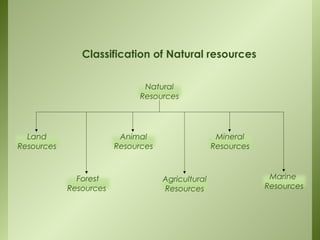
Natural
Resources
Land
Resources
Mineral
Resources
Marine
Resources
Agricultural
Resources
Animal
Resources
Forest
Resources
Classification of Natural resources
Classification of natural Resources
based on availability and uses
Natural
Resources
Renewable
Resources
( In-exhaustible
Resources )
Non-
renewable
Resources
( Exhaustible
Resources )
 All of the Earth’s organisms, air, water, and soil,
as well as materials such as oil, coal, and ore
that are removed from the ground.
 Separated into two broad categories:
 Renewable resources
 Nonrenewable resources
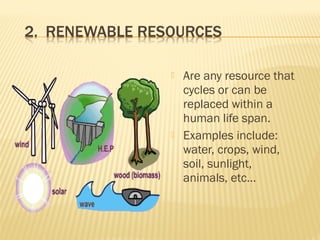
 Are any resource that
cycles or can be
replaced within a
human life span.
 Examples include:
water, crops, wind,
soil, sunlight,
animals, etc…
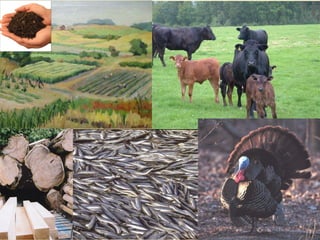
a. Food and fiber – are
renewable
agricultural
resources that can
be harvested or
raised indefinitely…
… unless their use
exceeds the rate
they can be
replaced.
b. Soil – a mixture of
living organisms and
dirt.
Even though it
initially takes
thousands of years
to form, the rate at
which soil can
regenerate depends
on the climate of an
area.
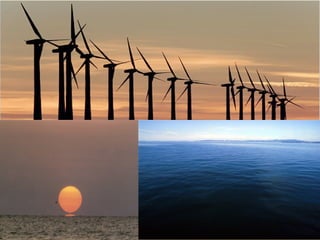
c. Wind – caused by
the uneven heating
of the Earth. Not
only renewable but
inexhaustible.
d. Sun – light from the
sun supports all the
life on Earth as we
know it. Also
considered
inexhaustible. (at
least for the next 5
billion years)
e. Water – constantly
renewed/replenished
by the water cycle.
However, fresh water
resources are
somewhat limited.
The use and quality of
water must be
carefully monitored to
ensure future use.
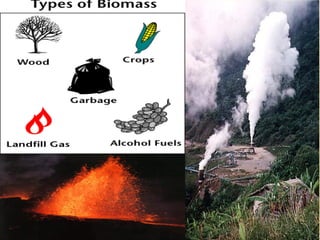
f. Biomass fuels – are
organic matter
(wood, plants,
animal residues,
etc…) that contain
stored solar energy.
Used to supply energy
to 15% of the
world’s supply.
g. Geothermal energy
– the heat
generated deep
within the Earth.
Fueled by the decay
of radioactive
elements. Used to
heat water.
 Any resource that cannot be replaced during
the time of a human life span.
 Took millions of years to form and exist in fixed
amounts in the Earth.
 They need to be conserved before they become
depleted.
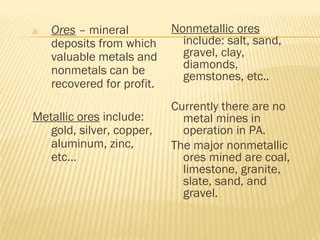
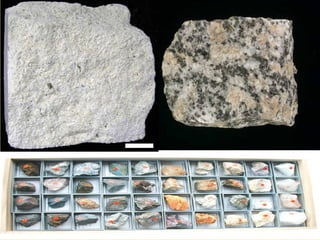
a. Ores – mineral
deposits from which
valuable metals and
nonmetals can be
recovered for profit.
Metallic ores include:
gold, silver, copper,
aluminum, zinc,
etc…
Nonmetallic ores
include: salt, sand,
gravel, clay,
diamonds,
gemstones, etc..
Currently there are no
metal mines in
operation in PA.
The major nonmetallic
ores mined are coal,
limestone, granite,
slate, sand, and
gravel.
 Are nonrenewable because they take millions
of years to form.
 In developing countries, the fossil fuels are
fossilized wood, charcoal, and peat.
 In developed countries, the fossil fuels are
mainly coal, natural gas, and oil.
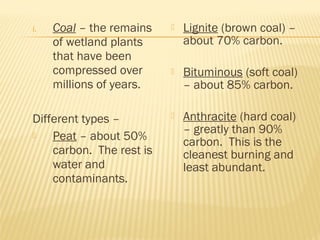
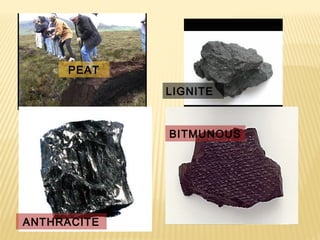
i. Coal – the remains
of wetland plants
that have been
compressed over
millions of years.
Different types –
 Peat – about 50%
carbon. The rest is
water and
contaminants.
 Lignite (brown coal) –
about 70% carbon.
 Bituminous (soft coal)
– about 85% carbon.
 Anthracite (hard coal)
– greatly than 90%
carbon. This is the
cleanest burning and
least abundant.
PEAT
LIGNITE
BITMUNOUS
ANTHRACITE
 Most of the coal fields in Western PA are
bituminous coal whereas the coal fields in
Eastern PA are anthracite.
 Russia produces about 50% of the world’s
supply of coal. China produces about
20%. The U.S. produces about 15% of the
world’s supply.
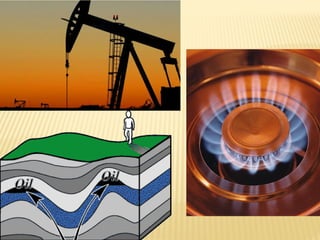
ii. Petroleum and
Natural Gas – are the
remains of mainly
marine organisms.
 Typically found in
underground
formations called
traps with the natural
gas trapped on top
and oil on the
bottom.
 Currently, PA does
not produce
significant amounts
of oil and gas but the
beginning of the U.S.
oil boom in the
1800’s started in
Titusville, PA.
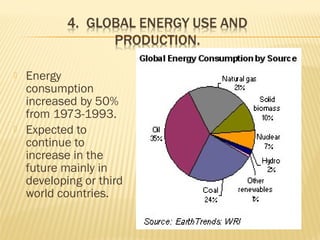
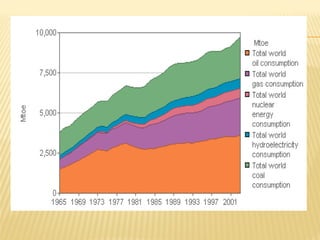
 Energy
consumption
increased by 50%
from 1973-1993.
 Expected to
continue to
increase in the
future mainly in
developing or third
world countries.
 Remember that using more fossil fuels
accelerates the global warming trend due
to more greenhouse emissions and
pollution.
 What other effects will a growth in global
energy use produce?
a. These are energy resources that are more
renewable or more environmentally friendly in
comparison to fossil fuels.
b. Currently include the following: solar, wind,
geothermal, hydropower, nuclear, and
biomass.
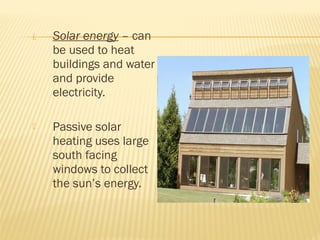
i. Solar energy – can
be used to heat
buildings and water
and provide
electricity.
 Passive solar
heating uses large
south facing
windows to collect
the sun’s energy.
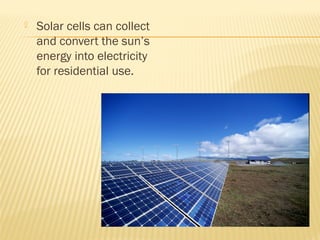
 Solar cells can collect
and convert the sun’s
energy into electricity
for residential use.
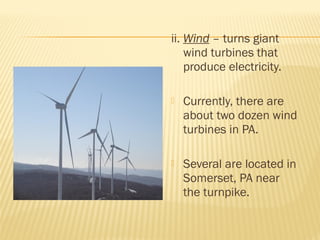
ii. Wind – turns giant
wind turbines that
produce electricity.
 Currently, there are
about two dozen wind
turbines in PA.
 Several are located in
Somerset, PA near
the turnpike.
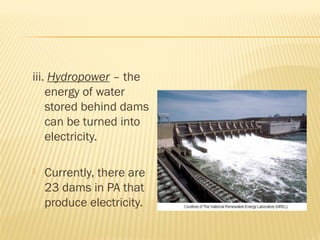
iii. Hydropower – the
energy of water
stored behind dams
can be turned into
electricity.
 Currently, there are
23 dams in PA that
produce electricity.
iv. Nuclear Power – uses the process of fission to
release energy to make electricity.
 Produces about 20% of the electricity in the
U.S.
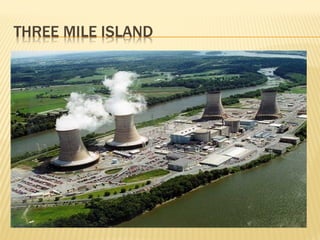
 Currently, PA has five nuclear power plants.
(Beaver Valley, Susquehanna, Three Mile
Island, Limerick and Peach Bottom)
 In 1979, there was a partial reactor meltdown
at Three Mile Island. This brought a halt to
nuclear development in the U.S. There have
been no new plants since.
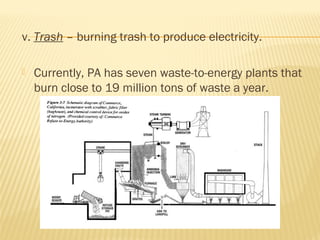
v. Trash – burning trash to produce electricity.
 Currently, PA has seven waste-to-energy plants that
burn close to 19 million tons of waste a year.
 Almost every resource needs to be
removed from the Earth and processed
in some way before it can be used.
 What ultimately determines the
availability of resources are the costs
involved in removing/extracting it from
the Earth and the costs involved in
processing/refining them into products.
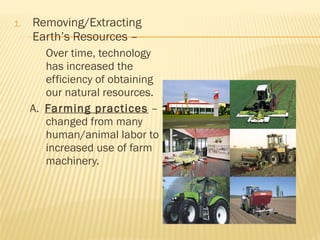
1. Removing/Extracting
Earth’s Resources –
Over time, technology
has increased the
efficiency of obtaining
our natural resources.
A. Farming practices –
changed from many
human/animal labor to
increased use of farm
machinery.

Renewable and nonrenewable resources

  • 2.
  • 3.
    1. Natural Resources 2.Classification of Natural resources 3. Classification of natural Resources based on availability and uses 4. Renewable Resources 5. Non-renewable resources 6. Classification of natural Resources 7. Biotic and Abiotic resources 8. Destruction v/s Conservation 9. Global warming 10. The Ozone Layer Content
  • 4.
  • 5.
    Classification of naturalResources based on availability and uses Natural Resources Renewable Resources ( In-exhaustible Resources ) Non- renewable Resources ( Exhaustible Resources )
  • 6.
     All ofthe Earth’s organisms, air, water, and soil, as well as materials such as oil, coal, and ore that are removed from the ground.  Separated into two broad categories:  Renewable resources  Nonrenewable resources
  • 7.
     Are anyresource that cycles or can be replaced within a human life span.  Examples include: water, crops, wind, soil, sunlight, animals, etc…
  • 8.
    a. Food andfiber – are renewable agricultural resources that can be harvested or raised indefinitely… … unless their use exceeds the rate they can be replaced. b. Soil – a mixture of living organisms and dirt. Even though it initially takes thousands of years to form, the rate at which soil can regenerate depends on the climate of an area.
  • 10.
    c. Wind –caused by the uneven heating of the Earth. Not only renewable but inexhaustible. d. Sun – light from the sun supports all the life on Earth as we know it. Also considered inexhaustible. (at least for the next 5 billion years) e. Water – constantly renewed/replenished by the water cycle. However, fresh water resources are somewhat limited. The use and quality of water must be carefully monitored to ensure future use.
  • 12.
    f. Biomass fuels– are organic matter (wood, plants, animal residues, etc…) that contain stored solar energy. Used to supply energy to 15% of the world’s supply. g. Geothermal energy – the heat generated deep within the Earth. Fueled by the decay of radioactive elements. Used to heat water.
  • 14.
     Any resourcethat cannot be replaced during the time of a human life span.  Took millions of years to form and exist in fixed amounts in the Earth.  They need to be conserved before they become depleted.
  • 15.
    a. Ores –mineral deposits from which valuable metals and nonmetals can be recovered for profit. Metallic ores include: gold, silver, copper, aluminum, zinc, etc… Nonmetallic ores include: salt, sand, gravel, clay, diamonds, gemstones, etc.. Currently there are no metal mines in operation in PA. The major nonmetallic ores mined are coal, limestone, granite, slate, sand, and gravel.
  • 17.
     Are nonrenewablebecause they take millions of years to form.  In developing countries, the fossil fuels are fossilized wood, charcoal, and peat.  In developed countries, the fossil fuels are mainly coal, natural gas, and oil.
  • 18.
    i. Coal –the remains of wetland plants that have been compressed over millions of years. Different types –  Peat – about 50% carbon. The rest is water and contaminants.  Lignite (brown coal) – about 70% carbon.  Bituminous (soft coal) – about 85% carbon.  Anthracite (hard coal) – greatly than 90% carbon. This is the cleanest burning and least abundant.
  • 19.
  • 20.
     Most ofthe coal fields in Western PA are bituminous coal whereas the coal fields in Eastern PA are anthracite.  Russia produces about 50% of the world’s supply of coal. China produces about 20%. The U.S. produces about 15% of the world’s supply.
  • 21.
    ii. Petroleum and NaturalGas – are the remains of mainly marine organisms.  Typically found in underground formations called traps with the natural gas trapped on top and oil on the bottom.  Currently, PA does not produce significant amounts of oil and gas but the beginning of the U.S. oil boom in the 1800’s started in Titusville, PA.
  • 23.
     Energy consumption increased by50% from 1973-1993.  Expected to continue to increase in the future mainly in developing or third world countries.
  • 25.
     Remember thatusing more fossil fuels accelerates the global warming trend due to more greenhouse emissions and pollution.  What other effects will a growth in global energy use produce?
  • 26.
    a. These areenergy resources that are more renewable or more environmentally friendly in comparison to fossil fuels. b. Currently include the following: solar, wind, geothermal, hydropower, nuclear, and biomass.
  • 27.
    i. Solar energy– can be used to heat buildings and water and provide electricity.  Passive solar heating uses large south facing windows to collect the sun’s energy.
  • 28.
     Solar cellscan collect and convert the sun’s energy into electricity for residential use.
  • 29.
    ii. Wind –turns giant wind turbines that produce electricity.  Currently, there are about two dozen wind turbines in PA.  Several are located in Somerset, PA near the turnpike.
  • 30.
    iii. Hydropower –the energy of water stored behind dams can be turned into electricity.  Currently, there are 23 dams in PA that produce electricity.
  • 31.
    iv. Nuclear Power– uses the process of fission to release energy to make electricity.  Produces about 20% of the electricity in the U.S.  Currently, PA has five nuclear power plants. (Beaver Valley, Susquehanna, Three Mile Island, Limerick and Peach Bottom)  In 1979, there was a partial reactor meltdown at Three Mile Island. This brought a halt to nuclear development in the U.S. There have been no new plants since.
  • 33.
    v. Trash –burning trash to produce electricity.  Currently, PA has seven waste-to-energy plants that burn close to 19 million tons of waste a year.
  • 34.
     Almost everyresource needs to be removed from the Earth and processed in some way before it can be used.  What ultimately determines the availability of resources are the costs involved in removing/extracting it from the Earth and the costs involved in processing/refining them into products.
  • 35.
    1. Removing/Extracting Earth’s Resources– Over time, technology has increased the efficiency of obtaining our natural resources. A. Farming practices – changed from many human/animal labor to increased use of farm machinery.