ENVIRONMENTAL STUDIES {2110007}
Branch-CIVIL
MADE BY:-
RAJ PATEL
 6.1.1 INDIAN SCENARIO
 6.1.2 CONVENTIONAL ENERGY SOURCES
 6.1.3 NON-CONVENTIONAL ENERGY SOURCES
 6.2.1 Energy
 6.2.2 Renewable energy
 6.2.3 Non-Renewable
 6.2.4 Environmental issues
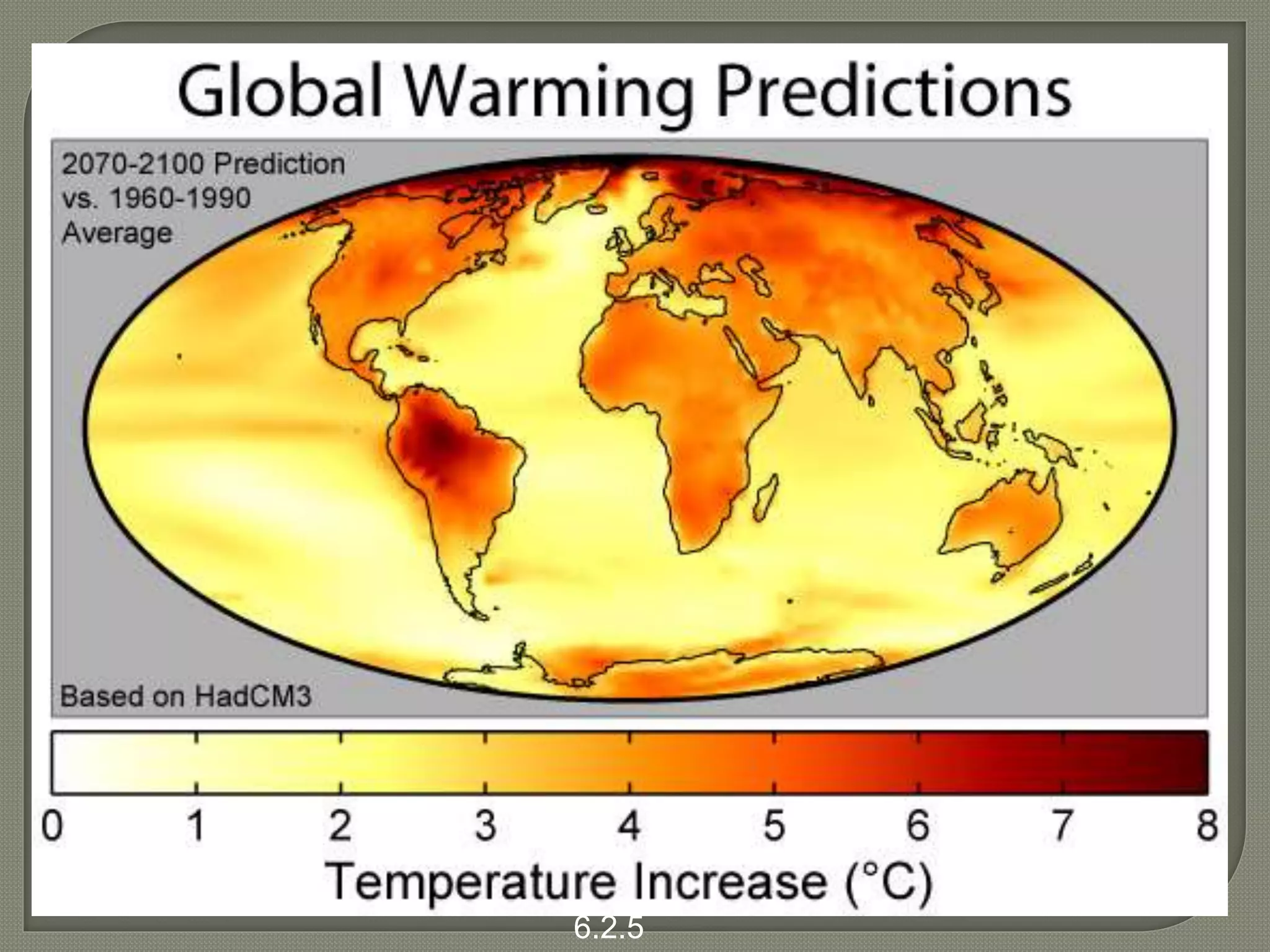
 6.2.5 Global Warming
 6.3.1 ENVIRONMENTAL IMPACTS OF COAL BASED
POWER PLANTS [G.T.U-MARCH-2009,JANUARY-
2011,MARCH-2012]
 6.3.2 ENVIRONMENTAL IMPACTS OF NUCLEAR
POWER PLANTS [G.T.U-MARCH-2009,JUNE-2010]
 6.3.3 PROBLEMS DUE TO OVER USE OF ENERGY
RESOURCES [G.T.U-MARCH/JUNE-2010,JULY-2011]
 Energy is vital source for economic and social development.
 To meet the increasing demand for energy, concrete efforts
have to be made to improve existing technology and to
develop new approaches in conventional sources.
 The role of new renewable sources of energy now a days has
become important.
 Energy utilization, irrespective of the energy source, has
environmental consequences like:-
1) greenhouse effect
2) global warming
 Nuclear energy raises environmental concerns about long-
term storage of radioactive waste.
 An understanding of these consequences and how to deal
with them requires knowledge on energy resources it
generation an utilization.
Energy
According
to sources
Convention
al sources
Non-
convention
al sources
According
to use
Commercial
Non-
commercial
According
to
renewable
property
Renewable
Non-
renewable
32%
21%
23%
6%
11%
7%
% of total energy usage
Oil
Coal
Natural gas
Nuclear
Biomass
Solar, Hydropower,
Wind power, etc.
 Coal is the main source of energy in India,
accounting for about 55% responsibility of energy,
followed by petroleum oil and natural gas.

Energy source % share
1). Coal 55%
2). Petroleum oil 31%
3). Natural gas 08%
4). Hydro power 05%
5). Nuclear power 1%
6.1.1
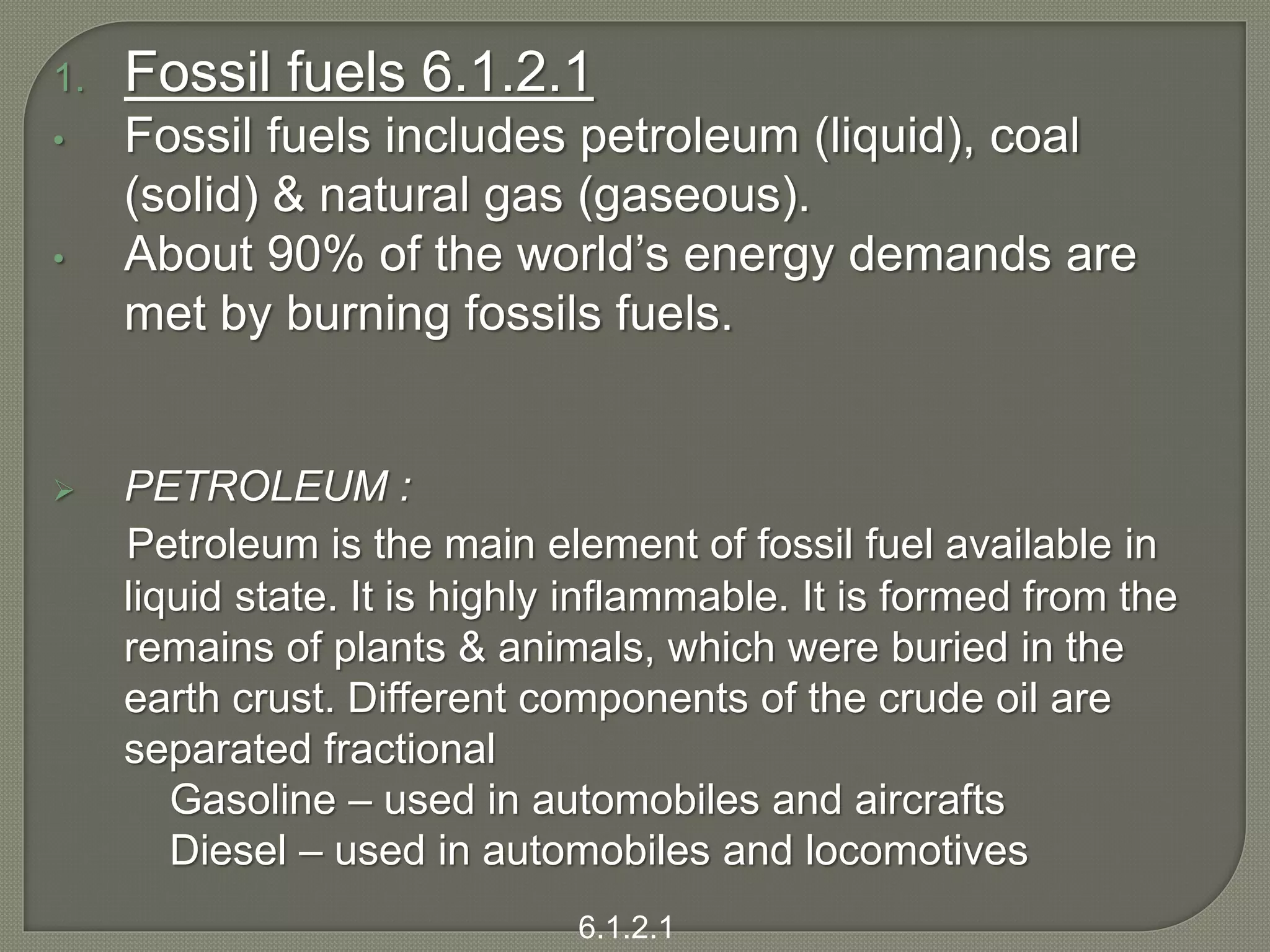
The energy which gets exhausted with use
and cannot be replaced are called
conventional energy sources.
These includes:-
1). Fossil fuels – petroleum, oil, coal,
natural gas
2). Nuclear energy – uranium, thorium
6.1.2
1. Fossil fuels 6.1.2.1
• Fossil fuels includes petroleum (liquid), coal
(solid) & natural gas (gaseous).
• About 90% of the world’s energy demands are
met by burning fossils fuels.
 PETROLEUM :
Petroleum is the main element of fossil fuel available in
liquid state. It is highly inflammable. It is formed from the
remains of plants & animals, which were buried in the
earth crust. Different components of the crude oil are
separated fractional
Gasoline – used in automobiles and aircrafts
Diesel – used in automobiles and locomotives
6.1.2.1
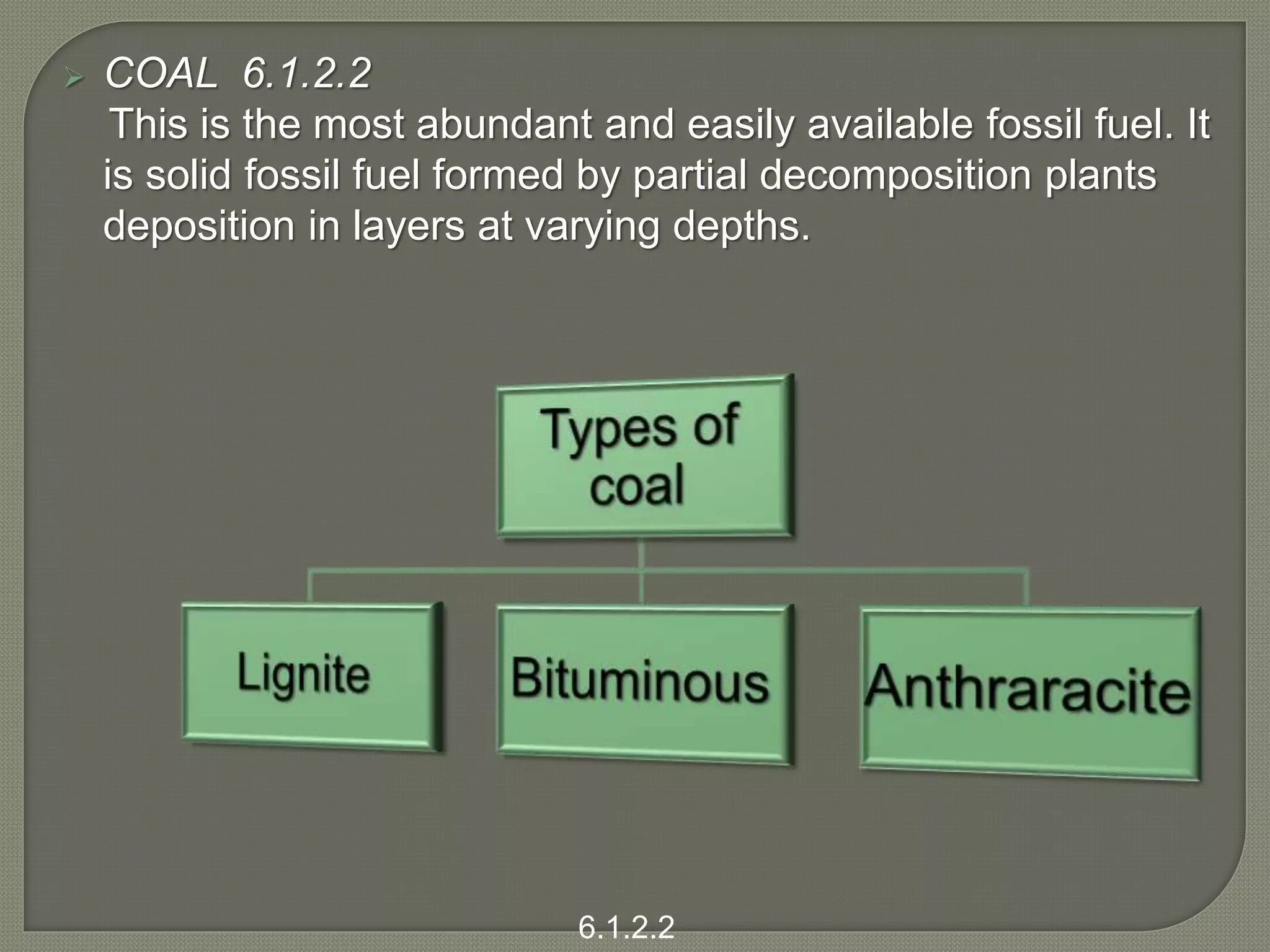
 COAL 6.1.2.2
This is the most abundant and easily available fossil fuel. It
is solid fossil fuel formed by partial decomposition plants
deposition in layers at varying depths.
6.1.2.2
6.1.2.2
1. Nuclear energy 6.1.2.3
• A small amount of radioactive material can
produce enormous amount of energy.
• Uranium -235 is the most popular radioactive
element used for producing nuclear energy.
• 1 tonne of uranium -235 will produce as much as
energy as by three million tones of coal or 12
million barrels of oil.
• Nuclear energy can be released to generate
electricity by two nuclear processes :
(i) Nuclear fission
(ii) Nuclear fusion
6.1.2
The energy sources which are capable of
being replaced or renewed by natural
processes are called Non-conventional
energy sources.
These natural resources are in exhaustible
and can be used to produce energy again
& again. Therefore they are also called
Alternate energy sources.
6.1.3
The important non- conventional energy
sources are :-
1. Solar energy
2. Wind energy
3. Hydropower energy
4. Biomass energy
5. Tidal energy
6. Geothermal energy
7. Hydrogen energy & fuel cell
6.1.3
1. Solar energy 6.1.3.1
• The sun is a source of solar energy.
• It is a large hydrogen reactor in which continuous nuclear
fusion reaction produces enormous amount of energy, in
the form of solar radiation.
• The sun is 150 million kilometers away from the earth and
its rays losses most of their energy while travelling.
• Only 4% of the total solar energy reaches the earth,
which is approximately 1kwh/sq. m of flat land on the
earth.
6.1.3.1
6.2.1 Energy
6.2.2 Renewable energy
6.2.3 Non-Renewable
6.2.4 Environmental issues
6.2.5 Global Warming
Energy
Energy is the ability to do work. The word
‘work’ means transferring energy from one place
to another. energy is neither destroyed nor
created. It can only be changed.
6.2.1
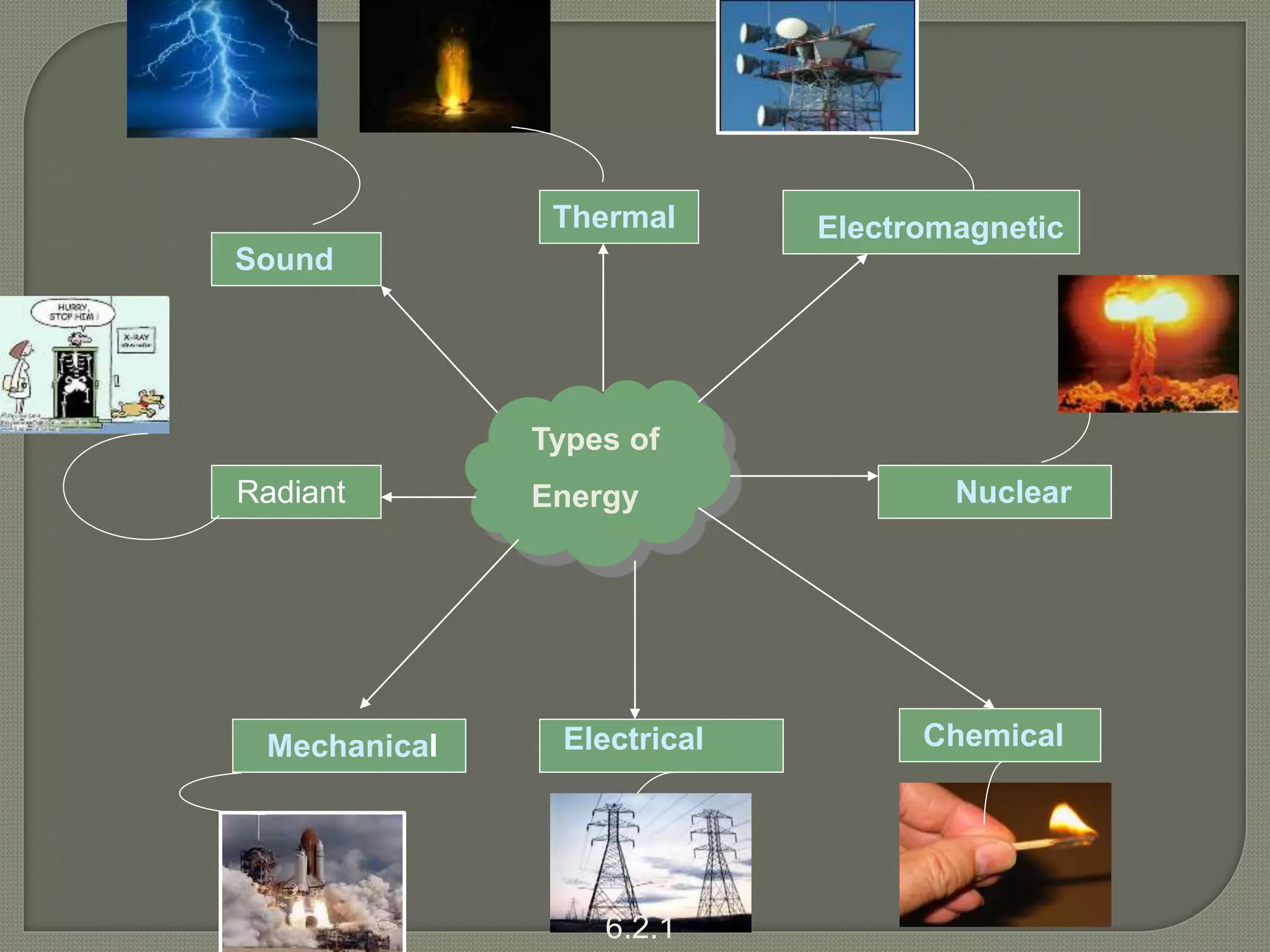
Types of
Energy
Mechanical Electrical
Sound
Chemical
Nuclear
ElectromagneticThermal
Radiant
6.2.1
Renewable Non-renewable
Those sources of energy which are being produced
continuously in nature and will never be
exhausted, are called renewable sources of
energy.
Renewable Energy 6.2.2
6.2.2
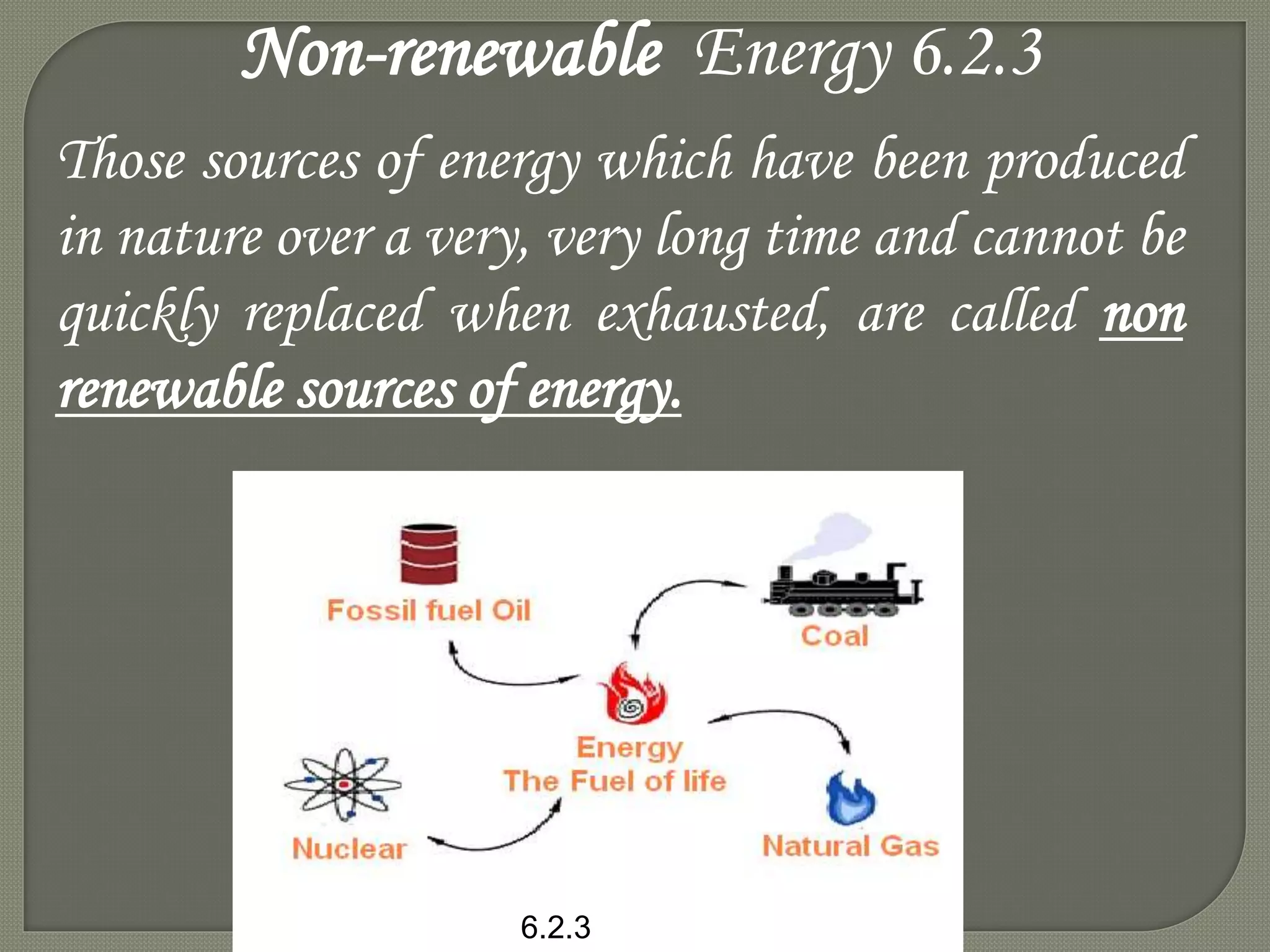
Those sources of energy which have been produced
in nature over a very, very long time and cannot be
quickly replaced when exhausted, are called non
renewable sources of energy.
Non-renewable Energy 6.2.3
6.2.3
Coal is the most abundant
fossil fuel in the world.
During the formation of
coal, carbonaceous matter
was first compressed into a
spongy material called
"peat," which is about 90%
water. As the peat became
more deeply buried, the
increased pressure and
temperature turned it into
coal.
Coal 6.2.3.1
6.2.3.1
OIL 6.2.3.2
Crude oil or liquid petroleum,
is a fossil fuel that is refined
into many different energy
products (e.g., gasoline, diesel
fuel, jet fuel, heating oil). Oil
forms underground in rock
such as shale, which is rich in
organic materials.
6.2.3.2
In most electric power plants,
water is heated and converted
into steam, which drives a
turbine-generator to produce
electricity. Fossil-fueled power
plants produce heat by burning
coal, oil, or natural gas. In a
nuclear power plant, the fission
of uranium atoms in the reactor
provides the heat to produce
steam for electricity.
Nuclear power 6.2.3.3
6.2.3.3
Natural gas production is often a by-
product of oil recovery, as the two
commonly share underground reservoirs.
Natural gas is a mixture of gases, the
most common being methane (CH4). It
also contains some ethane (C2H6),
propane (C3H8), and butane (C4H10).
Natural gas is usually not contaminated
with sulfur and is therefore the cleanest
burning fossil fuel.
Natural gas 6.2.3.4
6.2.3.4
Deforestation
Environmental Impacts of Mining
Global Warming
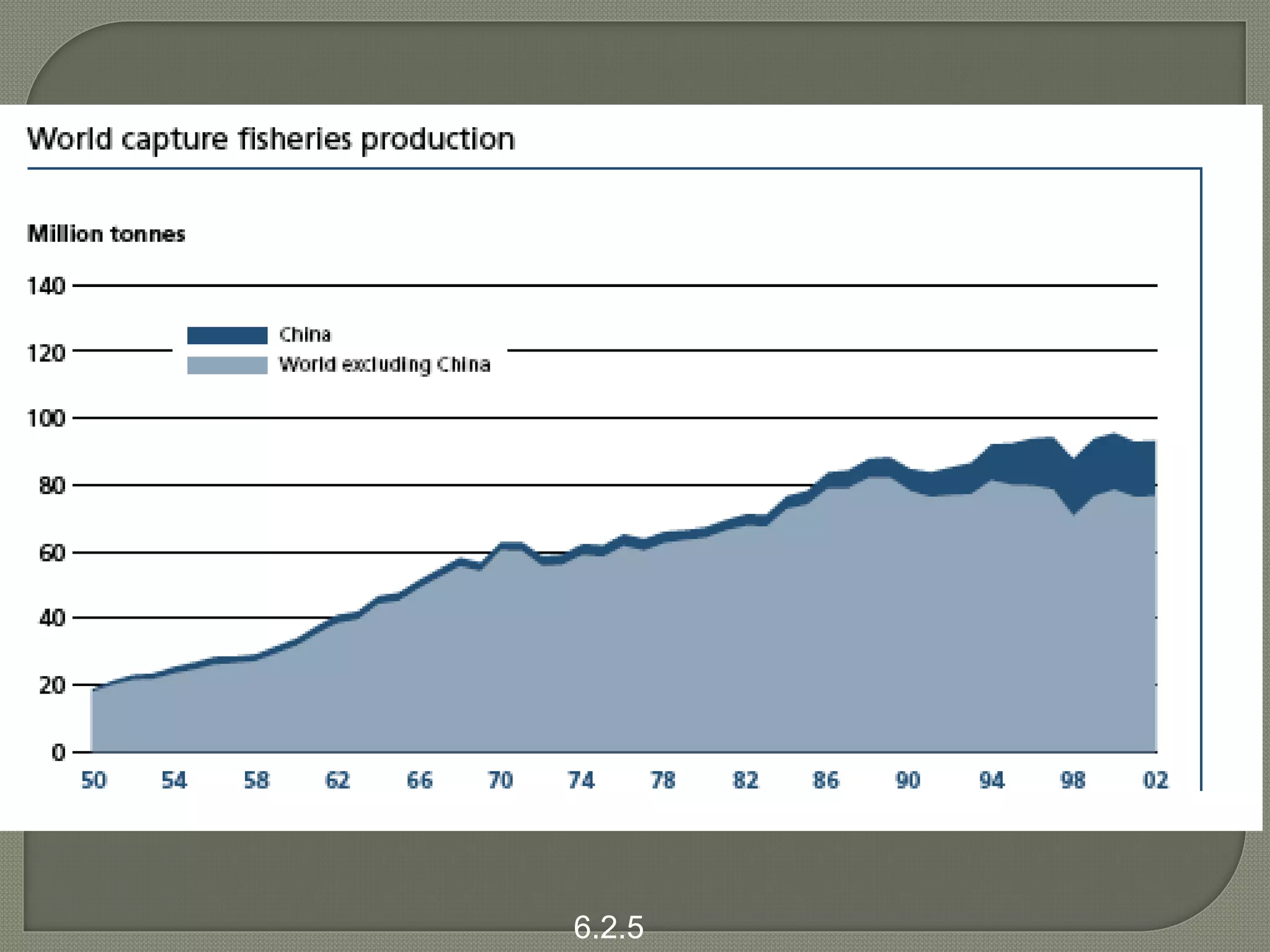
“Tragedy of the commons”—overfishing
and other
6.2.4
6.2.4
Jungle burned for agriculture in southern Mexico
6.2.4
Burning forests and decay of wood after
logging contribute to the release of
greenhouse gases
Loss of biodiversity
Forests are important parts of hydrologic
cycle in nature
6.2.4.1
6.2.4.3
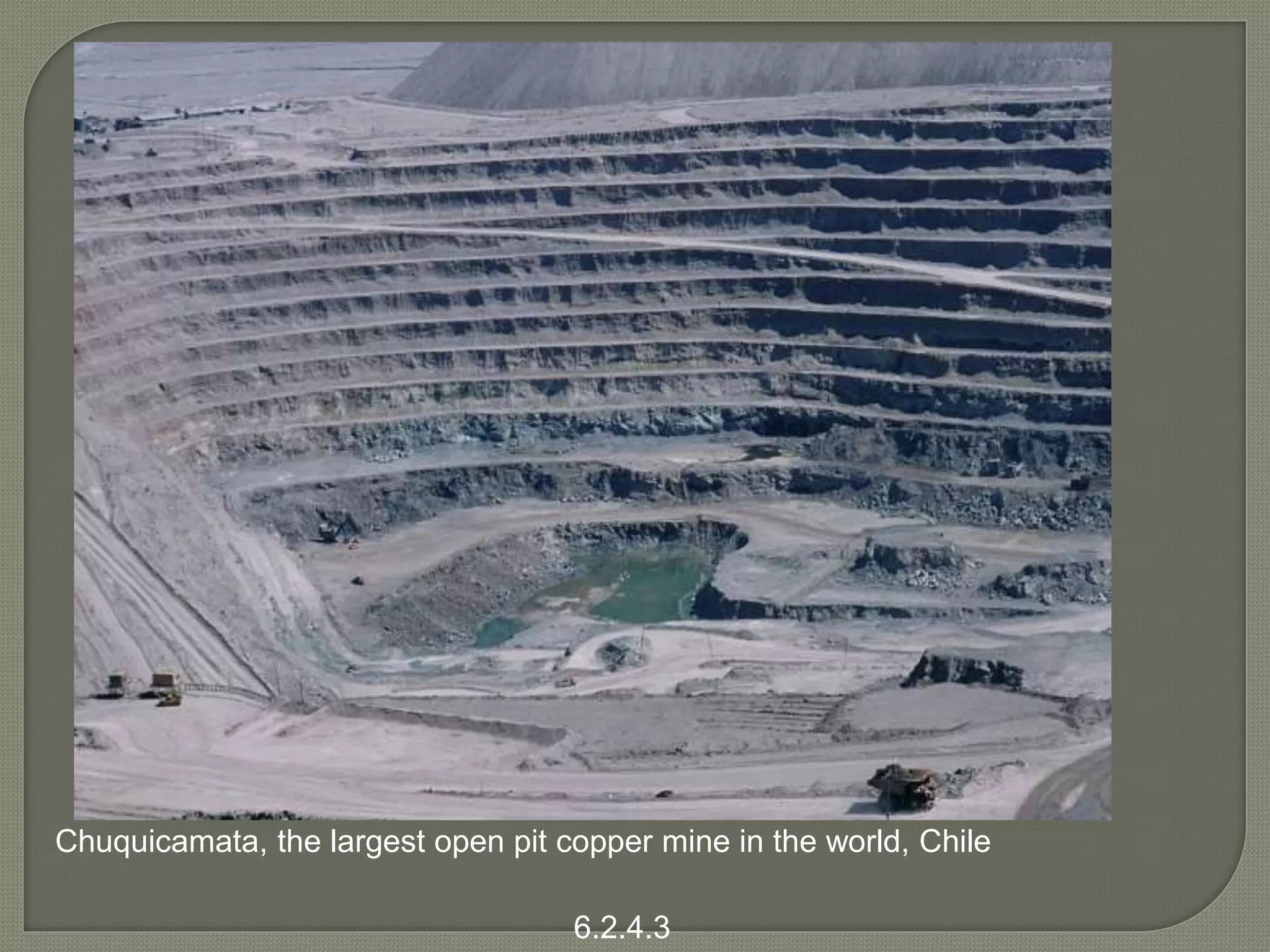
Chuquicamata, the largest open pit copper mine in the world, Chile
6.2.4.3
Iron hydroxide precipitate stains
a stream receiving acid
drainage from surface coal
mining.
6.2.4.3
Land/soil erosion
Formation of sinkholes,
Loss of biodiversity in the area
Contamination of groundwaters by
chemicals from the mining process and
products.
Abandoned mines can still pose safety
hazards such as deadly gases
6.2.4.4
6.2.5
6.2.5
6.2.5
6.2.5
6.2.5
Melting of permafrost and polar ice
Rising sea level
Spread of pests and disease
Ecological impacts (e.g. disturbed life cycle
of flora-fauna)
6.2.5
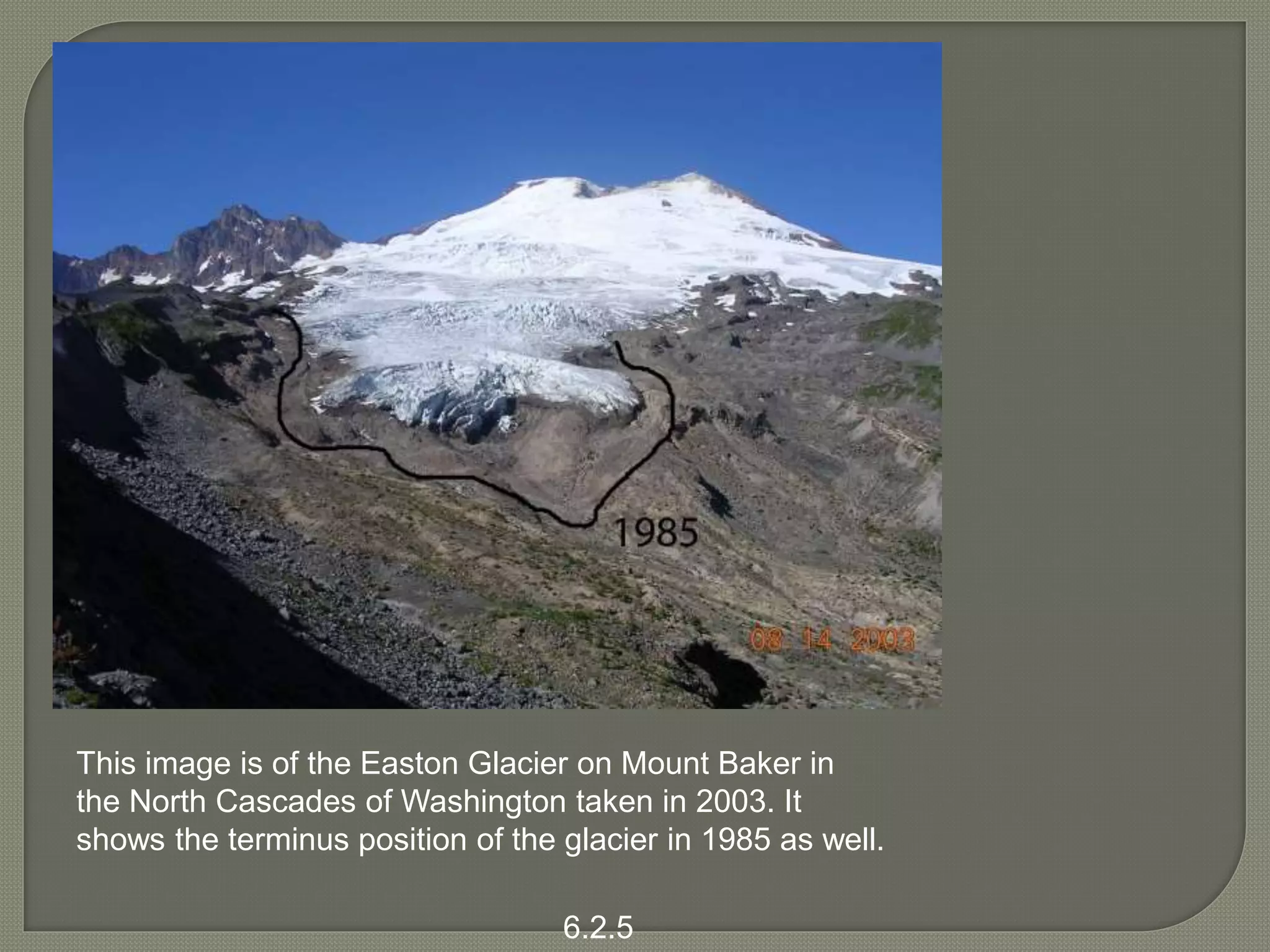
This image is of the Easton Glacier on Mount Baker in
the North Cascades of Washington taken in 2003. It
shows the terminus position of the glacier in 1985 as well.
6.2.5
6.2.5
 Free access and unrestricted demand for a
finite resource ultimately dooms the resource
through over-exploitation.
 Release of carbon dioxide into the
atmosphere is one example. As everyone
can release carbon dioxide into the
atmosphere with little personal consequence,
people tends to care very little about limiting
its emission.
6.2.5
6.2.5
INTRODUCTION
6.3.1 ENVIRONMENTAL IMPACTS OF
COAL BASED POWER PLANTS [G.T.U-
MARCH-2009,JANUARY-2011,MARCH-
2012]
6.3.2 ENVIRONMENTAL IMPACTS OF
NUCLEAR POWER PLANTS [G.T.U-
MARCH-2009,JUNE-2010]
6.3.3 PROBLEMS DUE TO OVER USE OF
ENERGY RESOURCES [G.T.U-
MARCH/JUNE-2010,JULY-2011]
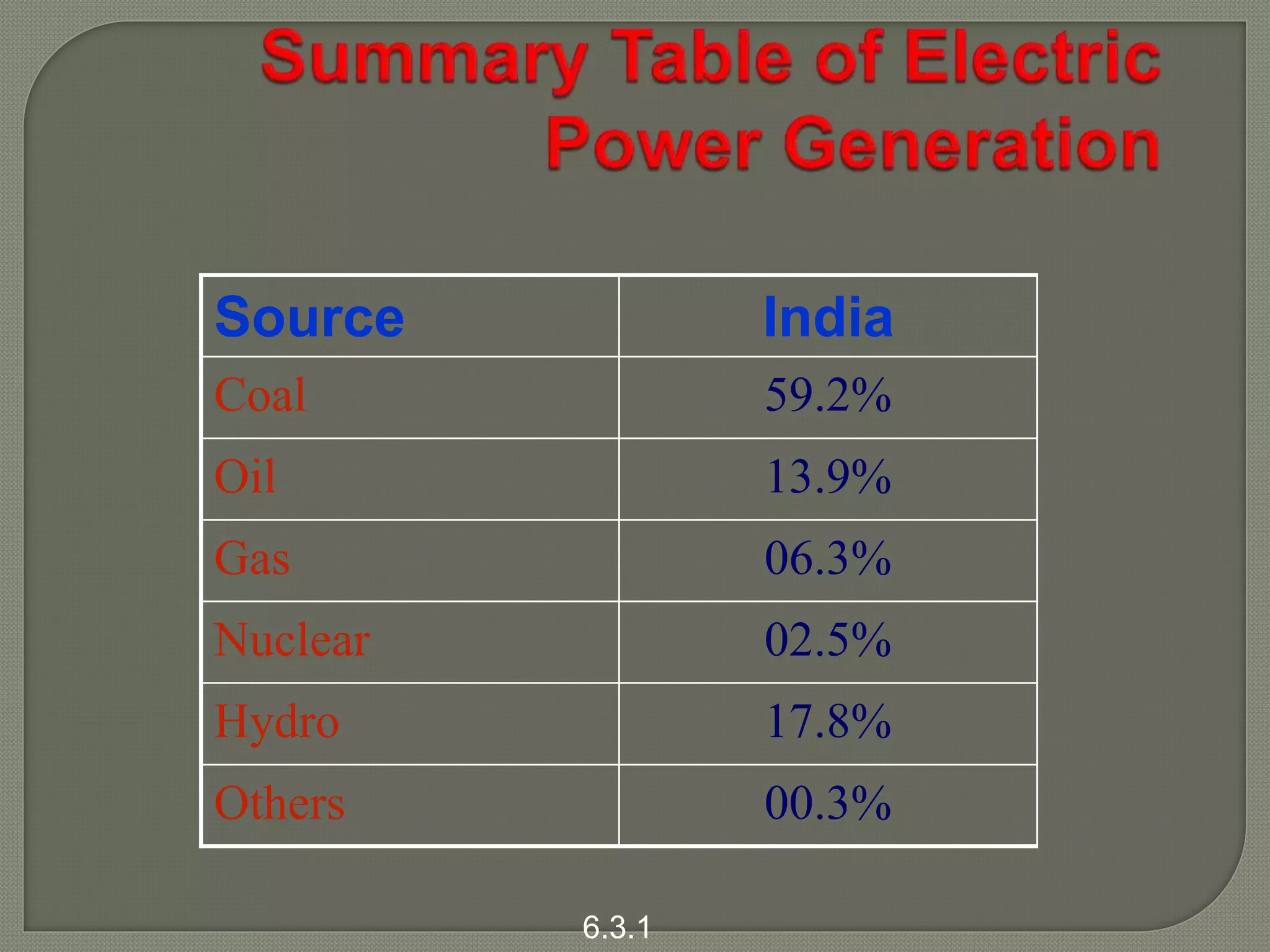
Source India
Coal 59.2%
Oil 13.9%
Gas 06.3%
Nuclear 02.5%
Hydro 17.8%
Others 00.3%
6.3.1
ENVIRONMENTAL ISSUES IN COAL
BASED POWER GENERATION [6.3.1]
Air Pollution :- High particulate matter emission levels due to
burning of inferior grade coal which
leads to generation of large quantity of fly ash
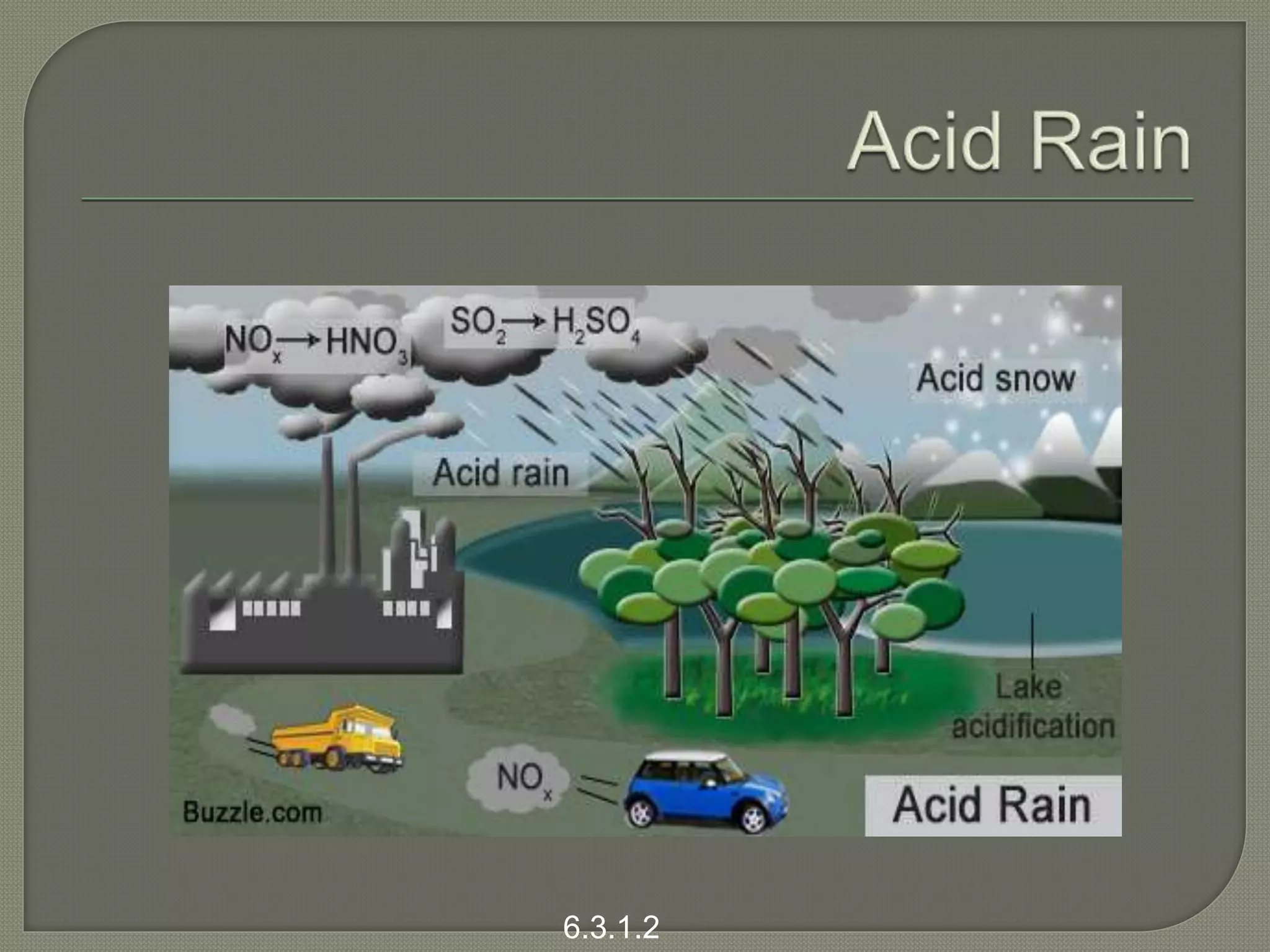
Emissions of SO2, NOx & Green house gas
(CO2) are also matter of concern
Water Pollution :- Mainly caused by the effluent discharge from ash
ponds, condenser cooling /cooling tower, DM
plant and Boiler blow down.
6.3.1
Noise Pollution :- High noise levels due to release of high pressure
steam and running of fans and motors
Land Degradation :- About 100 million tonnes of fly ash is generated by
use of coal far energy production. The disposal of
such large quantity of fly ash has occupied
thousands hectares of land which includes
agricultural and forest land too.
6.3.1
Air Pollution 6.3.1.1
6.3.1.1
Air Pollutants and its impact on human
health
Particulate Matter
Dust and smoke particles cause irritation of the
respiratory tract and produce bronchitis, asthma
and lung diseases.
Dust and smoke function as nuclei for
condensation of water vapors and produce smog
which attract chemicals like SO2, H2S, NO2,etc.
Smog not only reduce visibility but is also harmful
due to its contained chemicals.
6.3.1.1
Pollutants Emissions (in tones/day)
CO2 424650
Particulate
Matter
4374
SO2 3311
NOx 4966
6.3.1.1
Share of Suspended Particulate Matter Load
(tonnes/day) by Different Categories of
Industries (With Control Device), Total Load =
5365 tonnes/day
Sugar
10%
Thermal
Power
Plants
82%
Others
1%
Cement
7%
6.3.1.1
 Water which is discharged from the power
plants in to the water bodies have 10-16⁰c
higher temperature than the receiving
waters which lead to thermal pollution.
This thermal pollution cause reduction in
dissolved oxygen which effects the
aquatic animals.
Also the heat sensitive organisms will die.
6.3.1.2
6.3.1.2
6.3.1.3
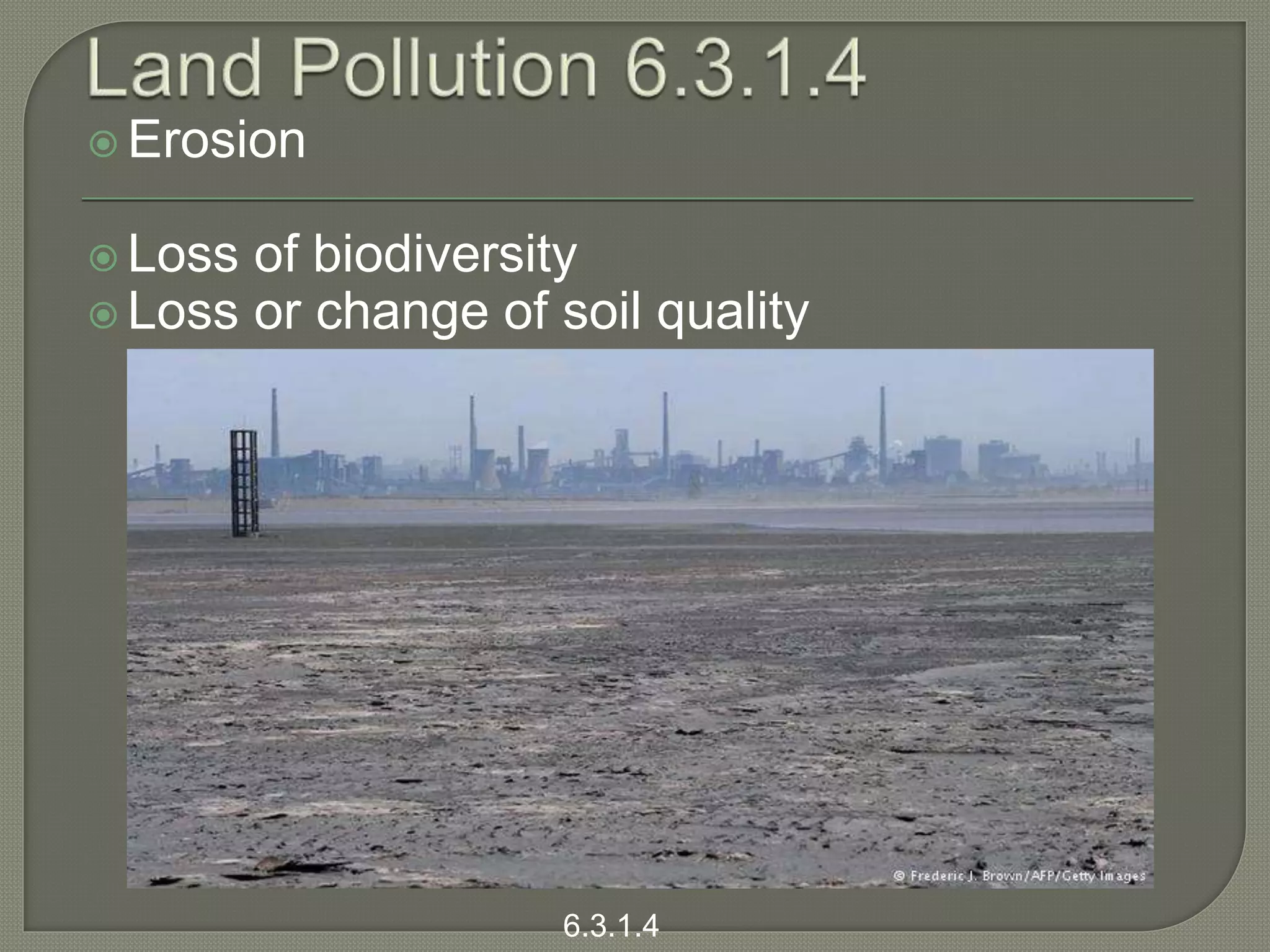
 Erosion
 Loss of biodiversity
 Loss or change of soil quality
6.3.1.4
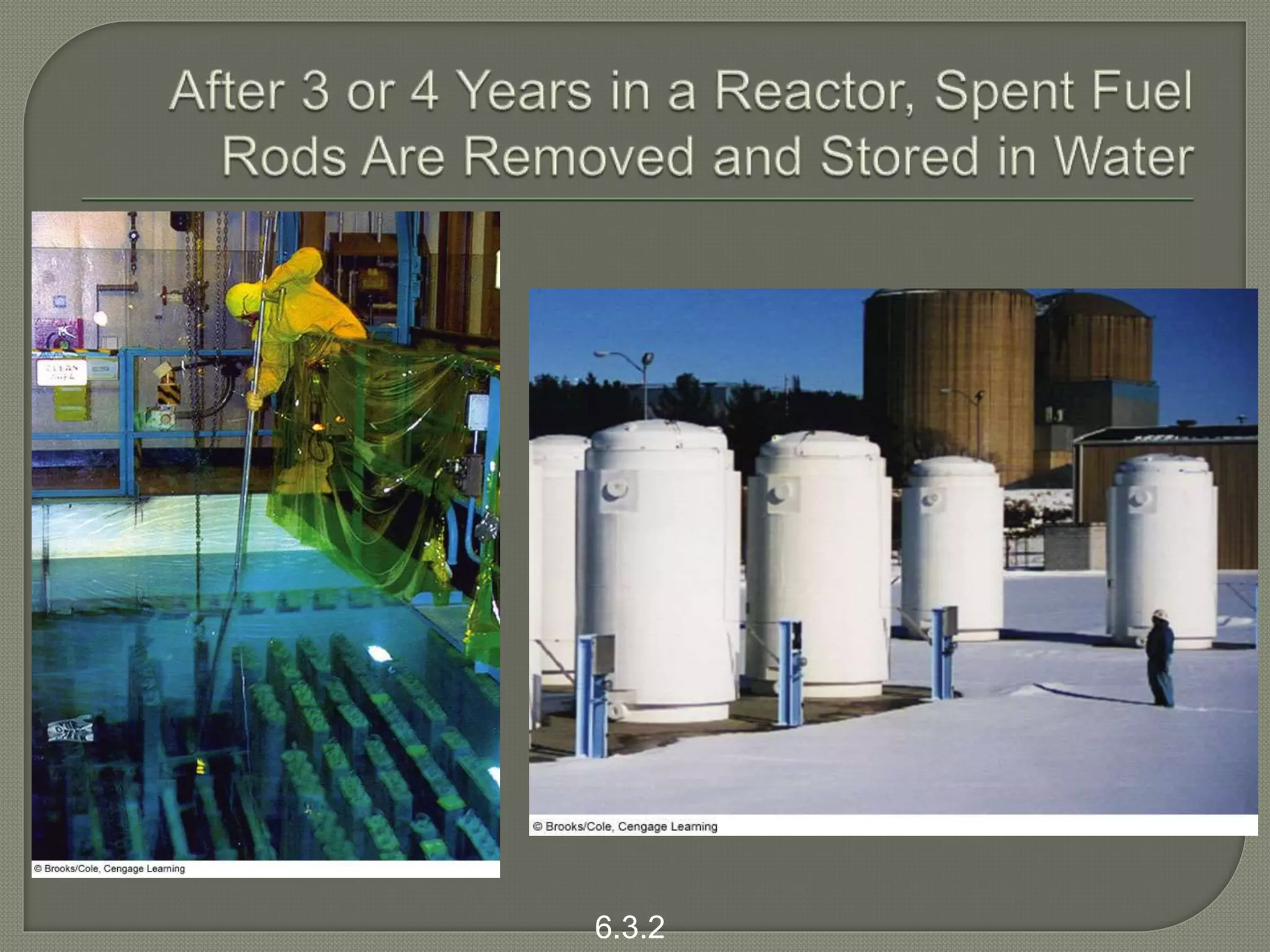
Nuclear power plants generate large
amount of deadly nuclear radioactive
waste.
The low level waste must be stored safely
for 100-500 years, while the high level
waste remains radio active for very long
period, roughly 240,000 years.
The effects may be somatic or genetic
damage.
6.3.2
6.3.2
586.3.2
 Chernobyl Nuclear accident of level 7 {INES} [IN
RUSSIA] is the worst nuclear disaster in the history,
it occurred on 26 April 1986.more than 2000 people
died and 5,75,000 people exposed.
 IN 1952 first nuclear accident in at chalk river of
level 5 {INES} in Canada, In 2011 Fukushima in
Japan of level 5 {INES}
 Till today total 21 accidents of nuclear power plants
occurs.
[International Nuclear Events Scale]
 Nuclear power plants also cause thermal pollution
causing damage to the aquatic life.
 Mining of uranium and other radioactive elements
also cause some radioactive pollution
6.3.2
 Following are the some of the important
problems which will arise due to over use of
energy resources.
 1)Extinction of resources:-Non renewable
resources like coal , crude oil , etc will be
completely depleted in the next 35-40 years
as they are in limited quantity.
 2)Pollution:-Over use of energy resources
results in lot of emission of SO2, NOx , CO2 ,
particulate matter.
6.3.3
Air pollution
6.3.3
 3)Economical Effects:-As these resources will
get depleted , cost will increase which will
seriously effects the economy and the
development of nation as large funds are
diverted to import resources.
 4)Need for development of new technology for
the use of alternative fuels:-The machineries
and vehicles which are using conventional
resources will become obsolete as their will be
no fuel to run them , so new technology has to
be developed using which alternative fuels can
be using for running vehicles and equipments.
6.3.3
Economic loss
6.3.3
6.3.3
Thank You

Energy Resources

  • 1.
  • 2.
     6.1.1 INDIANSCENARIO  6.1.2 CONVENTIONAL ENERGY SOURCES  6.1.3 NON-CONVENTIONAL ENERGY SOURCES  6.2.1 Energy  6.2.2 Renewable energy  6.2.3 Non-Renewable  6.2.4 Environmental issues  6.2.5 Global Warming  6.3.1 ENVIRONMENTAL IMPACTS OF COAL BASED POWER PLANTS [G.T.U-MARCH-2009,JANUARY- 2011,MARCH-2012]  6.3.2 ENVIRONMENTAL IMPACTS OF NUCLEAR POWER PLANTS [G.T.U-MARCH-2009,JUNE-2010]  6.3.3 PROBLEMS DUE TO OVER USE OF ENERGY RESOURCES [G.T.U-MARCH/JUNE-2010,JULY-2011]
  • 3.
     Energy isvital source for economic and social development.  To meet the increasing demand for energy, concrete efforts have to be made to improve existing technology and to develop new approaches in conventional sources.  The role of new renewable sources of energy now a days has become important.  Energy utilization, irrespective of the energy source, has environmental consequences like:- 1) greenhouse effect 2) global warming  Nuclear energy raises environmental concerns about long- term storage of radioactive waste.  An understanding of these consequences and how to deal with them requires knowledge on energy resources it generation an utilization.
  • 4.
    Energy According to sources Convention al sources Non- convention alsources According to use Commercial Non- commercial According to renewable property Renewable Non- renewable
  • 5.
    32% 21% 23% 6% 11% 7% % of totalenergy usage Oil Coal Natural gas Nuclear Biomass Solar, Hydropower, Wind power, etc.
  • 6.
     Coal isthe main source of energy in India, accounting for about 55% responsibility of energy, followed by petroleum oil and natural gas.  Energy source % share 1). Coal 55% 2). Petroleum oil 31% 3). Natural gas 08% 4). Hydro power 05% 5). Nuclear power 1% 6.1.1
  • 7.
    The energy whichgets exhausted with use and cannot be replaced are called conventional energy sources. These includes:- 1). Fossil fuels – petroleum, oil, coal, natural gas 2). Nuclear energy – uranium, thorium 6.1.2
  • 8.
    1. Fossil fuels6.1.2.1 • Fossil fuels includes petroleum (liquid), coal (solid) & natural gas (gaseous). • About 90% of the world’s energy demands are met by burning fossils fuels.  PETROLEUM : Petroleum is the main element of fossil fuel available in liquid state. It is highly inflammable. It is formed from the remains of plants & animals, which were buried in the earth crust. Different components of the crude oil are separated fractional Gasoline – used in automobiles and aircrafts Diesel – used in automobiles and locomotives 6.1.2.1
  • 9.
     COAL 6.1.2.2 Thisis the most abundant and easily available fossil fuel. It is solid fossil fuel formed by partial decomposition plants deposition in layers at varying depths. 6.1.2.2
  • 10.
  • 11.
    1. Nuclear energy6.1.2.3 • A small amount of radioactive material can produce enormous amount of energy. • Uranium -235 is the most popular radioactive element used for producing nuclear energy. • 1 tonne of uranium -235 will produce as much as energy as by three million tones of coal or 12 million barrels of oil. • Nuclear energy can be released to generate electricity by two nuclear processes : (i) Nuclear fission (ii) Nuclear fusion 6.1.2
  • 12.
    The energy sourceswhich are capable of being replaced or renewed by natural processes are called Non-conventional energy sources. These natural resources are in exhaustible and can be used to produce energy again & again. Therefore they are also called Alternate energy sources. 6.1.3
  • 13.
    The important non-conventional energy sources are :- 1. Solar energy 2. Wind energy 3. Hydropower energy 4. Biomass energy 5. Tidal energy 6. Geothermal energy 7. Hydrogen energy & fuel cell 6.1.3
  • 14.
    1. Solar energy6.1.3.1 • The sun is a source of solar energy. • It is a large hydrogen reactor in which continuous nuclear fusion reaction produces enormous amount of energy, in the form of solar radiation. • The sun is 150 million kilometers away from the earth and its rays losses most of their energy while travelling. • Only 4% of the total solar energy reaches the earth, which is approximately 1kwh/sq. m of flat land on the earth. 6.1.3.1
  • 15.
    6.2.1 Energy 6.2.2 Renewableenergy 6.2.3 Non-Renewable 6.2.4 Environmental issues 6.2.5 Global Warming
  • 17.
    Energy Energy is theability to do work. The word ‘work’ means transferring energy from one place to another. energy is neither destroyed nor created. It can only be changed. 6.2.1
  • 18.
  • 19.
  • 20.
    Those sources ofenergy which are being produced continuously in nature and will never be exhausted, are called renewable sources of energy. Renewable Energy 6.2.2 6.2.2
  • 21.
    Those sources ofenergy which have been produced in nature over a very, very long time and cannot be quickly replaced when exhausted, are called non renewable sources of energy. Non-renewable Energy 6.2.3 6.2.3
  • 22.
    Coal is themost abundant fossil fuel in the world. During the formation of coal, carbonaceous matter was first compressed into a spongy material called "peat," which is about 90% water. As the peat became more deeply buried, the increased pressure and temperature turned it into coal. Coal 6.2.3.1 6.2.3.1
  • 23.
    OIL 6.2.3.2 Crude oilor liquid petroleum, is a fossil fuel that is refined into many different energy products (e.g., gasoline, diesel fuel, jet fuel, heating oil). Oil forms underground in rock such as shale, which is rich in organic materials. 6.2.3.2
  • 24.
    In most electricpower plants, water is heated and converted into steam, which drives a turbine-generator to produce electricity. Fossil-fueled power plants produce heat by burning coal, oil, or natural gas. In a nuclear power plant, the fission of uranium atoms in the reactor provides the heat to produce steam for electricity. Nuclear power 6.2.3.3 6.2.3.3
  • 25.
    Natural gas productionis often a by- product of oil recovery, as the two commonly share underground reservoirs. Natural gas is a mixture of gases, the most common being methane (CH4). It also contains some ethane (C2H6), propane (C3H8), and butane (C4H10). Natural gas is usually not contaminated with sulfur and is therefore the cleanest burning fossil fuel. Natural gas 6.2.3.4 6.2.3.4
  • 26.
    Deforestation Environmental Impacts ofMining Global Warming “Tragedy of the commons”—overfishing and other 6.2.4
  • 27.
  • 28.
    Jungle burned foragriculture in southern Mexico 6.2.4
  • 29.
    Burning forests anddecay of wood after logging contribute to the release of greenhouse gases Loss of biodiversity Forests are important parts of hydrologic cycle in nature 6.2.4.1
  • 30.
  • 31.
    Chuquicamata, the largestopen pit copper mine in the world, Chile 6.2.4.3
  • 32.
    Iron hydroxide precipitatestains a stream receiving acid drainage from surface coal mining. 6.2.4.3
  • 33.
    Land/soil erosion Formation ofsinkholes, Loss of biodiversity in the area Contamination of groundwaters by chemicals from the mining process and products. Abandoned mines can still pose safety hazards such as deadly gases 6.2.4.4
  • 34.
  • 35.
  • 36.
  • 37.
  • 38.
  • 39.
    Melting of permafrostand polar ice Rising sea level Spread of pests and disease Ecological impacts (e.g. disturbed life cycle of flora-fauna) 6.2.5
  • 40.
    This image isof the Easton Glacier on Mount Baker in the North Cascades of Washington taken in 2003. It shows the terminus position of the glacier in 1985 as well. 6.2.5
  • 41.
  • 42.
     Free accessand unrestricted demand for a finite resource ultimately dooms the resource through over-exploitation.  Release of carbon dioxide into the atmosphere is one example. As everyone can release carbon dioxide into the atmosphere with little personal consequence, people tends to care very little about limiting its emission. 6.2.5
  • 43.
  • 44.
    INTRODUCTION 6.3.1 ENVIRONMENTAL IMPACTSOF COAL BASED POWER PLANTS [G.T.U- MARCH-2009,JANUARY-2011,MARCH- 2012] 6.3.2 ENVIRONMENTAL IMPACTS OF NUCLEAR POWER PLANTS [G.T.U- MARCH-2009,JUNE-2010] 6.3.3 PROBLEMS DUE TO OVER USE OF ENERGY RESOURCES [G.T.U- MARCH/JUNE-2010,JULY-2011]
  • 45.
    Source India Coal 59.2% Oil13.9% Gas 06.3% Nuclear 02.5% Hydro 17.8% Others 00.3% 6.3.1
  • 46.
    ENVIRONMENTAL ISSUES INCOAL BASED POWER GENERATION [6.3.1] Air Pollution :- High particulate matter emission levels due to burning of inferior grade coal which leads to generation of large quantity of fly ash Emissions of SO2, NOx & Green house gas (CO2) are also matter of concern Water Pollution :- Mainly caused by the effluent discharge from ash ponds, condenser cooling /cooling tower, DM plant and Boiler blow down. 6.3.1
  • 47.
    Noise Pollution :-High noise levels due to release of high pressure steam and running of fans and motors Land Degradation :- About 100 million tonnes of fly ash is generated by use of coal far energy production. The disposal of such large quantity of fly ash has occupied thousands hectares of land which includes agricultural and forest land too. 6.3.1
  • 48.
  • 49.
    Air Pollutants andits impact on human health Particulate Matter Dust and smoke particles cause irritation of the respiratory tract and produce bronchitis, asthma and lung diseases. Dust and smoke function as nuclei for condensation of water vapors and produce smog which attract chemicals like SO2, H2S, NO2,etc. Smog not only reduce visibility but is also harmful due to its contained chemicals. 6.3.1.1
  • 50.
    Pollutants Emissions (intones/day) CO2 424650 Particulate Matter 4374 SO2 3311 NOx 4966 6.3.1.1
  • 51.
    Share of SuspendedParticulate Matter Load (tonnes/day) by Different Categories of Industries (With Control Device), Total Load = 5365 tonnes/day Sugar 10% Thermal Power Plants 82% Others 1% Cement 7% 6.3.1.1
  • 52.
     Water whichis discharged from the power plants in to the water bodies have 10-16⁰c higher temperature than the receiving waters which lead to thermal pollution. This thermal pollution cause reduction in dissolved oxygen which effects the aquatic animals. Also the heat sensitive organisms will die. 6.3.1.2
  • 53.
  • 54.
  • 55.
     Erosion  Lossof biodiversity  Loss or change of soil quality 6.3.1.4
  • 56.
    Nuclear power plantsgenerate large amount of deadly nuclear radioactive waste. The low level waste must be stored safely for 100-500 years, while the high level waste remains radio active for very long period, roughly 240,000 years. The effects may be somatic or genetic damage. 6.3.2
  • 57.
  • 58.
  • 59.
     Chernobyl Nuclearaccident of level 7 {INES} [IN RUSSIA] is the worst nuclear disaster in the history, it occurred on 26 April 1986.more than 2000 people died and 5,75,000 people exposed.  IN 1952 first nuclear accident in at chalk river of level 5 {INES} in Canada, In 2011 Fukushima in Japan of level 5 {INES}  Till today total 21 accidents of nuclear power plants occurs. [International Nuclear Events Scale]  Nuclear power plants also cause thermal pollution causing damage to the aquatic life.  Mining of uranium and other radioactive elements also cause some radioactive pollution 6.3.2
  • 60.
     Following arethe some of the important problems which will arise due to over use of energy resources.  1)Extinction of resources:-Non renewable resources like coal , crude oil , etc will be completely depleted in the next 35-40 years as they are in limited quantity.  2)Pollution:-Over use of energy resources results in lot of emission of SO2, NOx , CO2 , particulate matter. 6.3.3
  • 61.
  • 62.
     3)Economical Effects:-Asthese resources will get depleted , cost will increase which will seriously effects the economy and the development of nation as large funds are diverted to import resources.  4)Need for development of new technology for the use of alternative fuels:-The machineries and vehicles which are using conventional resources will become obsolete as their will be no fuel to run them , so new technology has to be developed using which alternative fuels can be using for running vehicles and equipments. 6.3.3
  • 63.
  • 64.
  • 65.