

Natural resources occur naturally within environments that exist 
relatively undisturbed by humanity, in a natural form. 



A natural resource is often characterized by amounts 
of biodiversity and geo diversity existent in various ecosystems.



Natural resources are derived from the environment. Some of 
them are essential for our survival while most are used for 
satisfying our wants. Natural resources may be further classified 
in different ways.



Natural resources are materials and components (something that 
can be used) that can be found within the environment. 
Some natural resources such as sunlight and air can be found 
everywhere, and are known as ubiquitous resources. 
    
 However, most resources only occur in small sporadic areas, and 
are referred to as localized resources. 




There are very few resources that are considered inexhaustible 
(will not run out in foreseeable future) – these are solar radiation, 
geothermal energy, and air (though access to clean air may not 
be). 



The vast majority of resources are exhaustible, which means 
they have a finite quantity, and can be depleted if managed 
improperly.
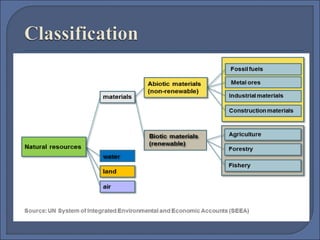
There are various methods of categorizing natural resources,
these include source of origin, stage of development, and by
their renewability. These classifications are described below.
On the basis of origin, resources may be divided into:

Biotic – Biotic resources are obtained from

the biosphere (living and organic material), such
as forests and animals, and the materials that can be obtained
from them. Fossil fuels such as coal and petroleum are also
included in this category because they are formed from
decayed organic matter.

Abiotic – Abiotic resources are those that come from non-

living, non-organic material. Examples of abiotic resources
include land, fresh water, air and heavy metals including ores
such as gold, iron, copper, silver, etc.
Considering their stage of development, natural resources may
be referred to in the following ways:

Potential resources – Potential resources are those that exist in

a region and may be used in the future. For
example, petroleum may exist in various places with sedimentary
rocks but until the time it is actually drilled out and put into use,
it remains a potential resource.

Actual resources – Actual resources are those that have been
surveyed, their quantity and quality determined and are being
used in present times.

Reserve resources – The part of an actual resource which can be
developed profitably in the future is called a reserve resource.

Stock resources – Stock resources are those that have been
surveyed but cannot be used by organisms due to lack of
technology. For example : hydrogen.
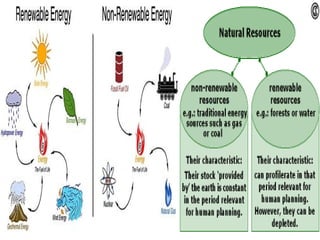
Renewability is a very popular topic and many natural resources can
be categorized as either renewable or non-renewable:

Renewable resources – Renewable resources can be replenished

naturally. Some of these resources, like sunlight, air, wind, etc., are
continuously available and their quantity is not noticeably affected
by human consumption. Though many renewable resources do not
have such a rapid recovery rate, these resources are susceptible to
depletion by over-use.

Non-renewable resources – Non-renewable resources either

form slowly or do not naturally form in the environment. Minerals
are the most common resource included in this category. A good
example of this are fossil fuels, which are in this category because
their rate of formation is extremely slow (potentially millions of
years), meaning they are considered non-renewable..


To conserve habitat in terrestrial eco regions and 
stop deforestation is a goal widely shared by many groups with a 
wide variety of motivations. Use depleting resources efficiently.



To protect sea life from extinction due to overfishing is another 
commonly stated goal of conservation — ensuring that "some 
will be available for our children" to continue a way of life.



The consumer conservation ethic is sometimes expressed by 
the four R's: " Rethink, Reduce, Recycle, Repair" This social 
ethic primarily relates to the sustained, and efficient use 
of renewable resources and the prevention of harm to common 
resources such as air and water quality.


Conservation biology is the scientific study of the nature and 
status of Earth's biodiversity with the aim of protecting species, 
their habitats, and ecosystems from excessive rates of  extinction. 



Habitat conservation is a land management practice that seeks 
to conserve, protect and restore, habitat areas for 
wild plants and animals, especially conservation reliant species, 
and prevent their extinction, fragmentation or reduction in range.



Natural resource management refers to the management 
of natural resources such as land, water, soil, plants and animals, 
with a particular focus on how management affects the quality of 
life for both present and future generations


National Natural Resources Management System
(NNRMS) is a national level inter-agency system for integrated 
natural resources management in the country. 



NNRMS supports the optimal utilization of country's natural 
resources by providing for a proper and systematic inventory of 
natural resources available using remote sensing data in 
conjunction with conventional data/techniques. 



In doing so, NNRMS adopts various advanced technologies of 
satellite and aerial remote sensing; Geographical Information 
Systems (GIS); precise Positioning Systems; database and 
networking infrastructure and advanced ground-based survey 
techniques.
 




NNRMS is established in 1983 and is supported by Planning
Commission, Government of India.



Department of Space (DOS) is the nodal agency for
implementing NNRMS in the country and the Secretariat of
NNRMS is housed in the ISRO Headquarters, Bangalore.



The Planning Committee of NNRMS (PC-NNRMS) is the
apex-body that provides guidelines for implementation of the
NNRMS and also oversees the progress of remote sensing
applications for natural resources management in the country.
Natural resources

Natural resources