ME 6403- Environmental Science and
Engineering
HUMAN POPULATION
AND
THE ENVIRONMENT
Prepared by
V.NaveenPrabhu
Assistant Professor
Sri Eshwar college of Engineering
Coimbatore
2
HUMAN POPULATION
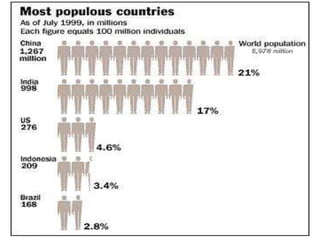
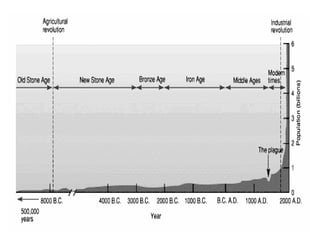
Every second, 4 or 5 children are born somewhere on the
earth and 2 people die.
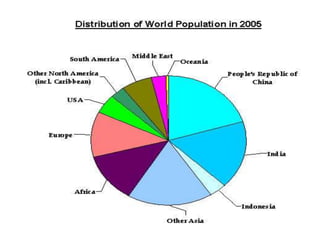
Over population will definitely cause natural resources
depletion and environmental degradation.
Total fertility rate: the number of children born to an
average woman.
Crude birth rate: the number of births/1000 person per
year
Crude death rate: the number of deaths per 1000 persons
per year
Life expectancy: it is average age of a person at death.
Current average life expectancy is around 40 to 50 years.
Reasons for the population growth:
Science and technological advancement has
increased the expectancy of human.
People started living with good sanitation food
and medical facilities increase in population
exponentially.
Therefore, in developing countries the
population increase is at a rate of 3.4% per
year.
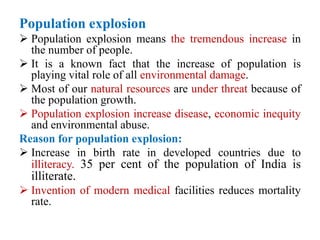
Population explosion
 Population explosion means the tremendous increase in
the number of people.
 It is a known fact that the increase of population is
playing vital role of all environmental damage.
 Most of our natural resources are under threat because of
the population growth.
 Population explosion increase disease, economic inequity
and environmental abuse.
Reason for population explosion:
 Increase in birth rate in developed countries due to
illiteracy. 35 per cent of the population of India is
illiterate.
 Invention of modern medical facilities reduces mortality
rate.
HUMAN RIGHTS
 Human rights day is celebrated on 10th December of every
year
Every individuals of India has the following rights.
 Human rights to Freedom
 Human rights to Property
 Human rights to Freedom of religion
 Human rights to Culture and civilization
 Human rights to Education
 Human rights to Equality
 Human rights to find Solution to exploitation
 Human rights to Food and shelter
 Human rights to health
 Human rights to employment
 Human rights to social security
 Human rights to form trades and companies
Role of IT in environment and human health:
Information technology is one of the fastest
growing recent technology.
Various software have been developed for
environment and health care.
 lot of techniques are used under IT for
development and application of computational
tools to acquire, store, analyze and visualize
satellite data which is used for observation,
and protection of environment.
Due to the development of the internet and
information through the satellites a wide
 Remote Sensing and GIS (Geographic Information
System) provides data and knowledge concerning the
global environment as it is used for mapping and
monitoring various natural resources.
 Ministry of Environment and Forest and Government
of India have created an Environment Information
System (ENVIS). Different ENVIS centers are set up
in different organizations for information collection,
storage which work towards boosting the relationship
between trade and environment .
IT is used for computer based modeling and
simulation of environmental scenarios for
analysis and prediction.
It enables environmental scientists and
researchers around the world to communicate,
collaborate and coordinate.
 IT can be used for audio, visual and data
communications for medical consultation,
treatment, nursing and medical education.
 IT is used for testing of DNA, creating DNA database and
genetic information about population. Medical records
and finger prints which are used by investigating agencies
to identify missing persons and criminals.
 IT helps in spreading awareness about endemic, epidemic
and communicable diseases. With the help of Remote
Sensing and GIS there is identification of several infested
areas which are prone to some diseases like malaria etc.
based upon mapping of such areas.
WOMEN & CHILD WELFARE
The policy for women aims at making them economically
independent and self reliant. Focus is on the following
areas, as per the policy.
1. Steps to eliminate violence against women;
2. Ensuring equality in view of legal rights
3. Improving the economic status of women;
4. Appropriate use of media;
5. Increased participation of women in local
self-Government
6. Enhancing community participation in
government activities (involvement of
Non-Governmental Organizations)
 It is the policy of Government to provide for the care
protection, treatment, development and rehabilitation of
neglected children
 Children’s Development is as important as the
development of material resources and the best way to
develop national human resources is to take care of
children.
 India has the largest child population in the world.
 All out efforts are being made by India for the
development and welfare of children.
 Significant progress has been made in many fields in
assuring children their basic rights.
 A lot more has to be done for the health, nutrition and
education of children.
The major activities included in different sectoral
programmes are given below:
Education.
Child Development and Nutrition .
Child Protection .
Child Health.
Child’s Environment: Water, Environment and
Sanitation.
VALUE EDUCATION
TYPES OF EDUCATION
i) Formal education
ii) Value education
iii) Value – based environmental education.
OBJECTIVES or NEED or IMPORTANCE OF
VALUE EDUCATION
i) To improve the integral growth of human being.
ii) To create attitudes towards sustainable lifestyle.
iii) To increase awareness about constitutional rights
iv) To understand about our natural environment.
METHODS OF IMPARTING VALUE
EDUCATION
i) Telling
own narration of the situation.
ii) Modeling
ideal values are presented to the learners as a model.
iii) Role playing
acting out the true feelings of the actors by asking the role of another
person
iv) Problem solving
a dilemma is presented to the learners.
v) Studying biographies of great man
use of the lives of the great man as the subject matter.
TYPES OF VALUES
1. Universal values (or) Social values.
2. Cultural values.
3. Individual values.
4. Global values.
5. Spiritual values.
HIV - Human Immune deficiency Virus.
AIDS - Acquired Immuno Deficiency
Syndrome.
INTRODUCTION TO ENVIRONMENT
AND HEALTH
OBJECTIVES:
-Health in its physical, mental, social and spiritual
context.
-Environment to be an important factor in the
interaction of agent the physical, biological and
social environment and understand their impact on
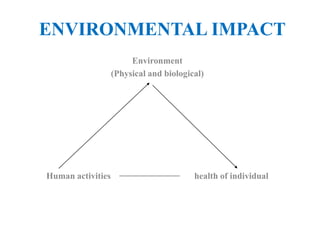
ENVIRONMENTAL IMPACT
Environment
(Physical and biological)
Human activities health of individual
COMPONENTS OF ENVIRONMENT:
PHYSICAL: air, water, soil, housing,
climate, geography, heat, light, noise,
debris, radiation, etc.
BIOLOGICAL: man, viruses, microbial
agents, insects, rodents, animals and
plants, etc.
The environment is all external conditions, circumstances, and
influences surrounding and affecting the growth and
development of an organism or community of organisms.
Environmental health is the study and management of
environmental conditions that affect the health and well-being of
humans.
Environmental hazards
Environmental hazards may be biological,
chemical and physical hazards.
Biological hazards
These are living organisms or their products that
are harmful to humans
A. Water-borne diseases are diseases that are
transmitted in drinking water.
1. Examples are polio virus, hepatitis A virus, Salmonella,
cholera, amoebic dysentery, Giardia, and Cryptosporidium.
2. These disease organisms are shed into the water and
produce illness in those who consume untreated, contaminated
water.
3. Our municipal water treatment facilities are usually able to
purify water by removing these agents or killing them by
disinfecting the water.
B. Food-borne diseasesFood-borne diseases are diseases
transmitted in or on food
1. Examples of food-borne agents are the bacteria
Salmonella, Escherichia coli as well as other
agents.
2. To protect against food-borne diseases,
sanitarians from local health departments routinely
inspect food service establishments (restaurants)
and retail food outlets (supermarkets) to verify that
food is being stored and handled properly.
C. Vector-borne diseases
Vector-borne diseases are those transmitted by
insects.
1. They are transmitted by mosquitoes and plague.
2. Improper environmental management can cause
vector-borne disease outbreaks.
Chemical hazards
Result from mismanagement or misuse of chemicals
resulting in an unacceptable risk to human health
A. Pesticides are chemicals that have been
manufactured for the purpose of reducing populations
of undesirable organisms (pests)
1. Examples of categories of pesticides are herbicides and
insecticides.
2. Most pesticides kill non-target organisms as well as the target, or
pest species.
3. The wise use of pesticides can protect human health and
agricultural crops.
Lead
lead is a naturally occurring element that is used
in the manufacturing of many industrial and
domestic products.
1. Health problems associated with the over
exposure to lead are anemia, birth defects, bone
damage, neurological damage, kidney damage,
and others.
2. Exposure is by ingestion and inhalation.
3. Children are particularly at risk from eating
peeling lead paint.
Physical hazards
This include airborne particles, humidity,
equipment design and radiation
A. Radon contamination results from over
exposure to radon gas.
1. Radon gas arises naturally from the earth and
sometimes occurs at dangerous levels in buildings and
homes.
2. Breathing in radon gas can cause lung cancer.

human population and the environment

  • 1.
    ME 6403- EnvironmentalScience and Engineering HUMAN POPULATION AND THE ENVIRONMENT Prepared by V.NaveenPrabhu Assistant Professor Sri Eshwar college of Engineering Coimbatore
  • 2.
  • 3.
    HUMAN POPULATION Every second,4 or 5 children are born somewhere on the earth and 2 people die. Over population will definitely cause natural resources depletion and environmental degradation. Total fertility rate: the number of children born to an average woman. Crude birth rate: the number of births/1000 person per year Crude death rate: the number of deaths per 1000 persons per year Life expectancy: it is average age of a person at death. Current average life expectancy is around 40 to 50 years.
  • 4.
    Reasons for thepopulation growth: Science and technological advancement has increased the expectancy of human. People started living with good sanitation food and medical facilities increase in population exponentially. Therefore, in developing countries the population increase is at a rate of 3.4% per year.
  • 5.
    Population explosion  Populationexplosion means the tremendous increase in the number of people.  It is a known fact that the increase of population is playing vital role of all environmental damage.  Most of our natural resources are under threat because of the population growth.  Population explosion increase disease, economic inequity and environmental abuse. Reason for population explosion:  Increase in birth rate in developed countries due to illiteracy. 35 per cent of the population of India is illiterate.  Invention of modern medical facilities reduces mortality rate.
  • 6.
    HUMAN RIGHTS  Humanrights day is celebrated on 10th December of every year Every individuals of India has the following rights.  Human rights to Freedom  Human rights to Property  Human rights to Freedom of religion  Human rights to Culture and civilization  Human rights to Education  Human rights to Equality  Human rights to find Solution to exploitation  Human rights to Food and shelter  Human rights to health  Human rights to employment  Human rights to social security  Human rights to form trades and companies
  • 10.
    Role of ITin environment and human health: Information technology is one of the fastest growing recent technology. Various software have been developed for environment and health care.  lot of techniques are used under IT for development and application of computational tools to acquire, store, analyze and visualize satellite data which is used for observation, and protection of environment. Due to the development of the internet and information through the satellites a wide
  • 11.
     Remote Sensingand GIS (Geographic Information System) provides data and knowledge concerning the global environment as it is used for mapping and monitoring various natural resources.  Ministry of Environment and Forest and Government of India have created an Environment Information System (ENVIS). Different ENVIS centers are set up in different organizations for information collection, storage which work towards boosting the relationship between trade and environment .
  • 12.
    IT is usedfor computer based modeling and simulation of environmental scenarios for analysis and prediction. It enables environmental scientists and researchers around the world to communicate, collaborate and coordinate.  IT can be used for audio, visual and data communications for medical consultation, treatment, nursing and medical education.
  • 13.
     IT isused for testing of DNA, creating DNA database and genetic information about population. Medical records and finger prints which are used by investigating agencies to identify missing persons and criminals.  IT helps in spreading awareness about endemic, epidemic and communicable diseases. With the help of Remote Sensing and GIS there is identification of several infested areas which are prone to some diseases like malaria etc. based upon mapping of such areas.
  • 14.
    WOMEN & CHILDWELFARE The policy for women aims at making them economically independent and self reliant. Focus is on the following areas, as per the policy. 1. Steps to eliminate violence against women; 2. Ensuring equality in view of legal rights 3. Improving the economic status of women; 4. Appropriate use of media; 5. Increased participation of women in local self-Government 6. Enhancing community participation in government activities (involvement of Non-Governmental Organizations)
  • 15.
     It isthe policy of Government to provide for the care protection, treatment, development and rehabilitation of neglected children  Children’s Development is as important as the development of material resources and the best way to develop national human resources is to take care of children.  India has the largest child population in the world.  All out efforts are being made by India for the development and welfare of children.  Significant progress has been made in many fields in assuring children their basic rights.  A lot more has to be done for the health, nutrition and education of children.
  • 16.
    The major activitiesincluded in different sectoral programmes are given below: Education. Child Development and Nutrition . Child Protection . Child Health. Child’s Environment: Water, Environment and Sanitation.
  • 17.
    VALUE EDUCATION TYPES OFEDUCATION i) Formal education ii) Value education iii) Value – based environmental education. OBJECTIVES or NEED or IMPORTANCE OF VALUE EDUCATION i) To improve the integral growth of human being. ii) To create attitudes towards sustainable lifestyle. iii) To increase awareness about constitutional rights iv) To understand about our natural environment.
  • 18.
    METHODS OF IMPARTINGVALUE EDUCATION i) Telling own narration of the situation. ii) Modeling ideal values are presented to the learners as a model. iii) Role playing acting out the true feelings of the actors by asking the role of another person iv) Problem solving a dilemma is presented to the learners. v) Studying biographies of great man use of the lives of the great man as the subject matter.
  • 19.
    TYPES OF VALUES 1.Universal values (or) Social values. 2. Cultural values. 3. Individual values. 4. Global values. 5. Spiritual values. HIV - Human Immune deficiency Virus. AIDS - Acquired Immuno Deficiency Syndrome.
  • 20.
    INTRODUCTION TO ENVIRONMENT ANDHEALTH OBJECTIVES: -Health in its physical, mental, social and spiritual context. -Environment to be an important factor in the interaction of agent the physical, biological and social environment and understand their impact on
  • 21.
    ENVIRONMENTAL IMPACT Environment (Physical andbiological) Human activities health of individual
  • 22.
    COMPONENTS OF ENVIRONMENT: PHYSICAL:air, water, soil, housing, climate, geography, heat, light, noise, debris, radiation, etc. BIOLOGICAL: man, viruses, microbial agents, insects, rodents, animals and plants, etc.
  • 23.
    The environment isall external conditions, circumstances, and influences surrounding and affecting the growth and development of an organism or community of organisms. Environmental health is the study and management of environmental conditions that affect the health and well-being of humans. Environmental hazards Environmental hazards may be biological, chemical and physical hazards.
  • 24.
    Biological hazards These areliving organisms or their products that are harmful to humans A. Water-borne diseases are diseases that are transmitted in drinking water. 1. Examples are polio virus, hepatitis A virus, Salmonella, cholera, amoebic dysentery, Giardia, and Cryptosporidium. 2. These disease organisms are shed into the water and produce illness in those who consume untreated, contaminated water. 3. Our municipal water treatment facilities are usually able to purify water by removing these agents or killing them by disinfecting the water.
  • 25.
    B. Food-borne diseasesFood-bornediseases are diseases transmitted in or on food 1. Examples of food-borne agents are the bacteria Salmonella, Escherichia coli as well as other agents. 2. To protect against food-borne diseases, sanitarians from local health departments routinely inspect food service establishments (restaurants) and retail food outlets (supermarkets) to verify that food is being stored and handled properly.
  • 26.
    C. Vector-borne diseases Vector-bornediseases are those transmitted by insects. 1. They are transmitted by mosquitoes and plague. 2. Improper environmental management can cause vector-borne disease outbreaks.
  • 27.
    Chemical hazards Result frommismanagement or misuse of chemicals resulting in an unacceptable risk to human health A. Pesticides are chemicals that have been manufactured for the purpose of reducing populations of undesirable organisms (pests) 1. Examples of categories of pesticides are herbicides and insecticides. 2. Most pesticides kill non-target organisms as well as the target, or pest species. 3. The wise use of pesticides can protect human health and agricultural crops.
  • 28.
    Lead lead is anaturally occurring element that is used in the manufacturing of many industrial and domestic products. 1. Health problems associated with the over exposure to lead are anemia, birth defects, bone damage, neurological damage, kidney damage, and others. 2. Exposure is by ingestion and inhalation. 3. Children are particularly at risk from eating peeling lead paint.
  • 29.
    Physical hazards This includeairborne particles, humidity, equipment design and radiation A. Radon contamination results from over exposure to radon gas. 1. Radon gas arises naturally from the earth and sometimes occurs at dangerous levels in buildings and homes. 2. Breathing in radon gas can cause lung cancer.