Why Mining is an
Environmental Evil?
Introduction
Mining is the extraction of minerals and other geological materials of economic value
from deposits on the Earth. Mining adversely affects the environment by inducing loss
of biodiversity, soil erosion, and contamination of surface water, groundwater, and
soil. Unregulated mining has the potential to release harmful substances into the soil,
air, and water.
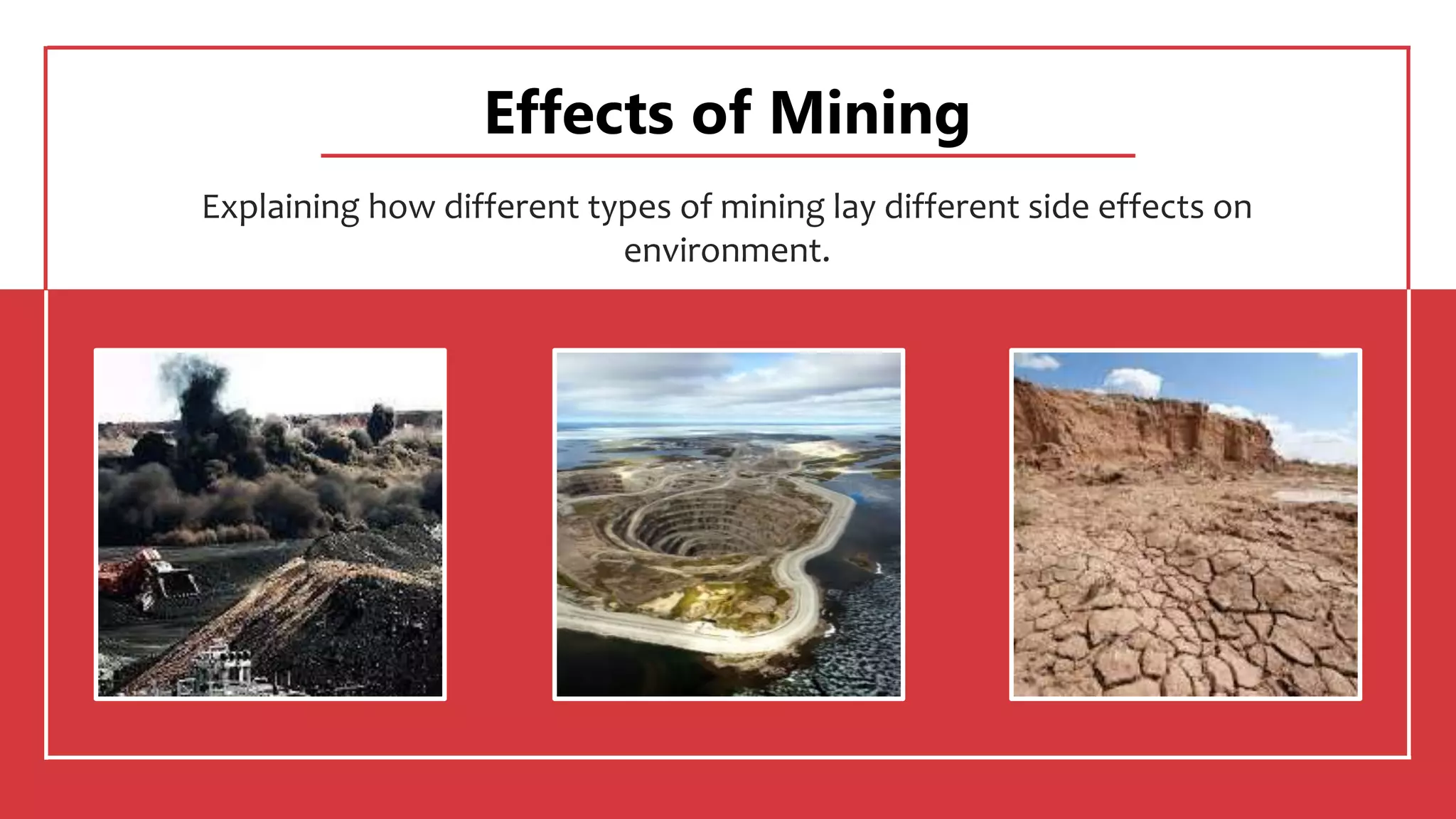
Effects of Mining
Explaining how different types of mining lay different side effects on
environment.
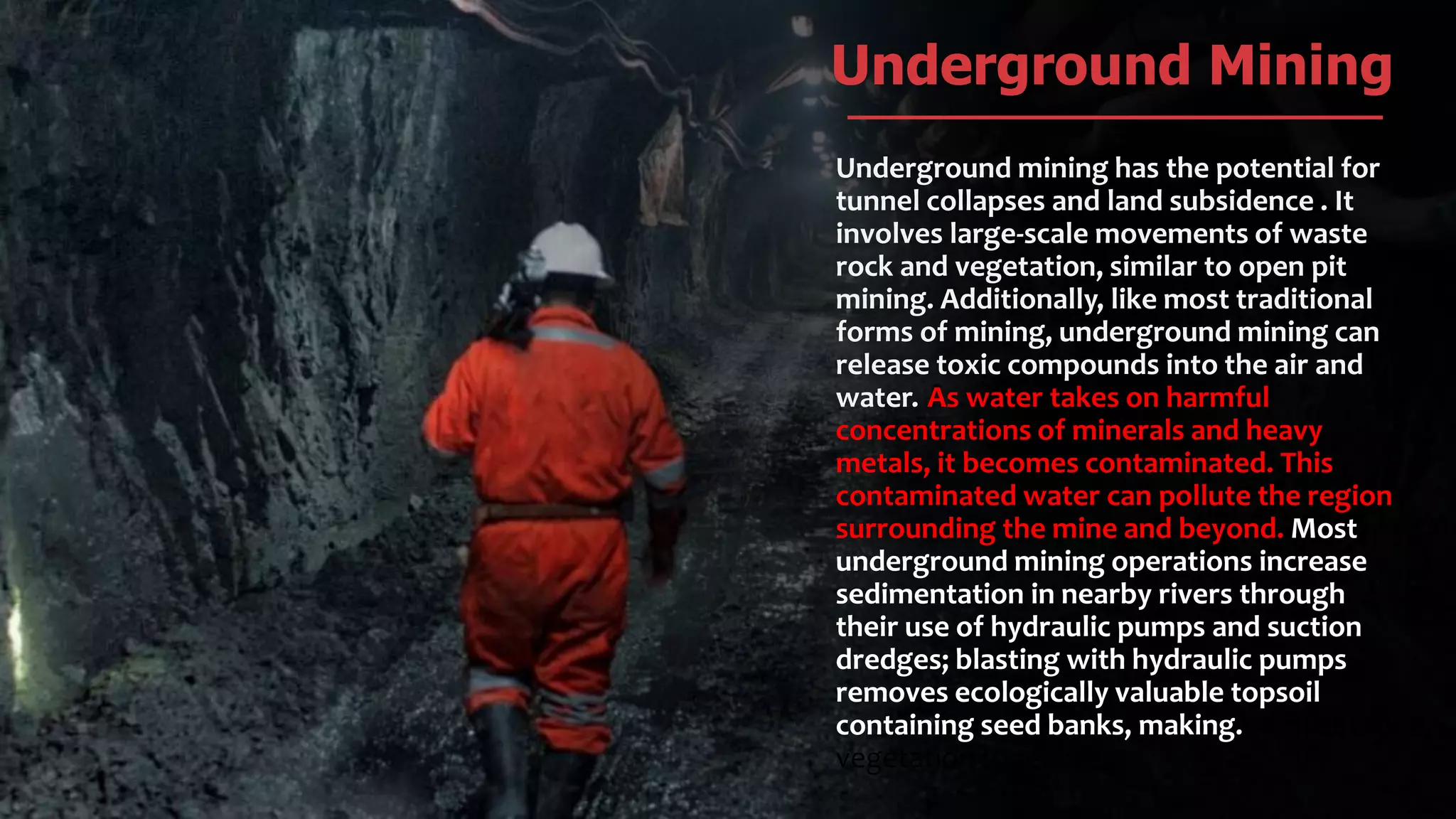
Underground Mining
Underground mining has the potential for
tunnel collapses and land subsidence . It
involves large-scale movements of waste
rock and vegetation, similar to open pit
mining. Additionally, like most traditional
forms of mining, underground mining can
release toxic compounds into the air and
water. As water takes on harmful
concentrations of minerals and heavy
metals, it becomes contaminated. This
contaminated water can pollute the region
surrounding the mine and beyond. Most
underground mining operations increase
sedimentation in nearby rivers through
their use of hydraulic pumps and suction
dredges; blasting with hydraulic pumps
removes ecologically valuable topsoil
containing seed banks, making.t difficult for
vegetation to recover
Open Pit Mining
One of the most typical methods of mining
for strategic minerals is open pit mining,
which involves material being removed
from an open pit. Because strategic
minerals are frequently only found in small
quantities and so require more ore to be
mined, this type of mining is very harmful
to the environment . Every stage of the
open-pit mining operation involves
environmental risks. Rock that has been
hidden for geological epochs is uncovered
through hard rock mining. These rocks are
exposed to metallic dust, asbestos-like
materials, and radioactive elements when
they are broken. Residual rock slurries,
which are mixes of liquid and ground rock
formed during separation, can leach
radioactive and hazardous materials into
bedrock if not effectively contained.
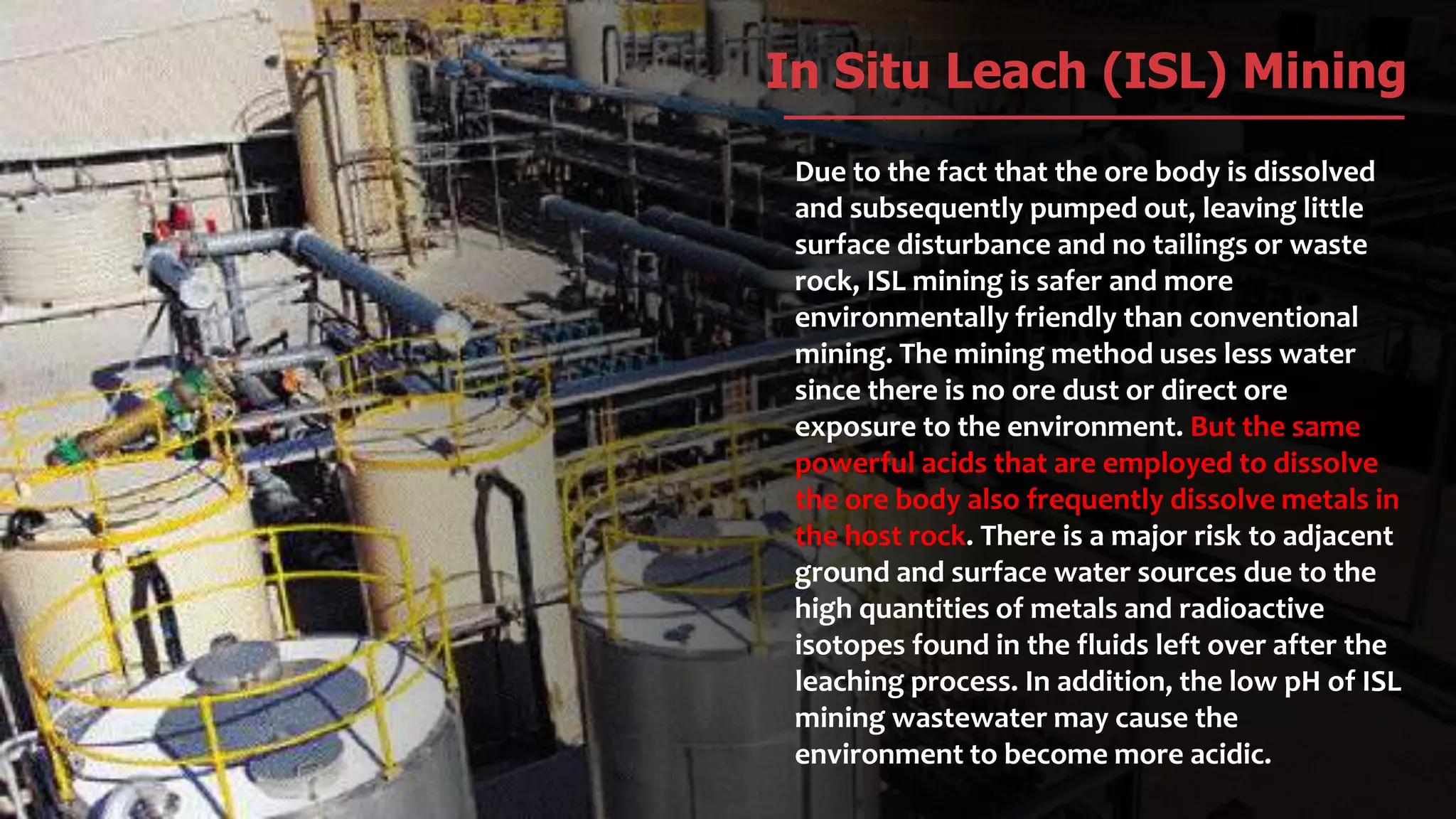
In Situ Leach (ISL) Mining
Due to the fact that the ore body is dissolved
and subsequently pumped out, leaving little
surface disturbance and no tailings or waste
rock, ISL mining is safer and more
environmentally friendly than conventional
mining. The mining method uses less water
since there is no ore dust or direct ore
exposure to the environment. But the same
powerful acids that are employed to dissolve
the ore body also frequently dissolve metals in
the host rock. There is a major risk to adjacent
ground and surface water sources due to the
high quantities of metals and radioactive
isotopes found in the fluids left over after the
leaching process. In addition, the low pH of ISL
mining wastewater may cause the
environment to become more acidic.
Additional Problems:
• Carbon Output
Mining, like most heavy industries, is dependent on fossil fuels, which generate the energy
needed to operate a mine. To combat these carbon emissions, some countries have enacted
regulations requiring emission credits, but many countries do not have codes dealing with carbon
output.
• Erosion and Endangered Species Habitat
Mining is an inherently invasive process that can cause damage to a landscape in an area much
larger than the mining site itself. The effects of this damage can continue years after a mine has
shut down, including the addition to greenhouse gasses, death of flora and fauna, and erosion of
land and habitat.
• Water Use and Wastewater
Most modern mining techniques have high water demands for extraction, processing, and waste
disposal. Wastewater from these processes can pollute water sources nearby and deplete
freshwater supplies in the region surrounding the mine.
Case Studies
Real life examples and incidents which
explain how mining degrades environment.
Greenland
2013 saw the opening of a mine in
Greenland by Australian company
Greenland Minerals and Energy Ltd. The
tailings disposal plan, however, called for
putting the waste in the Taseq Lake,
which will contaminate not just the lake
but also the rivers that flow into it and
the ocean beyond. These tailings would
inject fluorine, heavy metals, and
radioactive decay products into the lake
(Schuler et al, 2011). Plans for the mine are
still moving forward despite the negative
consequences it would have on the
environment and the neighborhood since
Denmark, the nation in charge of the
project, lacks environmental restrictions.
China
The region, in Southeast China, roughly
300 miles north of Hong Kong, saw a
boom in rare earth mining starting in the
1990s. The mining increased when China
started to develop more cellphones, wind
turbines, electric cars, and other high-
tech goods that needed rare earth
elements. However, the removal of these
metals from the earth's crust through the
use of a combination of water and
chemicals resulted in significant soil and
water pollution. According to current
estimates, China's "off-grid" mines
illegally export 20,000 tonnes or more of
REEs each year. This harms the health of
the workers and devastates the ecology
in the area.
India
Numerous issues relating to the
environment, public health, and worker
safety affect India's mining industry.
Numerous accidents that occurred in coal
and stone mines, both underground and on
the surface, in recent years have resulted in
the deaths of many mineworkers. The
Kudremukh Iron Ore Corporation Limited
(KIOCL) in the Western Ghats Mountain
Ranges of Karnataka State in southern
India is an example of a mining company
doing environmental harm. The KIOCL's
operations have badly harmed the
Kudremukh National Park as well as caused
extensive damage to the hills and
groundwater in the surrounding area.
Conclusion
Mining even though is essential for everyday functioning of this modern
world created by us humans, its killing the environment . If no action is
taken to remediate the many environmental problems inherent to modern
mining, the end cost for governments and communities would be
devastating. Already mines in China release 9,600 to 12,000 cubic meters of
toxic gas containing flue dust concentrate, hydrofluoric acid, sulfur dioxide,
and sulfuric acid for each ton of rare earth elements produced. Additionally,
nearly 75 cubic meters of acidic waste water and one ton of radioactive
waste residue are generated . Preemptive actions such as stricter
regulations and proper waste disposal strategies can reduce the costs of
environmental damage, and in some cases pay for themselves. We as
communities should come forward and stop mining in places where its
unnecessary and done in ways neglecting the surroundings we live in.
Thank you
Made by Dev Tyagi

Why Mining is an Environmental Evil.pptx

  • 1.
    Why Mining isan Environmental Evil?
  • 2.
    Introduction Mining is theextraction of minerals and other geological materials of economic value from deposits on the Earth. Mining adversely affects the environment by inducing loss of biodiversity, soil erosion, and contamination of surface water, groundwater, and soil. Unregulated mining has the potential to release harmful substances into the soil, air, and water.
  • 3.
    Effects of Mining Explaininghow different types of mining lay different side effects on environment.
  • 4.
    Underground Mining Underground mininghas the potential for tunnel collapses and land subsidence . It involves large-scale movements of waste rock and vegetation, similar to open pit mining. Additionally, like most traditional forms of mining, underground mining can release toxic compounds into the air and water. As water takes on harmful concentrations of minerals and heavy metals, it becomes contaminated. This contaminated water can pollute the region surrounding the mine and beyond. Most underground mining operations increase sedimentation in nearby rivers through their use of hydraulic pumps and suction dredges; blasting with hydraulic pumps removes ecologically valuable topsoil containing seed banks, making.t difficult for vegetation to recover
  • 5.
    Open Pit Mining Oneof the most typical methods of mining for strategic minerals is open pit mining, which involves material being removed from an open pit. Because strategic minerals are frequently only found in small quantities and so require more ore to be mined, this type of mining is very harmful to the environment . Every stage of the open-pit mining operation involves environmental risks. Rock that has been hidden for geological epochs is uncovered through hard rock mining. These rocks are exposed to metallic dust, asbestos-like materials, and radioactive elements when they are broken. Residual rock slurries, which are mixes of liquid and ground rock formed during separation, can leach radioactive and hazardous materials into bedrock if not effectively contained.
  • 6.
    In Situ Leach(ISL) Mining Due to the fact that the ore body is dissolved and subsequently pumped out, leaving little surface disturbance and no tailings or waste rock, ISL mining is safer and more environmentally friendly than conventional mining. The mining method uses less water since there is no ore dust or direct ore exposure to the environment. But the same powerful acids that are employed to dissolve the ore body also frequently dissolve metals in the host rock. There is a major risk to adjacent ground and surface water sources due to the high quantities of metals and radioactive isotopes found in the fluids left over after the leaching process. In addition, the low pH of ISL mining wastewater may cause the environment to become more acidic.
  • 7.
    Additional Problems: • CarbonOutput Mining, like most heavy industries, is dependent on fossil fuels, which generate the energy needed to operate a mine. To combat these carbon emissions, some countries have enacted regulations requiring emission credits, but many countries do not have codes dealing with carbon output. • Erosion and Endangered Species Habitat Mining is an inherently invasive process that can cause damage to a landscape in an area much larger than the mining site itself. The effects of this damage can continue years after a mine has shut down, including the addition to greenhouse gasses, death of flora and fauna, and erosion of land and habitat. • Water Use and Wastewater Most modern mining techniques have high water demands for extraction, processing, and waste disposal. Wastewater from these processes can pollute water sources nearby and deplete freshwater supplies in the region surrounding the mine.
  • 8.
    Case Studies Real lifeexamples and incidents which explain how mining degrades environment.
  • 9.
    Greenland 2013 saw theopening of a mine in Greenland by Australian company Greenland Minerals and Energy Ltd. The tailings disposal plan, however, called for putting the waste in the Taseq Lake, which will contaminate not just the lake but also the rivers that flow into it and the ocean beyond. These tailings would inject fluorine, heavy metals, and radioactive decay products into the lake (Schuler et al, 2011). Plans for the mine are still moving forward despite the negative consequences it would have on the environment and the neighborhood since Denmark, the nation in charge of the project, lacks environmental restrictions.
  • 10.
    China The region, inSoutheast China, roughly 300 miles north of Hong Kong, saw a boom in rare earth mining starting in the 1990s. The mining increased when China started to develop more cellphones, wind turbines, electric cars, and other high- tech goods that needed rare earth elements. However, the removal of these metals from the earth's crust through the use of a combination of water and chemicals resulted in significant soil and water pollution. According to current estimates, China's "off-grid" mines illegally export 20,000 tonnes or more of REEs each year. This harms the health of the workers and devastates the ecology in the area.
  • 11.
    India Numerous issues relatingto the environment, public health, and worker safety affect India's mining industry. Numerous accidents that occurred in coal and stone mines, both underground and on the surface, in recent years have resulted in the deaths of many mineworkers. The Kudremukh Iron Ore Corporation Limited (KIOCL) in the Western Ghats Mountain Ranges of Karnataka State in southern India is an example of a mining company doing environmental harm. The KIOCL's operations have badly harmed the Kudremukh National Park as well as caused extensive damage to the hills and groundwater in the surrounding area.
  • 12.
    Conclusion Mining even thoughis essential for everyday functioning of this modern world created by us humans, its killing the environment . If no action is taken to remediate the many environmental problems inherent to modern mining, the end cost for governments and communities would be devastating. Already mines in China release 9,600 to 12,000 cubic meters of toxic gas containing flue dust concentrate, hydrofluoric acid, sulfur dioxide, and sulfuric acid for each ton of rare earth elements produced. Additionally, nearly 75 cubic meters of acidic waste water and one ton of radioactive waste residue are generated . Preemptive actions such as stricter regulations and proper waste disposal strategies can reduce the costs of environmental damage, and in some cases pay for themselves. We as communities should come forward and stop mining in places where its unnecessary and done in ways neglecting the surroundings we live in.
  • 13.

Editor's Notes

  • #2 A template for students to design a field trip to a location for other students to view. Includes directions to the student of what to include on each slide and what content should be considered. 
  • #5 For example, Astoria, Oregon is a town on the Oregon coast well known for its starring role in the movie “The Goonies”. Today, we will take a trip from our school to Astoria through miles and time…
  • #6 For example, Astoria, Oregon is a town on the Oregon coast well known for its starring role in the movie “The Goonies”. Today, we will take a trip from our school to Astoria through miles and time…
  • #7 For example, Astoria, Oregon is a town on the Oregon coast well known for its starring role in the movie “The Goonies”. Today, we will take a trip from our school to Astoria through miles and time…
  • #9 You can use this type of slide for text, images, shapes and tables to help add information in a different way. Duplicate this slide to add additional images of important locations in your visit.
  • #10 You can use this type of slide for text, images, shapes and tables to help add information in a different way. Duplicate this slide to add additional images of important locations in your visit.
  • #11 You can use this type of slide for text, images, shapes and tables to help add information in a different way. Duplicate this slide to add additional images of important locations in your visit.
  • #12 You can use this type of slide for text, images, shapes and tables to help add information in a different way. Duplicate this slide to add additional images of important locations in your visit.