The Cerebello Pontine Angle
dr himanshu soni
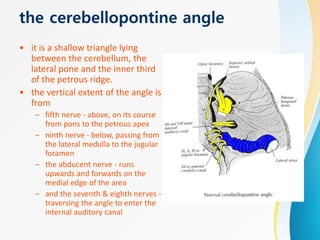
the cerebellopontine angle
• it is a shallow triangle lying
between the cerebellum, the
lateral pone and the inner third
of the petrous ridge.
• the vertical extent of the angle is
from
– fifth nerve - above, on its course
from pons to the petrous apex
– ninth nerve - below, passing from
the lateral medulla to the jugular
foramen
– the abducent nerve - runs
upwards and forwards on the
medial edge of the area
– and the seventh & eighth nerves -

traversing the angle to enter the
internal auditory canal
• the hallmark of a lesion in this area

– clinical evidence of damage to the seventh and
eighth nerves
• wide range of vestibular, auditory and motor
abnormalities occur.
• clinical history and examination
– gives most clues to the diverse pathologies in the
region
• important to know the anatomy of the nerves
for the presentation
• should be able to test the nerves bedside
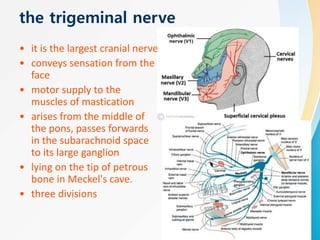
the trigeminal nerve
• it is the largest cranial nerve
• conveys sensation from the
face
• motor supply to the
muscles of mastication
• arises from the middle of
the pons, passes forwards
in the subarachnoid space
to its large ganglion
• lying on the tip of petrous
bone in Meckel's cave.
• three divisions
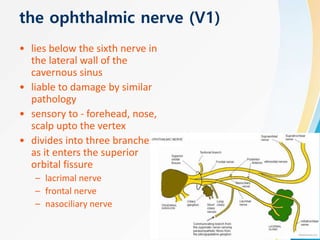
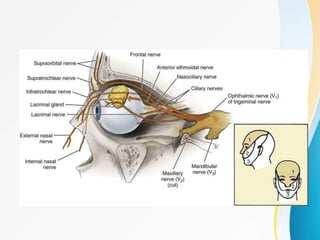
the ophthalmic nerve (V1)
• lies below the sixth nerve in
the lateral wall of the
cavernous sinus
• liable to damage by similar
pathology
• sensory to - forehead, nose,
scalp upto the vertex
• divides into three branches
as it enters the superior
orbital fissure
– lacrimal nerve
– frontal nerve
– nasociliary nerve
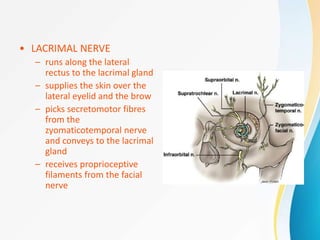
• LACRIMAL NERVE
– runs along the lateral
rectus to the lacrimal gland
– supplies the skin over the
lateral eyelid and the brow
– picks secretomotor fibres
from the
zyomaticotemporal nerve
and conveys to the lacrimal
gland
– receives proprioceptive
filaments from the facial
nerve
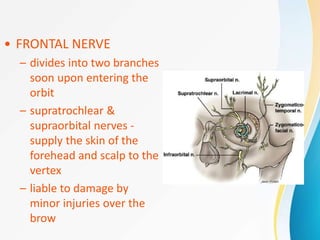
• FRONTAL NERVE
– divides into two branches
soon upon entering the
orbit
– supratrochlear &
supraorbital nerves -
supply the skin of the
forehead and scalp to the
vertex
– liable to damage by
minor injuries over the
brow
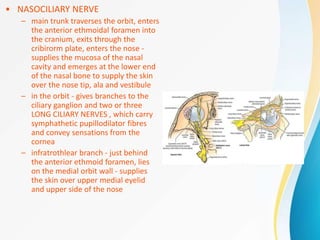
• NASOCILIARY NERVE
– main trunk traverses the orbit, enters
the anterior ethmoidal foramen into
the cranium, exits through the
cribirorm plate, enters the nose -
supplies the mucosa of the nasal
cavity and emerges at the lower end
of the nasal bone to supply the skin
over the nose tip, ala and vestibule
– in the orbit - gives branches to the
ciliary ganglion and two or three
LONG CILIARY NERVES , which carry
symphathetic pupillodilator fibres
and convey sensations from the
cornea
– infratrothlear branch - just behind
the anterior ethmoid foramen, lies
on the medial orbit wall - supplies
the skin over upper medial eyelid
and upper side of the nose
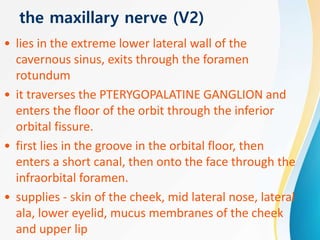
the maxillary nerve (V2)
• lies in the extreme lower lateral wall of the
cavernous sinus, exits through the foramen
rotundum
• it traverses the PTERYGOPALATINE GANGLION and
enters the floor of the orbit through the inferior
orbital fissure.
• first lies in the groove in the orbital floor, then
enters a short canal, then onto the face through the
infraorbital foramen.
• supplies - skin of the cheek, mid lateral nose, lateral
ala, lower eyelid, mucus membranes of the cheek
and upper lip
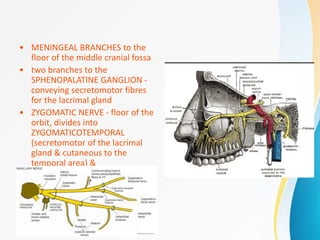
• MENINGEAL BRANCHES to the
floor of the middle cranial fossa
• two branches to the
SPHENOPALATINE GANGLION -
conveying secretomotor fibres
for the lacrimal gland
• ZYGOMATIC NERVE - floor of the
orbit, divides into
ZYGOMATICOTEMPORAL
(secretomotor of the lacrimal
gland & cutaneous to the
temporal area) &
ZYGOMATICOFACIAL (cutaneous
to the cheek, after piercing the
zygoma) nerves
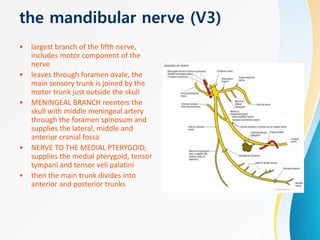
the mandibular nerve (V3)
• largest branch of the fifth nerve,
includes motor component of the
nerve
• leaves through foramen ovale, the
main sensory trunk is joined by the
motor trunk just outside the skull
• MENINGEAL BRANCH reenters the
skull with middle meningeal artery
through the foramen spinosum and
supplies the lateral, middle and
anterior cranial fossa
• NERVE TO THE MEDIAL PTERYGOID,
supplies the medial pterygoid, tensor
tympani and tensor veli palatini
• then the main trunk divides into
anterior and posterior trunks
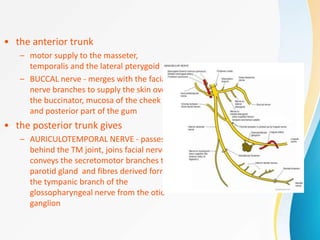
• the anterior trunk
– motor supply to the masseter,
temporalis and the lateral pterygoid
– BUCCAL nerve - merges with the facial
nerve branches to supply the skin over
the buccinator, mucosa of the cheek
and posterior part of the gum
• the posterior trunk gives
– AURICULOTEMPORAL NERVE - passes
behind the TM joint, joins facial nerve,
conveys the secretomotor branches to
parotid gland and fibres derived form
the tympanic branch of the
glossopharyngeal nerve from the otic
ganglion
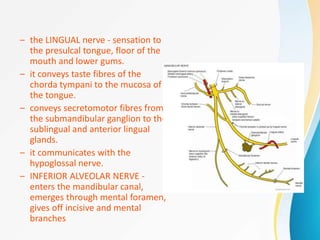
– the LINGUAL nerve - sensation to
the presulcal tongue, floor of the
mouth and lower gums.
– it conveys taste fibres of the
chorda tympani to the mucosa of
the tongue.
– conveys secretomotor fibres from
the submandibular ganglion to the
sublingual and anterior lingual
glands.
– it communicates with the
hypoglossal nerve.
– INFERIOR ALVEOLAR NERVE -
enters the mandibular canal,
emerges through mental foramen,
gives off incisive and mental
branches
• motor component leaves the inferior alveolar
nerve, just before it enters the mandible as the
mylohyoid nerve supplying the mylohyoid and
anterio belly of digastric.
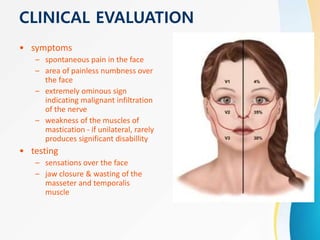
CLINICAL EVALUATION
• symptoms
– spontaneous pain in the face
– area of painless numbness over
the face
– extremely ominous sign
indicating malignant infiltration
of the nerve
– weakness of the muscles of
mastication - if unilateral, rarely
produces significant disabillity
• testing
– sensations over the face
– jaw closure & wasting of the
masseter and temporalis
muscle
• jaw opening - much weaker movement. if the
muscle on the right is weak, the jaw will be
pushed to the right side
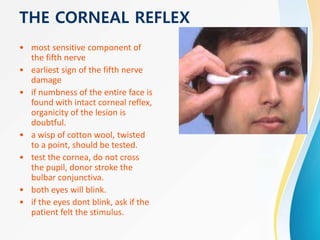
THE CORNEAL REFLEX
• most sensitive component of
the fifth nerve
• earliest sign of the fifth nerve
damage
• if numbness of the entire face is
found with intact corneal reflex,
organicity of the lesion is
doubtful.
• a wisp of cotton wool, twisted
to a point, should be tested.
• test the cornea, do not cross
the pupil, donor stroke the
bulbar conjunctiva.
• both eyes will blink.
• if the eyes dont blink, ask if the
patient felt the stimulus.
corneal response in presence of
paralysis of lid closure
• in LMN facial lesion, lid closure is affected
• tested in following ways
– patient is asked to compare sensation on both the sides
– observe whether eyeball rolls upward and away from
stimulus ( Bell's phenomena)
– the other eye shuts simultaneously
• if the reflex is impaired, suitable protection should be
arranged immediately either by
– eye patch as a short term measure
– tarsorrhaphy as a longer term measure
– deliberate paralysis of lid by botulinum in presence of
corneal ulceration
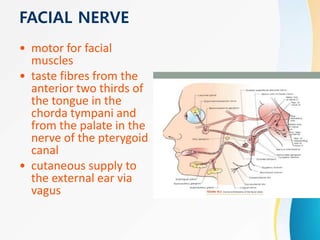
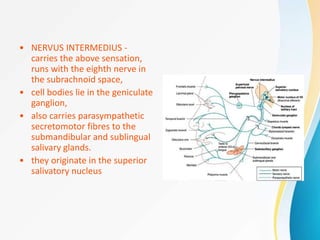
FACIAL NERVE
• motor for facial
muscles
• taste fibres from the
anterior two thirds of
the tongue in the
chorda tympani and
from the palate in the
nerve of the pterygoid
canal
• cutaneous supply to
the external ear via
vagus
• NERVUS INTERMEDIUS -
carries the above sensation,
runs with the eighth nerve in
the subrachnoid space,
• cell bodies lie in the geniculate
ganglion,
• also carries parasympathetic
secretomotor fibres to the
submandibular and sublingual
salivary glands.
• they originate in the superior
salivatory nucleus
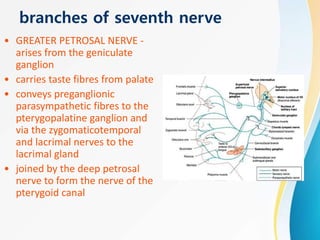
branches of seventh nerve
• GREATER PETROSAL NERVE -
arises from the geniculate
ganglion
• carries taste fibres from palate
• conveys preganglionic
parasympathetic fibres to the
pterygopalatine ganglion and
via the zygomaticotemporal
and lacrimal nerves to the
lacrimal gland
• joined by the deep petrosal
nerve to form the nerve of the
pterygoid canal
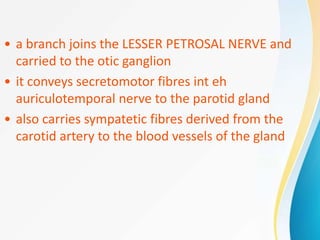
• a branch joins the LESSER PETROSAL NERVE and
carried to the otic ganglion
• it conveys secretomotor fibres int eh
auriculotemporal nerve to the parotid gland
• also carries sympatetic fibres derived from the
carotid artery to the blood vessels of the gland
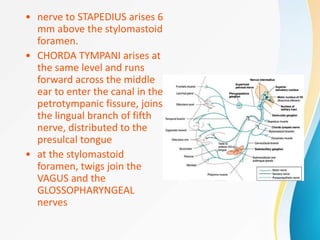
• nerve to STAPEDIUS arises 6
mm above the stylomastoid
foramen.
• CHORDA TYMPANI arises at
the same level and runs
forward across the middle
ear to enter the canal in the
petrotympanic fissure, joins
the lingual branch of fifth
nerve, distributed to the
presulcal tongue
• at the stylomastoid
foramen, twigs join the
VAGUS and the
GLOSSOPHARYNGEAL
nerves
• POSTERIOR AURICULAR NERVE supplies the muscles
of the ear and occipital belly of occipitofrontalis
• branches to the MUSCLE OF FACIAL EXPRESSION,
through the parotid and divides as temporal,
zygomatic, buccal, marginal, mandibular and
cervical branches
• cutaneous fibres distributed with the AURICULAR
BRANCH OF THE VAGUS, supplying the skin on both
sides of the auricle and part of the external auditory
canal and the tympanic membrane.
clinically important features
• almost purely motor, apart from the EAM and the
TM.
• chorda tympani, carrying the taste fibres, joins the
seventh nerve in the middle ear, theoretically,
absence of impaired taste sensation ought to be a
great localizing value, but not practically, as taste
fibres are often spared.
• it also supplies stapedius, which with tensor
tympani, damps down the oscillations of the TM,
hence with complete seventh lesion, alteration of
auditory acuity is seen
• it does not contribute to normal eye opening,
but contributes to forced eye opening.
• ptosis is not a feature of seventh palsy, but there
is weakness in eye closure
• in some individuals, posterior auricular branch
weakness, leads to inability to “wiggle the ears”.
• it supplies platysma, which is often forgotten to
be tested.
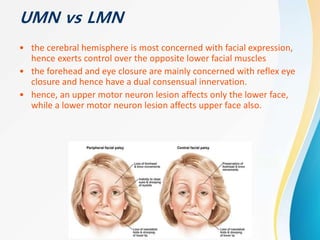
UMN vs LMN
• the cerebral hemisphere is most concerned with facial expression,
hence exerts control over the opposite lower facial muscles
• the forehead and eye closure are mainly concerned with reflex eye
closure and hence have a dual consensual innervation.
• hence, an upper motor neuron lesion affects only the lower face,
while a lower motor neuron lesion affects upper face also.
testing the facial nerve
• ability to wrinkle the head
• ability to shut the eyes - Bells phenomena
• ability to flare the nostrils, smile and show the
teeth
• evert the lowerlip
• taste sensations
– unimpaired taste sensation is not a reliable indicator
that the nerve is intact, but if the taste is affected, it
is certain that the lesion is proximal to or in the
petrous bone itself.
CP ANGLE LESIONS
• acoustic nerve tumors
• menigiomas
• cholesteatomas
• hemangioblastomas
• ectasia of the basilar artery
• metastatic deposits
• lymphoma
• pontine glioma
• medulloblastoma/astrocytoma
• carcinoma of the nasopharynx
• metastatic Hodgkin's disease
• meningeal involvement in Syphillis
• tuberculosis
The cerebello pontine angle

The cerebello pontine angle

  • 1.
    The Cerebello PontineAngle dr himanshu soni
  • 2.
    the cerebellopontine angle •it is a shallow triangle lying between the cerebellum, the lateral pone and the inner third of the petrous ridge. • the vertical extent of the angle is from – fifth nerve - above, on its course from pons to the petrous apex – ninth nerve - below, passing from the lateral medulla to the jugular foramen – the abducent nerve - runs upwards and forwards on the medial edge of the area – and the seventh & eighth nerves - traversing the angle to enter the internal auditory canal
  • 3.
    • the hallmarkof a lesion in this area – clinical evidence of damage to the seventh and eighth nerves • wide range of vestibular, auditory and motor abnormalities occur. • clinical history and examination – gives most clues to the diverse pathologies in the region • important to know the anatomy of the nerves for the presentation • should be able to test the nerves bedside
  • 4.
    the trigeminal nerve •it is the largest cranial nerve • conveys sensation from the face • motor supply to the muscles of mastication • arises from the middle of the pons, passes forwards in the subarachnoid space to its large ganglion • lying on the tip of petrous bone in Meckel's cave. • three divisions
  • 5.
    the ophthalmic nerve(V1) • lies below the sixth nerve in the lateral wall of the cavernous sinus • liable to damage by similar pathology • sensory to - forehead, nose, scalp upto the vertex • divides into three branches as it enters the superior orbital fissure – lacrimal nerve – frontal nerve – nasociliary nerve
  • 7.
    • LACRIMAL NERVE –runs along the lateral rectus to the lacrimal gland – supplies the skin over the lateral eyelid and the brow – picks secretomotor fibres from the zyomaticotemporal nerve and conveys to the lacrimal gland – receives proprioceptive filaments from the facial nerve
  • 8.
    • FRONTAL NERVE –divides into two branches soon upon entering the orbit – supratrochlear & supraorbital nerves - supply the skin of the forehead and scalp to the vertex – liable to damage by minor injuries over the brow
  • 9.
    • NASOCILIARY NERVE –main trunk traverses the orbit, enters the anterior ethmoidal foramen into the cranium, exits through the cribirorm plate, enters the nose - supplies the mucosa of the nasal cavity and emerges at the lower end of the nasal bone to supply the skin over the nose tip, ala and vestibule – in the orbit - gives branches to the ciliary ganglion and two or three LONG CILIARY NERVES , which carry symphathetic pupillodilator fibres and convey sensations from the cornea – infratrothlear branch - just behind the anterior ethmoid foramen, lies on the medial orbit wall - supplies the skin over upper medial eyelid and upper side of the nose
  • 10.
    the maxillary nerve(V2) • lies in the extreme lower lateral wall of the cavernous sinus, exits through the foramen rotundum • it traverses the PTERYGOPALATINE GANGLION and enters the floor of the orbit through the inferior orbital fissure. • first lies in the groove in the orbital floor, then enters a short canal, then onto the face through the infraorbital foramen. • supplies - skin of the cheek, mid lateral nose, lateral ala, lower eyelid, mucus membranes of the cheek and upper lip
  • 11.
    • MENINGEAL BRANCHESto the floor of the middle cranial fossa • two branches to the SPHENOPALATINE GANGLION - conveying secretomotor fibres for the lacrimal gland • ZYGOMATIC NERVE - floor of the orbit, divides into ZYGOMATICOTEMPORAL (secretomotor of the lacrimal gland & cutaneous to the temporal area) & ZYGOMATICOFACIAL (cutaneous to the cheek, after piercing the zygoma) nerves
  • 12.
    the mandibular nerve(V3) • largest branch of the fifth nerve, includes motor component of the nerve • leaves through foramen ovale, the main sensory trunk is joined by the motor trunk just outside the skull • MENINGEAL BRANCH reenters the skull with middle meningeal artery through the foramen spinosum and supplies the lateral, middle and anterior cranial fossa • NERVE TO THE MEDIAL PTERYGOID, supplies the medial pterygoid, tensor tympani and tensor veli palatini • then the main trunk divides into anterior and posterior trunks
  • 13.
    • the anteriortrunk – motor supply to the masseter, temporalis and the lateral pterygoid – BUCCAL nerve - merges with the facial nerve branches to supply the skin over the buccinator, mucosa of the cheek and posterior part of the gum • the posterior trunk gives – AURICULOTEMPORAL NERVE - passes behind the TM joint, joins facial nerve, conveys the secretomotor branches to parotid gland and fibres derived form the tympanic branch of the glossopharyngeal nerve from the otic ganglion
  • 14.
    – the LINGUALnerve - sensation to the presulcal tongue, floor of the mouth and lower gums. – it conveys taste fibres of the chorda tympani to the mucosa of the tongue. – conveys secretomotor fibres from the submandibular ganglion to the sublingual and anterior lingual glands. – it communicates with the hypoglossal nerve. – INFERIOR ALVEOLAR NERVE - enters the mandibular canal, emerges through mental foramen, gives off incisive and mental branches
  • 15.
    • motor componentleaves the inferior alveolar nerve, just before it enters the mandible as the mylohyoid nerve supplying the mylohyoid and anterio belly of digastric.
  • 16.
    CLINICAL EVALUATION • symptoms –spontaneous pain in the face – area of painless numbness over the face – extremely ominous sign indicating malignant infiltration of the nerve – weakness of the muscles of mastication - if unilateral, rarely produces significant disabillity • testing – sensations over the face – jaw closure & wasting of the masseter and temporalis muscle
  • 17.
    • jaw opening- much weaker movement. if the muscle on the right is weak, the jaw will be pushed to the right side
  • 18.
    THE CORNEAL REFLEX •most sensitive component of the fifth nerve • earliest sign of the fifth nerve damage • if numbness of the entire face is found with intact corneal reflex, organicity of the lesion is doubtful. • a wisp of cotton wool, twisted to a point, should be tested. • test the cornea, do not cross the pupil, donor stroke the bulbar conjunctiva. • both eyes will blink. • if the eyes dont blink, ask if the patient felt the stimulus.
  • 19.
    corneal response inpresence of paralysis of lid closure • in LMN facial lesion, lid closure is affected • tested in following ways – patient is asked to compare sensation on both the sides – observe whether eyeball rolls upward and away from stimulus ( Bell's phenomena) – the other eye shuts simultaneously • if the reflex is impaired, suitable protection should be arranged immediately either by – eye patch as a short term measure – tarsorrhaphy as a longer term measure – deliberate paralysis of lid by botulinum in presence of corneal ulceration
  • 20.
    FACIAL NERVE • motorfor facial muscles • taste fibres from the anterior two thirds of the tongue in the chorda tympani and from the palate in the nerve of the pterygoid canal • cutaneous supply to the external ear via vagus
  • 21.
    • NERVUS INTERMEDIUS- carries the above sensation, runs with the eighth nerve in the subrachnoid space, • cell bodies lie in the geniculate ganglion, • also carries parasympathetic secretomotor fibres to the submandibular and sublingual salivary glands. • they originate in the superior salivatory nucleus
  • 22.
    branches of seventhnerve • GREATER PETROSAL NERVE - arises from the geniculate ganglion • carries taste fibres from palate • conveys preganglionic parasympathetic fibres to the pterygopalatine ganglion and via the zygomaticotemporal and lacrimal nerves to the lacrimal gland • joined by the deep petrosal nerve to form the nerve of the pterygoid canal
  • 23.
    • a branchjoins the LESSER PETROSAL NERVE and carried to the otic ganglion • it conveys secretomotor fibres int eh auriculotemporal nerve to the parotid gland • also carries sympatetic fibres derived from the carotid artery to the blood vessels of the gland
  • 24.
    • nerve toSTAPEDIUS arises 6 mm above the stylomastoid foramen. • CHORDA TYMPANI arises at the same level and runs forward across the middle ear to enter the canal in the petrotympanic fissure, joins the lingual branch of fifth nerve, distributed to the presulcal tongue • at the stylomastoid foramen, twigs join the VAGUS and the GLOSSOPHARYNGEAL nerves
  • 25.
    • POSTERIOR AURICULARNERVE supplies the muscles of the ear and occipital belly of occipitofrontalis • branches to the MUSCLE OF FACIAL EXPRESSION, through the parotid and divides as temporal, zygomatic, buccal, marginal, mandibular and cervical branches • cutaneous fibres distributed with the AURICULAR BRANCH OF THE VAGUS, supplying the skin on both sides of the auricle and part of the external auditory canal and the tympanic membrane.
  • 26.
    clinically important features •almost purely motor, apart from the EAM and the TM. • chorda tympani, carrying the taste fibres, joins the seventh nerve in the middle ear, theoretically, absence of impaired taste sensation ought to be a great localizing value, but not practically, as taste fibres are often spared. • it also supplies stapedius, which with tensor tympani, damps down the oscillations of the TM, hence with complete seventh lesion, alteration of auditory acuity is seen
  • 27.
    • it doesnot contribute to normal eye opening, but contributes to forced eye opening. • ptosis is not a feature of seventh palsy, but there is weakness in eye closure • in some individuals, posterior auricular branch weakness, leads to inability to “wiggle the ears”. • it supplies platysma, which is often forgotten to be tested.
  • 28.
    UMN vs LMN •the cerebral hemisphere is most concerned with facial expression, hence exerts control over the opposite lower facial muscles • the forehead and eye closure are mainly concerned with reflex eye closure and hence have a dual consensual innervation. • hence, an upper motor neuron lesion affects only the lower face, while a lower motor neuron lesion affects upper face also.
  • 29.
    testing the facialnerve • ability to wrinkle the head • ability to shut the eyes - Bells phenomena • ability to flare the nostrils, smile and show the teeth • evert the lowerlip • taste sensations – unimpaired taste sensation is not a reliable indicator that the nerve is intact, but if the taste is affected, it is certain that the lesion is proximal to or in the petrous bone itself.
  • 30.
    CP ANGLE LESIONS •acoustic nerve tumors • menigiomas • cholesteatomas • hemangioblastomas • ectasia of the basilar artery • metastatic deposits • lymphoma • pontine glioma • medulloblastoma/astrocytoma • carcinoma of the nasopharynx • metastatic Hodgkin's disease • meningeal involvement in Syphillis • tuberculosis

Editor's Notes

  • #17 http://www.southwestpainmanagement.com/images/ofp-neuralgia-distribution.jpg