The Brain Stem
Brain Stem
Dr Toqeer Ahmed
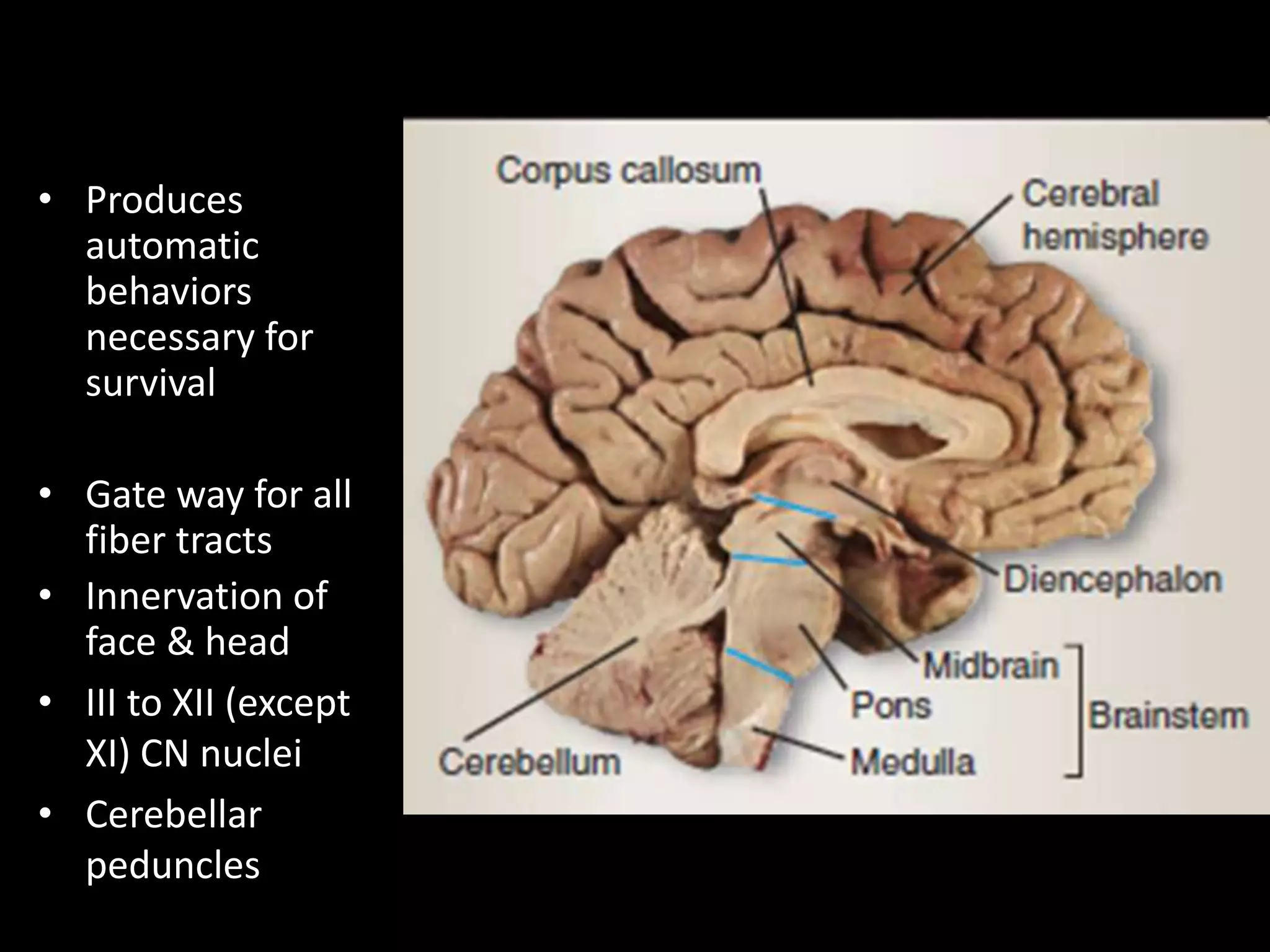
Brainstem: 3 major divisions
•In post cr
fossa, b/w
cerebrum
& SC
•Midbrain
•Pons
•Medulla
• Produces
automatic
behaviors
necessary for
survival
• Gate way for all
fiber tracts
• Innervation of
face & head
• III to XII (except
XI) CN nuclei
• Cerebellar
peduncles
GENERAL OVERVIEW
Tectum
• Most posterior
• Roof over ventricular system
• Colliculi & medullary vela
Tegmentum
• Largest, most central portion
• Contains reticular formation, CN
nuclei, ascending tracts
Basal portion
Descending Tracts
MIDBRAIN
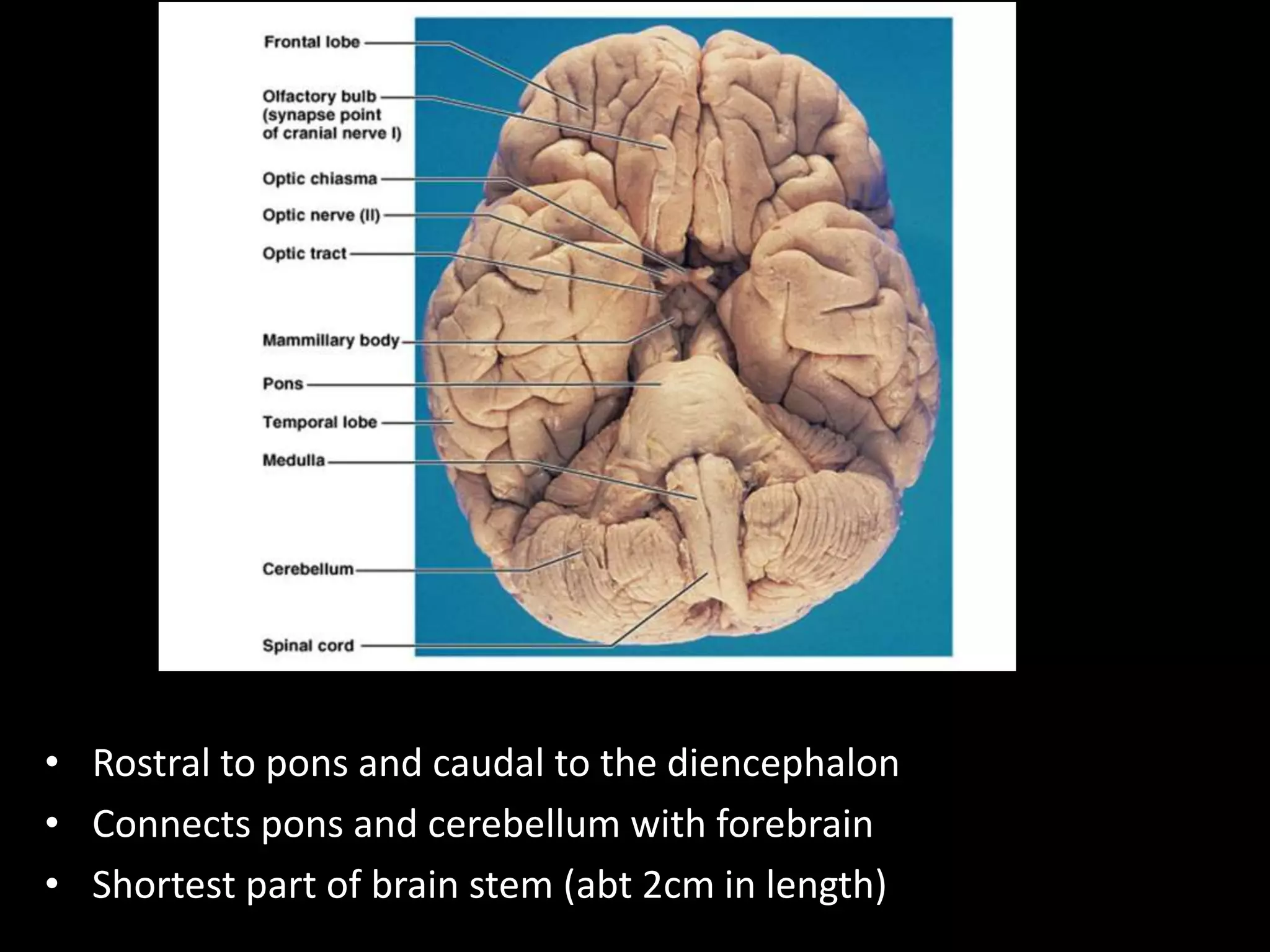
• Rostral to pons and caudal to the diencephalon
• Connects pons and cerebellum with forebrain
• Shortest part of brain stem (abt 2cm in length)
Posterior view
Corpora quadrigemina
•Rounded eminences
•Colliculi
•Tuber cinerium
Trochlear nerves wind
around the lateral
aspect of the midbrain
to enter cavernous
sinus.
The colliculi
Large nuclei of gray matter, lying beneath the
corresponding surface elevation.
Superior colliculi
• Larger and darker
• Connected to Lateral Geniculate
Body (LGB)
• Control reflex movements of the
eyes, head and neck in response to
visual stimuli
Inferior colliculi
• Connected to Medial Geniculate
Body (MGB)
• Control reflex movements of the
head, neck, and trunk in response to
auditory stimuli
Cruciform
sulcus
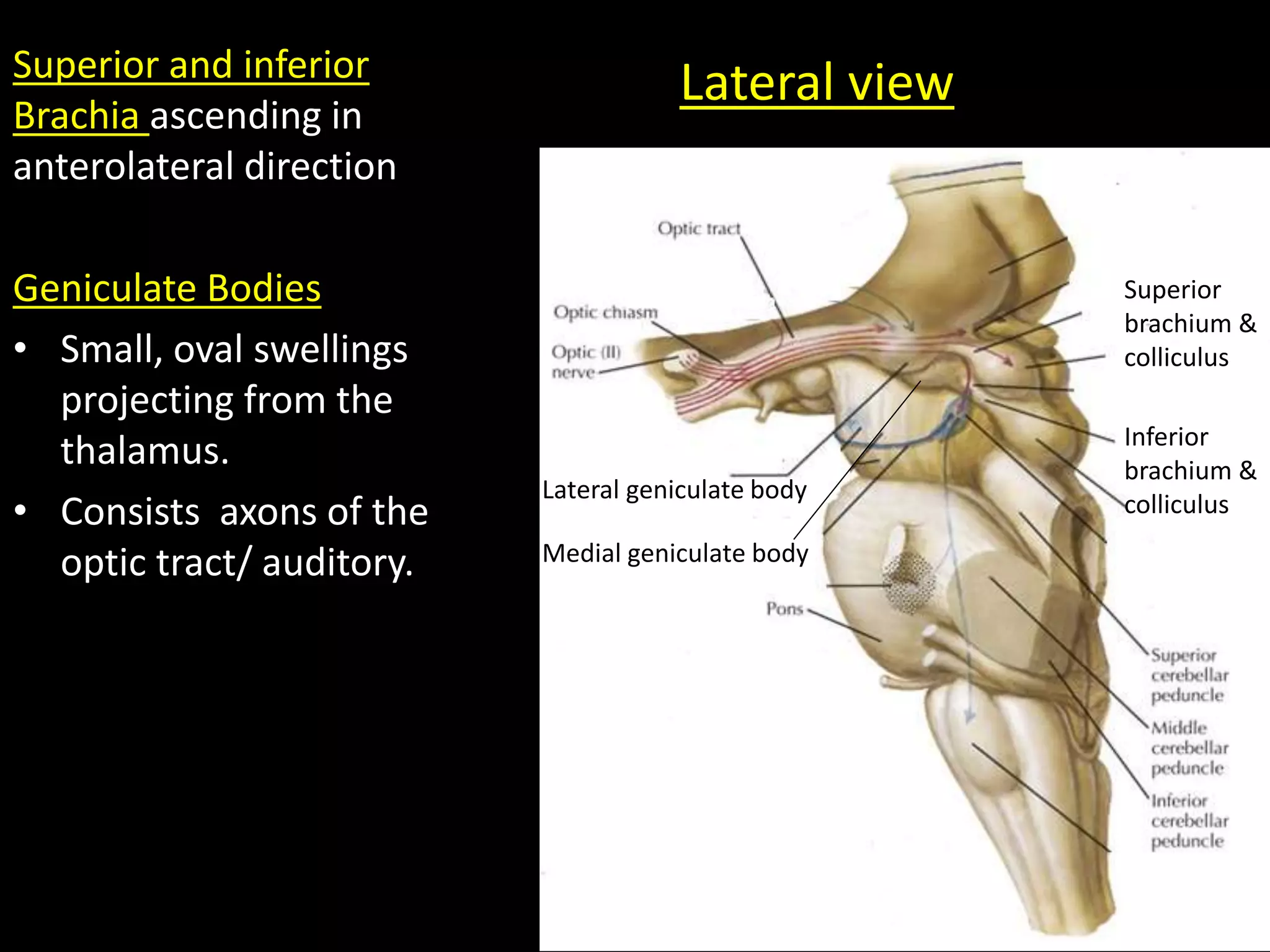
Lateral viewSuperior and inferior
Brachia ascending in
anterolateral direction
Geniculate Bodies
• Small, oval swellings
projecting from the
thalamus.
• Consists axons of the
optic tract/ auditory.
Lateral geniculate body
Medial geniculate body
Inferior
brachium &
colliculus
Superior
brachium &
colliculus
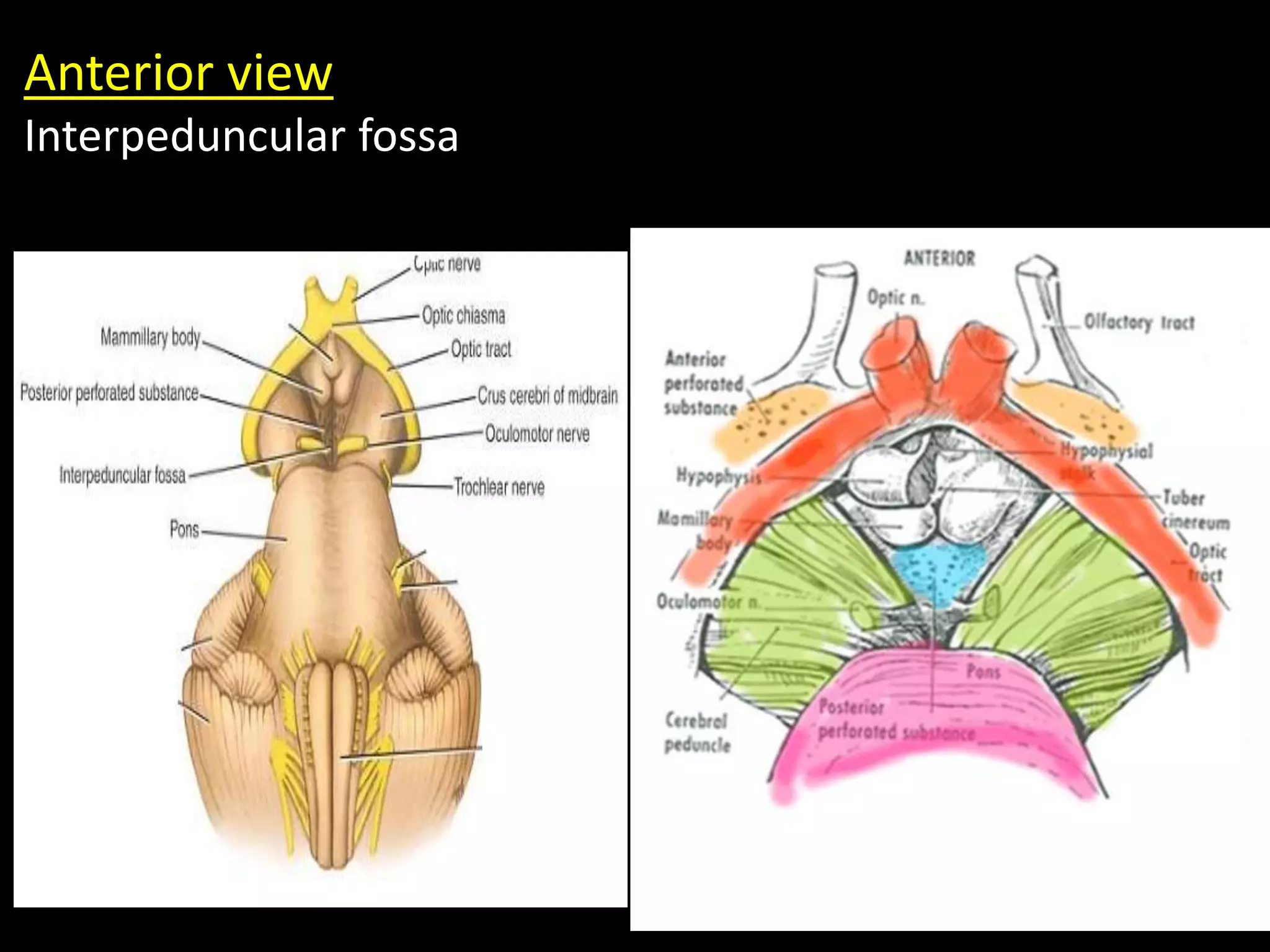
Anterior view
Interpeduncular fossa
• Midbrain 3D models - Sketchfab.html
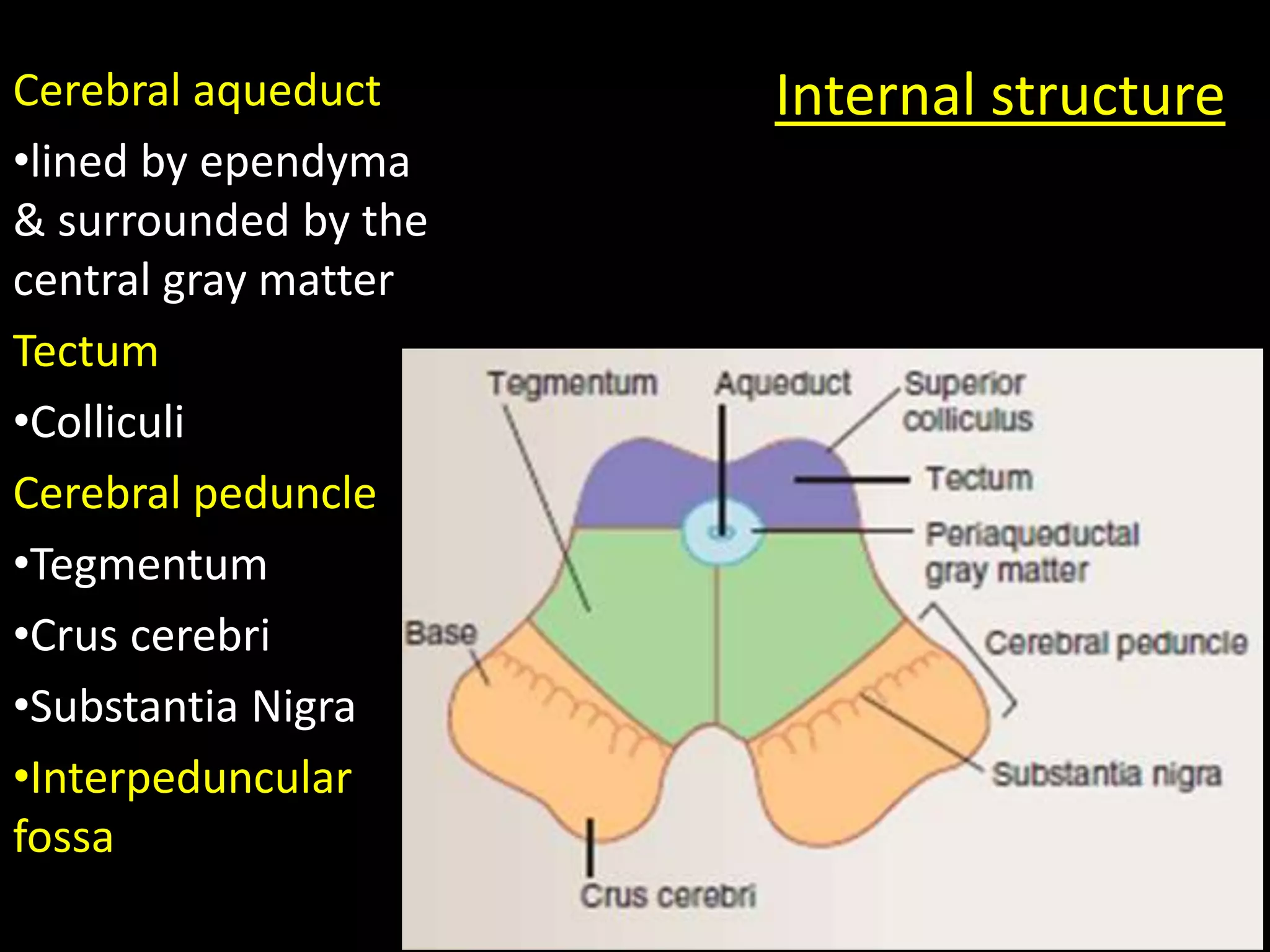
Internal structureCerebral aqueduct
•lined by ependyma
& surrounded by the
central gray matter
Tectum
•Colliculi
Cerebral peduncle
•Tegmentum
•Crus cerebri
•Substantia Nigra
•Interpeduncular
fossa
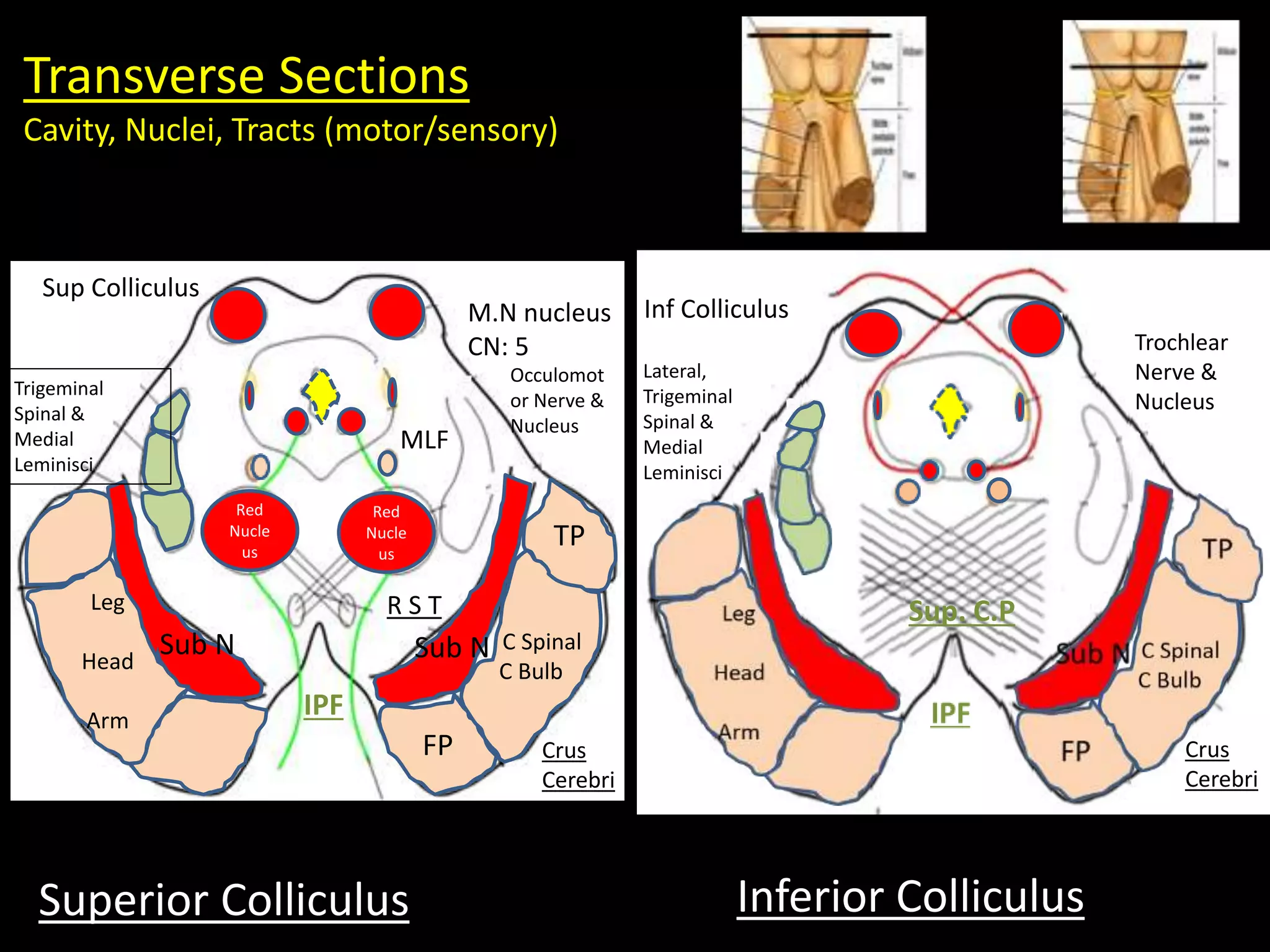
Transverse Sections
Cavity, Nuclei, Tracts (motor/sensory)
Superior Colliculus Inferior Colliculus
Sup Colliculus
M.N nucleus
CN: 5
Occulomot
or Nerve &
Nucleus
Red
Nucle
us
Red
Nucle
us
Sub NSub N
Crus
Cerebri
Crus
Cerebri
TP
FP
C Spinal
C Bulb
Leg
Head
Arm
MLF
R S T
Trigeminal
Spinal &
Medial
Leminisci
Inf Colliculus
Trochlear
Nerve &
Nucleus
Lateral,
Trigeminal
Spinal &
Medial
Leminisci
Sup. C.P
IPF
The Red Nucleus
Reddish, Rounded mass
of gray matter in
tegmentum
– Vascularity
– An iron-containing
pigment in cytoplasm
of many neurons.
Afferent fibers
Cerebral cortex, Cerebellum,
thalamus, SN & spinal cord.
Efferent fibers
Spinal cord, Reticular formation
& thalamus
Clinical Significance
Anatomical considerations
• Narrow stalk.
• Ascends out of the posterior cranial fossa through
the relatively small rigid opening in the tentorium
cerebelli.
• Two important cranial nerve nuclei.
• Reflex centers (the colliculi)
• the red nucleus and substantia nigra, [influencing
motor function]
• Ascending and descending tracts
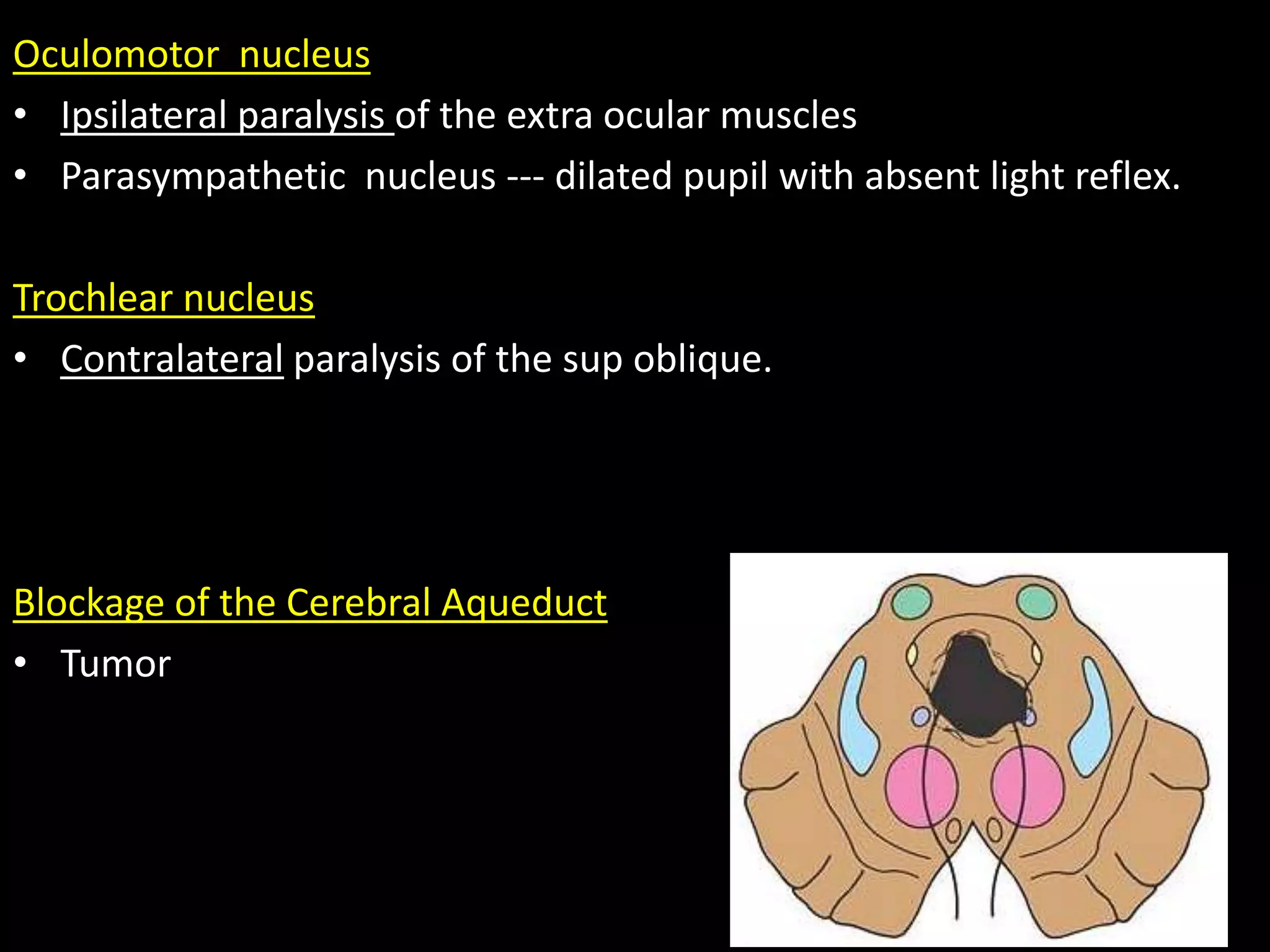
Oculomotor nucleus
• Ipsilateral paralysis of the extra ocular muscles
• Parasympathetic nucleus --- dilated pupil with absent light reflex.
Trochlear nucleus
• Contralateral paralysis of the sup oblique.
Blockage of the Cerebral Aqueduct
• Tumor
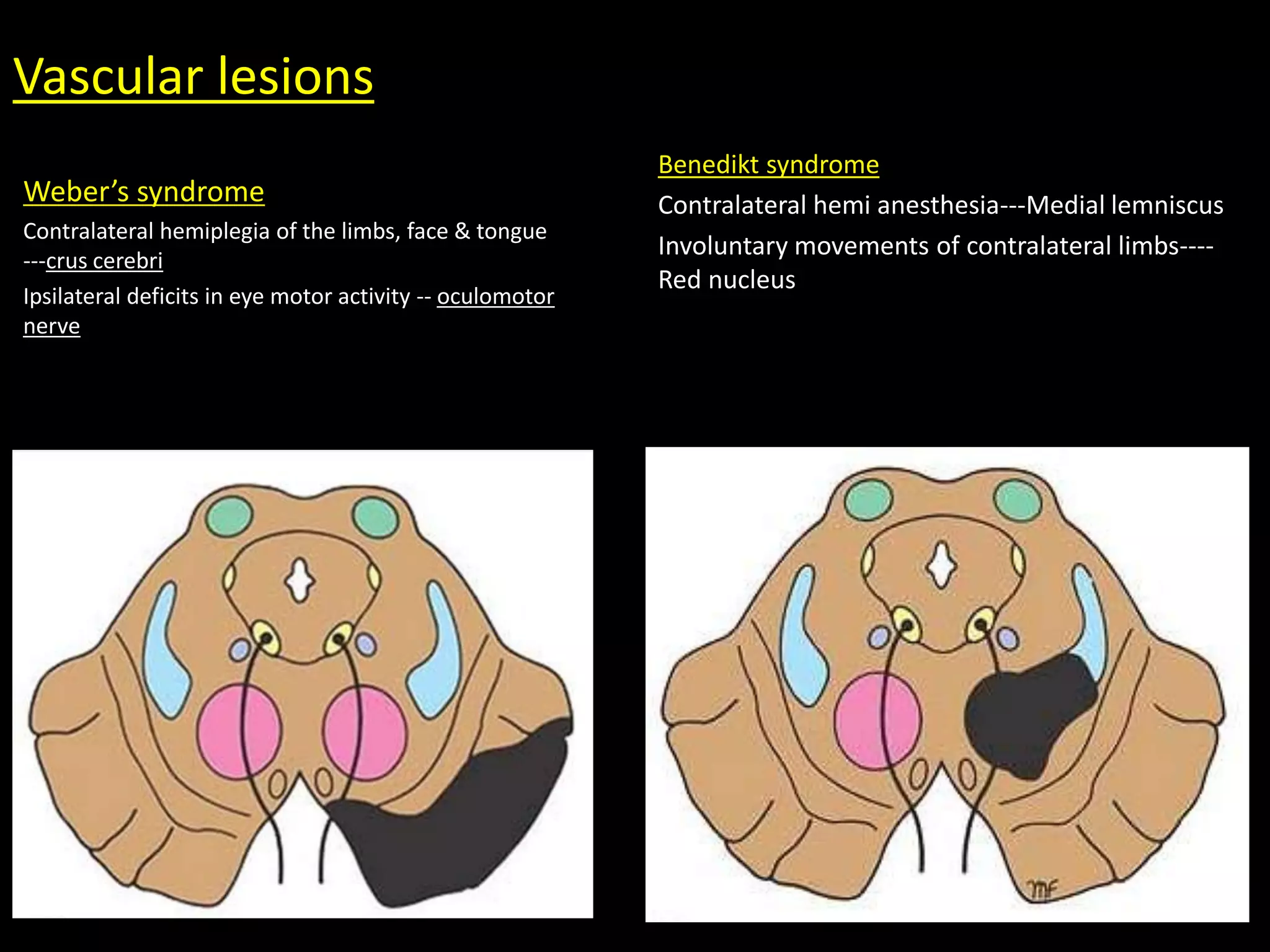
Vascular lesions
Weber’s syndrome
Contralateral hemiplegia of the limbs, face & tongue
---crus cerebri
Ipsilateral deficits in eye motor activity -- oculomotor
nerve
Benedikt syndrome
Contralateral hemi anesthesia---Medial lemniscus
Involuntary movements of contralateral limbs----
Red nucleus
THE PONS
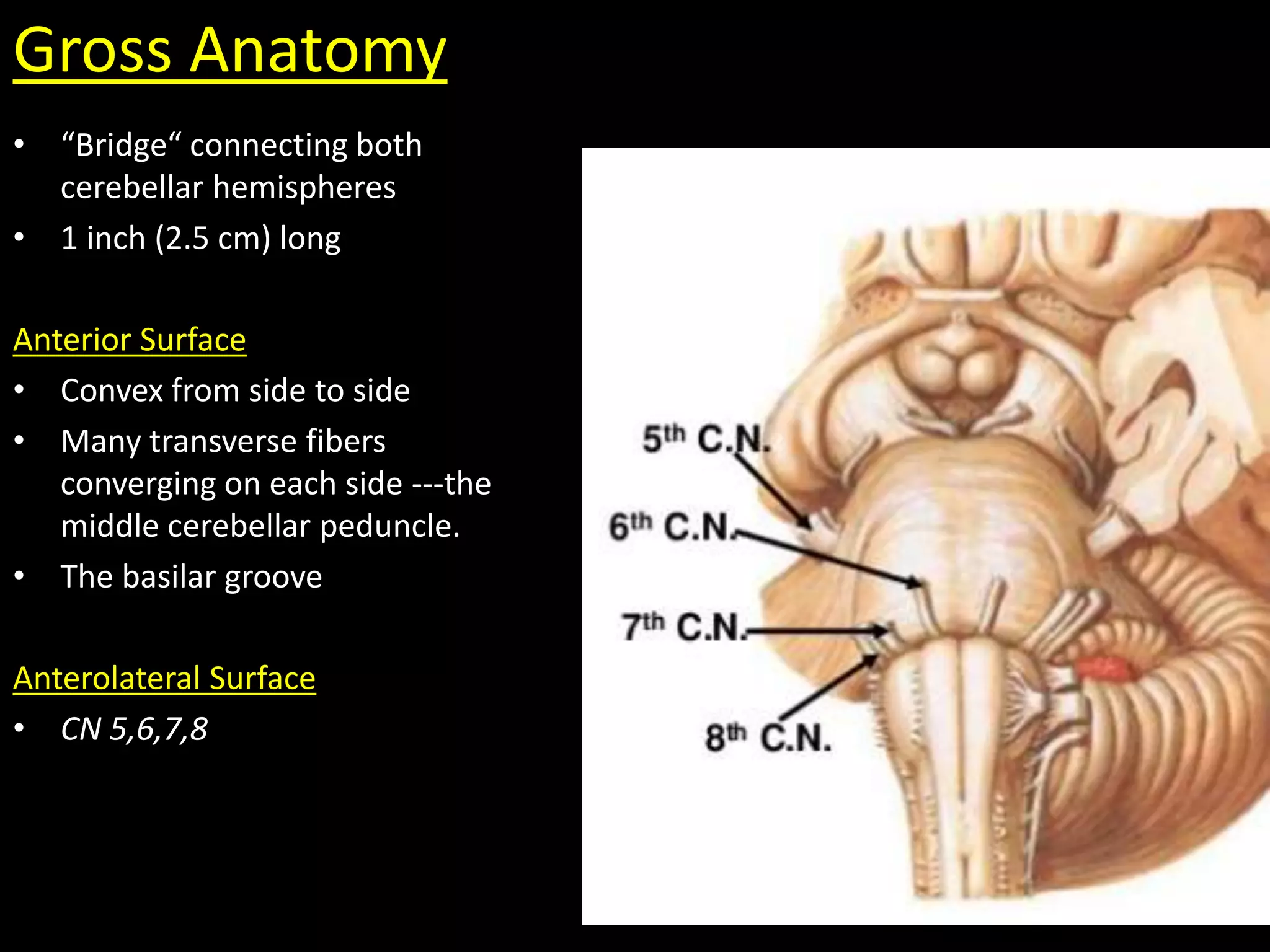
Gross Anatomy
• “Bridge“ connecting both
cerebellar hemispheres
• 1 inch (2.5 cm) long
Anterior Surface
• Convex from side to side
• Many transverse fibers
converging on each side ---the
middle cerebellar peduncle.
• The basilar groove
Anterolateral Surface
• CN 5,6,7,8
Posterior surface
• Hidden, triangular
• Forms Upper half of the
floor of the 4th ventricle
• Limited laterally by the
superior cerebellar
peduncles
• Median sulcus.
• Medial eminence (Lateral
elongated elevation,
bounded laterally by the
sulcus limitans
• Facial colliculus
– Expanded inferior end
of the medial eminence
(root of CN: 7
• Substantia ferruginea
– Bluish grey floor of the
superior part of the
sulcus limitans
• Area vestibuli
– Lateral to the sulcus
limitans
– underlying vestibular
nuclei
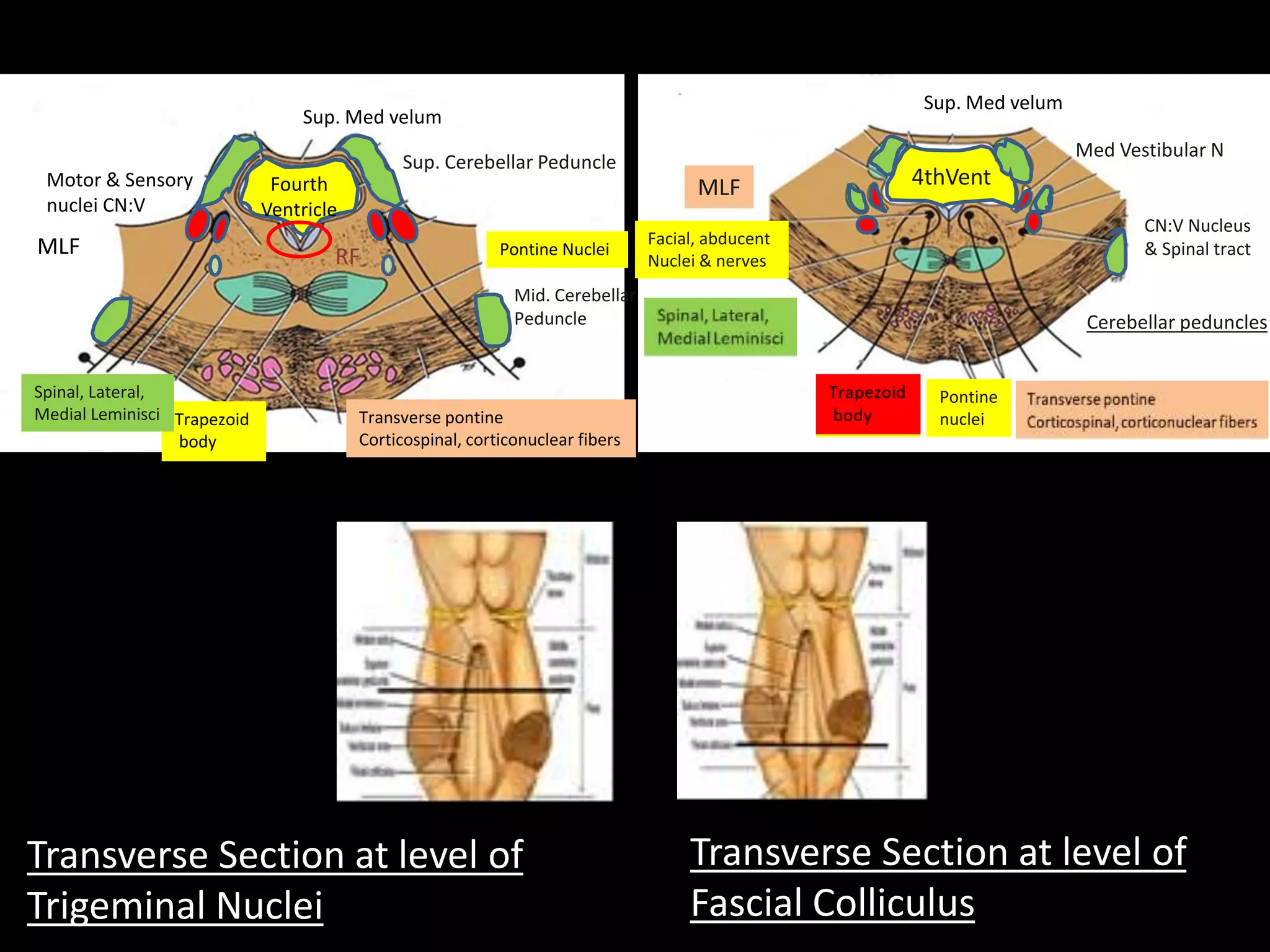
Transverse Section at level of
Fascial Colliculus
Transverse Section at level of
Trigeminal Nuclei
Fourth
Ventricle
Sup. Med velum
Motor & Sensory
nuclei CN:V
Pontine Nuclei
Trapezoid
body
Transverse pontine
Corticospinal, corticonuclear fibers
MLF RF
Spinal, Lateral,
Medial Leminisci
Sup. Cerebellar Peduncle
Mid. Cerebellar
Peduncle
Sup. Med velum
4thVent
Pontine
nuclei
Facial, abducent
Nuclei & nerves
Med Vestibular N
CN:V Nucleus
& Spinal tract
MLF
Cerebellar peduncles
Clinical significance
• Sensory and motor nuclei of 5th, 6th, 7th & 8th cranial
nerve.
• Respiratory nuclei:
– Apneustic & pneumotaxic centers work w/ the medulla to
maintain respiratory rhythm
• Cerebellar peduncles to/from the cerebellum
• Ascending, descending, and transverse tracts that
interconnect other portions of the CNS
Medial pontine syndrome (Paramedian pontine)
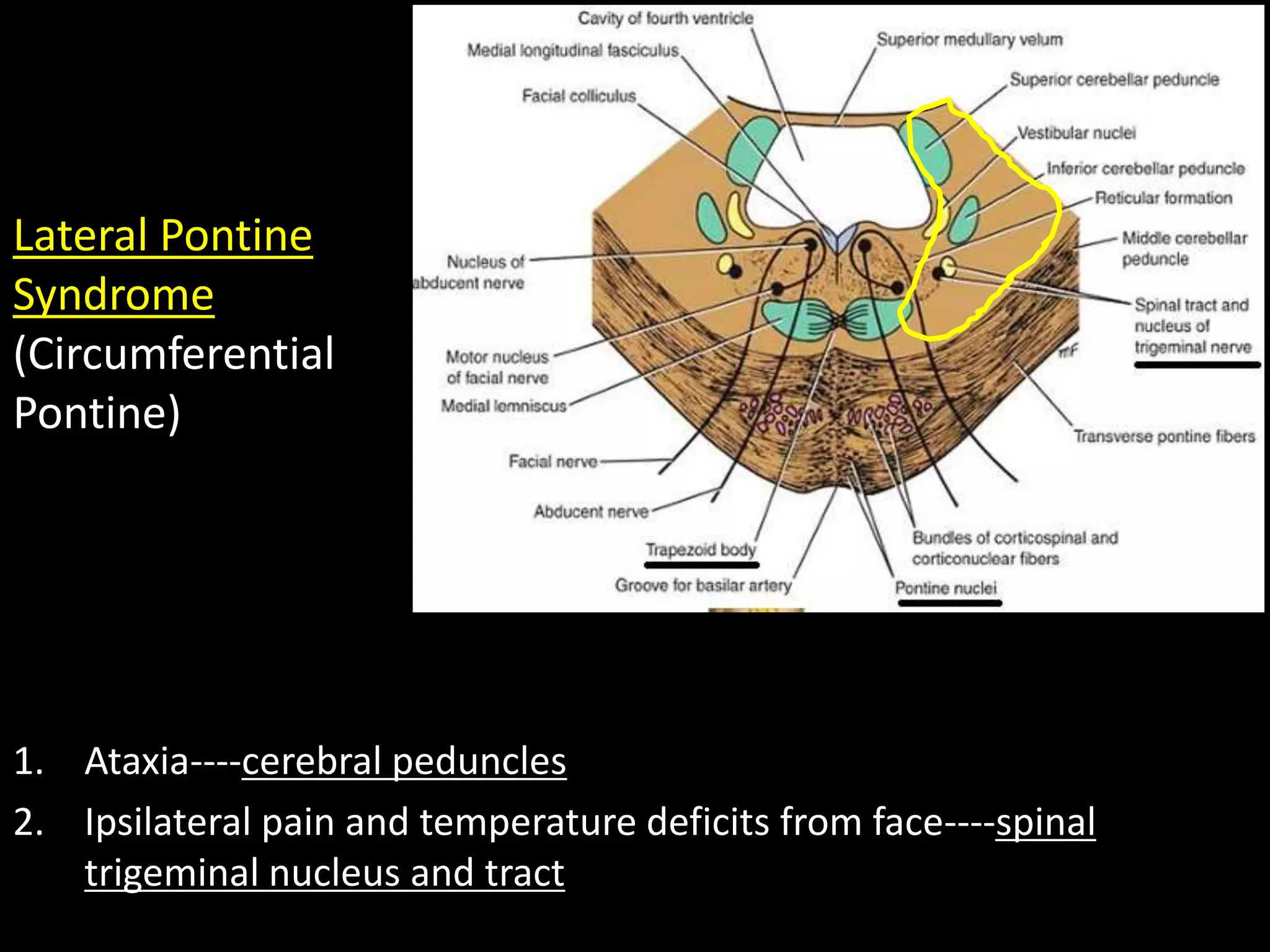
Lateral Pontine
Syndrome
(Circumferential
Pontine)
1. Ataxia----cerebral peduncles
2. Ipsilateral pain and temperature deficits from face----spinal
trigeminal nucleus and tract
Medulla Oblongata
Gross Appearance
Spino-medullary junction
• Foramen magnum (at the origin
of roots of the 1st cervical spinal
nerve)
• Lower part closed around central
canal
• Upper open part related to lower part
of 4th ventricle
• Connects the pons
superiorly with the spinal
cord inferiorly.
• Conical shape, its broad
extremity directed
superiorly
• 3cm X 2cm at its widest part
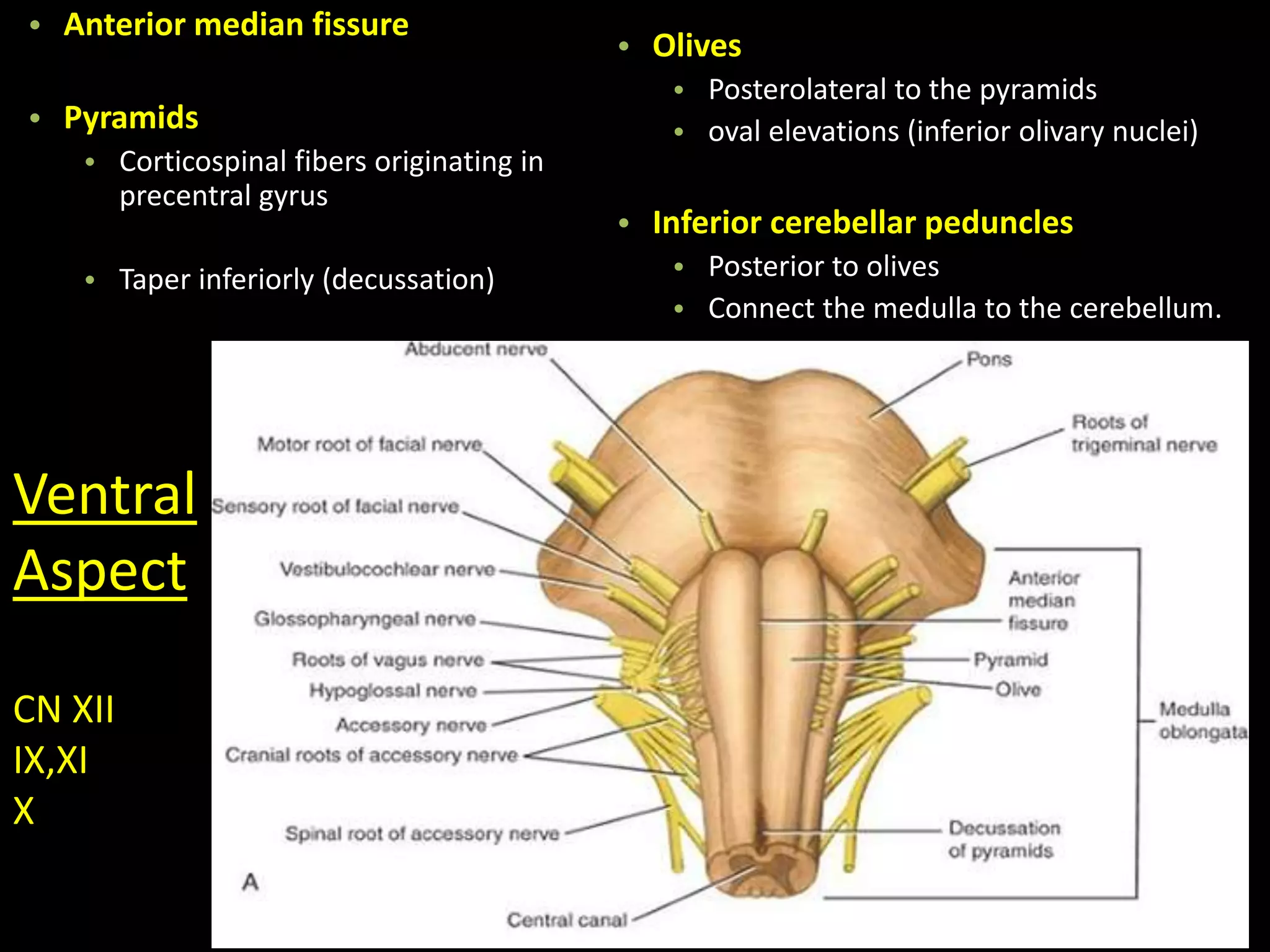
Ventral
Aspect
CN XII
IX,XI
X
• Olives
• Posterolateral to the pyramids
• oval elevations (inferior olivary nuclei)
• Inferior cerebellar peduncles
• Posterior to olives
• Connect the medulla to the cerebellum.
• Anterior median fissure
• Pyramids
• Corticospinal fibers originating in
precentral gyrus
• Taper inferiorly (decussation)
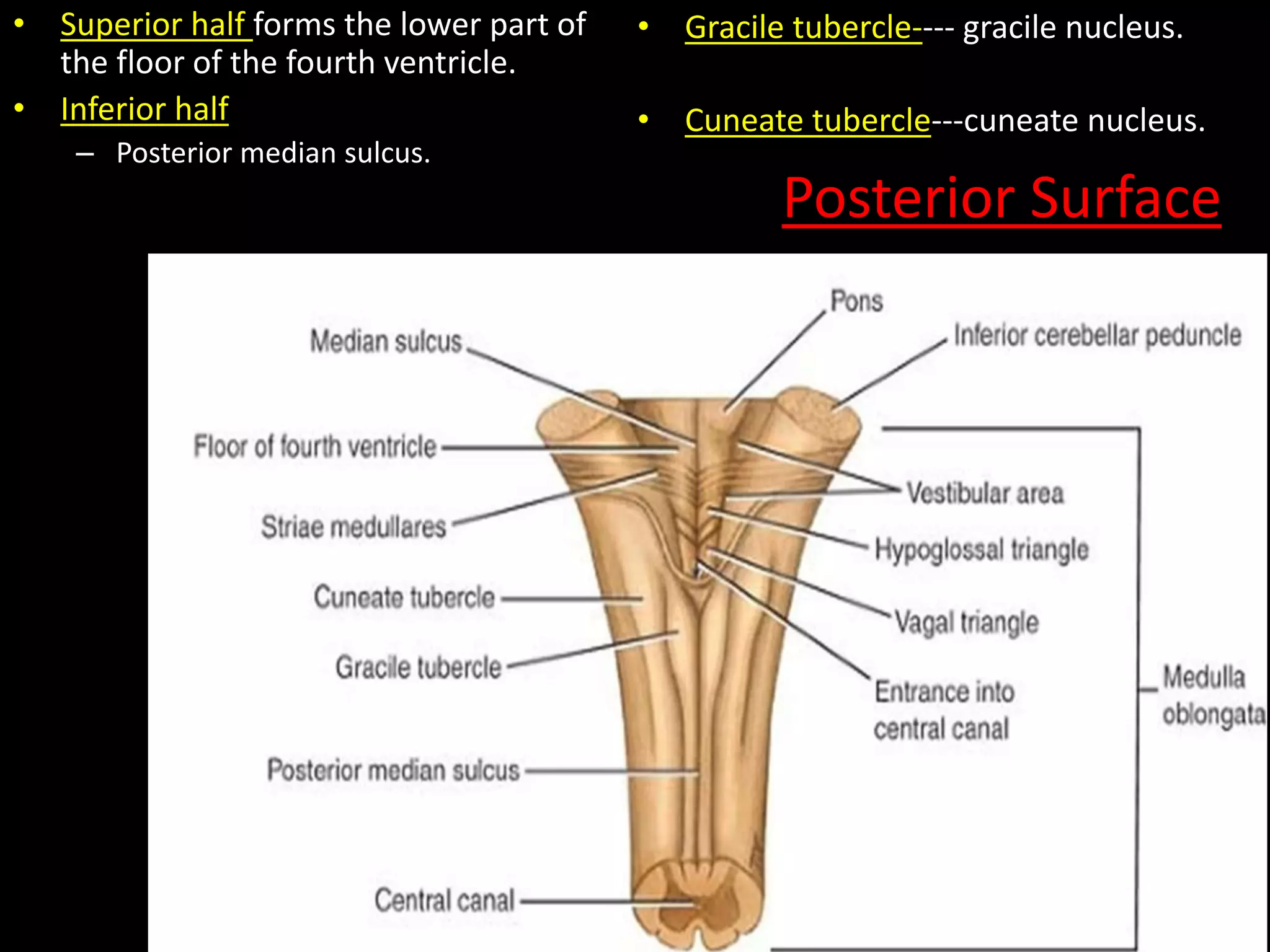
Posterior Surface
• Superior half forms the lower part of
the floor of the fourth ventricle.
• Inferior half
– Posterior median sulcus.
• Gracile tubercle---- gracile nucleus.
• Cuneate tubercle---cuneate nucleus.
Internal Structure
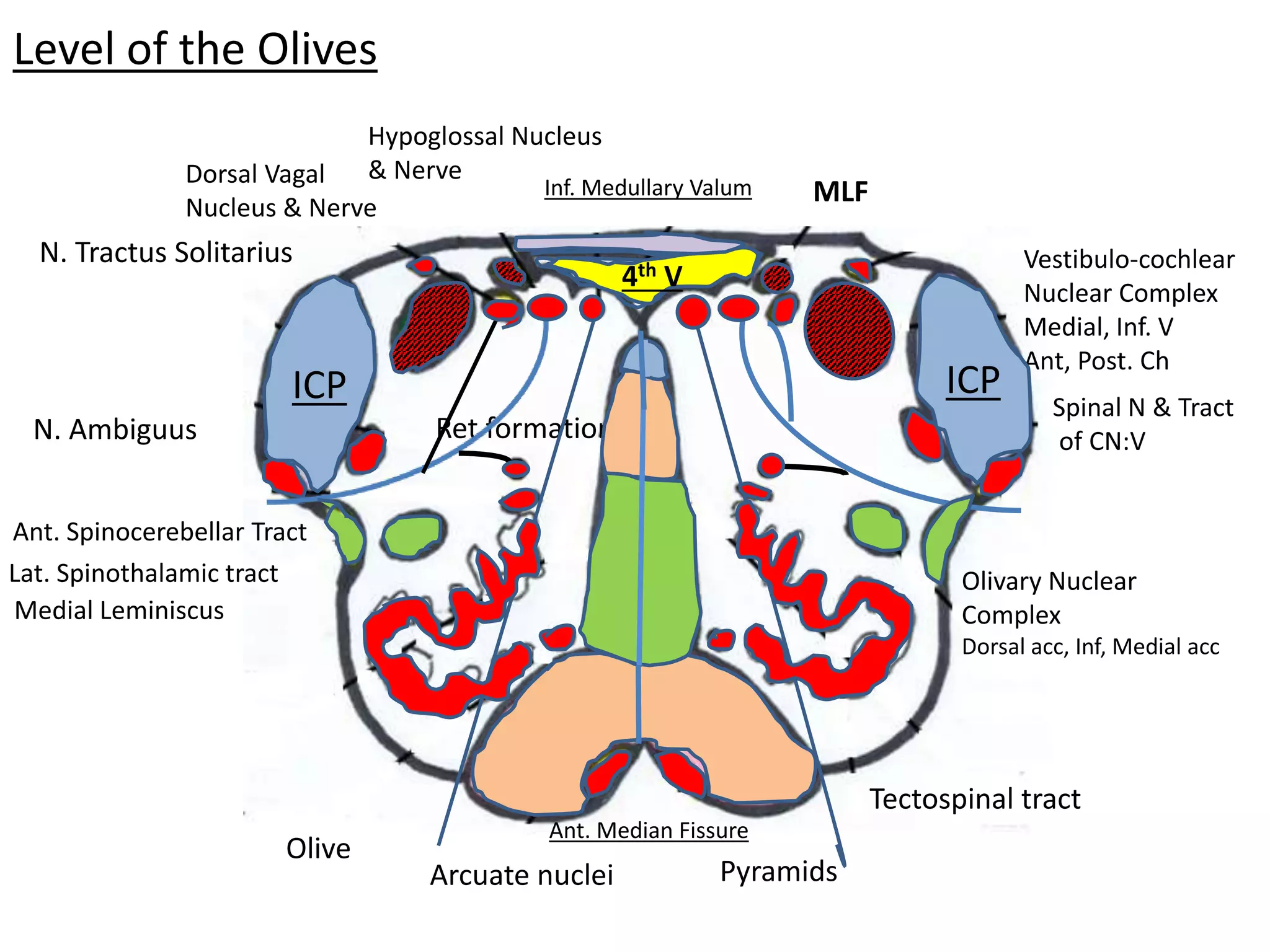
1. Level of the olives
– across the inferior part of
the fourth ventricle
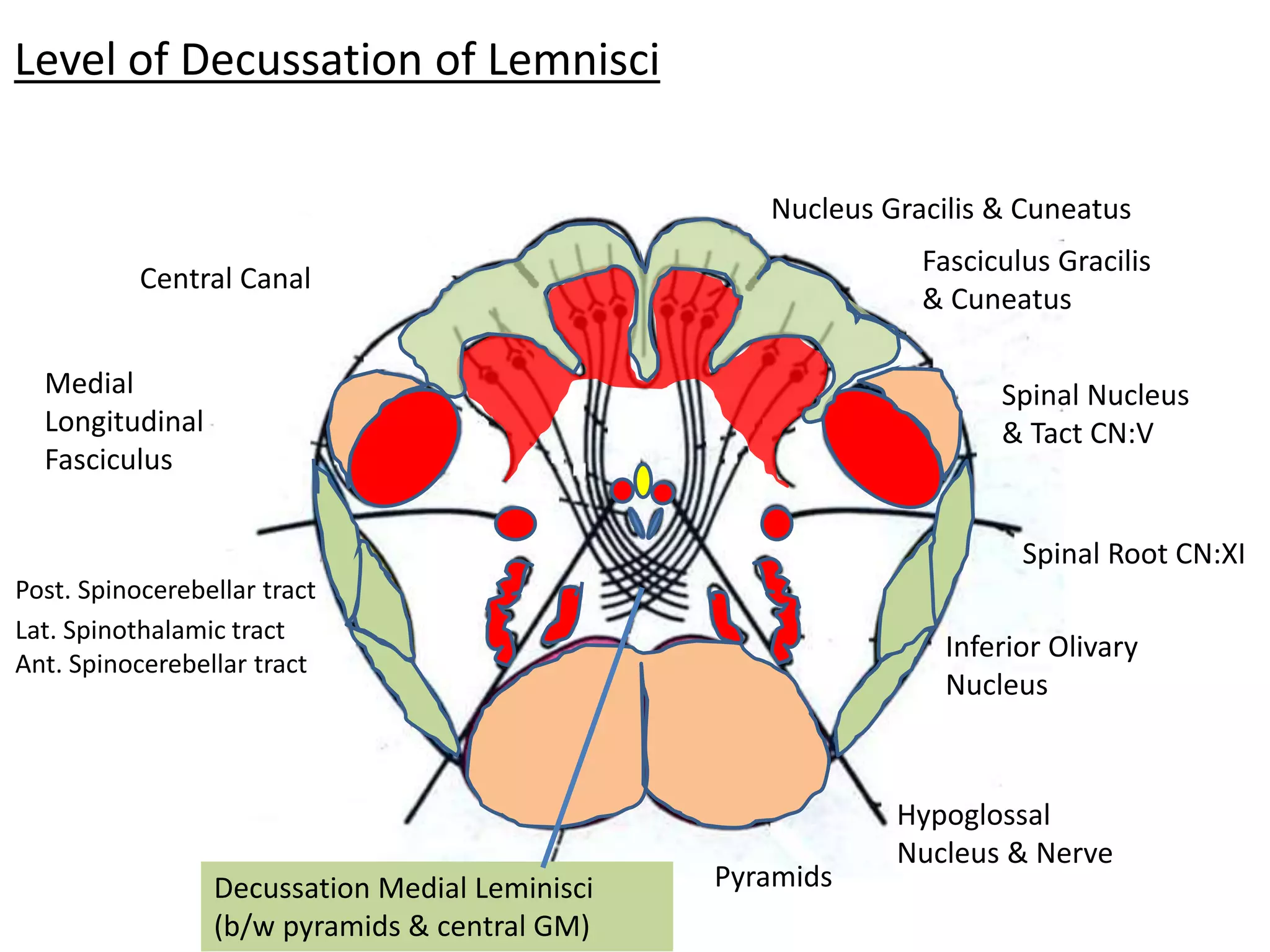
2. Level of decussation of
lemnisci
– The great sensory
decussation.
3. Level of decussation of
pyramids
– The Great motor
decussation
Level of the Olives
Inf. Medullary Valum
Vestibulo-cochlear
Nuclear Complex
Medial, Inf. V
Ant, Post. Ch
Olivary Nuclear
Complex
Dorsal acc, Inf, Medial acc
Hypoglossal Nucleus
& Nerve
PyramidsArcuate nuclei
Ant. Median Fissure
Olive
Medial Leminiscus
Tectospinal tract
Lat. Spinothalamic tract
Ant. Spinocerebellar Tract
N. Ambiguus
Spinal N & Tract
of CN:VRet formation
N. Tractus Solitarius
Dorsal Vagal
Nucleus & Nerve
MLF
4th V
ICP ICP
Nucleus
Ambiguus
Large motor neurons,
situated deep within
the reticular
formation.
The emerging nerve
fibers join the CN IX, X
and cranial part of CN
XI and are distributed
to voluntary skeletal
muscle.
Level of Decussation of Lemnisci
Nucleus Gracilis & Cuneatus
Fasciculus Gracilis
& Cuneatus
Spinal Nucleus
& Tact CN:V
Spinal Root CN:XI
Inferior Olivary
Nucleus
Hypoglossal
Nucleus & Nerve
PyramidsDecussation Medial Leminisci
(b/w pyramids & central GM)
Post. Spinocerebellar tract
Lat. Spinothalamic tract
Ant. Spinocerebellar tract
Medial
Longitudinal
Fasciculus
Central Canal
Level of Decussation of Pyramids
Nucleus Gracilis &
Cuneatus
Fasciculus Gracilis &
Cuneatus
Spinal Nucleus &
Tact CN:V
Spinal Root CN:XI
MLF
Acc. Olivary Nucleus
Pyramid
Central Canal
Post. Spinocerebellar Tract
Lat. Spinothalamic Tract
Ant. Spinocerebellar Tract
Lat. Corticospinal tract
with Decussation of
Pyramids
Clinical significance
• Nuclei of CN: 9, 10, 11 , 12
• Ascending & Descending tracts
• Respiratory centers
• Herniation
– d.t increased I/C pressure
– Headache, neck stiffness, paralysis
of last four CN
– Arnold-Chiari malformation
(congenital)
Medial
Medullary
Syndrome
(Anterior Spinal
Artery)
inferior alternating hemiplegia
1. Contralateral hemiplegia ---- pyramids or the corticospinal fibers
2. Contralateral loss of position sense, vibratory sense and discriminative touch----
medial leminiscus
3. Ipsilateral deviation and paralysis of the tongue---- hypoglossal nucleus or nerve
Lateral Medullary/ Wallenberg’s Syndrome (PICA)
• Vertigo, nausea and vomiting----vestibular nuclei
• Ipsilateral Hornor’s syndrome, (meiosis, ptosis, decreased
sweating)---descending hypothalamospinal tract
THE END

Brain stem

  • 1.
  • 2.
  • 3.
    Brainstem: 3 majordivisions •In post cr fossa, b/w cerebrum & SC •Midbrain •Pons •Medulla
  • 4.
    • Produces automatic behaviors necessary for survival •Gate way for all fiber tracts • Innervation of face & head • III to XII (except XI) CN nuclei • Cerebellar peduncles
  • 5.
    GENERAL OVERVIEW Tectum • Mostposterior • Roof over ventricular system • Colliculi & medullary vela Tegmentum • Largest, most central portion • Contains reticular formation, CN nuclei, ascending tracts Basal portion Descending Tracts
  • 6.
  • 7.
    • Rostral topons and caudal to the diencephalon • Connects pons and cerebellum with forebrain • Shortest part of brain stem (abt 2cm in length)
  • 8.
    Posterior view Corpora quadrigemina •Roundedeminences •Colliculi •Tuber cinerium Trochlear nerves wind around the lateral aspect of the midbrain to enter cavernous sinus.
  • 9.
    The colliculi Large nucleiof gray matter, lying beneath the corresponding surface elevation. Superior colliculi • Larger and darker • Connected to Lateral Geniculate Body (LGB) • Control reflex movements of the eyes, head and neck in response to visual stimuli Inferior colliculi • Connected to Medial Geniculate Body (MGB) • Control reflex movements of the head, neck, and trunk in response to auditory stimuli Cruciform sulcus
  • 10.
    Lateral viewSuperior andinferior Brachia ascending in anterolateral direction Geniculate Bodies • Small, oval swellings projecting from the thalamus. • Consists axons of the optic tract/ auditory. Lateral geniculate body Medial geniculate body Inferior brachium & colliculus Superior brachium & colliculus
  • 11.
  • 12.
    • Midbrain 3Dmodels - Sketchfab.html
  • 13.
    Internal structureCerebral aqueduct •linedby ependyma & surrounded by the central gray matter Tectum •Colliculi Cerebral peduncle •Tegmentum •Crus cerebri •Substantia Nigra •Interpeduncular fossa
  • 14.
    Transverse Sections Cavity, Nuclei,Tracts (motor/sensory) Superior Colliculus Inferior Colliculus Sup Colliculus M.N nucleus CN: 5 Occulomot or Nerve & Nucleus Red Nucle us Red Nucle us Sub NSub N Crus Cerebri Crus Cerebri TP FP C Spinal C Bulb Leg Head Arm MLF R S T Trigeminal Spinal & Medial Leminisci Inf Colliculus Trochlear Nerve & Nucleus Lateral, Trigeminal Spinal & Medial Leminisci Sup. C.P IPF
  • 15.
    The Red Nucleus Reddish,Rounded mass of gray matter in tegmentum – Vascularity – An iron-containing pigment in cytoplasm of many neurons. Afferent fibers Cerebral cortex, Cerebellum, thalamus, SN & spinal cord. Efferent fibers Spinal cord, Reticular formation & thalamus
  • 17.
  • 18.
    Anatomical considerations • Narrowstalk. • Ascends out of the posterior cranial fossa through the relatively small rigid opening in the tentorium cerebelli. • Two important cranial nerve nuclei. • Reflex centers (the colliculi) • the red nucleus and substantia nigra, [influencing motor function] • Ascending and descending tracts
  • 19.
    Oculomotor nucleus • Ipsilateralparalysis of the extra ocular muscles • Parasympathetic nucleus --- dilated pupil with absent light reflex. Trochlear nucleus • Contralateral paralysis of the sup oblique. Blockage of the Cerebral Aqueduct • Tumor
  • 20.
    Vascular lesions Weber’s syndrome Contralateralhemiplegia of the limbs, face & tongue ---crus cerebri Ipsilateral deficits in eye motor activity -- oculomotor nerve Benedikt syndrome Contralateral hemi anesthesia---Medial lemniscus Involuntary movements of contralateral limbs---- Red nucleus
  • 21.
  • 22.
    Gross Anatomy • “Bridge“connecting both cerebellar hemispheres • 1 inch (2.5 cm) long Anterior Surface • Convex from side to side • Many transverse fibers converging on each side ---the middle cerebellar peduncle. • The basilar groove Anterolateral Surface • CN 5,6,7,8
  • 23.
    Posterior surface • Hidden,triangular • Forms Upper half of the floor of the 4th ventricle • Limited laterally by the superior cerebellar peduncles • Median sulcus. • Medial eminence (Lateral elongated elevation, bounded laterally by the sulcus limitans • Facial colliculus – Expanded inferior end of the medial eminence (root of CN: 7 • Substantia ferruginea – Bluish grey floor of the superior part of the sulcus limitans • Area vestibuli – Lateral to the sulcus limitans – underlying vestibular nuclei
  • 24.
    Transverse Section atlevel of Fascial Colliculus Transverse Section at level of Trigeminal Nuclei Fourth Ventricle Sup. Med velum Motor & Sensory nuclei CN:V Pontine Nuclei Trapezoid body Transverse pontine Corticospinal, corticonuclear fibers MLF RF Spinal, Lateral, Medial Leminisci Sup. Cerebellar Peduncle Mid. Cerebellar Peduncle Sup. Med velum 4thVent Pontine nuclei Facial, abducent Nuclei & nerves Med Vestibular N CN:V Nucleus & Spinal tract MLF Cerebellar peduncles
  • 25.
    Clinical significance • Sensoryand motor nuclei of 5th, 6th, 7th & 8th cranial nerve. • Respiratory nuclei: – Apneustic & pneumotaxic centers work w/ the medulla to maintain respiratory rhythm • Cerebellar peduncles to/from the cerebellum • Ascending, descending, and transverse tracts that interconnect other portions of the CNS
  • 26.
    Medial pontine syndrome(Paramedian pontine)
  • 27.
    Lateral Pontine Syndrome (Circumferential Pontine) 1. Ataxia----cerebralpeduncles 2. Ipsilateral pain and temperature deficits from face----spinal trigeminal nucleus and tract
  • 28.
  • 29.
    Gross Appearance Spino-medullary junction •Foramen magnum (at the origin of roots of the 1st cervical spinal nerve) • Lower part closed around central canal • Upper open part related to lower part of 4th ventricle • Connects the pons superiorly with the spinal cord inferiorly. • Conical shape, its broad extremity directed superiorly • 3cm X 2cm at its widest part
  • 30.
    Ventral Aspect CN XII IX,XI X • Olives •Posterolateral to the pyramids • oval elevations (inferior olivary nuclei) • Inferior cerebellar peduncles • Posterior to olives • Connect the medulla to the cerebellum. • Anterior median fissure • Pyramids • Corticospinal fibers originating in precentral gyrus • Taper inferiorly (decussation)
  • 31.
    Posterior Surface • Superiorhalf forms the lower part of the floor of the fourth ventricle. • Inferior half – Posterior median sulcus. • Gracile tubercle---- gracile nucleus. • Cuneate tubercle---cuneate nucleus.
  • 32.
    Internal Structure 1. Levelof the olives – across the inferior part of the fourth ventricle 2. Level of decussation of lemnisci – The great sensory decussation. 3. Level of decussation of pyramids – The Great motor decussation
  • 33.
    Level of theOlives Inf. Medullary Valum Vestibulo-cochlear Nuclear Complex Medial, Inf. V Ant, Post. Ch Olivary Nuclear Complex Dorsal acc, Inf, Medial acc Hypoglossal Nucleus & Nerve PyramidsArcuate nuclei Ant. Median Fissure Olive Medial Leminiscus Tectospinal tract Lat. Spinothalamic tract Ant. Spinocerebellar Tract N. Ambiguus Spinal N & Tract of CN:VRet formation N. Tractus Solitarius Dorsal Vagal Nucleus & Nerve MLF 4th V ICP ICP
  • 34.
    Nucleus Ambiguus Large motor neurons, situateddeep within the reticular formation. The emerging nerve fibers join the CN IX, X and cranial part of CN XI and are distributed to voluntary skeletal muscle.
  • 35.
    Level of Decussationof Lemnisci Nucleus Gracilis & Cuneatus Fasciculus Gracilis & Cuneatus Spinal Nucleus & Tact CN:V Spinal Root CN:XI Inferior Olivary Nucleus Hypoglossal Nucleus & Nerve PyramidsDecussation Medial Leminisci (b/w pyramids & central GM) Post. Spinocerebellar tract Lat. Spinothalamic tract Ant. Spinocerebellar tract Medial Longitudinal Fasciculus Central Canal
  • 36.
    Level of Decussationof Pyramids Nucleus Gracilis & Cuneatus Fasciculus Gracilis & Cuneatus Spinal Nucleus & Tact CN:V Spinal Root CN:XI MLF Acc. Olivary Nucleus Pyramid Central Canal Post. Spinocerebellar Tract Lat. Spinothalamic Tract Ant. Spinocerebellar Tract Lat. Corticospinal tract with Decussation of Pyramids
  • 37.
    Clinical significance • Nucleiof CN: 9, 10, 11 , 12 • Ascending & Descending tracts • Respiratory centers • Herniation – d.t increased I/C pressure – Headache, neck stiffness, paralysis of last four CN – Arnold-Chiari malformation (congenital)
  • 38.
    Medial Medullary Syndrome (Anterior Spinal Artery) inferior alternatinghemiplegia 1. Contralateral hemiplegia ---- pyramids or the corticospinal fibers 2. Contralateral loss of position sense, vibratory sense and discriminative touch---- medial leminiscus 3. Ipsilateral deviation and paralysis of the tongue---- hypoglossal nucleus or nerve
  • 39.
    Lateral Medullary/ Wallenberg’sSyndrome (PICA) • Vertigo, nausea and vomiting----vestibular nuclei • Ipsilateral Hornor’s syndrome, (meiosis, ptosis, decreased sweating)---descending hypothalamospinal tract
  • 41.