BIOFILTERS: AND CONTROLL
OF AIR POLLUTION.
Aabid Bashir Mir.
M.Sc. 4th sem.
Roll No. 8258.
Department of Environmental Science.
University of Kashmir.
OUTLINE
Definition.
History.
Design.
Parameters to be maintained.
Microbial ecology.
Mechanism.
Extreme biofilters.
Applicability.
Comparison.
Conclusion.
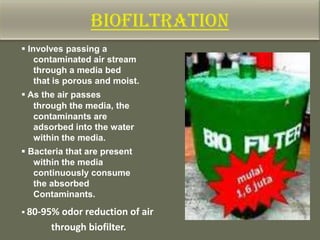
 Involves passing a
contaminated air stream
through a media bed
that is porous and moist.
 As the air passes
through the media, the
contaminants are
adsorbed into the water
within the media.
 Bacteria that are present
within the media
continuously consume
the absorbed
Contaminants.
 80-95% odor reduction of air
through biofilter.
History of Biofilters:
• 1923: The first proposition to use biological methods to treat odorous
compounds was as early as 1923. Bach thought of using a biologically active
biofilter to control emissions of H2S from a waste water treatment plant.
• 1955: Biological methods were first applied to treat odorous emissions in low
concentrations in Germany.
• 1959: A soil bed was installed at a sewage treatment plant in Nuremberg for
the control of odors from an incoming sewer main.
• 1960's: Biofiltration was first used for the treatment of gaseous pollutants both
in Germany and US; research was intensified.
• 1970's: Biofiltration becomes widespread in Germany.
• 1980's: Biofiltration is used for the treatment of toxic emissions and volatile
organic compounds (VOCs) from industry.
• 1990's: There are more than 500 biofilters operating both in Germany and
Netherlands, and it is spreading in the US.
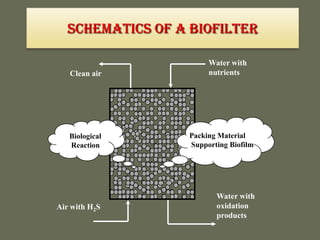
Schematics of a Biofilter
Air with H2S
Clean air
Packing Material
Supporting Biofilm
Biological
Reaction
Water with
nutrients
Water with
oxidation
products
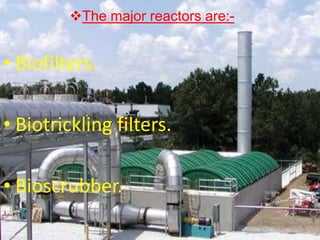
The major reactors are:-
• Biofilters.
• Biotrickling filters.
• Bioscrubber.
Classification of bioreactors for waste gas
purification.
Reactor type Microorganisms Water phase
Biofilter Fixed Stationary
Biotrickling filter Fixed Flowing
Bioscrubber Suspended Flowing
Biotrickling filter
Gas contaminants are
absorbed in a free liquid
phase prior to biodegradation
by microbes.
Operate with the air and
water phase moving either
counter-currently or co-
currently, depending on
specific operation.
Offer greater performance
than biofilters at higher
contaminant loadings.
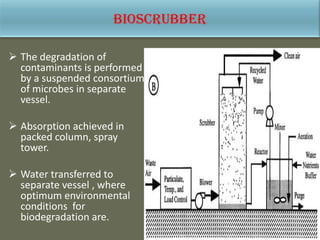
 The degradation of
contaminants is performed
by a suspended consortium
of microbes in separate
vessel.
 Absorption achieved in
packed column, spray
tower.
 Water transferred to
separate vessel , where
optimum environmental
conditions for
biodegradation are.
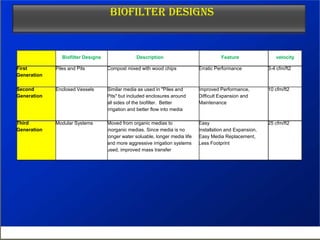
Biofilter Designs
Biofilter Designs Description Feature velocity
First Piles and Pits Compost mixed with wood chips Erratic Performance 3-4 cfm/ft2
Generation
Second Enclosed Vessels Similar media as used in "Piles and Improved Performance, 10 cfm/ft2
Generation Pits" but included enclosures around Difficult Expansion and
all sides of the biofilter. Better Maintenance
irrigation and better flow into media
Third Modular Systems Moved from organic medias to Easy 25 cfm/ft2
Generation inorganic medias. Since media is no Installation and Expansion,
longer water soluable, longer media life Easy Media Replacement,
and more aggressive irrigation systems Less Footprint
used, improved mass transfer
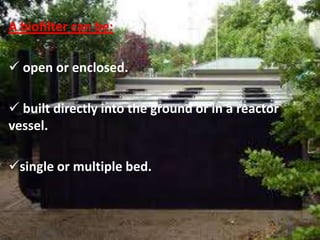
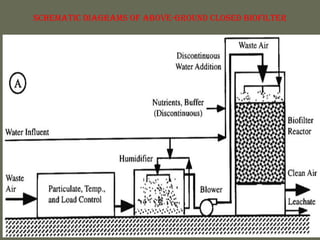
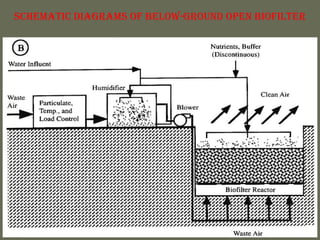
A biofilter can be:
 open or enclosed.
 built directly into the ground or in a reactor
vessel.
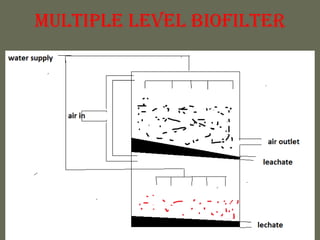
single or multiple bed.
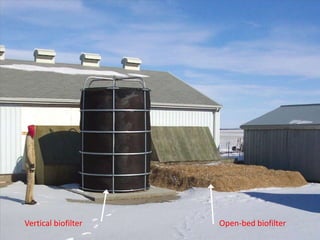
Vertical biofilter Open-bed biofilter
Schematic diagrams of above-ground closed biofilter
Schematic diagrams of below-ground open biofilter
Multiple level biofilter
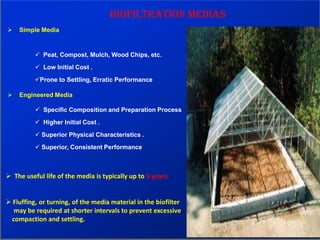
Biofiltration Medias
 Simple Media
 Peat, Compost, Mulch, Wood Chips, etc.
 Low Initial Cost .
Prone to Settling, Erratic Performance
 Engineered Media
 Specific Composition and Preparation Process
 Higher Initial Cost .
 Superior Physical Characteristics .
 Superior, Consistent Performance
 The useful life of the media is typically up to 5 years.
 Fluffing, or turning, of the media material in the biofilter
may be required at shorter intervals to prevent excessive
compaction and settling.
source: Devinny J.S. et al. (1999) “Biofiltration for air pollution control”, Lewis Publishers.
Summary of Important properties
of Common Biofilter Materials
Indigenous microorganisms
population density
Surface area
Air permeability
Assimilable nutrient content
Pollutant sorption capacity
Lifetime (year)
Cost
General applicability
Compost
H
M
M
H
M
2-4
L
E, cost
effective
Peat
M-L
H
H
M-H
M
2-4 L
M, water
control
problems
Soil
H
L-M
L
H
M
>30
Very L
E,
low-
activity
biofilters
Activated carbon,
perlite, and other
inert materials
None
H
M-H
None
L-H
>5
M-H
Needs nutrient,
may be expensive
Synthetic
material
None
H
Very H
None
None to H
very H
>15
Very H
Prototype only
or biotrickling
filters
Parameters that need to be maintained
 Moisture Content –
 Temperature –
Microorganisms operate best between 30 degrees C and 40 degrees.
 Oxygen Level -
Most of degradations are aerobic.
Oxygen is not used directly in the gas form but the microorganisms use the oxygen
present in dissolved form in the media.
 pH –
For better results must maintain a pH where the microorganisms
are the most efficient.
 Nutrient Supply:
For aerobic microorganisms, the O/N/P ratio is estimated as 100/5/1.
These are typically nitrogen, phosphorous, and some trace metals.
Microorganisms need a moist environment.
Media has a tendency to dry out because of the air flow.
Optimum 20 -60%.
Pretreatment of Gas Streams
• Besides humidification, heating, or cooling,
other pretreatment necessary may include
removing particulates.
• Though the biofilter is capable of removing
particulates, the solid matter can cause
clogging of the biofilter and gas distribution
system.
Microorganisms
• Fungi, Bacteria, and Actinomycetes.
• Start up of a biofilter process requires some acclimation time
for the microorganisms to grow specific to the compounds in
the gaseous stream.
• For easily degradable substances, this acclimation period is
typically around 10 days.
• The biomass has been shown to be able to be viable for shut
downs of approximately 2 weeks.
If inorganic nutrient and oxygen supplies are continued, the
biomass may be maintained for up to 2 months.
Mechanism:
Movement of the contaminants from the air to the
water phase occurs according to the physical laws.
The contaminants in the gas are either adsorbed onto
the solid particles of the media or absorbed into the
water layer that exists on the media particles.
Concentration of contaminants decreases from inlet to
outlet as they partionised between various phases.
Mechanism cont..
 Wastes partition out between soil and gas, so
that the VOC remain in soil longer than in air.
 Soil – gas partition coefficients indicate the
relative strength of retention.
 The coefficients increase with VOC molecular
weight and the no. of oxygen, nitrogen and
sulphur functional groups in the VOC molecules.
 In dry soils the coefficients for VOC is 1 for
methane to 10,000 for octane.
• Diffusion occurs through the water layer to the
microorganisms in the slime layer on the surface
of the media particles.
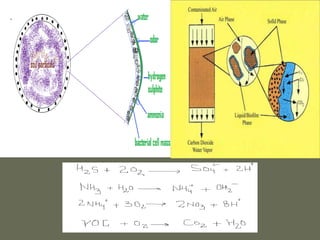
• Through biotransformation of the food source,
end products are formed, including carbon
dioxide, water, nitrogen, mineral salts, and energy.
• Biotransformation act along with adsorption,
absorption, and diffusion to remove
contaminants from the gaseous stream.
Biotransformation and transport processes in biofilters
Mechanism cont..
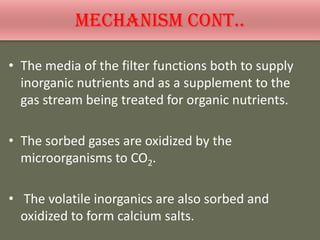
• The media of the filter functions both to supply
inorganic nutrients and as a supplement to the
gas stream being treated for organic nutrients.
• The sorbed gases are oxidized by the
microorganisms to CO2.
• The volatile inorganics are also sorbed and
oxidized to form calcium salts.
Mechanism cont..
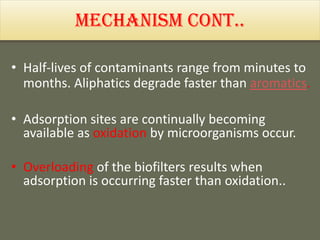
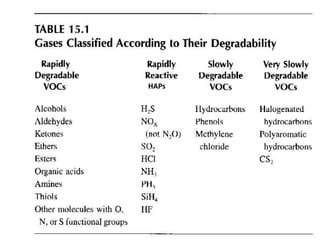
• Half-lives of contaminants range from minutes to
months. Aliphatics degrade faster than aromatics.
• Adsorption sites are continually becoming
available as oxidation by microorganisms occur.
• Overloading of the biofilters results when
adsorption is occurring faster than oxidation..
HAPs
Mechanism cont..
• The oxidation of organic matter
generates heat.
• The difference between the
amount being degraded and
the amount represented by
carbon dioxide release from
the biofilter gives an indication
of how much carbon is being
incorporated in biomass
(Medina et al., 1995).
Common Biofilters
 Pollutants: BTEX, NH3, Trirmethylamine, Ethanol,
Organic acids, etc.
 Emission sources: Various industrial systems
 Microorganisms: Pseudomonas, Bacillus, etc.
 Abundant water and oxygen.
 Aerobic metabolism.
 Temperature: 15-40 ºC, pH: 6-8.
 Metabolic product: CO2 , H2O, Biomass
Biofilter의 종류
Low pH Biofilters for Sulfide Oxidation
 Pollutants: H2S .
 Emission sources: various industrial systems,
wastewater collection and treatment facilities .
 Microorganisms: Thiobacillus thiooxidans,
Thiobacillus spp.
 pH: 1-3, Temp.: 15-40 ºC.
 Abundant water and oxygen.
 Aerobic metabolism.
 Metabolic product: H2SO4
Biofilter의 종류Low-Water-Content Biofilters
 Pollutants: VOCs, Odorous materials.
 Microorganisms: Filamentous fungi
(Xeromyces bisporous).
 Degradation of pollutants at low water .
Aerobic metabolism.
 Applications: Bench biofilters for treatment of
Tounlene, Ethylbenzene, o-Xylene
Biofilter의 종류
High-Temperature Biofilters
 Thermophilic Microorganisms: 45-60 ºC.
 Advantages:
 Higher degradation rate
 More economical treatment processes.
 Disadvantages:
 Fast decomposition of degradable support media
 Reduction of the solubility of pollutants.
 Applications:
 Deshusses et al. (1997): 100 g- ethyl acetate/m3•h,
45-50 ºC
 van Groenestijn et al. (1995):
Hot gases containing ethanol, 50-70 ºC
Biofilter의 종류
NOx Biofilters
 Microorganism:
 genus Nitrobacter:
Nitric oxide  Nitrite  Nitrate
 Denitrifying bacteria: NO  N2.
 Aerobic / Anaerobic Processes.
 Applications:
 Apel et al. (1995): Anaerobic removal of nitrogen
oxides from combustion gases using denitrifying
bacteria (NO  N2 in thick biofilm ).
 Biosaint (1999): Removal of ammonia using
Nitrobacter:95-98% removal at 50-1000 ppm
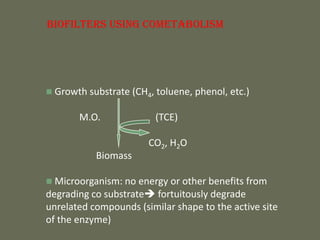
Biofilters using cometabolism Biofilter의 종류
 Growth substrate (CH4, toluene, phenol, etc.)
M.O. (TCE)
CO2, H2O
Biomass
 Microorganism: no energy or other benefits from
degrading co substrate fortuitously degrade
unrelated compounds (similar shape to the active site
of the enzyme)
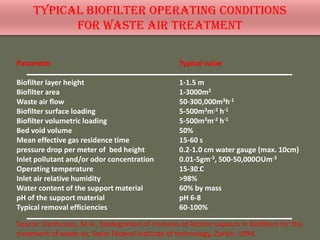
Typical Biofilter Operating Conditions
for Waste Air Treatment
Parameter
Biofilter layer height
Biofilter area
Waste air flow
Biofilter surface loading
Biofilter volumetric loading
Bed void volume
Mean effective gas residence time
pressure drop per meter of bed height
Inlet pollutant and/or odor concentration
Operating temperature
Inlet air relative humidity
Water content of the support material
pH of the support material
Typical removal efficiencies
Typical value
1-1.5 m
1-3000m2
50-300,000m3h-1
5-500m3m-2 h-1
5-500m3m-2 h-1
50%
15-60 s
0.2-1.0 cm water gauge (max. 10cm)
0.01-5gm-3, 500-50,000OUm-3
15-30 C
>98%
60% by mass
pH 6-8
60-100%
Source: Deshusses, M.A., biodegration of mixtures of ketone vapours in biofilters for the
treatment of waste air, Swiss Federal institute of technology, Zurich, 1994.
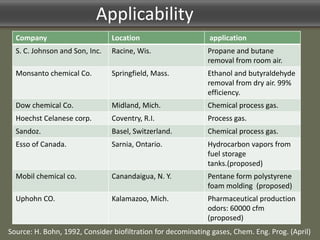
Applicability
Company Location application
S. C. Johnson and Son, Inc. Racine, Wis. Propane and butane
removal from room air.
Monsanto chemical Co. Springfield, Mass. Ethanol and butyraldehyde
removal from dry air. 99%
efficiency.
Dow chemical Co. Midland, Mich. Chemical process gas.
Hoechst Celanese corp. Coventry, R.I. Process gas.
Sandoz. Basel, Switzerland. Chemical process gas.
Esso of Canada. Sarnia, Ontario. Hydrocarbon vapors from
fuel storage
tanks.(proposed)
Mobil chemical co. Canandaigua, N. Y. Pentane form polystyrene
foam molding (proposed)
Uphohn CO. Kalamazoo, Mich. Pharmaceutical production
odors: 60000 cfm
(proposed)
Source: H. Bohn, 1992, Consider biofiltration for decominating gases, Chem. Eng. Prog. (April)
Investment costs vs. air flow rate for various
air pollution control technologies
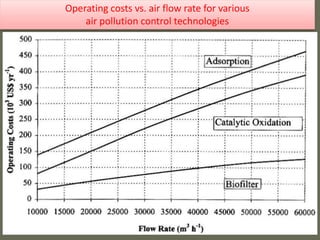
Operating costs vs. air flow rate for various
air pollution control technologies
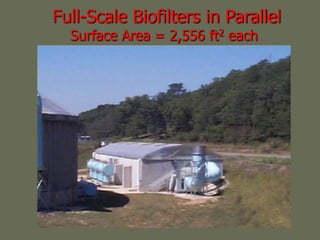
Full-Scale Biofilters in Parallel
Surface Area = 2,556 ft2 each
Comparison of Biofiltration Technology
 Benefits:
 Low Operating Cost
Does not require chemicals
Effective removal of compounds
 Drawbacks:
 Break-through can occur if air flow or concentration is not
consistent
 Does not remove ammonia or amines
 Relatively large footprint required
 Requirements:
 Requires continuous air flow
 Requires consistent loading
 Requires a humid and warm air stream
 Often requires an acclimation period for the media
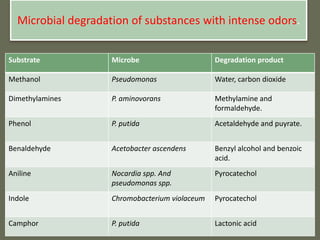
Microbial degradation of substances with intense odors.
Substrate Microbe Degradation product
Methanol Pseudomonas Water, carbon dioxide
Dimethylamines P. aminovorans Methylamine and
formaldehyde.
Phenol P. putida Acetaldehyde and puyrate.
Benaldehyde Acetobacter ascendens Benzyl alcohol and benzoic
acid.
Aniline Nocardia spp. And
pseudomonas spp.
Pyrocatechol
Indole Chromobacterium violaceum Pyrocatechol
Camphor P. putida Lactonic acid
• Biofiltration plays very important role in control of air
pollution
• Biofilter, like all systems follows laws of conservation &
mass balance
• Biofilter is successful only when microbial ecosystem is
healthy & vigorous
• The design of biofilter system requires a detailed
understanding of site,conditions,site limitations, system
components & costs
• Monitoring of BF is very important
REFRENCES.
 Head, I. M., Singleton, I., and Milner, M. (2003). Bioremediation: A critical
review horizon scientific press Norfolk.
 Devinny, J. S. ;Deshusses, M. A.,& Webster, T. S.Biofiltration for air
pollution control. Lewis publishers London.
 Sincero, A. P. and Sincero, G. A. Environmental engeenering.:PHI learning
Private Limited. N. Delhi.
 Evans, G. M. and Furlong, J. C. Environmental Biotechnology.: Wiley &
Sons.
 Liu, D. H. F. and Liptak, B. G. Environmental engineers handbook. (2nd ed.).
 Nathonson, J.A. Basic Environmental Technology.4th Ed.
 Brown, C. A. ,Karl, B. Air pollution control technology handbook.
 http://www.mega.cz/electrodialysis.html.
 www.globalspec.com/../air biofilter
 www.gnest.org/journal/vol 11_no2/218.
 www.ambio.ca/operation.php
Biofilters and air pollution controll by aabid mir

Biofilters and air pollution controll by aabid mir

  • 1.
    BIOFILTERS: AND CONTROLL OFAIR POLLUTION. Aabid Bashir Mir. M.Sc. 4th sem. Roll No. 8258. Department of Environmental Science. University of Kashmir.
  • 2.
    OUTLINE Definition. History. Design. Parameters to bemaintained. Microbial ecology. Mechanism. Extreme biofilters. Applicability. Comparison. Conclusion.
  • 3.
     Involves passinga contaminated air stream through a media bed that is porous and moist.  As the air passes through the media, the contaminants are adsorbed into the water within the media.  Bacteria that are present within the media continuously consume the absorbed Contaminants.  80-95% odor reduction of air through biofilter.
  • 4.
    History of Biofilters: •1923: The first proposition to use biological methods to treat odorous compounds was as early as 1923. Bach thought of using a biologically active biofilter to control emissions of H2S from a waste water treatment plant. • 1955: Biological methods were first applied to treat odorous emissions in low concentrations in Germany. • 1959: A soil bed was installed at a sewage treatment plant in Nuremberg for the control of odors from an incoming sewer main. • 1960's: Biofiltration was first used for the treatment of gaseous pollutants both in Germany and US; research was intensified. • 1970's: Biofiltration becomes widespread in Germany. • 1980's: Biofiltration is used for the treatment of toxic emissions and volatile organic compounds (VOCs) from industry. • 1990's: There are more than 500 biofilters operating both in Germany and Netherlands, and it is spreading in the US.
  • 5.
    Schematics of aBiofilter Air with H2S Clean air Packing Material Supporting Biofilm Biological Reaction Water with nutrients Water with oxidation products
  • 6.
    The major reactorsare:- • Biofilters. • Biotrickling filters. • Bioscrubber.
  • 7.
    Classification of bioreactorsfor waste gas purification. Reactor type Microorganisms Water phase Biofilter Fixed Stationary Biotrickling filter Fixed Flowing Bioscrubber Suspended Flowing
  • 8.
    Biotrickling filter Gas contaminantsare absorbed in a free liquid phase prior to biodegradation by microbes. Operate with the air and water phase moving either counter-currently or co- currently, depending on specific operation. Offer greater performance than biofilters at higher contaminant loadings.
  • 9.
     The degradationof contaminants is performed by a suspended consortium of microbes in separate vessel.  Absorption achieved in packed column, spray tower.  Water transferred to separate vessel , where optimum environmental conditions for biodegradation are.
  • 10.
    Biofilter Designs Biofilter DesignsDescription Feature velocity First Piles and Pits Compost mixed with wood chips Erratic Performance 3-4 cfm/ft2 Generation Second Enclosed Vessels Similar media as used in "Piles and Improved Performance, 10 cfm/ft2 Generation Pits" but included enclosures around Difficult Expansion and all sides of the biofilter. Better Maintenance irrigation and better flow into media Third Modular Systems Moved from organic medias to Easy 25 cfm/ft2 Generation inorganic medias. Since media is no Installation and Expansion, longer water soluable, longer media life Easy Media Replacement, and more aggressive irrigation systems Less Footprint used, improved mass transfer
  • 11.
    A biofilter canbe:  open or enclosed.  built directly into the ground or in a reactor vessel. single or multiple bed.
  • 12.
  • 13.
    Schematic diagrams ofabove-ground closed biofilter
  • 14.
    Schematic diagrams ofbelow-ground open biofilter
  • 15.
  • 16.
    Biofiltration Medias  SimpleMedia  Peat, Compost, Mulch, Wood Chips, etc.  Low Initial Cost . Prone to Settling, Erratic Performance  Engineered Media  Specific Composition and Preparation Process  Higher Initial Cost .  Superior Physical Characteristics .  Superior, Consistent Performance  The useful life of the media is typically up to 5 years.  Fluffing, or turning, of the media material in the biofilter may be required at shorter intervals to prevent excessive compaction and settling.
  • 17.
    source: Devinny J.S.et al. (1999) “Biofiltration for air pollution control”, Lewis Publishers. Summary of Important properties of Common Biofilter Materials Indigenous microorganisms population density Surface area Air permeability Assimilable nutrient content Pollutant sorption capacity Lifetime (year) Cost General applicability Compost H M M H M 2-4 L E, cost effective Peat M-L H H M-H M 2-4 L M, water control problems Soil H L-M L H M >30 Very L E, low- activity biofilters Activated carbon, perlite, and other inert materials None H M-H None L-H >5 M-H Needs nutrient, may be expensive Synthetic material None H Very H None None to H very H >15 Very H Prototype only or biotrickling filters
  • 18.
    Parameters that needto be maintained  Moisture Content –  Temperature – Microorganisms operate best between 30 degrees C and 40 degrees.  Oxygen Level - Most of degradations are aerobic. Oxygen is not used directly in the gas form but the microorganisms use the oxygen present in dissolved form in the media.  pH – For better results must maintain a pH where the microorganisms are the most efficient.  Nutrient Supply: For aerobic microorganisms, the O/N/P ratio is estimated as 100/5/1. These are typically nitrogen, phosphorous, and some trace metals. Microorganisms need a moist environment. Media has a tendency to dry out because of the air flow. Optimum 20 -60%.
  • 19.
    Pretreatment of GasStreams • Besides humidification, heating, or cooling, other pretreatment necessary may include removing particulates. • Though the biofilter is capable of removing particulates, the solid matter can cause clogging of the biofilter and gas distribution system.
  • 20.
    Microorganisms • Fungi, Bacteria,and Actinomycetes. • Start up of a biofilter process requires some acclimation time for the microorganisms to grow specific to the compounds in the gaseous stream. • For easily degradable substances, this acclimation period is typically around 10 days. • The biomass has been shown to be able to be viable for shut downs of approximately 2 weeks. If inorganic nutrient and oxygen supplies are continued, the biomass may be maintained for up to 2 months.
  • 21.
    Mechanism: Movement of thecontaminants from the air to the water phase occurs according to the physical laws. The contaminants in the gas are either adsorbed onto the solid particles of the media or absorbed into the water layer that exists on the media particles. Concentration of contaminants decreases from inlet to outlet as they partionised between various phases.
  • 22.
    Mechanism cont..  Wastespartition out between soil and gas, so that the VOC remain in soil longer than in air.  Soil – gas partition coefficients indicate the relative strength of retention.  The coefficients increase with VOC molecular weight and the no. of oxygen, nitrogen and sulphur functional groups in the VOC molecules.  In dry soils the coefficients for VOC is 1 for methane to 10,000 for octane.
  • 23.
    • Diffusion occursthrough the water layer to the microorganisms in the slime layer on the surface of the media particles. • Through biotransformation of the food source, end products are formed, including carbon dioxide, water, nitrogen, mineral salts, and energy. • Biotransformation act along with adsorption, absorption, and diffusion to remove contaminants from the gaseous stream.
  • 25.
    Biotransformation and transportprocesses in biofilters
  • 26.
    Mechanism cont.. • Themedia of the filter functions both to supply inorganic nutrients and as a supplement to the gas stream being treated for organic nutrients. • The sorbed gases are oxidized by the microorganisms to CO2. • The volatile inorganics are also sorbed and oxidized to form calcium salts.
  • 27.
    Mechanism cont.. • Half-livesof contaminants range from minutes to months. Aliphatics degrade faster than aromatics. • Adsorption sites are continually becoming available as oxidation by microorganisms occur. • Overloading of the biofilters results when adsorption is occurring faster than oxidation..
  • 28.
  • 29.
    Mechanism cont.. • Theoxidation of organic matter generates heat. • The difference between the amount being degraded and the amount represented by carbon dioxide release from the biofilter gives an indication of how much carbon is being incorporated in biomass (Medina et al., 1995).
  • 30.
    Common Biofilters  Pollutants:BTEX, NH3, Trirmethylamine, Ethanol, Organic acids, etc.  Emission sources: Various industrial systems  Microorganisms: Pseudomonas, Bacillus, etc.  Abundant water and oxygen.  Aerobic metabolism.  Temperature: 15-40 ºC, pH: 6-8.  Metabolic product: CO2 , H2O, Biomass
  • 31.
    Biofilter의 종류 Low pHBiofilters for Sulfide Oxidation  Pollutants: H2S .  Emission sources: various industrial systems, wastewater collection and treatment facilities .  Microorganisms: Thiobacillus thiooxidans, Thiobacillus spp.  pH: 1-3, Temp.: 15-40 ºC.  Abundant water and oxygen.  Aerobic metabolism.  Metabolic product: H2SO4
  • 32.
    Biofilter의 종류Low-Water-Content Biofilters Pollutants: VOCs, Odorous materials.  Microorganisms: Filamentous fungi (Xeromyces bisporous).  Degradation of pollutants at low water . Aerobic metabolism.  Applications: Bench biofilters for treatment of Tounlene, Ethylbenzene, o-Xylene
  • 33.
    Biofilter의 종류 High-Temperature Biofilters Thermophilic Microorganisms: 45-60 ºC.  Advantages:  Higher degradation rate  More economical treatment processes.  Disadvantages:  Fast decomposition of degradable support media  Reduction of the solubility of pollutants.  Applications:  Deshusses et al. (1997): 100 g- ethyl acetate/m3•h, 45-50 ºC  van Groenestijn et al. (1995): Hot gases containing ethanol, 50-70 ºC
  • 34.
    Biofilter의 종류 NOx Biofilters Microorganism:  genus Nitrobacter: Nitric oxide  Nitrite  Nitrate  Denitrifying bacteria: NO  N2.  Aerobic / Anaerobic Processes.  Applications:  Apel et al. (1995): Anaerobic removal of nitrogen oxides from combustion gases using denitrifying bacteria (NO  N2 in thick biofilm ).  Biosaint (1999): Removal of ammonia using Nitrobacter:95-98% removal at 50-1000 ppm
  • 35.
    Biofilters using cometabolismBiofilter의 종류  Growth substrate (CH4, toluene, phenol, etc.) M.O. (TCE) CO2, H2O Biomass  Microorganism: no energy or other benefits from degrading co substrate fortuitously degrade unrelated compounds (similar shape to the active site of the enzyme)
  • 36.
    Typical Biofilter OperatingConditions for Waste Air Treatment Parameter Biofilter layer height Biofilter area Waste air flow Biofilter surface loading Biofilter volumetric loading Bed void volume Mean effective gas residence time pressure drop per meter of bed height Inlet pollutant and/or odor concentration Operating temperature Inlet air relative humidity Water content of the support material pH of the support material Typical removal efficiencies Typical value 1-1.5 m 1-3000m2 50-300,000m3h-1 5-500m3m-2 h-1 5-500m3m-2 h-1 50% 15-60 s 0.2-1.0 cm water gauge (max. 10cm) 0.01-5gm-3, 500-50,000OUm-3 15-30 C >98% 60% by mass pH 6-8 60-100% Source: Deshusses, M.A., biodegration of mixtures of ketone vapours in biofilters for the treatment of waste air, Swiss Federal institute of technology, Zurich, 1994.
  • 37.
    Applicability Company Location application S.C. Johnson and Son, Inc. Racine, Wis. Propane and butane removal from room air. Monsanto chemical Co. Springfield, Mass. Ethanol and butyraldehyde removal from dry air. 99% efficiency. Dow chemical Co. Midland, Mich. Chemical process gas. Hoechst Celanese corp. Coventry, R.I. Process gas. Sandoz. Basel, Switzerland. Chemical process gas. Esso of Canada. Sarnia, Ontario. Hydrocarbon vapors from fuel storage tanks.(proposed) Mobil chemical co. Canandaigua, N. Y. Pentane form polystyrene foam molding (proposed) Uphohn CO. Kalamazoo, Mich. Pharmaceutical production odors: 60000 cfm (proposed) Source: H. Bohn, 1992, Consider biofiltration for decominating gases, Chem. Eng. Prog. (April)
  • 38.
    Investment costs vs.air flow rate for various air pollution control technologies
  • 39.
    Operating costs vs.air flow rate for various air pollution control technologies
  • 40.
    Full-Scale Biofilters inParallel Surface Area = 2,556 ft2 each
  • 41.
    Comparison of BiofiltrationTechnology  Benefits:  Low Operating Cost Does not require chemicals Effective removal of compounds  Drawbacks:  Break-through can occur if air flow or concentration is not consistent  Does not remove ammonia or amines  Relatively large footprint required  Requirements:  Requires continuous air flow  Requires consistent loading  Requires a humid and warm air stream  Often requires an acclimation period for the media
  • 42.
    Microbial degradation ofsubstances with intense odors. Substrate Microbe Degradation product Methanol Pseudomonas Water, carbon dioxide Dimethylamines P. aminovorans Methylamine and formaldehyde. Phenol P. putida Acetaldehyde and puyrate. Benaldehyde Acetobacter ascendens Benzyl alcohol and benzoic acid. Aniline Nocardia spp. And pseudomonas spp. Pyrocatechol Indole Chromobacterium violaceum Pyrocatechol Camphor P. putida Lactonic acid
  • 43.
    • Biofiltration playsvery important role in control of air pollution • Biofilter, like all systems follows laws of conservation & mass balance • Biofilter is successful only when microbial ecosystem is healthy & vigorous • The design of biofilter system requires a detailed understanding of site,conditions,site limitations, system components & costs • Monitoring of BF is very important
  • 44.
    REFRENCES.  Head, I.M., Singleton, I., and Milner, M. (2003). Bioremediation: A critical review horizon scientific press Norfolk.  Devinny, J. S. ;Deshusses, M. A.,& Webster, T. S.Biofiltration for air pollution control. Lewis publishers London.  Sincero, A. P. and Sincero, G. A. Environmental engeenering.:PHI learning Private Limited. N. Delhi.  Evans, G. M. and Furlong, J. C. Environmental Biotechnology.: Wiley & Sons.  Liu, D. H. F. and Liptak, B. G. Environmental engineers handbook. (2nd ed.).  Nathonson, J.A. Basic Environmental Technology.4th Ed.  Brown, C. A. ,Karl, B. Air pollution control technology handbook.  http://www.mega.cz/electrodialysis.html.  www.globalspec.com/../air biofilter  www.gnest.org/journal/vol 11_no2/218.  www.ambio.ca/operation.php