MICROBIAL INTERACTIONS
Ms. S. Menakagandhi
Assistant professor
Dept of Microbiology
ECCS
MICROBIAL INTERACTION
Biological interactions are the effects that the organisms in a community
have on one another
There are completely different kinds of microbial interactions which
incorporates interaction with different microbes.
a)Plant-Germ interactions promoting plant growth,
b)interaction with animals,
c)interaction with humans,
d)interaction with water
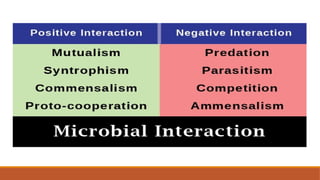
The interactions between the two populations are classified according to
whether both populations and one of them benefit from the associations, or
one or both populations are negatively affected.
POSITIVE INTERACTION
1. MUTUALISM
It is defined as the relationship in which each organism in
interaction gets benefits from the association
It is an obligatory relationship in which mutualist and host are
metabolically dependent on each other.
A mutualistic relationship is very specific.
Examples of mutualism:
Lichens: Lichens are an excellent example of mutualism. They
are the association of specific fungi and certain genus of algae.
2. SYNTROPHISM
It is an association in which the growth of one organism either depends on or
improved by the substrate provided by another organism.
In syntrophism, both organisms in association get to benefit from each other.
Examples of syntrophism:
a. Methanogenic ecosystem in a sludge digester
Methane produced by methanogenic bacteria depends upon interspecies
hydrogen transfer by other fermentative bacteria.
b. Lactobacillus arobinosus and Enterococcus faecalis
In the minimal media, Lactobacillus arobinosus and Enterococcus faecalis are
able to grow together but not alone.
3. PROTOCOOPERATION
•It is a relationship in which an organism in an association is mutually
benefited with each other.
•This interaction is similar to mutualism but the relationships between
the organisms in protocooperation are not obligatory as in mutualism.
Examples of Protocooperation:
a. Association of Desulfovibrio and Chromatium: It is a
protocooperation between the carbon cycle and the sulfur cycle.
b. Interaction between N2-fixing bacteria and cellulolytic
bacteria such as Cellulomonas.
4. COMMENSALISM
It is a relationship in which one organism (commensal) in the
association is benefited while another organism (host) of the
association is neither benefited nor harmed.
Examples of commensalism:
a. Non-pathogenic E. coli in the intestinal tract of
humans: E. coli is a facultative anaerobe that uses oxygen and
lowers the O2 concentration in the gut which creates a suitable
environment for obligate anaerobes such as Bacteroides. E.
coli is a host which remains unaffected by Bacteroides.
NEGATIVE INTERACTION
1. AMENSALISM (ANTAGONISM)
 one microbial population produces substances that are
inhibitory to other microbial population then this
interpopulation relationship is known as Ammensalism or
Antagonism.
It is a negative relationship.
Example :
a. Lactic acid produced by lactic acid bacteria in the vaginal
tract: Lactic acid produced by many normal floras in the vaginal
tract is inhibitory to many pathogenic organisms such
as Candida albicans.
2.COMPETITION
The competition represents a negative relationship between
two microbial populations in which both the population are
adversely affected with respect to their survival and growth.
Examples of competition:
a. Competition between Paramecium
caudatum and Paramecium aurelia
3. PARASITISM
It is a relationship in which one population (parasite) get
benefited and derive its nutrition from other population (host) in
the association which is harmed.
Examples of parasitism:
a. Viruses: Viruses are an obligate intracellular parasite that
exhibits great host specificity. There are many viruses that
are parasite to bacteria (bacteriophage), fungi, algae, protozoa
etc.
4. PREDATION
It is a widespread phenomenon when one organism (predator)
engulf or attack other organisms (prey).
Normally predator-prey interaction is of short duration.
Examples of Predation:
a. Protozoan-bacteria in soil: Many protozoans can feed on
various bacterial population which helps to maintain the count
of soil bacteria at optimum level
THANK YOU