Let there be light!!
--
MICROBIAL FUEL CELL Waste water treament and electricity generation
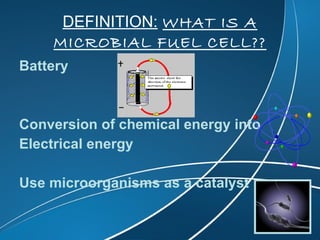
DEFINITION:   WHAT IS A MICROBIAL FUEL CELL?? Battery  Conversion of chemical energy into Electrical energy Use microorganisms as a catalyst
The microorganisms that  have the ability to produce electricity are called  : Cellular respiration Final e- acceptor: electrodes in a cell rather than nitrates  sulphates iron and oxygen . electrogenics MICROELECTRICITY
Electrolytic cell WHAT IS THE SOURCE OF INSPIRATION
 
Cellular respiration b.Cellular respiration
3 main components
How does it work?
 
Bacteria form a community  on anode called  BIOFILM . Biofilm produce a matrix  that stick to the anode. Sticky matrix  consists of  extracellular proteins, sugars,  and bacterial cells.  tiny  conductive nanowires that may help facilitate  electron conduction. ISSUE:HOW TO STICK BACTERIA TO ANODE?
A N O D E  and  c a t h o d e conductive Chemically stable biocompatible Non  corrosive Stainless steel  mesh Graphite plates Glassy carbons platinum
TYPES  OF  MFC 1. ANY MICROBE CAN PRODUCE  ELECTRICITY WITH AN ELECTRON SHUTTLE (INEFFICIENT) 2.MEDIATORS ARE MOSTLY PHENOLICS  WHICH ARE EXPENSIVE & TOXIC 1.NO ADDITIONAL ELECTRON  SHUTTLE IS NEEDED 2.FEW KNOWN MICROBES HAVE THIS  ABILITY 3.SHEWANELLA AND IRON REDUCERS DO!
Geobacteraceae , Desulfuromonas , Alcaligenes faecalis ,  Enterococcus faecium ,  Pseudomonas aeruginosa , Bacteroides  and Aeromonas  species were detected in the before-mentioned studies Azoarcus  and  Azospirillum ) ISSUE:WHICH MICROORGANISM TO BE USED?
APPLICATIONS AND USES scale up scale down mfc Waste disposal Water  treatment biosensors teaching Medical  devices Remote power  supplies
ADVANTAGES LOW COST  LOW MAINTENANCE ZERO POLLUTION  SUSTAINABLE  POWER VASTLY AVAILABLE   USE WIDE RANGE OF fuels
WASTEWATER TREATMENT We don’t spend a lot of time pondering wastewater treament unless we absolutely have to!! 2 billion people are without access to adequate sanitation or safe drinking water. These challenges demand for innovative solution   This is where microbial fuel cell comes in…
 
 
Various mfc designs in use The designs can be divided in two types:  1) Research type MFCs :
Continuous mfc
Scale up is still a big challenge High cost of cation exchange membranes Potential for biofouling  High internal resistance the power generation and limit the practical applications of mfc’c NEGATIVE SIDE OF THE PICTURE
CONCLUSION With the world’s attention focused on  global warming and depleting Natural resources, demand for green energy booming!! Mfc is an excellent source of bioenergy,that is energy from micro organisms. It is a promising solution for energy crisis because it is cheaper, cleaner and sustainable and can use variety of substrate/waste as a fuel Since It is a novel technology,it still needs a lot of working and recognition to be applied on large scale all over the world.

microbial fuel cell

  • 1.
    Let there belight!!
  • 2.
  • 3.
    MICROBIAL FUEL CELLWaste water treament and electricity generation
  • 4.
    DEFINITION: WHAT IS A MICROBIAL FUEL CELL?? Battery Conversion of chemical energy into Electrical energy Use microorganisms as a catalyst
  • 5.
    The microorganisms that have the ability to produce electricity are called : Cellular respiration Final e- acceptor: electrodes in a cell rather than nitrates sulphates iron and oxygen . electrogenics MICROELECTRICITY
  • 6.
    Electrolytic cell WHATIS THE SOURCE OF INSPIRATION
  • 7.
  • 8.
  • 9.
  • 10.
  • 11.
  • 12.
    Bacteria form acommunity on anode called BIOFILM . Biofilm produce a matrix that stick to the anode. Sticky matrix consists of extracellular proteins, sugars, and bacterial cells. tiny conductive nanowires that may help facilitate electron conduction. ISSUE:HOW TO STICK BACTERIA TO ANODE?
  • 13.
    A N OD E and c a t h o d e conductive Chemically stable biocompatible Non corrosive Stainless steel mesh Graphite plates Glassy carbons platinum
  • 14.
    TYPES OF MFC 1. ANY MICROBE CAN PRODUCE ELECTRICITY WITH AN ELECTRON SHUTTLE (INEFFICIENT) 2.MEDIATORS ARE MOSTLY PHENOLICS WHICH ARE EXPENSIVE & TOXIC 1.NO ADDITIONAL ELECTRON SHUTTLE IS NEEDED 2.FEW KNOWN MICROBES HAVE THIS ABILITY 3.SHEWANELLA AND IRON REDUCERS DO!
  • 15.
    Geobacteraceae , Desulfuromonas, Alcaligenes faecalis , Enterococcus faecium , Pseudomonas aeruginosa , Bacteroides and Aeromonas species were detected in the before-mentioned studies Azoarcus and Azospirillum ) ISSUE:WHICH MICROORGANISM TO BE USED?
  • 16.
    APPLICATIONS AND USESscale up scale down mfc Waste disposal Water treatment biosensors teaching Medical devices Remote power supplies
  • 17.
    ADVANTAGES LOW COST LOW MAINTENANCE ZERO POLLUTION SUSTAINABLE POWER VASTLY AVAILABLE USE WIDE RANGE OF fuels
  • 18.
    WASTEWATER TREATMENT Wedon’t spend a lot of time pondering wastewater treament unless we absolutely have to!! 2 billion people are without access to adequate sanitation or safe drinking water. These challenges demand for innovative solution This is where microbial fuel cell comes in…
  • 19.
  • 20.
  • 21.
    Various mfc designsin use The designs can be divided in two types: 1) Research type MFCs :
  • 22.
  • 23.
    Scale up isstill a big challenge High cost of cation exchange membranes Potential for biofouling High internal resistance the power generation and limit the practical applications of mfc’c NEGATIVE SIDE OF THE PICTURE
  • 24.
    CONCLUSION With theworld’s attention focused on global warming and depleting Natural resources, demand for green energy booming!! Mfc is an excellent source of bioenergy,that is energy from micro organisms. It is a promising solution for energy crisis because it is cheaper, cleaner and sustainable and can use variety of substrate/waste as a fuel Since It is a novel technology,it still needs a lot of working and recognition to be applied on large scale all over the world.