MICROBIAL FUEL CELL
CONTENTS
⚫ Introduction
⚫ Whatare fuel cells?
⚫ Whatare microbial fuel cells
⚫ principle
⚫ Constructionof MFC
⚫ Componentsof MFC
⚫ Working of MFC
⚫ Thermodynamicsof MFC
⚫ MFC Design
⚫ Types of MFC
⚫ Applicationsof MFC
⚫ Advantagesof MFC
⚫ Limitationsof MFC
⚫ Conclusion
⚫ References
INTRODUCTION
• Useof the fossil fuels can triggerglobal energycrisisand increased
global warming hence there is considerable interest in research
fraternityon green production
⚫ In an era of climate change, alternate energy sources are desired to
replace oil and carbon resources. Subsequently, climate change effects
in someareasand the increasing productionof biofuelsarealso putting
pressureon availablewaterresources.
⚫ Microbial Fuel Cells have the potential to simultaneously treat
wastewater forreuseand togenerateelectricity; thereby producing two
increasinglyscarce resources
⚫ Microbial fuel cell technologyrepresentsa new form of renewable
energy by generating electricity from what would otherwise be
considered waste, such as industrial wastes orwastewateretc
Continuation….
• M.C Potterwas the first toperformwork on thesubject in 1911 in
E.coli,A professorof botanyat the Universityof Durham
• In 1931, however, Barnet Cohendrew moreattention totheareawhen
he created a numberof microbial half fuel cells that, when connected
in series, were capable of producing over 35 volts, though only with a
currentof 2 milliamps
• In 1911 B.H. Kim devoloped mediatorless MFC was a milestone in MFC,
Enhanced thecommercialviablity,byeleiminating costly mediator
chemicals.
• Microbial fuel cells havecomea long way since theearly 20th century.
Whatare fuel cells?
Device thatconvertschemical energy from fuel intoelectricity through
chemical reactionwith oxygen oranotheroxidizing agent.
What are Microbial fuel cells?
⚫ Chemical energy toelectrical energy
⚫ Catalytic reactionof microorganisms
⚫ Bio-electrochemical system
⚫ Mimics bacterial interaction
primary flowdiagram
⚫ Based on redoxreactions
⚫ Harness the natural metabolism of microbes toproduceelectricity
⚫ Bacteriaconvertssubstrate intoelectrons
⚫ Electronsrun through thecircuit togeneratepower
Principle
CONSTRUCTION OF MFC:
Components of MFC
⚫ Anode
⚫ Cathode
⚫ Exchange membrane
⚫ Substrate
⚫ Electrical circuit
⚫ Microbes
Anode;
⚫ Conductive,biocompatible & chemicalystablewith substrate
⚫ Stainlesssteel mesh,graphiteplatesorrods
⚫ Bacteria live in theanodecompartmentand convertsubstrateto CO2,H2O
and energy
⚫ Bacteriaare kept in an oxygen less environment
Anodecompartment
Cathode;
⚫ Electronsand protons recombineat thecathode
⚫ O2 reduced towater
⚫ Ptcatalyst is used
Cathodecompartment
Exchange membrane;
⚫ NAFION or ULTREX
⚫ Protons flows through the EM
⚫ Protonand electrons recombineon theotherside.
⚫ Can b a proton orcation exchange membrane
Exchange membrane
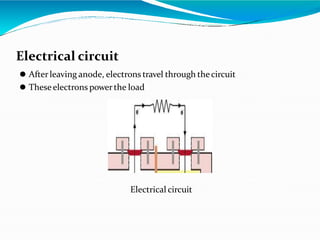
Electrical circuit
⚫ Afterleaving anode, electrons travel through thecircuit
⚫ Theseelectrons powerthe load
Electrical circuit
Substrates;
⚫ Substrates provideenergy forthe bacterial cell
⚫ Influences theeconomicviabilityand overall performancesuch as
powerdensityand coloumbicefficiency of MFC
⚫ Concentration,compositionand type
⚫ Organicsubstrates-carbohydrates, protein,volatileacids,celluloseand
wastewater
⚫ Acetate is commonly used as substrate
Substrates used in MFC
Substrate type Concentrations Current density
(m A/cm2)
Acetate 1g/L 0.8
Lactate 18mM 0.005
Glucose 6.7Mm 0.7
Sucrose 2674mg/L 0.19
Glucaronic acid 6.7mM 0.18
Phenol 400mg/L 0.1
Sodium fumerate 25mM 2.05
Starch 10g/L 1.3
Cellulosic particles 4g/L 0.02
Xylose 6.7mM 0.74
Domestic wastewater 600mg/L 0.06
Brewery wastewater 2240mg/L 0.2
Microbes used in MFC
⚫Axenic bacterial culture
⚫ Metal reducing bacteria
⚫ Shewanella putrefaciens
⚫ Geobacter sulfurreducens
⚫ Rhodoferax ferrireducens
⚫ Clostridium beijerinckii
⚫Mixed bacterial fuel culture
⚫ Desulfuromonas,
⚫ Alcaligenes faecalis,
⚫ Enterococcus faecium,
⚫ Pseudomonas aeruginosa,
⚫ Proteobacteria,
Continuation…..
⚫ Clostridium butricum
⚫ Bacteroidesand
⚫ Aeromonasspecies
⚫ nitrogen fixing bacteria (e.g. Azoarcusand Azospirillum)
Working of MFC
Continuation…….
⚫ Anodeand cathodeseparated bycathodespecific membrane
⚫ Microbesatanodeoxidizeorganic fuel generateselectronsand protons
⚫ Protons move to thecathodecompartment through the membrane
⚫ Electrons transferred to thecathodecompartmentthrough external
circuittogeneratecurrent
⚫ Electronsand protonsareconsumed in cathodechamber, combining
with O2 to formwater
→ 2CO2 + 2H+ +8e-
⚫ Anodicreaction:
CH3COO- + H2O
acetate
⚫ Cathodic reaction:
O2 + 4e- + 4 H+ → 2 H2O
Thermodynamics of MFC
⚫ Using Gibbs freeenergy
∆G r = Gr + RT ( lnπ)
0
⚫ Cell electromotive force
W = EemfQ = ∆Gr , Q = nF
Eemf = ∆ Gr∕ nF
⚫ Overall reaction in termsof the potential as
Eemf = E0
emf –RT∕nF ln(π)
positive fora favourabl reaction
directlyproducesavalueof emf forthe reaction
MFC Design
⚫Differentconfigurationsare possible
⚫ Widelyused is a twochamber MFC built in traditional ‘H’ shape
Twochamberconnected bya tubecontaining a seperatorusually
CEM orplain salt bridge
Types of MFCs
⚫ Mediator MFC
⚫ Mediatorfree MFC
⚫ Microbial electrolysis fuel cell
Continuation……
⚫ Soil based MFC
⚫ Phototrophicbiofilm MFC
⚫ Nanoporous MFC
⚫ Sediment MFC
⚫ Membrane less MFC
Applications of MFC
⚫ Wastewatertreatment
⚫ Powergeneration
⚫ Secondary fuel production
⚫ Bio-Sensors
⚫ Desalination
⚫ Educational tool
Advantages of MFC
⚫ Generationof energyoutof biowaste / organic matter
⚫ Directconversionof substrateenergy toelectricity
⚫ Omissionof gas treatment
⚫ Aeration
⚫ Bioremediationof toxiccompounds
Limitations of MFC
⚫ Low powerdensity
⚫ High initial cost
⚫ Activation losses
⚫ Ohmic losses
⚫ Bacterial metabolic losses
Conclusion
⚫ MFCs have been explored as a new source of electricity generation
during operational waste water treatment.
⚫ Phototropic MFCs and solar powered MFC also represent an
exceptional attempt in the progress of MFCs technology for electricity
production.
⚫ It can be used for production of secondary fuel as well as in
bioremediation of toxic compounds.
⚫ However, this technology is only in research stage and more research is
required before domestic MFCs can be made available for
commercialization
⚫ Provided the biological understanding increases, the electrochemical
technology advances and the overall electrode prices decrease, this
technology might qualify as a new core technology for conversion of
carbohydrates to electricity in years to come.

MFffffffffffffffffffffffffffffffffC.pptx

  • 1.
  • 2.
    CONTENTS ⚫ Introduction ⚫ Whatarefuel cells? ⚫ Whatare microbial fuel cells ⚫ principle ⚫ Constructionof MFC ⚫ Componentsof MFC ⚫ Working of MFC ⚫ Thermodynamicsof MFC ⚫ MFC Design ⚫ Types of MFC ⚫ Applicationsof MFC ⚫ Advantagesof MFC ⚫ Limitationsof MFC ⚫ Conclusion ⚫ References
  • 3.
    INTRODUCTION • Useof thefossil fuels can triggerglobal energycrisisand increased global warming hence there is considerable interest in research fraternityon green production ⚫ In an era of climate change, alternate energy sources are desired to replace oil and carbon resources. Subsequently, climate change effects in someareasand the increasing productionof biofuelsarealso putting pressureon availablewaterresources. ⚫ Microbial Fuel Cells have the potential to simultaneously treat wastewater forreuseand togenerateelectricity; thereby producing two increasinglyscarce resources ⚫ Microbial fuel cell technologyrepresentsa new form of renewable energy by generating electricity from what would otherwise be considered waste, such as industrial wastes orwastewateretc
  • 4.
    Continuation…. • M.C Potterwasthe first toperformwork on thesubject in 1911 in E.coli,A professorof botanyat the Universityof Durham • In 1931, however, Barnet Cohendrew moreattention totheareawhen he created a numberof microbial half fuel cells that, when connected in series, were capable of producing over 35 volts, though only with a currentof 2 milliamps • In 1911 B.H. Kim devoloped mediatorless MFC was a milestone in MFC, Enhanced thecommercialviablity,byeleiminating costly mediator chemicals. • Microbial fuel cells havecomea long way since theearly 20th century.
  • 5.
    Whatare fuel cells? Devicethatconvertschemical energy from fuel intoelectricity through chemical reactionwith oxygen oranotheroxidizing agent.
  • 6.
    What are Microbialfuel cells? ⚫ Chemical energy toelectrical energy ⚫ Catalytic reactionof microorganisms ⚫ Bio-electrochemical system ⚫ Mimics bacterial interaction primary flowdiagram
  • 7.
    ⚫ Based onredoxreactions ⚫ Harness the natural metabolism of microbes toproduceelectricity ⚫ Bacteriaconvertssubstrate intoelectrons ⚫ Electronsrun through thecircuit togeneratepower Principle
  • 8.
  • 9.
    Components of MFC ⚫Anode ⚫ Cathode ⚫ Exchange membrane ⚫ Substrate ⚫ Electrical circuit ⚫ Microbes
  • 10.
    Anode; ⚫ Conductive,biocompatible &chemicalystablewith substrate ⚫ Stainlesssteel mesh,graphiteplatesorrods ⚫ Bacteria live in theanodecompartmentand convertsubstrateto CO2,H2O and energy ⚫ Bacteriaare kept in an oxygen less environment Anodecompartment
  • 11.
    Cathode; ⚫ Electronsand protonsrecombineat thecathode ⚫ O2 reduced towater ⚫ Ptcatalyst is used Cathodecompartment
  • 12.
    Exchange membrane; ⚫ NAFIONor ULTREX ⚫ Protons flows through the EM ⚫ Protonand electrons recombineon theotherside. ⚫ Can b a proton orcation exchange membrane Exchange membrane
  • 13.
    Electrical circuit ⚫ Afterleavinganode, electrons travel through thecircuit ⚫ Theseelectrons powerthe load Electrical circuit
  • 14.
    Substrates; ⚫ Substrates provideenergyforthe bacterial cell ⚫ Influences theeconomicviabilityand overall performancesuch as powerdensityand coloumbicefficiency of MFC ⚫ Concentration,compositionand type ⚫ Organicsubstrates-carbohydrates, protein,volatileacids,celluloseand wastewater ⚫ Acetate is commonly used as substrate
  • 15.
    Substrates used inMFC Substrate type Concentrations Current density (m A/cm2) Acetate 1g/L 0.8 Lactate 18mM 0.005 Glucose 6.7Mm 0.7 Sucrose 2674mg/L 0.19 Glucaronic acid 6.7mM 0.18 Phenol 400mg/L 0.1 Sodium fumerate 25mM 2.05 Starch 10g/L 1.3 Cellulosic particles 4g/L 0.02 Xylose 6.7mM 0.74 Domestic wastewater 600mg/L 0.06 Brewery wastewater 2240mg/L 0.2
  • 16.
    Microbes used inMFC ⚫Axenic bacterial culture ⚫ Metal reducing bacteria ⚫ Shewanella putrefaciens ⚫ Geobacter sulfurreducens ⚫ Rhodoferax ferrireducens ⚫ Clostridium beijerinckii ⚫Mixed bacterial fuel culture ⚫ Desulfuromonas, ⚫ Alcaligenes faecalis, ⚫ Enterococcus faecium, ⚫ Pseudomonas aeruginosa, ⚫ Proteobacteria,
  • 17.
    Continuation….. ⚫ Clostridium butricum ⚫Bacteroidesand ⚫ Aeromonasspecies ⚫ nitrogen fixing bacteria (e.g. Azoarcusand Azospirillum)
  • 18.
  • 19.
    Continuation……. ⚫ Anodeand cathodeseparatedbycathodespecific membrane ⚫ Microbesatanodeoxidizeorganic fuel generateselectronsand protons ⚫ Protons move to thecathodecompartment through the membrane ⚫ Electrons transferred to thecathodecompartmentthrough external circuittogeneratecurrent ⚫ Electronsand protonsareconsumed in cathodechamber, combining with O2 to formwater → 2CO2 + 2H+ +8e- ⚫ Anodicreaction: CH3COO- + H2O acetate ⚫ Cathodic reaction: O2 + 4e- + 4 H+ → 2 H2O
  • 20.
    Thermodynamics of MFC ⚫Using Gibbs freeenergy ∆G r = Gr + RT ( lnπ) 0 ⚫ Cell electromotive force W = EemfQ = ∆Gr , Q = nF Eemf = ∆ Gr∕ nF ⚫ Overall reaction in termsof the potential as Eemf = E0 emf –RT∕nF ln(π) positive fora favourabl reaction directlyproducesavalueof emf forthe reaction
  • 21.
    MFC Design ⚫Differentconfigurationsare possible ⚫Widelyused is a twochamber MFC built in traditional ‘H’ shape Twochamberconnected bya tubecontaining a seperatorusually CEM orplain salt bridge
  • 22.
    Types of MFCs ⚫Mediator MFC ⚫ Mediatorfree MFC ⚫ Microbial electrolysis fuel cell
  • 23.
    Continuation…… ⚫ Soil basedMFC ⚫ Phototrophicbiofilm MFC ⚫ Nanoporous MFC ⚫ Sediment MFC ⚫ Membrane less MFC
  • 24.
    Applications of MFC ⚫Wastewatertreatment ⚫ Powergeneration ⚫ Secondary fuel production ⚫ Bio-Sensors ⚫ Desalination ⚫ Educational tool
  • 25.
    Advantages of MFC ⚫Generationof energyoutof biowaste / organic matter ⚫ Directconversionof substrateenergy toelectricity ⚫ Omissionof gas treatment ⚫ Aeration ⚫ Bioremediationof toxiccompounds
  • 26.
    Limitations of MFC ⚫Low powerdensity ⚫ High initial cost ⚫ Activation losses ⚫ Ohmic losses ⚫ Bacterial metabolic losses
  • 27.
    Conclusion ⚫ MFCs havebeen explored as a new source of electricity generation during operational waste water treatment. ⚫ Phototropic MFCs and solar powered MFC also represent an exceptional attempt in the progress of MFCs technology for electricity production. ⚫ It can be used for production of secondary fuel as well as in bioremediation of toxic compounds. ⚫ However, this technology is only in research stage and more research is required before domestic MFCs can be made available for commercialization ⚫ Provided the biological understanding increases, the electrochemical technology advances and the overall electrode prices decrease, this technology might qualify as a new core technology for conversion of carbohydrates to electricity in years to come.