Presented by
PRAVEEN H M
1CG14ME074
Mechanical Engineering
CIT, Gubbi, Tumakuru - 572 216
Channabasaveshwara Institute of Technology
(NAAC Accredited & ISO 9001:2015 Certified Institution)
(Affiliated to Visvesvaraya Technological University, Belagavi)
(Recognised by A.I.C.T.E. New Delhi)
Under the Guidance of
Mr. NATESH C P M.Tech,(Ph.D),AMIE
Asst. Professor, Dept. of ME
CIT, Gubbi, Tumakuru - 572 216
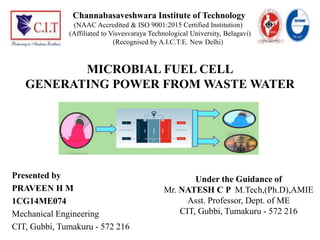
MICROBIAL FUEL CELL
GENERATING POWER FROM WASTE WATER
CONTENTS
 INTRODUCTION
 MICROBIAL FUEL CELL(MFC)
 TYPES OF MFC
 PRINCIPLE
 CONSTRUCTION
 WORKING OF MFC
 APPLICATION OF MFC
 ADVANTAGES OF MFC
 LIMITATIONS OF MFC
 CONCLUSION
 REFERENCES
INTRODUCTION
 Renewable and clean forms of energy are one of society's greatest
needs.
 Use of the fossil fuels can trigger global energy crisis and
increased global warming hence there is considerable interest in
research fraternity on green production.
 In an era of climate change, alternate energy sources are desired
to replace oil and carbon resources. Subsequently, climate change
effects in some areas and the increasing production of biofuels
are also putting pressure on available water resources.
 Microbial Fuel Cells have the potential to simultaneously treat
wastewater for reuse and to generate electricity;
 M.C Potter was the first to perform work on the subject in 1911 in
E.coli, professor of botany at the University of Durham.
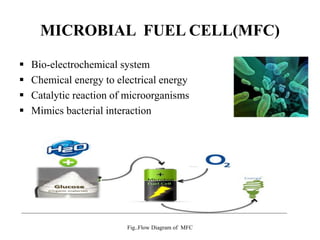
MICROBIAL FUEL CELL(MFC)
 Bio-electrochemical system
 Chemical energy to electrical energy
 Catalytic reaction of microorganisms
 Mimics bacterial interaction
Fig..Flow Diagram of MFC
PRINCIPLE
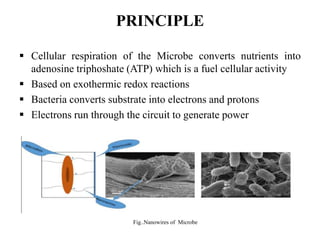
 Cellular respiration of the Microbe converts nutrients into
adenosine triphoshate (ATP) which is a fuel cellular activity
 Based on exothermic redox reactions
 Bacteria converts substrate into electrons and protons
 Electrons run through the circuit to generate power
Fig..Nanowires of Microbe
TYPES OF MFC
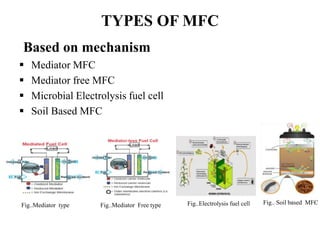
Based on mechanism
 Mediator MFC
 Mediator free MFC
 Microbial Electrolysis fuel cell
 Soil Based MFC
Fig..Mediator type Fig..Mediator Free type Fig..Electrolysis fuel cell Fig.. Soil based MFC
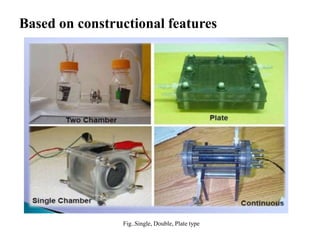
Based on constructional features
Fig..Single, Double, Plate type
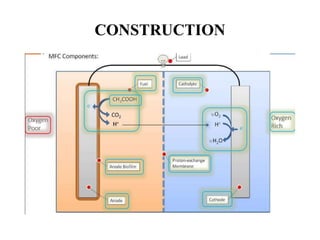
CONSTRUCTION
COMPONENTS
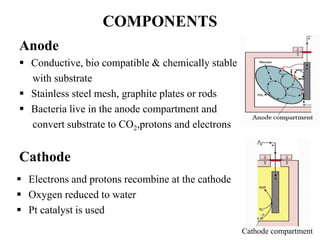
Anode
 Conductive, bio compatible & chemically stable
with substrate
 Stainless steel mesh, graphite plates or rods
 Bacteria live in the anode compartment and
convert substrate to CO2,protons and electrons
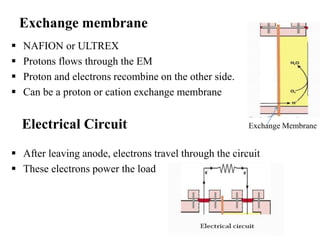
 Electrons and protons recombine at the cathode
 Oxygen reduced to water
 Pt catalyst is used
Cathode
Cathode compartment
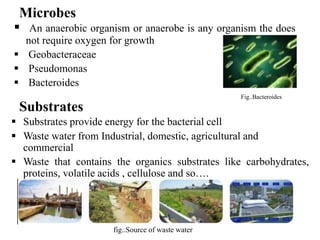
Exchange membrane
 NAFION or ULTREX
 Protons flows through the EM
 Proton and electrons recombine on the other side.
 Can be a proton or cation exchange membrane
 After leaving anode, electrons travel through the circuit
 These electrons power the load
Exchange MembraneElectrical Circuit
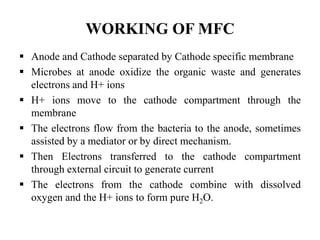
Microbes
 An anaerobic organism or anaerobe is any organism the does
not require oxygen for growth
 Geobacteraceae
 Pseudomonas
 Bacteroides
Substrates
 Substrates provide energy for the bacterial cell
 Waste water from Industrial, domestic, agricultural and
commercial
 Waste that contains the organics substrates like carbohydrates,
proteins, volatile acids , cellulose and so….
Fig..Bacteroides
fig..Source of waste water
WORKING OF MFC
 Anode and Cathode separated by Cathode specific membrane
 Microbes at anode oxidize the organic waste and generates
electrons and H+ ions
 H+ ions move to the cathode compartment through the
membrane
 The electrons flow from the bacteria to the anode, sometimes
assisted by a mediator or by direct mechanism.
 Then Electrons transferred to the cathode compartment
through external circuit to generate current
 The electrons from the cathode combine with dissolved
oxygen and the H+ ions to form pure H2O.
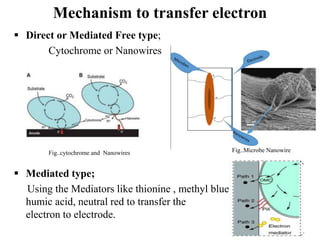
Mechanism to transfer electron
 Direct or Mediated Free type;
Cytochrome or Nanowires
 Mediated type;
Using the Mediators like thionine , methyl blue,
humic acid, neutral red to transfer the
electron to electrode.
Fig..cytochrome and Nanowires Fig..Microbe Nanowire
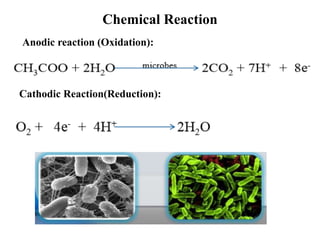
Chemical Reaction
Anodic reaction (Oxidation):
Cathodic Reaction(Reduction):
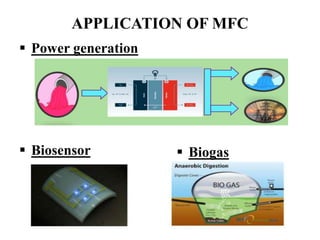
APPLICATION OF MFC
 Power generation
 Biosensor  Biogas
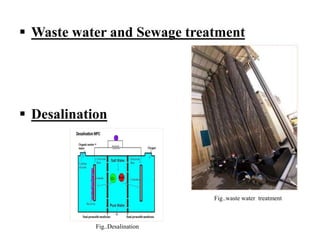
 Waste water and Sewage treatment
 Desalination
Fig..waste water treatment
Fig..Desalination
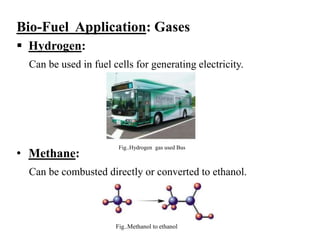
Bio-Fuel Application: Gases
 Hydrogen:
Can be used in fuel cells for generating electricity.
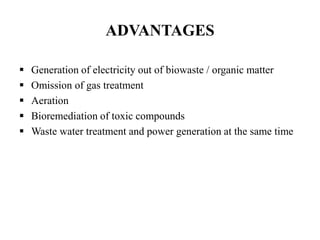
• Methane:
Can be combusted directly or converted to ethanol.
Fig..Methanol to ethanol
Fig..Hydrogen gas used Bus
ADVANTAGES
 Generation of electricity out of biowaste / organic matter
 Omission of gas treatment
 Aeration
 Bioremediation of toxic compounds
 Waste water treatment and power generation at the same time
LIMITATIONS
 Low power density
 High initial cost
 Activation losses
 Ohmic losses
 Bacterial metabolic losses
CONCLUSION
 Microbial Fuel Cell technology is clean and effective technology.
 MFCs have been explored as a new source of electricity
generation during operational waste water treatment
 Phototropic MFCs and solar powered MFC also represent an
exceptional attempt in the progress of MFCs technology for
electricity production
 It can be used for production of secondary fuel as well as in
bioremediation of toxic compounds
 However, this technology is only in research stage and more
research is required before domestic MFCs can be made available
for commercialization
REFERENCES
 Ghangrekar MM, Shinde VB. “Membrane-less microbial fuel cell treating
wastewater and effect of electrode distance and area on electricity
production” Bioresour Technol. 2007;98(15):2879–2885. doi:
10.1016/j.biortech.2006.09.050.
 Sumiao Pang, Yang Gao, Seokheun Choi , “Flexible and stretchable microbial fuel
cells with modified conductive and hydrophilic textile "Biosensor and
Bioelectronics 100(2018) 504-511
 A. S. Vishwanathana,, Kartik S. Aiyera, S. Siva Sankara Saib, Govind Rao, “High-
throughput platform for screening microbial fuel cell components”Procedia
Technology 27 ( 2017 ) 260 – 262
 Yu Tiana ,b,n, Hui Lib, Lipin Lib, Xinying Su, “In-situ integration of microbial fuel
cell with hollow-fiber membrane bioreactor for wastewater treatment and membrane
fouling mitigation” Biotechnology report 14(2017)47-53.
 Bruce e. Logan,*Bert Hamelers,Rene Arozendal,“Microbial Fuel Cells:
Methodology and Technology”.
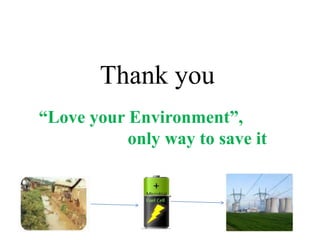
Thank you
“Love your Environment”,
only way to save it

MICROBIAL FUEL CELL

  • 1.
    Presented by PRAVEEN HM 1CG14ME074 Mechanical Engineering CIT, Gubbi, Tumakuru - 572 216 Channabasaveshwara Institute of Technology (NAAC Accredited & ISO 9001:2015 Certified Institution) (Affiliated to Visvesvaraya Technological University, Belagavi) (Recognised by A.I.C.T.E. New Delhi) Under the Guidance of Mr. NATESH C P M.Tech,(Ph.D),AMIE Asst. Professor, Dept. of ME CIT, Gubbi, Tumakuru - 572 216 MICROBIAL FUEL CELL GENERATING POWER FROM WASTE WATER
  • 2.
    CONTENTS  INTRODUCTION  MICROBIALFUEL CELL(MFC)  TYPES OF MFC  PRINCIPLE  CONSTRUCTION  WORKING OF MFC  APPLICATION OF MFC  ADVANTAGES OF MFC  LIMITATIONS OF MFC  CONCLUSION  REFERENCES
  • 3.
    INTRODUCTION  Renewable andclean forms of energy are one of society's greatest needs.  Use of the fossil fuels can trigger global energy crisis and increased global warming hence there is considerable interest in research fraternity on green production.  In an era of climate change, alternate energy sources are desired to replace oil and carbon resources. Subsequently, climate change effects in some areas and the increasing production of biofuels are also putting pressure on available water resources.  Microbial Fuel Cells have the potential to simultaneously treat wastewater for reuse and to generate electricity;  M.C Potter was the first to perform work on the subject in 1911 in E.coli, professor of botany at the University of Durham.
  • 4.
    MICROBIAL FUEL CELL(MFC) Bio-electrochemical system  Chemical energy to electrical energy  Catalytic reaction of microorganisms  Mimics bacterial interaction Fig..Flow Diagram of MFC
  • 5.
    PRINCIPLE  Cellular respirationof the Microbe converts nutrients into adenosine triphoshate (ATP) which is a fuel cellular activity  Based on exothermic redox reactions  Bacteria converts substrate into electrons and protons  Electrons run through the circuit to generate power Fig..Nanowires of Microbe
  • 6.
    TYPES OF MFC Basedon mechanism  Mediator MFC  Mediator free MFC  Microbial Electrolysis fuel cell  Soil Based MFC Fig..Mediator type Fig..Mediator Free type Fig..Electrolysis fuel cell Fig.. Soil based MFC
  • 7.
    Based on constructionalfeatures Fig..Single, Double, Plate type
  • 8.
  • 9.
    COMPONENTS Anode  Conductive, biocompatible & chemically stable with substrate  Stainless steel mesh, graphite plates or rods  Bacteria live in the anode compartment and convert substrate to CO2,protons and electrons  Electrons and protons recombine at the cathode  Oxygen reduced to water  Pt catalyst is used Cathode Cathode compartment
  • 10.
    Exchange membrane  NAFIONor ULTREX  Protons flows through the EM  Proton and electrons recombine on the other side.  Can be a proton or cation exchange membrane  After leaving anode, electrons travel through the circuit  These electrons power the load Exchange MembraneElectrical Circuit
  • 11.
    Microbes  An anaerobicorganism or anaerobe is any organism the does not require oxygen for growth  Geobacteraceae  Pseudomonas  Bacteroides Substrates  Substrates provide energy for the bacterial cell  Waste water from Industrial, domestic, agricultural and commercial  Waste that contains the organics substrates like carbohydrates, proteins, volatile acids , cellulose and so…. Fig..Bacteroides fig..Source of waste water
  • 12.
    WORKING OF MFC Anode and Cathode separated by Cathode specific membrane  Microbes at anode oxidize the organic waste and generates electrons and H+ ions  H+ ions move to the cathode compartment through the membrane  The electrons flow from the bacteria to the anode, sometimes assisted by a mediator or by direct mechanism.  Then Electrons transferred to the cathode compartment through external circuit to generate current  The electrons from the cathode combine with dissolved oxygen and the H+ ions to form pure H2O.
  • 13.
    Mechanism to transferelectron  Direct or Mediated Free type; Cytochrome or Nanowires  Mediated type; Using the Mediators like thionine , methyl blue, humic acid, neutral red to transfer the electron to electrode. Fig..cytochrome and Nanowires Fig..Microbe Nanowire
  • 14.
    Chemical Reaction Anodic reaction(Oxidation): Cathodic Reaction(Reduction):
  • 15.
    APPLICATION OF MFC Power generation  Biosensor  Biogas
  • 16.
     Waste waterand Sewage treatment  Desalination Fig..waste water treatment Fig..Desalination
  • 17.
    Bio-Fuel Application: Gases Hydrogen: Can be used in fuel cells for generating electricity. • Methane: Can be combusted directly or converted to ethanol. Fig..Methanol to ethanol Fig..Hydrogen gas used Bus
  • 18.
    ADVANTAGES  Generation ofelectricity out of biowaste / organic matter  Omission of gas treatment  Aeration  Bioremediation of toxic compounds  Waste water treatment and power generation at the same time
  • 19.
    LIMITATIONS  Low powerdensity  High initial cost  Activation losses  Ohmic losses  Bacterial metabolic losses
  • 20.
    CONCLUSION  Microbial FuelCell technology is clean and effective technology.  MFCs have been explored as a new source of electricity generation during operational waste water treatment  Phototropic MFCs and solar powered MFC also represent an exceptional attempt in the progress of MFCs technology for electricity production  It can be used for production of secondary fuel as well as in bioremediation of toxic compounds  However, this technology is only in research stage and more research is required before domestic MFCs can be made available for commercialization
  • 21.
    REFERENCES  Ghangrekar MM,Shinde VB. “Membrane-less microbial fuel cell treating wastewater and effect of electrode distance and area on electricity production” Bioresour Technol. 2007;98(15):2879–2885. doi: 10.1016/j.biortech.2006.09.050.  Sumiao Pang, Yang Gao, Seokheun Choi , “Flexible and stretchable microbial fuel cells with modified conductive and hydrophilic textile "Biosensor and Bioelectronics 100(2018) 504-511  A. S. Vishwanathana,, Kartik S. Aiyera, S. Siva Sankara Saib, Govind Rao, “High- throughput platform for screening microbial fuel cell components”Procedia Technology 27 ( 2017 ) 260 – 262  Yu Tiana ,b,n, Hui Lib, Lipin Lib, Xinying Su, “In-situ integration of microbial fuel cell with hollow-fiber membrane bioreactor for wastewater treatment and membrane fouling mitigation” Biotechnology report 14(2017)47-53.  Bruce e. Logan,*Bert Hamelers,Rene Arozendal,“Microbial Fuel Cells: Methodology and Technology”.
  • 22.
    Thank you “Love yourEnvironment”, only way to save it