Contents:
2
 Introduction
 History
 Literature survey
 Types of Microbial fuel cells
 Working Principle
 Applications
 References
11/25/2013
Introduction
• Microbial Fuel Cells (MFCs) are an emerging
technology that uses bacteria to generate electricity
from waste.
• Microbial Fuel Cells are used to produce electricity
while simultaneously cleaning wastewater.
• With future development, MFCs have the potential to
produce hydrogen for fuel cells, desalinate sea water,
and provide sustainable energy sources for remote areas.
3 11/25/2013
Definition
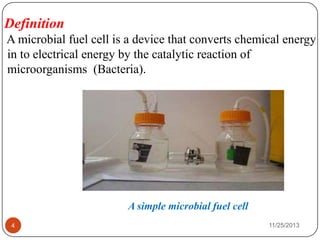
A microbial fuel cell is a device that converts chemical energy
in to electrical energy by the catalytic reaction of
microorganisms (Bacteria).
A simple microbial fuel cell
4 11/25/2013
History
• The idea of obtaining energy from bacteria began in
1911 with M. C. Potter, a professor of botany at the
University of Durham .
• In 1980, M. J. Allen and H. Peter Bennetto from
Kings College in London revolutionized the original
microbial fuel cell design.
• In the 1990s, B-H.Kim, a researcher from the Korean
Institute of Science and Technology, discovered that
certain species of bacteria were electrochemically
active and didn’t require the use of a mediator
molecule to transport electrons to the electrodes.
5 11/25/2013
11/25/20136
Literature Survey
“Electricity production coupled with Waste Water
treatment using MICROBIAL FUEL CELL”
 by Vineetha V, Shibu K. Department of Civil
Engineering, College of Engineering,
Thiruvananthapuram, Kerala.
 This paper presents the study on mediator less MFCs for
waste water treatment using modified anodes .
 comparison of electricity generation was carried out with
Plain carbon rods and iron coated carbon rods as anodes.
11/25/20137
 It was observed that this single chambered mediator less
microbial fuel cell was capable of giving higher removal
of Chemical Oxygen Demand (COD) and Biological
Oxygen Demand (BOD).
 maximum voltage production was obtained from MFC
with heated iron coated carbon as anode.
11/25/20138
“Electricity Generation from Petrochemical Wastewater
Using a Membrane-Less Single Chamber” Microbial Fuel
Cell
 By Seyed Kamran Foad Marashi, Hamid-Reza Kariminia
 Effects of wastewater concentration as substrate for
microbial oxidation, and anode material (stainless steel or
carbon brush) were investigated as designing parameters
 Higher voltage was observed at more concentrated
wastewater.
 Carbon brush anode had 2-folds maximum power density
than that of stainless steel anode electrode.
11/25/20139
 by Hongwei Gao, Andrew Meehan, and Zbigniew
Lewandowski ,Montana State University, Bozeman, USA.
“New Microbial Fuel Cell Power System for
Efficiency Improvement”
 Their paper presents a power management system for
energy harvesting with multiple microbial fuel cells (MFCs)
 The system first connects a capacitor to each MFC
in parallel so that the capacitors are charged by the
MFCs
11/25/201310
 The system allows low voltage low current MFCs to be
used to power high voltage high current electronic devices
deployed in the water. The system was tested in the lab
 Then the system disconnects the capacitors from the
MFCs, connects all the capacitors in series, and connects all
the series-connected capacitors to a boost converter.
Types of Microbial fuel cells
• Mediator microbial fuel cell:
The electron transfer from microbial cells to the
electrode is facilitated by mediators such as
thionine, methyl blue, neutral red and so on.
• Mediator-free microbial fuel cell:
Mediator-free microbial fuel cells do not require a
mediator but use electrochemically active bacteria to
transfer electrons to the electrode.
11 11/25/2013
Some electrochemically active bacteria's are:
 Shewanella putrefaciens
 Aeromonas hydrophila
 Geobacteraceae, etc.
12 11/25/2013
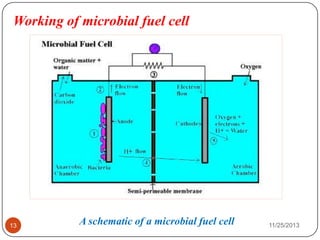
Working of microbial fuel cell
A schematic of a microbial fuel cell13 11/25/2013
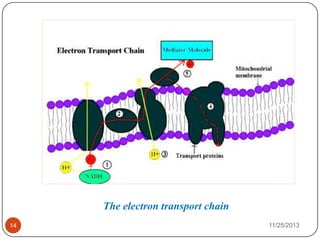
The electron transport chain
14 11/25/2013
11/25/201315
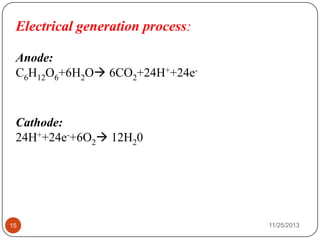
Electrical generation process:
Anode:
C6H12O6+6H2O 6CO2+24H++24e-
Cathode:
24H++24e-+6O2 12H20
11/25/201316
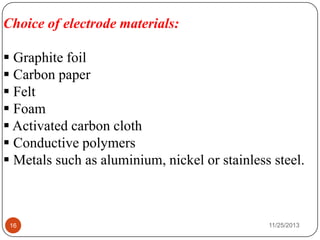
Choice of electrode materials:
 Graphite foil
 Carbon paper
 Felt
 Foam
 Activated carbon cloth
 Conductive polymers
 Metals such as aluminium, nickel or stainless steel.
Ways the MFC can improve the
world
17
(Applications)
11/25/2013
• Brewery and food manufacturing wastewater can
be treated by microbial fuel cells because their
wastewater is rich in organic compounds that can
serve as food for the microorganisms.
Brewery Wastewater Treatment
• Breweries are ideal for the implementation of
microbial fuel cells, as their wastewater composition is
always the same.
• Fosters, an Australian beer company, has begun
testing out an MFC to clean its wastewater while
generating electricity and clean water.
18 11/25/2013
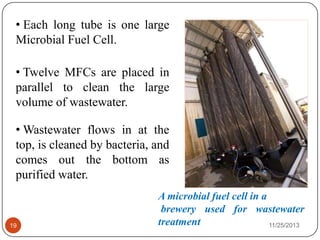
A microbial fuel cell in a
brewery used for wastewater
treatment
• Each long tube is one large
Microbial Fuel Cell.
• Twelve MFCs are placed in
parallel to clean the large
volume of wastewater.
• Wastewater flows in at the
top, is cleaned by bacteria, and
comes out the bottom as
purified water.
19 11/25/2013
Sewage Treatment
• Sewage wastewater can also be converted via microbial
fuel cells to decompose the waste organic material contained
within it.
•Research has shown that MFCs can reduce the amount of
organic material present in sewage wastewater up to 80%.
•The process is very similar to brewery wastewater
treatment, with the difference being that the water must first
be pre-treated to remove toxins and other non-biodegradable
materials.
20 11/25/2013
Desalination
• Desalination of sea water and brackish water for use as
drinking water has always presented significant problems
because of the amount of energy required to remove the
dissolved salts from the water.
• By using an adapted microbial fuel cell, this process
could proceed with no external electrical energy input.
21 11/25/2013
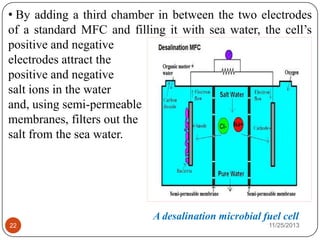
• By adding a third chamber in between the two electrodes
of a standard MFC and filling it with sea water, the cell’s
positive and negative
electrodes attract the
positive and negative
salt ions in the water
and, using semi-permeable
membranes, filters out the
salt from the sea water.
A desalination microbial fuel cell
22 11/25/2013
Hydrogen Production
• The standard MFC is converted to hydrogen production by
keeping both chambers anaerobic and supplementing the MFC
with electricity.
•Hydrogen bubbles form at the cathode and are collected for
use as fuel source.
• This method of producing hydrogen is very efficient because
more than 90% of the protons and electrons generated by the
bacteria at the anode are turned into hydrogen gas .
23 11/25/2013
Remote Sensors
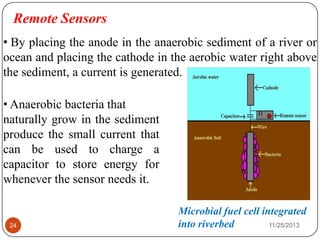
• By placing the anode in the anaerobic sediment of a river or
ocean and placing the cathode in the aerobic water right above
the sediment, a current is generated.
• Anaerobic bacteria that
naturally grow in the sediment
produce the small current that
can be used to charge a
capacitor to store energy for
whenever the sensor needs it.
Microbial fuel cell integrated
into riverbed24 11/25/2013
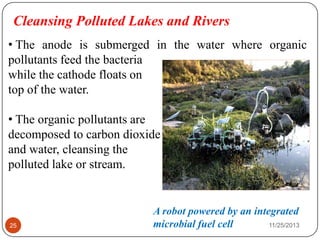
Cleansing Polluted Lakes and Rivers
• The anode is submerged in the water where organic
pollutants feed the bacteria
while the cathode floats on
top of the water.
• The organic pollutants are
decomposed to carbon dioxide
and water, cleansing the
polluted lake or stream.
A robot powered by an integrated
microbial fuel cell25 11/25/2013
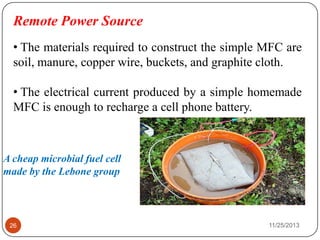
Remote Power Source
• The materials required to construct the simple MFC are
soil, manure, copper wire, buckets, and graphite cloth.
• The electrical current produced by a simple homemade
MFC is enough to recharge a cell phone battery.
A cheap microbial fuel cell
made by the Lebone group
26 11/25/2013
Conclusion
• The many applications of MFCs will help to reduce the
use of fossil fuels.
• Widespread use of MFCs in these areas can take our
waste products and transform them into energy
.
27 11/25/2013
• Microbial Fuel Cells (MFCs) use bacteria to convert
organic waste material into electrical energy.
References
28 11/25/2013
[1] Emmanuel P. Leana and Sandhya Babel, 2011
IEEE First Conference on Clean Energy and Technology CET
“Electricity Generation from Anaerobic Sludge and Cassava
Wastewater Subjected to Pre-treatment Methods Using
Microbial Fuel Cell”.
[2] Vineetha V, Shibu K. Department of Civil Engineering,
College of Engineering, Thiruvananthapuram, Kerala
“Electricity production coupled with Waste water treatment
using microbial fuel cell”
29 11/25/2013
[3] Seyed Kamran Foad Marashi, Hamid-Reza Kariminia
Department of Chemical and Petroleum Engineering
Sharif University of Technology Tehran, Iran
“Electricity Generation from Petrochemical Wastewater
Using a Membrane-Less Single Chamber” Microbial Fuel
Cell
[4] Hongwei Gao, Andrew Meehan, and Zbigniew
Lewandowski Montana State University, Bozeman, USA
“New Microbial Fuel Cell Power System for
Efficiency Improvement”
11/25/201330
Websites:
http://en.wikipedia.org/wiki/Microbial_fuel_cell
http://www.microbialfuelcell.org/www/
http://illumin.usc.edu/printer/134/microbial-fuel-cells-
generating-power-from-waste/
31 11/25/2013

Special topic seminar microbial fuel cells

  • 2.
    Contents: 2  Introduction  History Literature survey  Types of Microbial fuel cells  Working Principle  Applications  References 11/25/2013
  • 3.
    Introduction • Microbial FuelCells (MFCs) are an emerging technology that uses bacteria to generate electricity from waste. • Microbial Fuel Cells are used to produce electricity while simultaneously cleaning wastewater. • With future development, MFCs have the potential to produce hydrogen for fuel cells, desalinate sea water, and provide sustainable energy sources for remote areas. 3 11/25/2013
  • 4.
    Definition A microbial fuelcell is a device that converts chemical energy in to electrical energy by the catalytic reaction of microorganisms (Bacteria). A simple microbial fuel cell 4 11/25/2013
  • 5.
    History • The ideaof obtaining energy from bacteria began in 1911 with M. C. Potter, a professor of botany at the University of Durham . • In 1980, M. J. Allen and H. Peter Bennetto from Kings College in London revolutionized the original microbial fuel cell design. • In the 1990s, B-H.Kim, a researcher from the Korean Institute of Science and Technology, discovered that certain species of bacteria were electrochemically active and didn’t require the use of a mediator molecule to transport electrons to the electrodes. 5 11/25/2013
  • 6.
    11/25/20136 Literature Survey “Electricity productioncoupled with Waste Water treatment using MICROBIAL FUEL CELL”  by Vineetha V, Shibu K. Department of Civil Engineering, College of Engineering, Thiruvananthapuram, Kerala.  This paper presents the study on mediator less MFCs for waste water treatment using modified anodes .  comparison of electricity generation was carried out with Plain carbon rods and iron coated carbon rods as anodes.
  • 7.
    11/25/20137  It wasobserved that this single chambered mediator less microbial fuel cell was capable of giving higher removal of Chemical Oxygen Demand (COD) and Biological Oxygen Demand (BOD).  maximum voltage production was obtained from MFC with heated iron coated carbon as anode.
  • 8.
    11/25/20138 “Electricity Generation fromPetrochemical Wastewater Using a Membrane-Less Single Chamber” Microbial Fuel Cell  By Seyed Kamran Foad Marashi, Hamid-Reza Kariminia  Effects of wastewater concentration as substrate for microbial oxidation, and anode material (stainless steel or carbon brush) were investigated as designing parameters  Higher voltage was observed at more concentrated wastewater.  Carbon brush anode had 2-folds maximum power density than that of stainless steel anode electrode.
  • 9.
    11/25/20139  by HongweiGao, Andrew Meehan, and Zbigniew Lewandowski ,Montana State University, Bozeman, USA. “New Microbial Fuel Cell Power System for Efficiency Improvement”  Their paper presents a power management system for energy harvesting with multiple microbial fuel cells (MFCs)  The system first connects a capacitor to each MFC in parallel so that the capacitors are charged by the MFCs
  • 10.
    11/25/201310  The systemallows low voltage low current MFCs to be used to power high voltage high current electronic devices deployed in the water. The system was tested in the lab  Then the system disconnects the capacitors from the MFCs, connects all the capacitors in series, and connects all the series-connected capacitors to a boost converter.
  • 11.
    Types of Microbialfuel cells • Mediator microbial fuel cell: The electron transfer from microbial cells to the electrode is facilitated by mediators such as thionine, methyl blue, neutral red and so on. • Mediator-free microbial fuel cell: Mediator-free microbial fuel cells do not require a mediator but use electrochemically active bacteria to transfer electrons to the electrode. 11 11/25/2013
  • 12.
    Some electrochemically activebacteria's are:  Shewanella putrefaciens  Aeromonas hydrophila  Geobacteraceae, etc. 12 11/25/2013
  • 13.
    Working of microbialfuel cell A schematic of a microbial fuel cell13 11/25/2013
  • 14.
    The electron transportchain 14 11/25/2013
  • 15.
    11/25/201315 Electrical generation process: Anode: C6H12O6+6H2O6CO2+24H++24e- Cathode: 24H++24e-+6O2 12H20
  • 16.
    11/25/201316 Choice of electrodematerials:  Graphite foil  Carbon paper  Felt  Foam  Activated carbon cloth  Conductive polymers  Metals such as aluminium, nickel or stainless steel.
  • 17.
    Ways the MFCcan improve the world 17 (Applications) 11/25/2013
  • 18.
    • Brewery andfood manufacturing wastewater can be treated by microbial fuel cells because their wastewater is rich in organic compounds that can serve as food for the microorganisms. Brewery Wastewater Treatment • Breweries are ideal for the implementation of microbial fuel cells, as their wastewater composition is always the same. • Fosters, an Australian beer company, has begun testing out an MFC to clean its wastewater while generating electricity and clean water. 18 11/25/2013
  • 19.
    A microbial fuelcell in a brewery used for wastewater treatment • Each long tube is one large Microbial Fuel Cell. • Twelve MFCs are placed in parallel to clean the large volume of wastewater. • Wastewater flows in at the top, is cleaned by bacteria, and comes out the bottom as purified water. 19 11/25/2013
  • 20.
    Sewage Treatment • Sewagewastewater can also be converted via microbial fuel cells to decompose the waste organic material contained within it. •Research has shown that MFCs can reduce the amount of organic material present in sewage wastewater up to 80%. •The process is very similar to brewery wastewater treatment, with the difference being that the water must first be pre-treated to remove toxins and other non-biodegradable materials. 20 11/25/2013
  • 21.
    Desalination • Desalination ofsea water and brackish water for use as drinking water has always presented significant problems because of the amount of energy required to remove the dissolved salts from the water. • By using an adapted microbial fuel cell, this process could proceed with no external electrical energy input. 21 11/25/2013
  • 22.
    • By addinga third chamber in between the two electrodes of a standard MFC and filling it with sea water, the cell’s positive and negative electrodes attract the positive and negative salt ions in the water and, using semi-permeable membranes, filters out the salt from the sea water. A desalination microbial fuel cell 22 11/25/2013
  • 23.
    Hydrogen Production • Thestandard MFC is converted to hydrogen production by keeping both chambers anaerobic and supplementing the MFC with electricity. •Hydrogen bubbles form at the cathode and are collected for use as fuel source. • This method of producing hydrogen is very efficient because more than 90% of the protons and electrons generated by the bacteria at the anode are turned into hydrogen gas . 23 11/25/2013
  • 24.
    Remote Sensors • Byplacing the anode in the anaerobic sediment of a river or ocean and placing the cathode in the aerobic water right above the sediment, a current is generated. • Anaerobic bacteria that naturally grow in the sediment produce the small current that can be used to charge a capacitor to store energy for whenever the sensor needs it. Microbial fuel cell integrated into riverbed24 11/25/2013
  • 25.
    Cleansing Polluted Lakesand Rivers • The anode is submerged in the water where organic pollutants feed the bacteria while the cathode floats on top of the water. • The organic pollutants are decomposed to carbon dioxide and water, cleansing the polluted lake or stream. A robot powered by an integrated microbial fuel cell25 11/25/2013
  • 26.
    Remote Power Source •The materials required to construct the simple MFC are soil, manure, copper wire, buckets, and graphite cloth. • The electrical current produced by a simple homemade MFC is enough to recharge a cell phone battery. A cheap microbial fuel cell made by the Lebone group 26 11/25/2013
  • 27.
    Conclusion • The manyapplications of MFCs will help to reduce the use of fossil fuels. • Widespread use of MFCs in these areas can take our waste products and transform them into energy . 27 11/25/2013 • Microbial Fuel Cells (MFCs) use bacteria to convert organic waste material into electrical energy.
  • 28.
    References 28 11/25/2013 [1] EmmanuelP. Leana and Sandhya Babel, 2011 IEEE First Conference on Clean Energy and Technology CET “Electricity Generation from Anaerobic Sludge and Cassava Wastewater Subjected to Pre-treatment Methods Using Microbial Fuel Cell”. [2] Vineetha V, Shibu K. Department of Civil Engineering, College of Engineering, Thiruvananthapuram, Kerala “Electricity production coupled with Waste water treatment using microbial fuel cell”
  • 29.
    29 11/25/2013 [3] SeyedKamran Foad Marashi, Hamid-Reza Kariminia Department of Chemical and Petroleum Engineering Sharif University of Technology Tehran, Iran “Electricity Generation from Petrochemical Wastewater Using a Membrane-Less Single Chamber” Microbial Fuel Cell [4] Hongwei Gao, Andrew Meehan, and Zbigniew Lewandowski Montana State University, Bozeman, USA “New Microbial Fuel Cell Power System for Efficiency Improvement”
  • 30.
  • 31.