




icrobial Fuel Cell
The future of Bio-energy…M Vishal .V. Doshi
Ms in Molecular Biology (Contd.),
Skövde University,
Skövde-54162,
Sweden.
What is Microbial Fuel Cells (MFC) ?
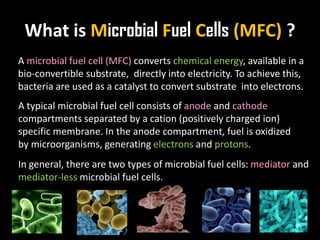
A microbial fuel cell (MFC) converts chemical energy, available in a
bio-convertible substrate, directly into electricity. To achieve this,
bacteria are used as a catalyst to convert substrate into electrons.
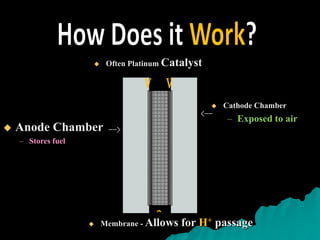
A typical microbial fuel cell consists of anode and cathode
compartments separated by a cation (positively charged ion)
specific membrane. In the anode compartment, fuel is oxidized
by microorganisms, generating electrons and protons.
In general, there are two types of microbial fuel cells: mediator and
mediator-less microbial fuel cells.
Why Microbial Fuel Cells (MFC) ?
• Unlimited supply of fuel
• No reliance on foreign oil
• Little or no pollutants
• Much higher energy conversion %
• No moving parts
• No noise
 Anode Chamber
– Stores fuel
-->
 Cathode Chamber
– Exposed to air
<--
 Membrane - Allows for H+ passage^
 Often Platinum Catalyst
V V
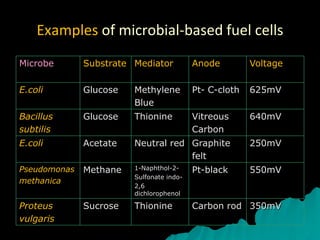
Examples of microbial-based fuel cells
Microbe Substrate Mediator Anode Voltage
E.coli Glucose Methylene
Blue
Pt- C-cloth 625mV
Bacillus
subtilis
Glucose Thionine Vitreous
Carbon
640mV
E.coli Acetate Neutral red Graphite
felt
250mV
Pseudomonas
methanica
Methane 1-Naphthol-2-
Sulfonate indo-
2,6
dichlorophenol
Pt-black 550mV
Proteus
vulgaris
Sucrose Thionine Carbon rod 350mV
Molecular Biology
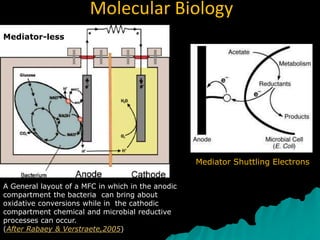
A General layout of a MFC in which in the anodic
compartment the bacteria can bring about
oxidative conversions while in the cathodic
compartment chemical and microbial reductive
processes can occur.
(After Rabaey & Verstraete,2005)
Mediator Shuttling Electrons
Mediator-less
Molecular Biology
Mediator-less
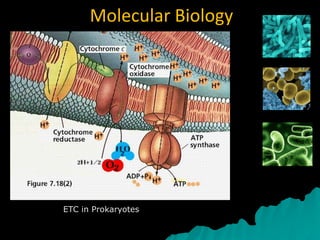
ETC in Prokaryotes
Molecular Biology
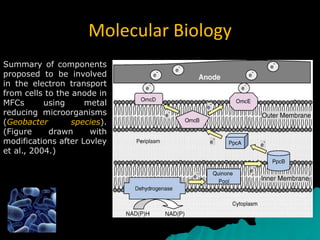
Summary of components
proposed to be involved
in the electron transport
from cells to the anode in
MFCs using metal
reducing microorganisms
(Geobacter species).
(Figure drawn with
modifications after Lovley
et al., 2004.)
Significant Factors Affecting
MFC Operation
 Type of electrodes
 Surface area of electrodes
 Use of catalysts
 Conc. of hydrocarbon in anode chamber
 Agitation of hydrocarbon molecules
 Rate of replacement of hydrocarbons
 Types of microbes/enzymes
 Conc. of microbes/enzymes
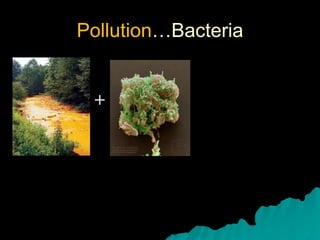
Pollution…An Example
Pollution…Bacteria
+
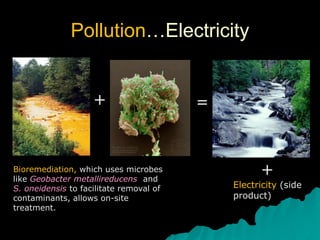
Pollution…Electricity
+ =
Bioremediation, which uses microbes
like Geobacter metallireducens and
S. oneidensis to facilitate removal of
contaminants, allows on-site
treatment.
+
Electricity (side
product)
Conclusion..!?
Thank you for
patient listening

Bio fuel cells | Sludge Treatment

  • 1.
    icrobial Fuel Cell Thefuture of Bio-energy…M Vishal .V. Doshi Ms in Molecular Biology (Contd.), Skövde University, Skövde-54162, Sweden.
  • 2.
    What is MicrobialFuel Cells (MFC) ? A microbial fuel cell (MFC) converts chemical energy, available in a bio-convertible substrate, directly into electricity. To achieve this, bacteria are used as a catalyst to convert substrate into electrons. A typical microbial fuel cell consists of anode and cathode compartments separated by a cation (positively charged ion) specific membrane. In the anode compartment, fuel is oxidized by microorganisms, generating electrons and protons. In general, there are two types of microbial fuel cells: mediator and mediator-less microbial fuel cells.
  • 3.
    Why Microbial FuelCells (MFC) ? • Unlimited supply of fuel • No reliance on foreign oil • Little or no pollutants • Much higher energy conversion % • No moving parts • No noise
  • 4.
     Anode Chamber –Stores fuel -->  Cathode Chamber – Exposed to air <--  Membrane - Allows for H+ passage^  Often Platinum Catalyst V V
  • 5.
    Examples of microbial-basedfuel cells Microbe Substrate Mediator Anode Voltage E.coli Glucose Methylene Blue Pt- C-cloth 625mV Bacillus subtilis Glucose Thionine Vitreous Carbon 640mV E.coli Acetate Neutral red Graphite felt 250mV Pseudomonas methanica Methane 1-Naphthol-2- Sulfonate indo- 2,6 dichlorophenol Pt-black 550mV Proteus vulgaris Sucrose Thionine Carbon rod 350mV
  • 6.
    Molecular Biology A Generallayout of a MFC in which in the anodic compartment the bacteria can bring about oxidative conversions while in the cathodic compartment chemical and microbial reductive processes can occur. (After Rabaey & Verstraete,2005) Mediator Shuttling Electrons Mediator-less
  • 7.
  • 8.
    Molecular Biology Summary ofcomponents proposed to be involved in the electron transport from cells to the anode in MFCs using metal reducing microorganisms (Geobacter species). (Figure drawn with modifications after Lovley et al., 2004.)
  • 9.
    Significant Factors Affecting MFCOperation  Type of electrodes  Surface area of electrodes  Use of catalysts  Conc. of hydrocarbon in anode chamber  Agitation of hydrocarbon molecules  Rate of replacement of hydrocarbons  Types of microbes/enzymes  Conc. of microbes/enzymes
  • 10.
  • 11.
  • 12.
    Pollution…Electricity + = Bioremediation, whichuses microbes like Geobacter metallireducens and S. oneidensis to facilitate removal of contaminants, allows on-site treatment. + Electricity (side product)
  • 13.
  • 14.