Bioelectricity
Introduction
 Bioelectricity is the electrical currents and electrical potentials
generated by or occurring within living cells, tissues, and organisms.
 Bioelectrochemical systems (BESs) are composite devices that use
microorganisms and/or enzymes to generate or consume electric
current for a range of applications from power production to
bioremediation to biofuel formation.
 Two bioenergetic systems (BESs) gaining traction in renewable
energy are microbial fuel cells (MFCs) and microbial electrolysis cells
(MECs).
 MFCs use electrogenic microbes to generate renewable electricity
from the microbial catabolism of organic material in waste.
History
 M.C Potter was the first to perform work on the subject in 1911
in E.coli and yeast, A professor of botany at the University of
Durham.
 In 1931, however, Barnet Cohen drew more attention to the
area when he created several microbial half-fuel cells that,
when connected in series, could produce over 35 volts, though
only with a current of 2 milliamps.
 In 1911, B.H. Kim developed a mediator-less MFC, marking a
milestone in the field by enhancing commercial viability through
the elimination of costly mediator chemicals.
Microbial Fuel Cells ( MFCs)
 MFCs are BESs that use graphite and microbes as biocatalysts
to generate electrical currents which is much cheaper than
traditional fuel cells.
 The organic fuel used is biodegradable and is oxidized by
microorganisms in anode chamber to provide electrons to the
circuit.
 Newer MFCs, that don't rely on organic molecules have
emerged. Photosynthetic microbial fuel cells (photoMFCs), or
bio-photovoltaics (BPVs), use light energy captured by
phototrophs to generate electricity.
Principle
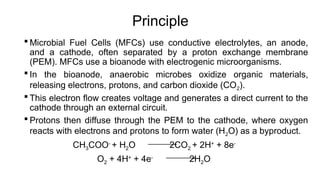
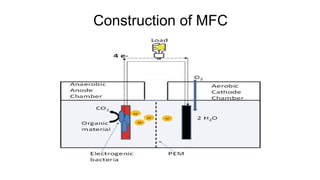
 Microbial Fuel Cells (MFCs) use conductive electrolytes, an anode,
and a cathode, often separated by a proton exchange membrane
(PEM). MFCs use a bioanode with electrogenic microorganisms.
 In the bioanode, anaerobic microbes oxidize organic materials,
releasing electrons, protons, and carbon dioxide (CO2).
 This electron flow creates voltage and generates a direct current to the
cathode through an external circuit.
 Protons then diffuse through the PEM to the cathode, where oxygen
reacts with electrons and protons to form water (H2O) as a byproduct.
CH3COO-
+ H2O 2CO2 + 2H+
+ 8e-
O2 + 4H+
+ 4e-
2H2O
Construction of MFC
Components of MFC
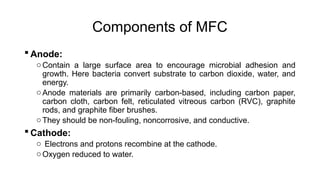
 Anode:
oContain a large surface area to encourage microbial adhesion and
growth. Here bacteria convert substrate to carbon dioxide, water, and
energy.
oAnode materials are primarily carbon-based, including carbon paper,
carbon cloth, carbon felt, reticulated vitreous carbon (RVC), graphite
rods, and graphite fiber brushes.
oThey should be non-fouling, noncorrosive, and conductive.
 Cathode:
o Electrons and protons recombine at the cathode.
oOxygen reduced to water.
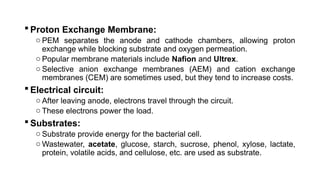
 Proton Exchange Membrane:
o PEM separates the anode and cathode chambers, allowing proton
exchange while blocking substrate and oxygen permeation.
o Popular membrane materials include Nafion and Ultrex.
o Selective anion exchange membranes (AEM) and cation exchange
membranes (CEM) are sometimes used, but they tend to increase costs.
 Electrical circuit:
o After leaving anode, electrons travel through the circuit.
o These electrons power the load.
 Substrates:
o Substrate provide energy for the bacterial cell.
o Wastewater, acetate, glucose, starch, sucrose, phenol, xylose, lactate,
protein, volatile acids, and cellulose, etc. are used as substrate.
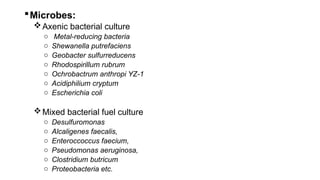
Microbes:
Axenic bacterial culture
o Metal-reducing bacteria
o Shewanella putrefaciens
o Geobacter sulfurreducens
o Rhodospirillum rubrum
o Ochrobactrum anthropi YZ-1
o Acidiphilium cryptum
o Escherichia coli
Mixed bacterial fuel culture
o Desulfuromonas
o Alcaligenes faecalis,
o Enteroccoccus faecium,
o Pseudomonas aeruginosa,
o Clostridium butricum
o Proteobacteria etc.
Types of MFC
 Electric current generation relies on the oxidation rate of
substrates mediated by microorganisms and the efficiency of
electron transfer to the electrodes.
 Mechanisms electrogens use to transfer electrons to anode
include-
1. Indirect electron transfer using electron mediators (Mediator
MFC) and
2. Direct electron transfer through contact between the electrode
and cell surface (Mediator-less MFC).
Mediator MFC
 Mediators are essential for microorganisms without active surface
proteins or factors that aid electron transfer to the anode.
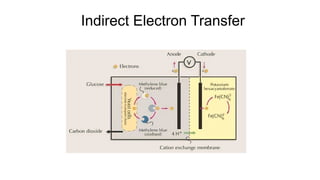
 This occurs when electron mediators enter the cell, harnessing
electrons from metabolic reactions and delivering them to the
anode.
 Electron mediators are produced by Pseudomonas, Enterococcus,
and Lactobacillus etc.
 Some electron mediators or electron acceptors include
ferricyanide, anthraquinone, persulfate, and manganese dioxide.
Indirect Electron Transfer
Direct Electron Transfer
 This process is accomplished without the use of any diffusional
electron mediators.
 The performance of a direct transfer MFC depends on electron
transfer between the bacterial membrane and the electrode.
 Geobacter sulfurreducens, Shewanella putrefaciens, and
Rhodoferax ferrireducens, etc. are capable of direct electron
transfer.
 Mediator-less microbial fuel cells can derive energy from plants
known as plant microbial fuel cells.
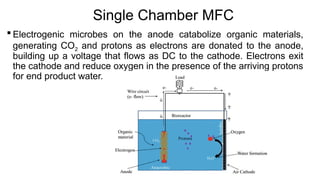
Single Chamber MFC
 Electrogenic microbes on the anode catabolize organic materials,
generating CO2 and protons as electrons are donated to the anode,
building up a voltage that flows as DC to the cathode. Electrons exit
the cathode and reduce oxygen in the presence of the arriving protons
for end product water.
Photosynthetic Microbial Fuel Cells (PhotoMFCs)
 PhotoMFCs utilize photosynthetic microorganisms added to the anode
and/or cathode chambers of the bioreactor.
 PhotoMFCs were first examined for light-driven microbial electrogenesis in
the 1960s using Rhodospirillum rubrum and Oscillatoria spp. as biocatalysts.
 In the 1980s electron mediators were added to anode chambers to produce
higher power density.
 PhotoMFCs may have the potential for removing carbon dioxide from the
atmosphere.
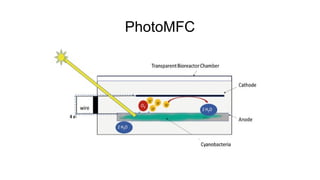
 A cyanobacterial biofilm grown on an illuminated anode photolyzes H2O to
form oxygen plus protons as electrons are donated to the anode, building a
voltage. Electrons flow as DC from the anode to the cathode where electrons
reduce oxygen in the presence of protons to reform water.
PhotoMFC
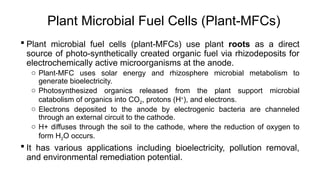
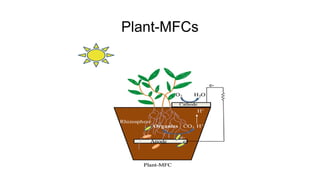
Plant Microbial Fuel Cells (Plant-MFCs)
 Plant microbial fuel cells (plant-MFCs) use plant roots as a direct
source of photo-synthetically created organic fuel via rhizodeposits for
electrochemically active microorganisms at the anode.
o Plant-MFC uses solar energy and rhizosphere microbial metabolism to
generate bioelectricity.
o Photosynthesized organics released from the plant support microbial
catabolism of organics into CO2, protons (H+
), and electrons.
o Electrons deposited to the anode by electrogenic bacteria are channeled
through an external circuit to the cathode.
o H+ diffuses through the soil to the cathode, where the reduction of oxygen to
form H2O occurs.
 It has various applications including bioelectricity, pollution removal,
and environmental remediation potential.
Plant-MFCs
Applications
 Waste water treatment
 Power generation
 Secondary fuel production
 Bio-Sensors –
oGlucose sensors
 Desalination
 Educational tool
Advantages
 Generation of energy out of biowaste/ organic matter
 Direct conversion of substrate energy to electricity.
 Omission of gas treatment
 Aeration
 Bioremediation of toxic compounds.
Challenges and Limitations
 slow start-up
 low power output-
oMFC resistance,
oMicrobial electron transport processes,
oElectrolyte resistance, and losses at the anode or cathode,
oCharge transfer and membrane resistance, and
oElectron acceptor reduction losses
 Resistance of proton transfer by the membrane material.
 Internal losses such as ohmic, concentration, and activation
losses.
Thank You

Bioelectricity_Undergraduate level .pptx

  • 1.
  • 2.
    Introduction  Bioelectricity isthe electrical currents and electrical potentials generated by or occurring within living cells, tissues, and organisms.  Bioelectrochemical systems (BESs) are composite devices that use microorganisms and/or enzymes to generate or consume electric current for a range of applications from power production to bioremediation to biofuel formation.  Two bioenergetic systems (BESs) gaining traction in renewable energy are microbial fuel cells (MFCs) and microbial electrolysis cells (MECs).  MFCs use electrogenic microbes to generate renewable electricity from the microbial catabolism of organic material in waste.
  • 3.
    History  M.C Potterwas the first to perform work on the subject in 1911 in E.coli and yeast, A professor of botany at the University of Durham.  In 1931, however, Barnet Cohen drew more attention to the area when he created several microbial half-fuel cells that, when connected in series, could produce over 35 volts, though only with a current of 2 milliamps.  In 1911, B.H. Kim developed a mediator-less MFC, marking a milestone in the field by enhancing commercial viability through the elimination of costly mediator chemicals.
  • 4.
    Microbial Fuel Cells( MFCs)  MFCs are BESs that use graphite and microbes as biocatalysts to generate electrical currents which is much cheaper than traditional fuel cells.  The organic fuel used is biodegradable and is oxidized by microorganisms in anode chamber to provide electrons to the circuit.  Newer MFCs, that don't rely on organic molecules have emerged. Photosynthetic microbial fuel cells (photoMFCs), or bio-photovoltaics (BPVs), use light energy captured by phototrophs to generate electricity.
  • 5.
    Principle  Microbial FuelCells (MFCs) use conductive electrolytes, an anode, and a cathode, often separated by a proton exchange membrane (PEM). MFCs use a bioanode with electrogenic microorganisms.  In the bioanode, anaerobic microbes oxidize organic materials, releasing electrons, protons, and carbon dioxide (CO2).  This electron flow creates voltage and generates a direct current to the cathode through an external circuit.  Protons then diffuse through the PEM to the cathode, where oxygen reacts with electrons and protons to form water (H2O) as a byproduct. CH3COO- + H2O 2CO2 + 2H+ + 8e- O2 + 4H+ + 4e- 2H2O
  • 6.
  • 7.
    Components of MFC Anode: oContain a large surface area to encourage microbial adhesion and growth. Here bacteria convert substrate to carbon dioxide, water, and energy. oAnode materials are primarily carbon-based, including carbon paper, carbon cloth, carbon felt, reticulated vitreous carbon (RVC), graphite rods, and graphite fiber brushes. oThey should be non-fouling, noncorrosive, and conductive.  Cathode: o Electrons and protons recombine at the cathode. oOxygen reduced to water.
  • 8.
     Proton ExchangeMembrane: o PEM separates the anode and cathode chambers, allowing proton exchange while blocking substrate and oxygen permeation. o Popular membrane materials include Nafion and Ultrex. o Selective anion exchange membranes (AEM) and cation exchange membranes (CEM) are sometimes used, but they tend to increase costs.  Electrical circuit: o After leaving anode, electrons travel through the circuit. o These electrons power the load.  Substrates: o Substrate provide energy for the bacterial cell. o Wastewater, acetate, glucose, starch, sucrose, phenol, xylose, lactate, protein, volatile acids, and cellulose, etc. are used as substrate.
  • 9.
    Microbes: Axenic bacterial culture oMetal-reducing bacteria o Shewanella putrefaciens o Geobacter sulfurreducens o Rhodospirillum rubrum o Ochrobactrum anthropi YZ-1 o Acidiphilium cryptum o Escherichia coli Mixed bacterial fuel culture o Desulfuromonas o Alcaligenes faecalis, o Enteroccoccus faecium, o Pseudomonas aeruginosa, o Clostridium butricum o Proteobacteria etc.
  • 10.
    Types of MFC Electric current generation relies on the oxidation rate of substrates mediated by microorganisms and the efficiency of electron transfer to the electrodes.  Mechanisms electrogens use to transfer electrons to anode include- 1. Indirect electron transfer using electron mediators (Mediator MFC) and 2. Direct electron transfer through contact between the electrode and cell surface (Mediator-less MFC).
  • 11.
    Mediator MFC  Mediatorsare essential for microorganisms without active surface proteins or factors that aid electron transfer to the anode.  This occurs when electron mediators enter the cell, harnessing electrons from metabolic reactions and delivering them to the anode.  Electron mediators are produced by Pseudomonas, Enterococcus, and Lactobacillus etc.  Some electron mediators or electron acceptors include ferricyanide, anthraquinone, persulfate, and manganese dioxide.
  • 12.
  • 13.
    Direct Electron Transfer This process is accomplished without the use of any diffusional electron mediators.  The performance of a direct transfer MFC depends on electron transfer between the bacterial membrane and the electrode.  Geobacter sulfurreducens, Shewanella putrefaciens, and Rhodoferax ferrireducens, etc. are capable of direct electron transfer.  Mediator-less microbial fuel cells can derive energy from plants known as plant microbial fuel cells.
  • 14.
    Single Chamber MFC Electrogenic microbes on the anode catabolize organic materials, generating CO2 and protons as electrons are donated to the anode, building up a voltage that flows as DC to the cathode. Electrons exit the cathode and reduce oxygen in the presence of the arriving protons for end product water.
  • 15.
    Photosynthetic Microbial FuelCells (PhotoMFCs)  PhotoMFCs utilize photosynthetic microorganisms added to the anode and/or cathode chambers of the bioreactor.  PhotoMFCs were first examined for light-driven microbial electrogenesis in the 1960s using Rhodospirillum rubrum and Oscillatoria spp. as biocatalysts.  In the 1980s electron mediators were added to anode chambers to produce higher power density.  PhotoMFCs may have the potential for removing carbon dioxide from the atmosphere.  A cyanobacterial biofilm grown on an illuminated anode photolyzes H2O to form oxygen plus protons as electrons are donated to the anode, building a voltage. Electrons flow as DC from the anode to the cathode where electrons reduce oxygen in the presence of protons to reform water.
  • 16.
  • 17.
    Plant Microbial FuelCells (Plant-MFCs)  Plant microbial fuel cells (plant-MFCs) use plant roots as a direct source of photo-synthetically created organic fuel via rhizodeposits for electrochemically active microorganisms at the anode. o Plant-MFC uses solar energy and rhizosphere microbial metabolism to generate bioelectricity. o Photosynthesized organics released from the plant support microbial catabolism of organics into CO2, protons (H+ ), and electrons. o Electrons deposited to the anode by electrogenic bacteria are channeled through an external circuit to the cathode. o H+ diffuses through the soil to the cathode, where the reduction of oxygen to form H2O occurs.  It has various applications including bioelectricity, pollution removal, and environmental remediation potential.
  • 18.
  • 19.
    Applications  Waste watertreatment  Power generation  Secondary fuel production  Bio-Sensors – oGlucose sensors  Desalination  Educational tool
  • 20.
    Advantages  Generation ofenergy out of biowaste/ organic matter  Direct conversion of substrate energy to electricity.  Omission of gas treatment  Aeration  Bioremediation of toxic compounds.
  • 21.
    Challenges and Limitations slow start-up  low power output- oMFC resistance, oMicrobial electron transport processes, oElectrolyte resistance, and losses at the anode or cathode, oCharge transfer and membrane resistance, and oElectron acceptor reduction losses  Resistance of proton transfer by the membrane material.  Internal losses such as ohmic, concentration, and activation losses.
  • 22.