By Sagar Divetiya
110990135013
Environmental Science & Technology
4th sem
1) Perquisites
a) Electrochemical cell
b) Fuel cells
2) Microbial Fuel cell (MFC)
a) Definition, meaning & Principle
b) Basic Design
c) Components & Working
3) Types of MFC
4) Applications of MFC
5) Advantages & limitations
6) Future & facts
9/8/2013 6:37 AM 2Composed by : Sagar Divetiya
9/8/2013 6:37 AM 3Composed by : Sagar Divetiya
A simple voltaic cell
9/8/2013 6:37 AM 4Composed by : Sagar Divetiya
“ A fuel cell is a device that converts the chemical energy
from a fuel into electricity through a chemical reaction with
oxygen or another oxidizing agent ”
Fuel
Fuel cell
Energy
9/8/2013 6:37 AM 5Composed by : Sagar Divetiya
9/8/2013 6:37 AM 6Composed by : Sagar Divetiya
9/8/2013 6:37 AM 7Composed by : Sagar Divetiya
9/8/2013 6:37 AM 8Composed by : Sagar Divetiya
 MFCs are still taking baby steps.
 If Fuel cells are new technology for us then MFCs are
newest.
 A very few people are working on it.
 Knowledge of Microbiology, Biochemistry, Material
science, Environmental Engineering, etc. required to
understand & improve this technology.
9/8/2013 6:37 AM 9Composed by : Sagar Divetiya
“ A microbial fuel cell is a device that converts
chemical energy to electrical energy by the catalytic
reaction of microorganisms. ”
9/8/2013 6:37 AM 10Composed by : Sagar Divetiya
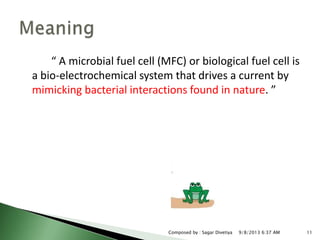
“ A microbial fuel cell (MFC) or biological fuel cell is
a bio-electrochemical system that drives a current by
mimicking bacterial interactions found in nature. ”
9/8/2013 6:37 AM 11Composed by : Sagar Divetiya
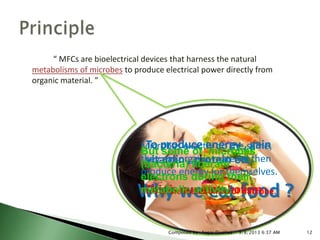
“ MFCs are bioelectrical devices that harness the natural
metabolisms of microbes to produce electrical power directly from
organic material. ”
Why we eat food ?
To produce energy , gain
vitamin , protein etc.
This is our metabolism
Microbes exactly do the same,
they eat organic material then
produce energy for themselves.
This is the metabolism of microbe.
But some of microbes
(bacteria) liberate
electrons during their
metabolic activity.
9/8/2013 6:37 AM 12Composed by : Sagar Divetiya
Fuel
Microbial
Fuel Cell
Energy
Glucose
(Organic material)
Fuel cell
9/8/2013 6:37 AM 13Composed by : Sagar Divetiya
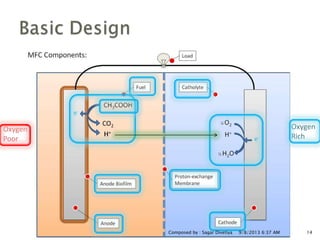
Oxygen
Poor
Oxygen
Rich
9/8/2013 6:37 AM 14Composed by : Sagar Divetiya
 Anodic Reaction (Oxidation)
◦ EX-1 : CH3COO - + 2H2O 2CO2 + 7H+ + 8e-
(Acetic acid ion)
◦ EX-2 : C6H12O6 + 6H2O 6CO2 + 24H+ + 24e-
(glucose)
 Cathodic Reaction (Reduction)
◦ EX-1 : O2 + 4H+ + 4e- 2H2O
◦ EX-2 : 6O2 + 24H+ + 24e- 12H2O
9/8/2013 6:37 AM 15Composed by : Sagar Divetiya
 Various things like glucose, acetate etc.
 Can be Obtained from Wastewater & solid waste
especially domestic.
9/8/2013 6:37 AM 16Composed by : Sagar Divetiya
9/8/2013 6:37 AM 17Composed by : Sagar Divetiya
9/8/2013 6:37 AM 18Composed by : Sagar Divetiya
9/8/2013 6:37 AM 19Composed by : Sagar Divetiya
9/8/2013 6:37 AM 20Composed by : Sagar Divetiya
9/8/2013 6:37 AM 21Composed by : Sagar Divetiya
9/8/2013 6:37 AM 22Composed by : Sagar Divetiya
9/8/2013 6:37 AM 23Composed by : Sagar Divetiya
9/8/2013 6:37 AM 24Composed by : Sagar Divetiya
9/8/2013 6:37 AM 25Composed by : Sagar Divetiya
 Treatment of Wastewater & solid wastes
◦ BOD removal
 Used to measure strength of wastewater
◦ Biosensor ( Principle: Voltage is proportional to organic material)
 Electrical Power Generation
 Bio-hydrogen
9/8/2013 6:37 AM 26Composed by : Sagar Divetiya
9/8/2013 6:37 AM 27Composed by : Sagar Divetiya
 Wider variety of applications over conventional fuel
cells.
 Can be used to solve Environmental Problems
 Wastewater treatment & power generation at a same
time.
 Good alternative to Conventional Power Generation
Systems.
9/8/2013 6:37 AM 28Composed by : Sagar Divetiya
 Limit on surface area of anode as bacteria can clog
small pores and hence limit on current.
 Still not economically competitive.
 Power produced way below when compared with
conventional cells.
 Very slow performance in wastewater treatment.
9/8/2013 6:37 AM 29Composed by : Sagar Divetiya
9/8/2013 6:37 AM 30Composed by : Sagar Divetiya
“Love your Environment”,
only way to save it
9/8/2013 6:37 AM 31Composed by : Sagar Divetiya

Microbial fuel cell advanced

  • 1.
  • 2.
    1) Perquisites a) Electrochemicalcell b) Fuel cells 2) Microbial Fuel cell (MFC) a) Definition, meaning & Principle b) Basic Design c) Components & Working 3) Types of MFC 4) Applications of MFC 5) Advantages & limitations 6) Future & facts 9/8/2013 6:37 AM 2Composed by : Sagar Divetiya
  • 3.
    9/8/2013 6:37 AM3Composed by : Sagar Divetiya
  • 4.
    A simple voltaiccell 9/8/2013 6:37 AM 4Composed by : Sagar Divetiya
  • 5.
    “ A fuelcell is a device that converts the chemical energy from a fuel into electricity through a chemical reaction with oxygen or another oxidizing agent ” Fuel Fuel cell Energy 9/8/2013 6:37 AM 5Composed by : Sagar Divetiya
  • 6.
    9/8/2013 6:37 AM6Composed by : Sagar Divetiya
  • 7.
    9/8/2013 6:37 AM7Composed by : Sagar Divetiya
  • 8.
    9/8/2013 6:37 AM8Composed by : Sagar Divetiya
  • 9.
     MFCs arestill taking baby steps.  If Fuel cells are new technology for us then MFCs are newest.  A very few people are working on it.  Knowledge of Microbiology, Biochemistry, Material science, Environmental Engineering, etc. required to understand & improve this technology. 9/8/2013 6:37 AM 9Composed by : Sagar Divetiya
  • 10.
    “ A microbialfuel cell is a device that converts chemical energy to electrical energy by the catalytic reaction of microorganisms. ” 9/8/2013 6:37 AM 10Composed by : Sagar Divetiya
  • 11.
    “ A microbialfuel cell (MFC) or biological fuel cell is a bio-electrochemical system that drives a current by mimicking bacterial interactions found in nature. ” 9/8/2013 6:37 AM 11Composed by : Sagar Divetiya
  • 12.
    “ MFCs arebioelectrical devices that harness the natural metabolisms of microbes to produce electrical power directly from organic material. ” Why we eat food ? To produce energy , gain vitamin , protein etc. This is our metabolism Microbes exactly do the same, they eat organic material then produce energy for themselves. This is the metabolism of microbe. But some of microbes (bacteria) liberate electrons during their metabolic activity. 9/8/2013 6:37 AM 12Composed by : Sagar Divetiya
  • 13.
    Fuel Microbial Fuel Cell Energy Glucose (Organic material) Fuelcell 9/8/2013 6:37 AM 13Composed by : Sagar Divetiya
  • 14.
    Oxygen Poor Oxygen Rich 9/8/2013 6:37 AM14Composed by : Sagar Divetiya
  • 15.
     Anodic Reaction(Oxidation) ◦ EX-1 : CH3COO - + 2H2O 2CO2 + 7H+ + 8e- (Acetic acid ion) ◦ EX-2 : C6H12O6 + 6H2O 6CO2 + 24H+ + 24e- (glucose)  Cathodic Reaction (Reduction) ◦ EX-1 : O2 + 4H+ + 4e- 2H2O ◦ EX-2 : 6O2 + 24H+ + 24e- 12H2O 9/8/2013 6:37 AM 15Composed by : Sagar Divetiya
  • 16.
     Various thingslike glucose, acetate etc.  Can be Obtained from Wastewater & solid waste especially domestic. 9/8/2013 6:37 AM 16Composed by : Sagar Divetiya
  • 17.
    9/8/2013 6:37 AM17Composed by : Sagar Divetiya
  • 18.
    9/8/2013 6:37 AM18Composed by : Sagar Divetiya
  • 19.
    9/8/2013 6:37 AM19Composed by : Sagar Divetiya
  • 20.
    9/8/2013 6:37 AM20Composed by : Sagar Divetiya
  • 21.
    9/8/2013 6:37 AM21Composed by : Sagar Divetiya
  • 22.
    9/8/2013 6:37 AM22Composed by : Sagar Divetiya
  • 23.
    9/8/2013 6:37 AM23Composed by : Sagar Divetiya
  • 24.
    9/8/2013 6:37 AM24Composed by : Sagar Divetiya
  • 25.
    9/8/2013 6:37 AM25Composed by : Sagar Divetiya
  • 26.
     Treatment ofWastewater & solid wastes ◦ BOD removal  Used to measure strength of wastewater ◦ Biosensor ( Principle: Voltage is proportional to organic material)  Electrical Power Generation  Bio-hydrogen 9/8/2013 6:37 AM 26Composed by : Sagar Divetiya
  • 27.
    9/8/2013 6:37 AM27Composed by : Sagar Divetiya
  • 28.
     Wider varietyof applications over conventional fuel cells.  Can be used to solve Environmental Problems  Wastewater treatment & power generation at a same time.  Good alternative to Conventional Power Generation Systems. 9/8/2013 6:37 AM 28Composed by : Sagar Divetiya
  • 29.
     Limit onsurface area of anode as bacteria can clog small pores and hence limit on current.  Still not economically competitive.  Power produced way below when compared with conventional cells.  Very slow performance in wastewater treatment. 9/8/2013 6:37 AM 29Composed by : Sagar Divetiya
  • 30.
    9/8/2013 6:37 AM30Composed by : Sagar Divetiya
  • 31.
    “Love your Environment”, onlyway to save it 9/8/2013 6:37 AM 31Composed by : Sagar Divetiya

Editor's Notes

  • #4 What we must know before get started ?
  • #5 From here, We are taking redox principle to generate emf
  • #6 >> Let us first understand what is fuel cell ?>> “ A fuel cell is a device that converts the chemical energy from a fuel into electricity through a chemical reaction with oxygen or another oxidizing agent ”>> and here is the flow diagram of normal fuel cell
  • #7 >> let us simplify illustration & observe inlet and outlet>> now various components
  • #8 Mobile, Stationary, Portable etc.
  • #9 Now Let get started with Microbial Fuel Cells or MFCs
  • #11 “ A microbial fuel cell is a device that converts chemical energy to electrical energy by the catalytic reaction of microorganisms. ”
  • #12 “ A microbial fuel cell (MFC) or biological fuel cell is a bio-electrochemical system that drives a current by mimicking bacterial interactions found in nature. ”
  • #13 >> “ MFCs are bioelectrical devices that harness the natural metabolisms of microbesto produce electrical power directly from organic material. ”>> Why we eat food ?>> ans is to produce energy, gain essentials for our body - this is a part of our metabolism>> Bacteria exactly do the same - this is a part of their metabolism>> but some of the bacteria liberate electrons during their metabolism - and that is what we want.
  • #14 >> There is slight change in normal fuel cell, we have seen earlier >> replacing fuel organic material and h2o>> Replacing fuel cell with Microbial fuel cell>> give O2>> and produce energy
  • #15 >> This MFCs is lot more looking like electrochemical cell not fuel cell because this is a simplified diagram>> now let us see, Various components of MFC>> Fuel, anode, anode biofilm, …>> Now working,>> on anode : bacteria of biofilm is breaking organic material and liberating electrons>> on cathode : h2o produced>> H+ i.e. proton is transferred via Proton Exchange Membrane>> Oxygen poor medium is provided for natural anaerobic conditions>> Oxygen rich medium is provided for reduction
  • #16 Redox reactions involved>> on anode hydrolysis or breaking of organic material>> on cathode reduction of H+
  • #17 Organic materials can also be used from wastewater & solid waste
  • #18 This is a table illustrating various microbe used according to organic substrate in MFCs.
  • #20 Here, there is no direct contact between Microbe an anode so mediator i.e. some kind of chemical is used to transfer e- to anode.
  • #21 Here, there is a direct contact between microbe and anode mostly by nanowire.
  • #28 This is Microbial Electrolysis Cell uses reverse Process of MFC to produce H2 i.e. can be used as fuel.
  • #37 Soil based MFC