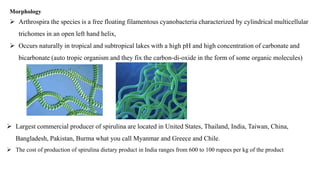
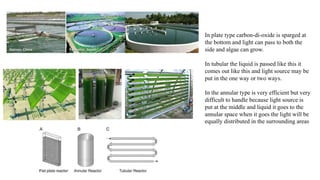
Spirulina is a type of blue-green algae that is high in protein and nutrients. It can be consumed as a dietary supplement or used as an animal feed additive. Spirulina has 50-70% protein, more than beef or chicken, as well as fatty acids, vitamins, minerals, and phycocyanin pigment. It is commercially produced through cultivation in open ponds or closed photobioreactors. Proper temperature, lighting, water, and nutrients are needed for growth. The production process involves inoculation, cultivation, harvesting, dewatering, and drying the algal biomass. Operating parameters like light intensity, pH, and temperature must be carefully controlled.