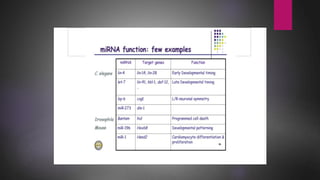
Micro
RNA’s
Presented by: Muhammad Nauman kabir
B.S microbiology (4th semester)
Subject: Biotechnology
Teacher’s Name: Madam irum dilshad
Topics to be covered
 Introduction of MiRNA
 History of MiRNA
 Biogenesis
 Diseases related to MiRNA
Introduction
 Small non coding RNA molecule(~22 nucleotides).
 Found in plants, animals and viruses.
 Transcribed by RNA polymerase II from independent genes or introns of protein coding
genes.
 They play important gene-regulatory roles in both plats and animals.
 The first MiRNA lin-4 was discovered in C-elegans in the year 1993.
 Human genome may encode over 1000 miRNAs.
History of MiRNA
 The first miRNA was discovered in 1993 by a group led by Ambros and including Lee and
Feinbaum; but additional insight into its mode of action required simultaneously published
work by Ruvkun's team, including Wightman and Ha.These groups published back-to-back
papers on the lin-4 gene, which was known to control the timing of C. elegans larval
development by repressing the lin-14 gene. When Lee et al. isolated the lin-4 gene, they
found that instead of producing an mRNA encoding a protein, it produced short non-coding
RNAs, one of which was a ~22-nucleotide RNA that contained sequences partially
complementary to multiple sequences in the 3' UTR of the lin-14.
 In 2000 a second small RNA was characterized: let-7 RNA, which represses lin-41 to
promote a later developmental transition in C. elegans. The let-7 RNA was found to be
conserved in many species, leading to the suggestion that let-7 RNA and additional "small
temporal RNAs" might regulate the timing of development in diverse animals, including
humans.
 A year later, the lin-4 and let-7 RNAs were found to be part of a large class of small RNAs
present in C. elegans, Drosophila and human cells. The many RNAs of this class resembled
the lin-4 and let-7 RNAs, except their expression patterns were usually inconsistent with a
role in regulating the timing of development. This suggested that most might function in
other types of regulatory pathways. At this point, researchers started using the term
“microRNA” to refer to this class of small regulatory RNAs.
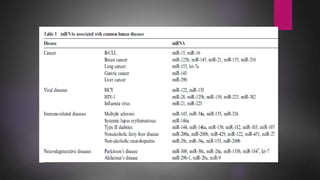
 The first human disease associated with deregulation of miRNAs was chronic lymphocytic
leukemia.
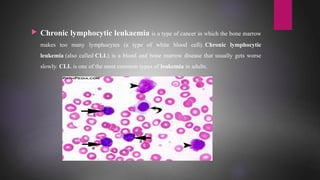
 Chronic lymphocytic leukaemia is a type of cancer in which the bone marrow
makes too many lymphocytes (a type of white blood cell). Chronic lymphocytic
leukemia (also called CLL) is a blood and bone marrow disease that usually gets worse
slowly. CLL is one of the most common types of leukemia in adults.
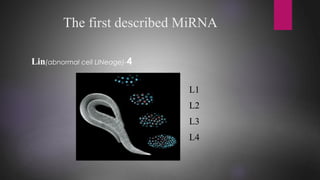
The first described MiRNA
Lin(abnormal cell LINeage)-4
L1
L2
L3
L4
Biogenesis
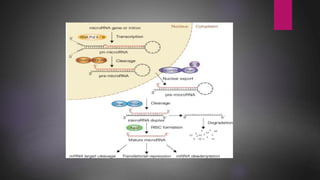
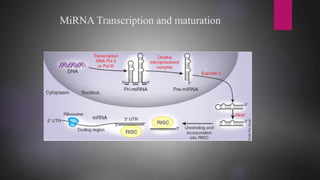
 Biogenesis of microRNAs (miRNAs) can be summarized in five steps.
 Transcription: miRNA transcripts may come from autonomously transcribed genes, they
may be contained in cotranscripts with other genes, or they may be located in introns of
host genes. Most miRNAs are transcribed by RNA polymerase II, however a few miRNAs
originate as RNA polymerase III cotranscripts with neighboring repetitive elements. The
initial transcript, termed a primary microRNA (pri-miRNA), contains an imperfectly
double-stranded region within a hairpin loop. Longer sequences extend from the 5' and 3'
ends of the hairpin and may also contain double-stranded regions.
 Cleavage by DROSHA: The 5' and 3' ends of the pri-miRNA are removed during
endoribonucleolytic cleavage by the DROSHA nuclease in a complex with the RNA-
binding protein DGCR8 (the Microprocessor complex). The cleavage product is a short
hairpin of about 60 to 70 nt called the pre-microRNA (pre-miRNA).
 Nuclear export by Exportin-5: The resulting pre-miRNA is bound by Exportin-5 in a
complex with Ran and GTP. The complex translocates the pre-miRNA through the nuclear
pore into the cytoplasm.
 Cleavage by DICER1: Once in the cytoplasm the pre-miRNA is bound by the RISC
loading complex which contains DICER1, an Argonaute protein and either TARBP2 or
PRKRA. DICER1 cleaves the pre-miRNA to yield an imperfectly double-stranded miRNA
of about 21 to 23 nucleotides. At this stage the double-stranded miRNA has protruding
single-stranded 3' ends of 2-3 nt.
 Incorporation into RNA-Induced Silencing Complex (RISC) and strand selection: The
double-stranded miRNA is passed to a Argonaute protein contained in the RISC loading
complex. One strand, the passenger strand, will be removed and degraded; the other strand,
the guide strand, will be retained and will guide the Argonaute:miRNA complex (RISC) to
target mRNAs.
 The human genome encodes 4 Argonaute proteins (AGO1 (EIF2C1), AGO2 (EIF2C2),
AGO3 (EIF2C3), AGO4 (EIF2C4)), however only AGO2 (EIF2C2) can cleave target
mRNAs with perfect or nearly perfect complementarity to the guide miRNA. For
complexes that contain AGO2, cleavage of the passenger strand of the double-stranded
miRNA accompanies removal of the passenger strand. Complexes containing other
Argonautes may use a helicase to remove the passenger strand but this is not fully known.
MiRNA Transcription and maturation
Biogenesis in plants
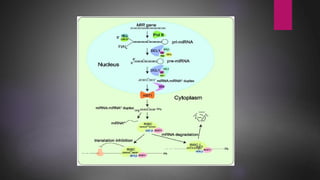
 miRNA biogenesis in plants differs from animal biogenesis mainly in the steps of nuclear processing
and export. Instead of being cleaved by two different enzymes, once inside and once outside the
nucleus, both cleavages of the plant miRNA are performed by a Dicer homolog, called Dicer-
like1 (DL1). DL1 is expressed only in the nucleus of plant cells, which indicates that both reactions
take place inside the nucleus. Before plant miRNA:miRNA* duplexes are transported out of the
nucleus, its 3' overhangs are methylated by a RNA methyltransferaseprotein called Hua-
Enhancer1 (HEN1). The duplex is then transported out of the nucleus to the cytoplasm by a protein
called Hasty (HST), an Exportin 5 homolog, where they disassemble and the mature miRNA is
incorporated into the RISC.
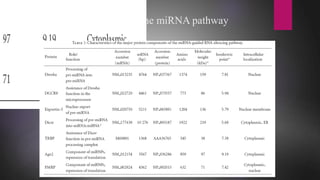
Proteins involved in the miRNA pathway
Micro RNAs
Micro RNAs
Micro RNAs

Micro RNAs

  • 2.
    Micro RNA’s Presented by: MuhammadNauman kabir B.S microbiology (4th semester) Subject: Biotechnology Teacher’s Name: Madam irum dilshad
  • 3.
    Topics to becovered  Introduction of MiRNA  History of MiRNA  Biogenesis  Diseases related to MiRNA
  • 4.
    Introduction  Small noncoding RNA molecule(~22 nucleotides).  Found in plants, animals and viruses.  Transcribed by RNA polymerase II from independent genes or introns of protein coding genes.  They play important gene-regulatory roles in both plats and animals.  The first MiRNA lin-4 was discovered in C-elegans in the year 1993.  Human genome may encode over 1000 miRNAs.
  • 5.
    History of MiRNA The first miRNA was discovered in 1993 by a group led by Ambros and including Lee and Feinbaum; but additional insight into its mode of action required simultaneously published work by Ruvkun's team, including Wightman and Ha.These groups published back-to-back papers on the lin-4 gene, which was known to control the timing of C. elegans larval development by repressing the lin-14 gene. When Lee et al. isolated the lin-4 gene, they found that instead of producing an mRNA encoding a protein, it produced short non-coding RNAs, one of which was a ~22-nucleotide RNA that contained sequences partially complementary to multiple sequences in the 3' UTR of the lin-14.
  • 6.
     In 2000a second small RNA was characterized: let-7 RNA, which represses lin-41 to promote a later developmental transition in C. elegans. The let-7 RNA was found to be conserved in many species, leading to the suggestion that let-7 RNA and additional "small temporal RNAs" might regulate the timing of development in diverse animals, including humans.
  • 7.
     A yearlater, the lin-4 and let-7 RNAs were found to be part of a large class of small RNAs present in C. elegans, Drosophila and human cells. The many RNAs of this class resembled the lin-4 and let-7 RNAs, except their expression patterns were usually inconsistent with a role in regulating the timing of development. This suggested that most might function in other types of regulatory pathways. At this point, researchers started using the term “microRNA” to refer to this class of small regulatory RNAs.  The first human disease associated with deregulation of miRNAs was chronic lymphocytic leukemia.

  • 8.
     Chronic lymphocyticleukaemia is a type of cancer in which the bone marrow makes too many lymphocytes (a type of white blood cell). Chronic lymphocytic leukemia (also called CLL) is a blood and bone marrow disease that usually gets worse slowly. CLL is one of the most common types of leukemia in adults.
  • 9.
    The first describedMiRNA Lin(abnormal cell LINeage)-4 L1 L2 L3 L4
  • 10.
    Biogenesis  Biogenesis ofmicroRNAs (miRNAs) can be summarized in five steps.  Transcription: miRNA transcripts may come from autonomously transcribed genes, they may be contained in cotranscripts with other genes, or they may be located in introns of host genes. Most miRNAs are transcribed by RNA polymerase II, however a few miRNAs originate as RNA polymerase III cotranscripts with neighboring repetitive elements. The initial transcript, termed a primary microRNA (pri-miRNA), contains an imperfectly double-stranded region within a hairpin loop. Longer sequences extend from the 5' and 3' ends of the hairpin and may also contain double-stranded regions.
  • 11.
     Cleavage byDROSHA: The 5' and 3' ends of the pri-miRNA are removed during endoribonucleolytic cleavage by the DROSHA nuclease in a complex with the RNA- binding protein DGCR8 (the Microprocessor complex). The cleavage product is a short hairpin of about 60 to 70 nt called the pre-microRNA (pre-miRNA).  Nuclear export by Exportin-5: The resulting pre-miRNA is bound by Exportin-5 in a complex with Ran and GTP. The complex translocates the pre-miRNA through the nuclear pore into the cytoplasm.  Cleavage by DICER1: Once in the cytoplasm the pre-miRNA is bound by the RISC loading complex which contains DICER1, an Argonaute protein and either TARBP2 or PRKRA. DICER1 cleaves the pre-miRNA to yield an imperfectly double-stranded miRNA of about 21 to 23 nucleotides. At this stage the double-stranded miRNA has protruding single-stranded 3' ends of 2-3 nt.
  • 12.
     Incorporation intoRNA-Induced Silencing Complex (RISC) and strand selection: The double-stranded miRNA is passed to a Argonaute protein contained in the RISC loading complex. One strand, the passenger strand, will be removed and degraded; the other strand, the guide strand, will be retained and will guide the Argonaute:miRNA complex (RISC) to target mRNAs.  The human genome encodes 4 Argonaute proteins (AGO1 (EIF2C1), AGO2 (EIF2C2), AGO3 (EIF2C3), AGO4 (EIF2C4)), however only AGO2 (EIF2C2) can cleave target mRNAs with perfect or nearly perfect complementarity to the guide miRNA. For complexes that contain AGO2, cleavage of the passenger strand of the double-stranded miRNA accompanies removal of the passenger strand. Complexes containing other Argonautes may use a helicase to remove the passenger strand but this is not fully known.
  • 14.
  • 15.
    Biogenesis in plants miRNA biogenesis in plants differs from animal biogenesis mainly in the steps of nuclear processing and export. Instead of being cleaved by two different enzymes, once inside and once outside the nucleus, both cleavages of the plant miRNA are performed by a Dicer homolog, called Dicer- like1 (DL1). DL1 is expressed only in the nucleus of plant cells, which indicates that both reactions take place inside the nucleus. Before plant miRNA:miRNA* duplexes are transported out of the nucleus, its 3' overhangs are methylated by a RNA methyltransferaseprotein called Hua- Enhancer1 (HEN1). The duplex is then transported out of the nucleus to the cytoplasm by a protein called Hasty (HST), an Exportin 5 homolog, where they disassemble and the mature miRNA is incorporated into the RISC.
  • 17.
    Proteins involved inthe miRNA pathway

Editor's Notes

  • #5 <number>