Tay Sachs Disease
By: Mohamed Samir El-Asaly
PT, CKTP
2016
What is Tay-Sachs?
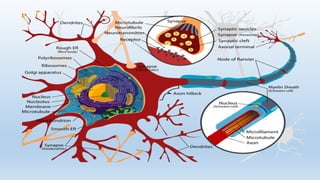
• Tay-Sachs diseases causes a progressive
deterioration of nerve cells and of mental
and physical abilities that begins around six
months of age.
• The disease occurs when harmful quantities
of cell membrane components components
known as gangliosides accumulate in the
brain’s nerve cells
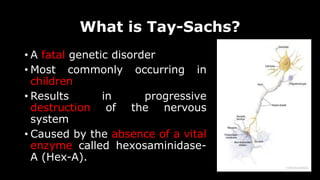
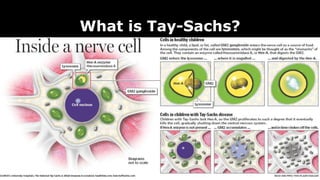
What is Tay-Sachs?
• A fatal genetic disorder
• Most commonly occurring in
children
• Results in progressive
destruction of the nervous
system
• Caused by the absence of a vital
enzyme called hexosaminidase-
A (Hex-A).
What is Tay-Sachs?
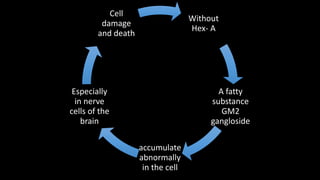
Without
Hex- A
A fatty
substance
GM2
gangloside
accumulate
abnormally
in the cell
Especially
in nerve
cells of the
brain
Cell
damage
and death
What is Tay-Sachs?
•Autosomal recessive lipid storage
disorder
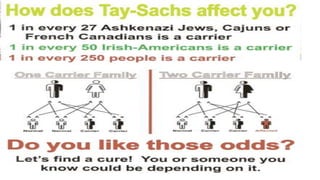
•High incidence among Ashkanazi Jews,
Cajuns, French Canadians
•Lack of enzyme, Hexosaminidase A
•Leads to accumulation of GM2
ganglioside in the neurons
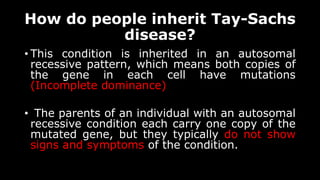
How do people inherit Tay-Sachs
disease?
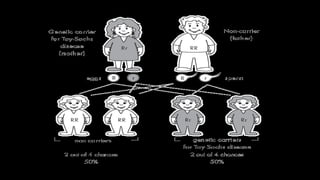
• This condition is inherited in an autosomal
recessive pattern, which means both copies of
the gene in each cell have mutations
(Incomplete dominance)
• The parents of an individual with an autosomal
recessive condition each carry one copy of the
mutated gene, but they typically do not show
signs and symptoms of the condition.
Symptoms of Tay-Sachs
• Infants initially appear healthy; symptoms
appear not before 6 months of age
• Development begins to slow
• Loss of motor skills, mental functions
• Child becomes blind, deaf, paralyzed, mentally
retarded, and non-responsive
• Fatal, usually by age 4
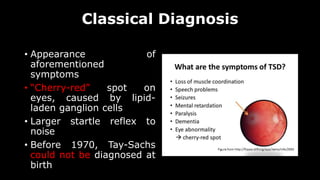
Classical Diagnosis
• Appearance of
aforementioned
symptoms
• “Cherry-red” spot on
eyes, caused by lipid-
laden ganglion cells
• Larger startle reflex to
noise
• Before 1970, Tay-Sachs
could not be diagnosed at
birth
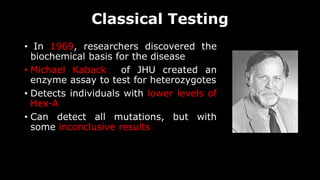
Classical Testing
• In 1969, researchers discovered the
biochemical basis for the disease
• Michael Kaback of JHU created an
enzyme assay to test for heterozygotes
• Detects individuals with lower levels of
Hex-A
• Can detect all mutations, but with
some inconclusive results
Classical Treatment
• There is currently no treatment for Tay-
Sachs disease
• Supportive treatment
• Anti-seizure medicine
• Feeding tube
• Proper nutrition, hydration
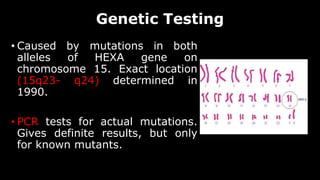
Genetic Testing
• Caused by mutations in both
alleles of HEXA gene on
chromosome 15. Exact location
(15q23- q24) determined in
1990.
• PCR tests for actual mutations.
Gives definite results, but only
for known mutants.
Treatment
All in experimental stages
• Gene therapy
1. Replace defective HEXA genes.
2. Difficult to transport genes to neurons.
• Enzyme replacement therapy by replacing Hex-A.
1. Hex-A is too big to pass through the blood- brain
barrier.
2. Neurons are unable to take up Hex-A because it is too
big.
Prevention
• Prenatal diagnosis
• Genetic testing by amniocentesis
• Embryo screening: Test embryo prior to in
vitro fertilization
Select embryos without Tay-Sachs
Thank you for Listening

Tay Sachs disease

  • 1.
    Tay Sachs Disease By:Mohamed Samir El-Asaly PT, CKTP 2016
  • 2.
    What is Tay-Sachs? •Tay-Sachs diseases causes a progressive deterioration of nerve cells and of mental and physical abilities that begins around six months of age. • The disease occurs when harmful quantities of cell membrane components components known as gangliosides accumulate in the brain’s nerve cells
  • 3.
    What is Tay-Sachs? •A fatal genetic disorder • Most commonly occurring in children • Results in progressive destruction of the nervous system • Caused by the absence of a vital enzyme called hexosaminidase- A (Hex-A).
  • 5.
  • 6.
    Without Hex- A A fatty substance GM2 gangloside accumulate abnormally inthe cell Especially in nerve cells of the brain Cell damage and death
  • 7.
    What is Tay-Sachs? •Autosomalrecessive lipid storage disorder •High incidence among Ashkanazi Jews, Cajuns, French Canadians •Lack of enzyme, Hexosaminidase A •Leads to accumulation of GM2 ganglioside in the neurons
  • 8.
    How do peopleinherit Tay-Sachs disease? • This condition is inherited in an autosomal recessive pattern, which means both copies of the gene in each cell have mutations (Incomplete dominance) • The parents of an individual with an autosomal recessive condition each carry one copy of the mutated gene, but they typically do not show signs and symptoms of the condition.
  • 11.
    Symptoms of Tay-Sachs •Infants initially appear healthy; symptoms appear not before 6 months of age • Development begins to slow • Loss of motor skills, mental functions • Child becomes blind, deaf, paralyzed, mentally retarded, and non-responsive • Fatal, usually by age 4
  • 12.
    Classical Diagnosis • Appearanceof aforementioned symptoms • “Cherry-red” spot on eyes, caused by lipid- laden ganglion cells • Larger startle reflex to noise • Before 1970, Tay-Sachs could not be diagnosed at birth
  • 13.
    Classical Testing • In1969, researchers discovered the biochemical basis for the disease • Michael Kaback of JHU created an enzyme assay to test for heterozygotes • Detects individuals with lower levels of Hex-A • Can detect all mutations, but with some inconclusive results
  • 14.
    Classical Treatment • Thereis currently no treatment for Tay- Sachs disease • Supportive treatment • Anti-seizure medicine • Feeding tube • Proper nutrition, hydration
  • 15.
    Genetic Testing • Causedby mutations in both alleles of HEXA gene on chromosome 15. Exact location (15q23- q24) determined in 1990. • PCR tests for actual mutations. Gives definite results, but only for known mutants.
  • 16.
    Treatment All in experimentalstages • Gene therapy 1. Replace defective HEXA genes. 2. Difficult to transport genes to neurons. • Enzyme replacement therapy by replacing Hex-A. 1. Hex-A is too big to pass through the blood- brain barrier. 2. Neurons are unable to take up Hex-A because it is too big.
  • 17.
    Prevention • Prenatal diagnosis •Genetic testing by amniocentesis • Embryo screening: Test embryo prior to in vitro fertilization Select embryos without Tay-Sachs
  • 18.
    Thank you forListening