Small Noncoding RNAs:
miRNAs, siRNAs, and piRNA
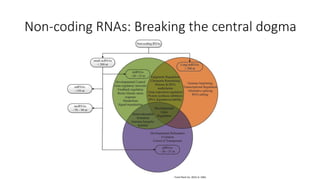
Non-coding RNAs: Breaking the central dogma
Front Plant Sci. 2015; 6: 1001.
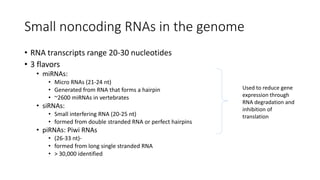
Small noncoding RNAs in the genome
• RNA transcripts range 20-30 nucleotides
• 3 flavors
• miRNAs:
• Micro RNAs (21-24 nt)
• Generated from RNA that forms a hairpin
• ~2600 miRNAs in vertebrates
• siRNAs:
• Small interfering RNA (20-25 nt)
• formed from double stranded RNA or perfect hairpins
• piRNAs: Piwi RNAs
• (26-33 nt)-
• formed from long single stranded RNA
• > 30,000 identified
Used to reduce gene
expression through
RNA degradation and
inhibition of
translation
Discovery of small noncoding RNAs
• Early 1990s in c elegans
• Identified 2 small RNA molecules 22 and 61 nt in the lin-4 gene that
were involved with silencing lin-14
• The 2 small RNAs were complimentary to a region within the lin-14
transcript
• Later determined that the 61 nt RNA was the precursor of a 22 nt
miRNA
• siRNAs were discovered a few years later in plants. Identified 25 nt
RNA from virus involved in gene silencing.
Generation of small noncoding RNAs
Nature 451, 414–416
siRNA: precursor is double stranded RNA from sense and
antisense transcription or perfect hairpins. 100% base
pairing of the 2 strands
miRNA: transcribed from one strand in which the RNA
forms a hairpin. There is not 100% base pairing in the
hairpin.
piRNA: long single stranded RNA with no base pairing
All of these are processed and cleaved to form the small
mature forms of the RNAs
siRNA and miRNA use similar machinery (RNAi pathway)
while piRNA has a unique pathway.
Production of siRNA
• Originally believed to be an immune defense against foreign RNA
• Endogenous production from transposons, centromeric RNA, mRNA,
etc…
• Generated from all types of RNA Pol
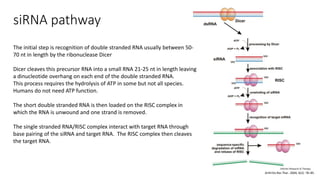
siRNA pathway
Arthritis Res Ther. 2004; 6(2): 78–85.
The initial step is recognition of double stranded RNA usually between 50-
70 nt in length by the ribonuclease Dicer
Dicer cleaves this precursor RNA into a small RNA 21-25 nt in length leaving
a dinucleotide overhang on each end of the double stranded RNA.
This process requires the hydrolysis of ATP in some but not all species.
Humans do not need ATP function.
The short double stranded RNA is then loaded on the RISC complex in
which the RNA is unwound and one strand is removed.
The single stranded RNA/RISC complex interact with target RNA through
base pairing of the siRNA and target RNA. The RISC complex then cleaves
the target RNA.
Dicer Ribonuclease
• Humans only have 1 isoform while other organisms have more than
one (Drosophilia have 2, Arabidopsis have 4)
• Drosophilia have unique functions for their 2 isoforms. Dicer1
processes miRNA while Dicer2 processes siRNA
• Usually purifies with a partner (TRBP in humans, R2D2 in Drosophila)
which has RNA binding activity. It is unclear what these partners do
as RNA processing occurs in the absence of these binding partners
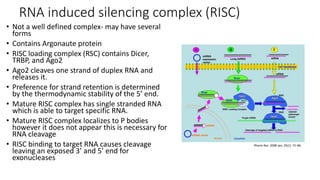
RNA induced silencing complex (RISC)
• Not a well defined complex- may have several
forms
• Contains Argonaute protein
• RISC loading complex (RSC) contains Dicer,
TRBP, and Ago2
• Ago2 cleaves one strand of duplex RNA and
releases it.
• Preference for strand retention is determined
by the thermodynamic stability of the 5’ end.
• Mature RISC complex has single stranded RNA
which is able to target specific RNA.
• Mature RISC complex localizes to P bodies
however it does not appear this is necessary for
RNA cleavage
• RISC binding to target RNA causes cleavage
leaving an exposed 3’ and 5’ end for
exonucleases
Pharm Res. 2008 Jan; 25(1): 72–86.
RISC
RISC
RdRP
RISC
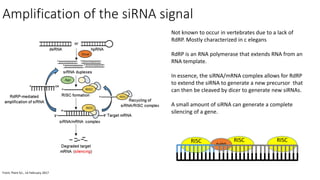
Amplification of the siRNA signal
Front. Plant Sci., 14 February 2017
Not known to occur in vertebrates due to a lack of
RdRP. Mostly characterized in c elegans
RdRP is an RNA polymerase that extends RNA from an
RNA template.
In essence, the siRNA/mRNA complex allows for RdRP
to extend the siRNA to generate a new precursor that
can then be cleaved by dicer to generate new siRNAs.
A small amount of siRNA can generate a complete
silencing of a gene.
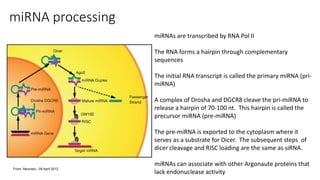
miRNA processing
Front. Neurosci., 09 April 2012
miRNAs are transcribed by RNA Pol II
The RNA forms a hairpin through complementary
sequences
The initial RNA transcript is called the primary miRNA (pri-
miRNA)
A complex of Drosha and DGCR8 cleave the pri-miRNA to
release a hairpin of 70-100 nt. This hairpin is called the
precursor miRNA (pre-miRNA)
The pre-miRNA is exported to the cytoplasm where it
serves as a substrate for Dicer. The subsequent steps of
dicer cleavage and RISC loading are the same as siRNA.
miRNAs can associate with other Argonaute proteins that
lack endonuclease activity
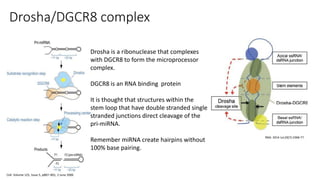
Drosha/DGCR8 complex
Cell. Volume 125, Issue 5, p887–901, 2 June 2006
Drosha is a ribonuclease that complexes
with DGCR8 to form the microprocessor
complex.
DGCR8 is an RNA binding protein
It is thought that structures within the
stem loop that have double stranded single
stranded junctions direct cleavage of the
pri-miRNA.
Remember miRNA create hairpins without
100% base pairing.
RNA. 2014 Jul;20(7):1068-77.
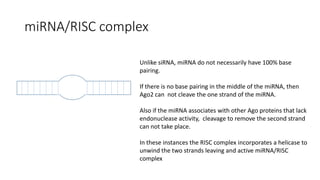
miRNA/RISC complex
Unlike siRNA, miRNA do not necessarily have 100% base
pairing.
If there is no base pairing in the middle of the miRNA, then
Ago2 can not cleave the one strand of the miRNA.
Also if the miRNA associates with other Ago proteins that lack
endonuclease activity, cleavage to remove the second strand
can not take place.
In these instances the RISC complex incorporates a helicase to
unwind the two strands leaving and active miRNA/RISC
complex
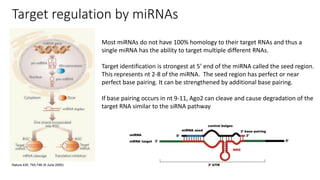
Target regulation by miRNAs
Nature 435, 745-746 (9 June 2005)
Most miRNAs do not have 100% homology to their target RNAs and thus a
single miRNA has the ability to target multiple different RNAs.
Target identification is strongest at 5’ end of the miRNA called the seed region.
This represents nt 2-8 of the miRNA. The seed region has perfect or near
perfect base pairing. It can be strengthened by additional base pairing.
If base pairing occurs in nt 9-11, Ago2 can cleave and cause degradation of the
target RNA similar to the siRNA pathway
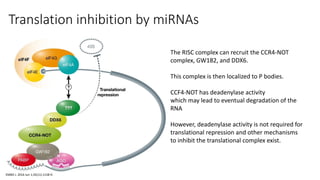
Translation inhibition by miRNAs
EMBO J. 2016 Jun 1;35(11):1158-9.
The RISC complex can recruit the CCR4-NOT
complex, GW182, and DDX6.
This complex is then localized to P bodies.
CCF4-NOT has deadenylase activity
which may lead to eventual degradation of the
RNA
However, deadenylase activity is not required for
translational repression and other mechanisms
to inhibit the translational complex exist.
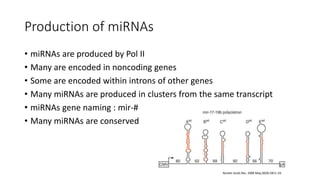
Production of miRNAs
• miRNAs are produced by Pol II
• Many are encoded in noncoding genes
• Some are encoded within introns of other genes
• Many miRNAs are produced in clusters from the same transcript
• miRNAs gene naming : mir-#
• Many miRNAs are conserved
Nucleic Acids Res. 2008 May;36(9):2811-24.
Piwi RNAs
• piRNAs do not have a conserved mechanism of biogenesis
• Strand specific suggesting they arise from single stranded RNA
• Usually start with a uracil.
• ~80% have intergenic sequences
• Preferentially expressed in germ cells
• May be critical in silencing transposable elements.
• Bind Piwi proteins which are members of the Argonaute family
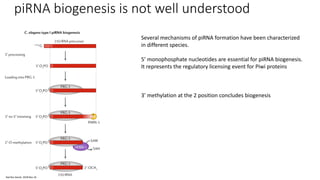
piRNA biogenesis is not well understood
Several mechanisms of piRNA formation have been characterized
in different species.
5’ monophosphate nucleotides are essential for piRNA biogenesis.
It represents the regulatory licensing event for Piwi proteins
3’ methylation at the 2 position concludes biogenesis
Nat Rev Genet. 2018 Nov 16
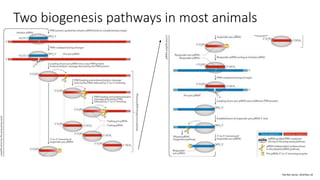
Two biogenesis pathways in most animals
Nat Rev Genet. 2018 Nov 16
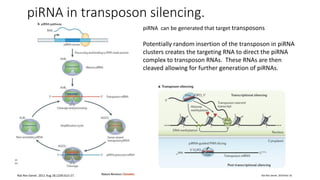
piRNA in transposon silencing.
Nat Rev Genet. 2011 Aug 18;12(9):615-27.
piRNA can be generated that target transposons
Potentially random insertion of the transposon in piRNA
clusters creates the targeting RNA to direct the piRNA
complex to transposon RNAs. These RNAs are then
cleaved allowing for further generation of piRNAs.
Nat Rev Genet. 2018 Nov 16
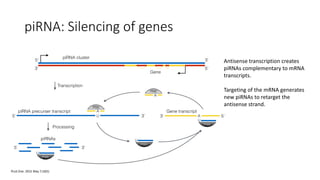
piRNA: Silencing of genes
PLoS One. 2015 May 7;10(5)
Antisense transcription creates
piRNAs complementary to mRNA
transcripts.
Targeting of the mRNA generates
new piRNAs to retarget the
antisense strand.
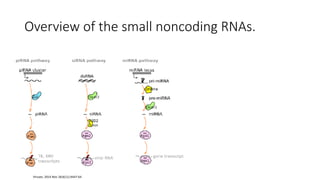
Overview of the small noncoding RNAs.
Viruses. 2014 Nov 18;6(11):4447-64

small noncoding RNA.pdf

  • 1.
  • 2.
    Non-coding RNAs: Breakingthe central dogma Front Plant Sci. 2015; 6: 1001.
  • 3.
    Small noncoding RNAsin the genome • RNA transcripts range 20-30 nucleotides • 3 flavors • miRNAs: • Micro RNAs (21-24 nt) • Generated from RNA that forms a hairpin • ~2600 miRNAs in vertebrates • siRNAs: • Small interfering RNA (20-25 nt) • formed from double stranded RNA or perfect hairpins • piRNAs: Piwi RNAs • (26-33 nt)- • formed from long single stranded RNA • > 30,000 identified Used to reduce gene expression through RNA degradation and inhibition of translation
  • 4.
    Discovery of smallnoncoding RNAs • Early 1990s in c elegans • Identified 2 small RNA molecules 22 and 61 nt in the lin-4 gene that were involved with silencing lin-14 • The 2 small RNAs were complimentary to a region within the lin-14 transcript • Later determined that the 61 nt RNA was the precursor of a 22 nt miRNA • siRNAs were discovered a few years later in plants. Identified 25 nt RNA from virus involved in gene silencing.
  • 5.
    Generation of smallnoncoding RNAs Nature 451, 414–416 siRNA: precursor is double stranded RNA from sense and antisense transcription or perfect hairpins. 100% base pairing of the 2 strands miRNA: transcribed from one strand in which the RNA forms a hairpin. There is not 100% base pairing in the hairpin. piRNA: long single stranded RNA with no base pairing All of these are processed and cleaved to form the small mature forms of the RNAs siRNA and miRNA use similar machinery (RNAi pathway) while piRNA has a unique pathway.
  • 6.
    Production of siRNA •Originally believed to be an immune defense against foreign RNA • Endogenous production from transposons, centromeric RNA, mRNA, etc… • Generated from all types of RNA Pol
  • 7.
    siRNA pathway Arthritis ResTher. 2004; 6(2): 78–85. The initial step is recognition of double stranded RNA usually between 50- 70 nt in length by the ribonuclease Dicer Dicer cleaves this precursor RNA into a small RNA 21-25 nt in length leaving a dinucleotide overhang on each end of the double stranded RNA. This process requires the hydrolysis of ATP in some but not all species. Humans do not need ATP function. The short double stranded RNA is then loaded on the RISC complex in which the RNA is unwound and one strand is removed. The single stranded RNA/RISC complex interact with target RNA through base pairing of the siRNA and target RNA. The RISC complex then cleaves the target RNA.
  • 8.
    Dicer Ribonuclease • Humansonly have 1 isoform while other organisms have more than one (Drosophilia have 2, Arabidopsis have 4) • Drosophilia have unique functions for their 2 isoforms. Dicer1 processes miRNA while Dicer2 processes siRNA • Usually purifies with a partner (TRBP in humans, R2D2 in Drosophila) which has RNA binding activity. It is unclear what these partners do as RNA processing occurs in the absence of these binding partners
  • 9.
    RNA induced silencingcomplex (RISC) • Not a well defined complex- may have several forms • Contains Argonaute protein • RISC loading complex (RSC) contains Dicer, TRBP, and Ago2 • Ago2 cleaves one strand of duplex RNA and releases it. • Preference for strand retention is determined by the thermodynamic stability of the 5’ end. • Mature RISC complex has single stranded RNA which is able to target specific RNA. • Mature RISC complex localizes to P bodies however it does not appear this is necessary for RNA cleavage • RISC binding to target RNA causes cleavage leaving an exposed 3’ and 5’ end for exonucleases Pharm Res. 2008 Jan; 25(1): 72–86.
  • 10.
    RISC RISC RdRP RISC Amplification of thesiRNA signal Front. Plant Sci., 14 February 2017 Not known to occur in vertebrates due to a lack of RdRP. Mostly characterized in c elegans RdRP is an RNA polymerase that extends RNA from an RNA template. In essence, the siRNA/mRNA complex allows for RdRP to extend the siRNA to generate a new precursor that can then be cleaved by dicer to generate new siRNAs. A small amount of siRNA can generate a complete silencing of a gene.
  • 11.
    miRNA processing Front. Neurosci.,09 April 2012 miRNAs are transcribed by RNA Pol II The RNA forms a hairpin through complementary sequences The initial RNA transcript is called the primary miRNA (pri- miRNA) A complex of Drosha and DGCR8 cleave the pri-miRNA to release a hairpin of 70-100 nt. This hairpin is called the precursor miRNA (pre-miRNA) The pre-miRNA is exported to the cytoplasm where it serves as a substrate for Dicer. The subsequent steps of dicer cleavage and RISC loading are the same as siRNA. miRNAs can associate with other Argonaute proteins that lack endonuclease activity
  • 12.
    Drosha/DGCR8 complex Cell. Volume125, Issue 5, p887–901, 2 June 2006 Drosha is a ribonuclease that complexes with DGCR8 to form the microprocessor complex. DGCR8 is an RNA binding protein It is thought that structures within the stem loop that have double stranded single stranded junctions direct cleavage of the pri-miRNA. Remember miRNA create hairpins without 100% base pairing. RNA. 2014 Jul;20(7):1068-77.
  • 13.
    miRNA/RISC complex Unlike siRNA,miRNA do not necessarily have 100% base pairing. If there is no base pairing in the middle of the miRNA, then Ago2 can not cleave the one strand of the miRNA. Also if the miRNA associates with other Ago proteins that lack endonuclease activity, cleavage to remove the second strand can not take place. In these instances the RISC complex incorporates a helicase to unwind the two strands leaving and active miRNA/RISC complex
  • 14.
    Target regulation bymiRNAs Nature 435, 745-746 (9 June 2005) Most miRNAs do not have 100% homology to their target RNAs and thus a single miRNA has the ability to target multiple different RNAs. Target identification is strongest at 5’ end of the miRNA called the seed region. This represents nt 2-8 of the miRNA. The seed region has perfect or near perfect base pairing. It can be strengthened by additional base pairing. If base pairing occurs in nt 9-11, Ago2 can cleave and cause degradation of the target RNA similar to the siRNA pathway
  • 15.
    Translation inhibition bymiRNAs EMBO J. 2016 Jun 1;35(11):1158-9. The RISC complex can recruit the CCR4-NOT complex, GW182, and DDX6. This complex is then localized to P bodies. CCF4-NOT has deadenylase activity which may lead to eventual degradation of the RNA However, deadenylase activity is not required for translational repression and other mechanisms to inhibit the translational complex exist.
  • 16.
    Production of miRNAs •miRNAs are produced by Pol II • Many are encoded in noncoding genes • Some are encoded within introns of other genes • Many miRNAs are produced in clusters from the same transcript • miRNAs gene naming : mir-# • Many miRNAs are conserved Nucleic Acids Res. 2008 May;36(9):2811-24.
  • 17.
    Piwi RNAs • piRNAsdo not have a conserved mechanism of biogenesis • Strand specific suggesting they arise from single stranded RNA • Usually start with a uracil. • ~80% have intergenic sequences • Preferentially expressed in germ cells • May be critical in silencing transposable elements. • Bind Piwi proteins which are members of the Argonaute family
  • 18.
    piRNA biogenesis isnot well understood Several mechanisms of piRNA formation have been characterized in different species. 5’ monophosphate nucleotides are essential for piRNA biogenesis. It represents the regulatory licensing event for Piwi proteins 3’ methylation at the 2 position concludes biogenesis Nat Rev Genet. 2018 Nov 16
  • 19.
    Two biogenesis pathwaysin most animals Nat Rev Genet. 2018 Nov 16
  • 20.
    piRNA in transposonsilencing. Nat Rev Genet. 2011 Aug 18;12(9):615-27. piRNA can be generated that target transposons Potentially random insertion of the transposon in piRNA clusters creates the targeting RNA to direct the piRNA complex to transposon RNAs. These RNAs are then cleaved allowing for further generation of piRNAs. Nat Rev Genet. 2018 Nov 16
  • 21.
    piRNA: Silencing ofgenes PLoS One. 2015 May 7;10(5) Antisense transcription creates piRNAs complementary to mRNA transcripts. Targeting of the mRNA generates new piRNAs to retarget the antisense strand.
  • 22.
    Overview of thesmall noncoding RNAs. Viruses. 2014 Nov 18;6(11):4447-64