MOFT Tutorials
Multi Object Filtering Multi Target Tracking
Multiple Hypothesis Tracking
Part-2 / n-Best MHT
n-Best MHT
▪ original MHT formulation of Reid not applicable on most practical
tracking scenarios.
▪ solution - direct computation of only the 𝑛-best hypotheses instead of
identifying all possible hypotheses
▪ problem is reduced to a linear assignment problem (LAP) from the
field of mathematical optimization.
▪ 𝑛-best MHT approach ,the LAP and the Hungarian method as one
algorithm for determining a solution
▪ Murty’s algorithm to solve for an arbitrary number of ranked best
solutions
Multiple Hypothesis Tracking
Linear Assignment Problem - LAP
▪ MHT algorithm can be reformulated to directly solve for the 𝑛-best
hypotheses using Murty’s algorithm
▪ classical LAP deals with the problem of how to assign 𝑛 ∈ ℕ workers
to 𝑛 jobs in the best possible manner (e. g. the cheapest or the most
efficient).
▪ an assignment problem is completely specified by two components:
▪ assignments representing the combinatorial structure
▪ a cost function giving the cost of an assignment.
▪ traditional formulation the LAP is squared which means the number of
workers is equal to the number of jobs.
▪ number of feasible solutions is 𝑛!
Multiple Hypothesis Tracking
▪ LAP can be formulated as a weighted bipartite matching problem
▪ given a bipartite graph 𝐺 = 𝑉 = 𝑋 ∪ 𝑌, 𝐸 with an associated cost
function 𝑤: 𝐸 → ℝ, a perfect matching 𝑀∗ with minimum cost is to be
found.
▪ for all other matchings 𝑀′
≠ 𝑀∗
of 𝐺 it holds that 𝑤(𝑀′
) ≤ 𝑤(𝑀∗
)
▪ 𝑀∗
is called a min-weight matching
▪ set of vertices 𝑋 and 𝑌 describe the workers and jobs respectively and
the matching 𝑀∗
describes the assignment
▪ it can be assumed that the graph 𝐺 is complete
▪ if 𝐺 is not complete, edges with cost max
𝑒∈𝐸
𝑤 𝑒 + 1 can be added
without changing the resulting matching
Multiple Hypothesis Tracking
▪ another representation is a cost matrix 𝐶 ∈ ℝ 𝑛𝑥𝑛, where each 𝑐𝑖 𝑥 ,𝑖 𝑦
is the cost for assigning vertex 𝑥 ∈ 𝑋 to vertex 𝑦 ∈ 𝑌 .
▪ an assignment can be represented either by a second matrix 𝐴 ∈
0,1 𝑛𝑥𝑛, where 𝑎𝑖 𝑥 ,𝑖 𝑦 = 1 if 𝑥 ∈ 𝑋 was assigned to 𝑦 ∈ 𝑌 and 0
otherwise, or by a set of matrix element indices 𝑎 =
𝑖1, 𝑗1 , ⋯ , 𝑖 𝑛, 𝑗 𝑛 , in which no two distinct members have the same
row or column index: 𝑟, 𝑠 , 𝑡, 𝑢 ∈ 𝑎 ⟹ 𝑟 ≠ 𝑡 and 𝑠 ≠ 𝑢
▪ index function 𝑖: 𝑉 → 1, ⋯ , 𝑛 maps vertices to matrix cells
▪ many polynomial time algorithms of different complexity and speed to
solve the LAP.
▪ Hungarian method as the most well-known LAP solving
Multiple Hypothesis Tracking
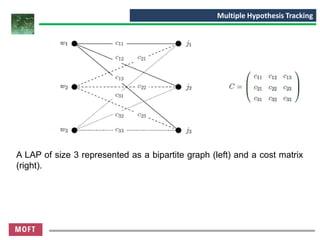
A LAP of size 3 represented as a bipartite graph (left) and a cost matrix
(right).
Multiple Hypothesis Tracking
Hungarian Method
▪ Hungarian method (also known as Kuhn-Munkres algorithm) is an
algorithm for solving weighted, linear assignment problems
▪ calculates a max-weight matching.
▪ easy to change the assignment costs slightly in order to obtain a min-
weight matching
▪ by the following transformation:
𝑤 𝑥, 𝑦 ← max
𝑎,𝑏 ∈𝐸
𝑤 𝑎, 𝑏 − 𝑤 𝑥, 𝑦 , ∀ 𝑥, 𝑦 ∈ 𝐸
▪ theorem to transform the optimization problem of finding a max-weight
matching into the combinatorial problem of finding a perfect matching
Multiple Hypothesis Tracking
Theorem 1. If the equality graph 𝐺𝑙 of a graph 𝐺 = 𝑉, 𝐸 has a perfect
matching 𝑀∗
⊆ 𝐺𝑙 , then 𝑀∗
is a max-weight matching.
▪ Hungarian method starts with an arbitrary but feasible labeling 𝑙 and
an arbitrary matching 𝑀 of 𝐺𝑙.
▪ while 𝑀 is not a perfect matching its size is increased with an
augmenting path.
▪ if no augmenting path exists, 𝑙 is improved to 𝑙′
so that 𝐺𝑙 ⊂ 𝐺𝑙′
The details of all undertaken steps are given below:
Multiple Hypothesis Tracking
1. Initialize a vertex labeling 𝑙 according to equation and determine the
corresponding equality sub-graph 𝐺𝑙.
2. Pick an arbitrary matching 𝑀 in 𝐺𝑙.
3. If 𝑀 is a perfect matching (theorem 1), also a max-weight matching
was found and the algorithm terminates (goto step 6). Otherwise, some
unmatched vertex 𝑥 ∈ 𝑋 exists still. Set 𝑆 = 𝑥 and 𝑇 = ∅ ;.
4. If 𝑁𝑙 𝑆 = 𝑇, find 𝛼𝑙 = min
𝑥∈𝑆,𝑦∉𝑇
𝑙 𝑥 + 𝑙 𝑦 − 𝑤 𝑥, 𝑦 and update the
vertex labeling in the following manner:
𝑙′
𝑣 = ൞
𝑙 𝑣 − 𝛼𝑙 𝑣 ∈ 𝑆
𝑙 𝑣 + 𝛼𝑙 𝑣 ∈ 𝑇
𝑙 𝑣 𝑜𝑡ℎ𝑒𝑟𝑤𝑖𝑠𝑒
Multiple Hypothesis Tracking
5. If 𝑁𝑙 𝑆 ≠ 𝑇 , pick 𝑦 ∈ 𝑁𝑙 𝑆 𝑇 and perform the following case
differentiation:
_ If 𝑦 is free, the path between 𝑢 and 𝑦 is augmenting. Augment 𝑀 and
go to step 2.
_ If 𝑦 is matched to 𝑧, update 𝑆 ← 𝑆 ∪ 𝑧 and 𝑇 ← 𝑇 ∪ 𝑦 and go to step
3.
6. Done.
▪ algorithm always terminates because in each step either the size of 𝑀
or 𝐺𝑙 is increased
▪ when the algorithm terminates, 𝑀 will be a perfect matching as well as
a max-weight matching
▪ Hungarian method solves the LAP in 𝒪 𝑉 3
Multiple Hypothesis Tracking
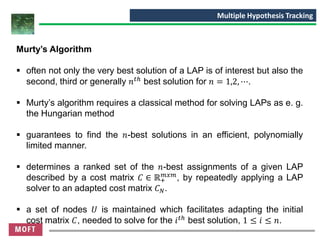
Rectangular Linear Assignment Problem
▪ number of workers 𝑚 is different from the number of jobs 𝑛 (but 𝑚 ≤
𝑛) are called rectangular linear assignment problems (RLAPs).
▪ for rectangular LAPs there exist ς𝑖=0
𝑚−1
𝑛 − 𝑖 solutions.
▪ a widely used approach to solve a RLAP is to extend it to a regular
square LAP by adding dummy vertices and edges to the graph
▪ strongly unrecommended because the increased size of the LAP
increases the associated computational costs required for solving i
▪ recommended - algorithms particularly designed for rectangular LAPs.
▪ best algorithm to solve the RLAP is the extended JVC algorithm,
called JVR.
Multiple Hypothesis Tracking
Murty’s Algorithm
▪ often not only the very best solution of a LAP is of interest but also the
second, third or generally 𝑛 𝑡ℎ best solution for 𝑛 = 1,2, ⋯.
▪ Murty’s algorithm requires a classical method for solving LAPs as e. g.
the Hungarian method
▪ guarantees to find the 𝑛-best solutions in an efficient, polynomially
limited manner.
▪ determines a ranked set of the 𝑛-best assignments of a given LAP
described by a cost matrix 𝐶 ∈ ℝ+
𝑚𝑥𝑚
, by repeatedly applying a LAP
solver to an adapted cost matrix 𝐶 𝑁.
▪ a set of nodes 𝑈 is maintained which facilitates adapting the initial
cost matrix 𝐶, needed to solve for the 𝑖 𝑡ℎ best solution, 1 ≤ 𝑖 ≤ 𝑛.
Multiple Hypothesis Tracking
▪ a worker-to-job assignment is called a cell
▪ a node 𝑁 in that context is a 4-tuple which consists of
▪ the best assignment 𝑎 𝑁
∗
for node 𝑁,
▪ its assignment costs 𝑐(𝑎 𝑁
∗
),
▪ a set of 𝑟 fixed cells 𝐹 𝑁
▪ a set of 𝑠 excluded cells 𝐸 𝑁:
𝑁 = 𝑎 𝑁
∗
, 𝑐(𝑎 𝑁
∗
), 𝑔1, ℎ1 , ⋯ , 𝑔 𝑟, ℎ 𝑟 , 𝑘1, 𝑙1 , ⋯ , 𝑘 𝑠, 𝑙 𝑠
▪ let 𝒜 denote the set of all possible assignments, 𝑁 describes a
restricted set of assignments 𝒜 𝑁 ⊆ 𝒜 , where certain cells are
included and others are excluded
𝒜 𝑁 = 𝑎 ∈ 𝒜| 𝑔1, ℎ1 , ⋯ , 𝑔 𝑟, ℎ 𝑟 ∈ 𝑎 ∧ 𝑘1, 𝑙1 , ⋯ , 𝑘 𝑠, 𝑙 𝑠 ∉ 𝑎
= 𝑔1, ℎ1 , ⋯ , 𝑔 𝑟, ℎ 𝑟 , 𝑘1, 𝑙1 , ⋯ , 𝑘 𝑠, 𝑙 𝑠
where a bar above a cell indicates that it is excluded from the node.
Multiple Hypothesis Tracking
▪ node 𝑁 describes all possible assignments that contain the cells
𝑔1, ℎ1 , ⋯ , 𝑔 𝑟, ℎ 𝑟 and that do not contain the cells 𝑘1, 𝑙1 , ⋯ , 𝑘 𝑠, 𝑙 𝑠 .
▪ first step of Murty’s algorithm, stage 1, the very best assignment 𝑎 𝑁1
∗
=
𝑝1, 𝑞1 , ⋯ , 𝑝 𝑛, 𝑞 𝑛 with cost 𝑐 𝑎 𝑁1
∗
of 𝐶 is determined with the use
of a classical LAP solver
▪ afterwards, it is used to initialize the set 𝑈 :
𝑈 = 𝑎 𝑁1
∗
, 𝑐 𝑎 𝑁1
∗
, ∅, ∅
▪ second part of the algorithm, as stage 2, the node in 𝑈 with least costs
is repeatedly determined, removed from 𝑈, inserted into the result list
𝑅 and finally partitioned
▪ until 𝑈 is empty or the 𝑛-best solutions are found and thus 𝑅 = 𝑛.
Multiple Hypothesis Tracking
▪ partitioning a node 𝑁 by an assignment 𝑎 involves the creation of 𝑟 −
1 new nodes 𝑁𝑖,
▪ restricted set of assignments 𝒜 𝑁 𝑖
of each child node does not contain
the assignment 𝑎 and it holds that ‫ڂ‬𝑖=1
𝑟−1
𝒜 𝑁 𝑖
= 𝒜 𝑎 .
▪ partitioning a node 𝑁 by an assignment 𝑎 = 𝑔1, ℎ1 , ⋯ , 𝑔 𝑟, ℎ 𝑟 is
done in the following way:
𝑁𝑖 = 𝑎 𝑁 𝑖
∗
, 𝑐 𝑎 𝑁 𝑖
∗
, 𝐹 𝑁 ∪ 𝑔1, ℎ1 , ⋯ , 𝑔 𝑟−1, ℎ 𝑟−1 , 𝐸 𝑁 ∪ 𝑔𝑖, ℎ𝑖
▪ only 𝑟 − 1, not 𝑟, new nodes have to be generated, cost matrix of the
last partition 𝑁𝑟 would only be of size 1𝑥1 with 𝐶 𝑁 𝑟 11
= ∞ .
▪ such a matrix does not contain any feasible assignment and hence
only 𝑟 − 1 child nodes are generated.
Multiple Hypothesis Tracking
▪ to construct the remaining cost matrix 𝐶 𝑁 ∈ ℝ+
𝑛−𝑟 𝑥 𝑛−𝑟
of a node 𝑁
the following changes need to be applied on the initial cost matrix 𝐶.
▪ first, all rows 𝑔1, ⋯ , 𝑔 𝑟and all columns ℎ1, ⋯ , ℎ 𝑟 have to be striked off
to fix these cells in all successive assignments of the node
▪ second, all matrix cells 𝑘1, 𝑙1 , ⋯ , 𝑘 𝑠, 𝑙 𝑠 have to be replaced by ∞ to
exclude these cells in all successive assignments of the node
▪ algorithm is as well applicable with minor changes to rectangular
assignment problems
▪ for rectangular matrices 𝑟, instead of 𝑟 − 1, partitions have to be
generated because the last partition might still contain valid
assignments
Multiple Hypothesis Tracking
▪ while solving for the 𝑛-best assignments each assignment creates in
the worst-case 𝑚 new sub-problems (nodes)
▪ up to 𝒪 𝑛𝑚 nodes have to be inserted into the priority queue 𝑈 and
up to 𝒪 𝑛𝑚 LAPs have to be solved
▪ solving a single LAP has a worst-case complexity of 𝒪 𝑚3
.
▪ inserting a single node into 𝑈 has a worst-case complexity of 𝒪 𝑛𝑚 .
▪ worst-case complexity of Murty’s algorithm is
𝒪 𝑛𝑚 𝑚3 + 𝑛𝑚 = 𝒪 𝑛𝑚4
Multiple Hypothesis Tracking
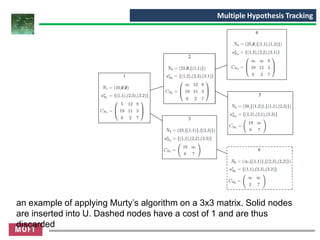
an example of applying Murty’s algorithm on a 3x3 matrix. Solid nodes
are inserted into U. Dashed nodes have a cost of 1 and are thus
discarded
Multiple Hypothesis Tracking
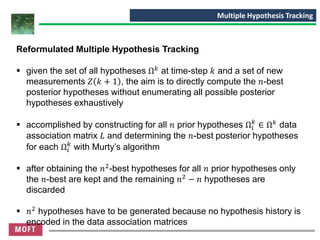
Reformulated Multiple Hypothesis Tracking
▪ given the set of all hypotheses Ω 𝑘 at time-step 𝑘 and a set of new
measurements 𝑍 𝑘 + 1 , the aim is to directly compute the 𝑛-best
posterior hypotheses without enumerating all possible posterior
hypotheses exhaustively
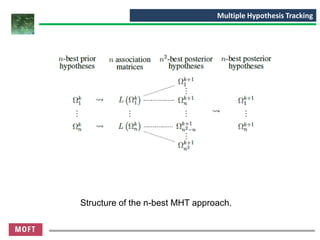
▪ accomplished by constructing for all 𝑛 prior hypotheses Ω𝑖
𝑘
∈ Ω 𝑘 data
association matrix 𝐿 and determining the 𝑛-best posterior hypotheses
for each Ω𝑖
𝑘
with Murty’s algorithm
▪ after obtaining the 𝑛2
-best hypotheses for all 𝑛 prior hypotheses only
the 𝑛-best are kept and the remaining 𝑛2 − 𝑛 hypotheses are
discarded
▪ 𝑛2 hypotheses have to be generated because no hypothesis history is
encoded in the data association matrices
Multiple Hypothesis Tracking
▪ data association matrices only account for the association
probabilities of the current scan and they do not incorporate
probabilities of prior hypotheses
▪ consequently, to recast Reid’s conceptual MHT algorithm into a LAP
two things must be obtained:
1. hypothesis generation procedure has to be reformulated so that it is
possible to apply Murty’s algorithm to solve for the 𝑛-best posterior
hypotheses.
2. a formula is required which gives the number of all feasible posterior
hypotheses because there might exist more feasible assignments than
feasible posterior hypotheses for a given hypothesis and for a given set
of measurements.
Multiple Hypothesis Tracking
Structure of the n-best MHT approach.
Multiple Hypothesis Tracking
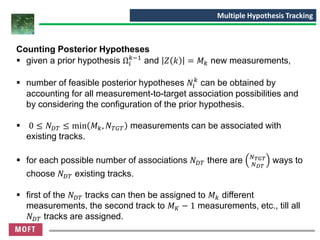
Counting Posterior Hypotheses
▪ given a prior hypothesis Ω𝑖
𝑘−1
and 𝑍 𝑘 = 𝑀 𝑘 new measurements,
▪ number of feasible posterior hypotheses 𝑁𝑖
𝑘
can be obtained by
accounting for all measurement-to-target association possibilities and
by considering the configuration of the prior hypothesis.
▪ 0 ≤ 𝑁 𝐷𝑇 ≤ min 𝑀 𝑘, 𝑁 𝑇𝐺𝑇 measurements can be associated with
existing tracks.
▪ for each possible number of associations 𝑁 𝐷𝑇 there are 𝑁 𝑇𝐺𝑇
𝑁 𝐷𝑇
ways to
choose 𝑁 𝐷𝑇 existing tracks.
▪ first of the 𝑁 𝐷𝑇 tracks can then be assigned to 𝑀 𝑘 different
measurements, the second track to 𝑀 𝐾 − 1 measurements, etc., till all
𝑁 𝐷𝑇 tracks are assigned.
Multiple Hypothesis Tracking
▪ 𝑀 𝑘 ∙ 𝑀 𝑘 − 1 ∙ ⋯ ∙ 𝑀 𝑘 − 𝑁 𝐷𝑇 + 1 = 𝑀 𝑘
𝑁 𝐷𝑇
𝑁 𝐷𝑇! ways of assigning
𝑁 𝐷𝑇 existing tracks to 𝑀 𝐾 measurements.
▪ 𝑀 𝑘 − 𝑁 𝐷𝑇 remaining measurements to be assigned to either a false
alarm, or a new target
▪ 2 𝑀 𝑘−𝑁 𝐷𝑇 possible assignments left
▪ total number of parent hypotheses 𝑁𝑖
𝑘
, given the prior hypothesis Ω𝑖
𝑘
𝑁𝑖
𝑘
= ෍
𝑁 𝐷𝑇=0
min 𝑀 𝑘,𝑁 𝑇𝐺𝑇
𝑁 𝑇𝐺𝑇
𝑁 𝐷𝑇
𝑀 𝑘
𝑁 𝐷𝑇
𝑁 𝐷𝑇! 2 𝑀 𝑘−𝑁 𝐷𝑇
Multiple Hypothesis Tracking
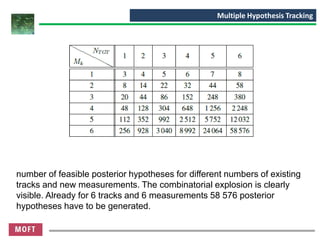
number of feasible posterior hypotheses for different numbers of existing
tracks and new measurements. The combinatorial explosion is clearly
visible. Already for 6 tracks and 6 measurements 58 576 posterior
hypotheses have to be generated.
Multiple Hypothesis Tracking
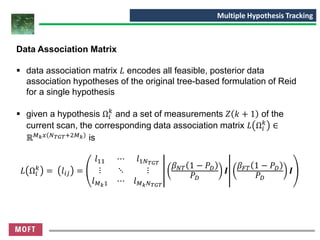
Data Association Matrix
▪ data association matrix 𝐿 encodes all feasible, posterior data
association hypotheses of the original tree-based formulation of Reid
for a single hypothesis
▪ given a hypothesis Ω𝑖
𝑘
and a set of measurements 𝑍 𝑘 + 1 of the
current scan, the corresponding data association matrix 𝐿 Ω𝑖
𝑘
∈
ℝ 𝑀 𝑘 𝑥 𝑁 𝑇𝐺𝑇+2𝑀 𝑘 is
𝐿 Ω𝑖
𝑘
= 𝑙𝑖𝑗 =
𝑙11 ⋯ 𝑙1𝑁 𝑇𝐺𝑇
⋮ ⋱ ⋮
𝑙 𝑀 𝑘1 ⋯ 𝑙 𝑀 𝑘 𝑁 𝑇𝐺𝑇
𝛽 𝑁𝑇 1 − 𝑃 𝐷
𝑃 𝐷
𝑰
𝛽 𝐹𝑇 1 − 𝑃 𝐷
𝑃 𝐷
𝑰
Multiple Hypothesis Tracking
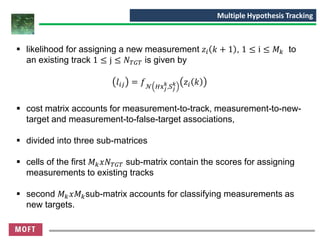
▪ likelihood for assigning a new measurement 𝑧𝑖 𝑘 + 1 , 1 ≤ i ≤ 𝑀 𝑘 to
an existing track 1 ≤ j ≤ 𝑁 𝑇𝐺𝑇 is given by
𝑙𝑖𝑗 = 𝑓 𝒩 𝐻x 𝑗
𝑘
,S 𝑗
𝑘 𝑧𝑖 𝑘
▪ cost matrix accounts for measurement-to-track, measurement-to-new-
target and measurement-to-false-target associations,
▪ divided into three sub-matrices
▪ cells of the first 𝑀 𝑘 𝑥𝑁 𝑇𝐺𝑇 sub-matrix contain the scores for assigning
measurements to existing tracks
▪ second 𝑀 𝑘 𝑥𝑀 𝑘sub-matrix accounts for classifying measurements as
new targets.
Multiple Hypothesis Tracking
▪ last 𝑀 𝑘 𝑥𝑀 𝑘 sub-matrix accounts for classifying measurements as false
alarms
▪ matrix corresponds one-to-one to the set of all posterior hypotheses of
Ω𝑖
𝑘
in the manner of Reid
▪ applying Murty’s algorithm on 𝐿 will not result in the 𝑛-best posterior
hypothesis because:
1. the probabilities of the hypothesis rating equation are connected by
multiplications, while assignment costs are the sums of matrix
elements,
2. the underlying LAP solver minimizes the assignment costs which
results in the 𝑛-worst assignments instead of the 𝑛-best.
Multiple Hypothesis Tracking
▪ both problems can be eliminated by taking the negative logarithm of
each matrix element
▪ transforms the sum of matrix elements into multiplications
▪ negative logarithm maps probabilities to the inverse order of numbers
which results in the 𝑛-best assignments: −log ∶ 0,1 → 0, ∞ .
Multiple Hypothesis Tracking
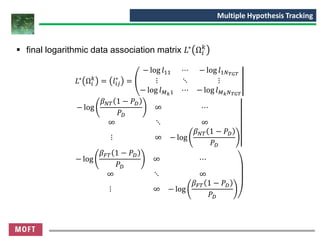
▪ final logarithmic data association matrix 𝐿∗ Ω𝑖
𝑘
𝐿∗ Ω𝑖
𝑘
= 𝑙𝑖𝑗
∗
= ቌ ቮ
− log 𝑙11 ⋯ − log 𝑙1𝑁 𝑇𝐺𝑇
⋮ ⋱ ⋮
− log 𝑙 𝑀 𝑘1 ⋯ − log 𝑙 𝑀 𝑘 𝑁 𝑇𝐺𝑇
− log
𝛽 𝑁𝑇 1 − 𝑃 𝐷
𝑃 𝐷
∞ ⋯
∞ ⋱ ∞
⋮ ∞ − log
𝛽 𝑁𝑇 1 − 𝑃 𝐷
𝑃 𝐷
− log
𝛽 𝐹𝑇 1 − 𝑃 𝐷
𝑃 𝐷
∞ ⋯
∞ ⋱ ∞
⋮ ∞ − log
𝛽 𝐹𝑇 1 − 𝑃 𝐷
𝑃 𝐷
Multiple Hypothesis Tracking
New Hypothesis Generation Algorithm
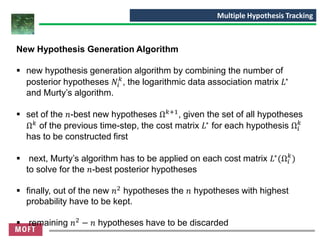
▪ new hypothesis generation algorithm by combining the number of
posterior hypotheses 𝑁𝑖
𝑘
, the logarithmic data association matrix 𝐿∗
and Murty’s algorithm.
▪ set of the 𝑛-best new hypotheses Ω 𝑘+1
, given the set of all hypotheses
Ω 𝑘 of the previous time-step, the cost matrix 𝐿∗ for each hypothesis Ω𝑖
𝑘
has to be constructed first
▪ next, Murty’s algorithm has to be applied on each cost matrix 𝐿∗
(Ω𝑖
𝑘
)
to solve for the 𝑛-best posterior hypotheses
▪ finally, out of the new 𝑛2
hypotheses the 𝑛 hypotheses with highest
probability have to be kept.
▪ remaining 𝑛2
− 𝑛 hypotheses have to be discarded
Multiple Hypothesis Tracking
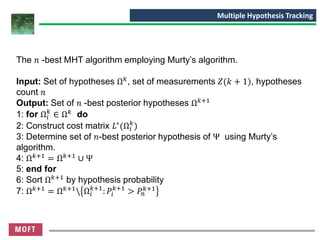
The 𝑛 -best MHT algorithm employing Murty’s algorithm.
Input: Set of hypotheses Ω 𝑘, set of measurements 𝑍(𝑘 + 1), hypotheses
count 𝑛
Output: Set of 𝑛 -best posterior hypotheses Ω 𝑘+1
1: for Ω𝑖
𝑘
∈ Ω 𝑘
do
2: Construct cost matrix 𝐿∗(Ω𝑖
𝑘
)
3: Determine set of 𝑛-best posterior hypothesis of Ψ using Murty’s
algorithm.
4: Ω 𝑘+1
= Ω 𝑘+1
∪ Ψ
5: end for
6: Sort Ω 𝑘+1
by hypothesis probability
7: Ω 𝑘+1 = Ω 𝑘+1 Ω𝑖
𝑘+1
: 𝑃𝑖
𝑘+1
> 𝑃𝑛
𝑘+1
Multiple Hypothesis Tracking
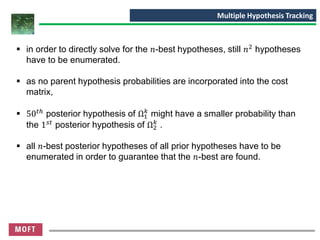
▪ in order to directly solve for the 𝑛-best hypotheses, still 𝑛2 hypotheses
have to be enumerated.
▪ as no parent hypothesis probabilities are incorporated into the cost
matrix,
▪ 50 𝑡ℎ
posterior hypothesis of Ω1
𝑘
might have a smaller probability than
the 1 𝑠𝑡 posterior hypothesis of Ω2
𝑘
.
▪ all 𝑛-best posterior hypotheses of all prior hypotheses have to be
enumerated in order to guarantee that the 𝑛-best are found.
Multiple Hypothesis Tracking
Modified Gating
▪ gating technique cannot be directly applied in 𝑛-best MHT.
▪ in 𝑛-best MHT all measurements have to be considered because a
static cost matrix is used for data association
▪ it is possible to exclude non-gating measurements in a way that the
computational workload is reduced considerably.
▪ structure of the cost matrix in Murty’s algorithm can be exploited to
avoid the partitioning of certain nodes
▪ by assigning respective element of a measurement-to-track
association to ∞, if the measurement does not fall into the gating
▪ this cell is henceforth excluded from the assignment
Multiple Hypothesis Tracking
References
[1] David Geier, Development and Evaluation of a Real-time Capable
Multiple Hypothesis Tracker, Technische Universität Berlin,2012
[2] Y. Bar-Shalom, X. Rong Li, T. Kirubarajan, “Estimation with
Applications to Tracking and Navigation”, Wiley, 2001
[3] U. Orguner, “Target Tracking”, Lecture notes, Linköpings University,
2010.
[4] S.S. Blackman, R. Popoli, “Design and Analysis of Modern Tracking
Systems”, Artech House, 1999
Other MOFT Tutorials – Lists and Links
Introduction to Multi Target Tracking
Bayesian Inference and Filtering
Kalman Filtering
Sequential Monte Carlo (SMC) Methods and Particle Filtering
Single Object Filtering Single Target Tracking
Nearest Neighbor(NN) and Probabilistic Data Association Filter(PDAF)
Multi Object Filtering Multi Target Tracking
Global Nearest Neighbor and Joint Probabilistic Data Association Filter
Data Association in Multi Target Tracking
Multiple Hypothesis Tracking, MHT
Other MOFT Tutorials – Lists and Links
Random Finite Sets, RFS
Random Finite Set Based RFS Filters
RFS Filters, Probability Hypothesis Density, PHD
RFS Filters, Cardinalized Probability Hypothesis Density, CPHD Filter
RFS Filters, Multi Bernoulli MemBer and Cardinality Balanced MeMBer, CBMemBer Filter
RFS Labeled Filters, Generalized Labeled Multi Bernoulli, GLMB and Labeled Multi Bernoulli, LMB Filters
Multiple Model Methods in Multi Target Tracking
Multi Target Tracking Implementation
Multi Target Tracking Performance and Metrics
http://www.egniya.com/EN/MOFT/Tutorials/
moft@egniya.com

MHT Multi Hypothesis Tracking - Part2

  • 1.
    MOFT Tutorials Multi ObjectFiltering Multi Target Tracking Multiple Hypothesis Tracking Part-2 / n-Best MHT
  • 2.
    n-Best MHT ▪ originalMHT formulation of Reid not applicable on most practical tracking scenarios. ▪ solution - direct computation of only the 𝑛-best hypotheses instead of identifying all possible hypotheses ▪ problem is reduced to a linear assignment problem (LAP) from the field of mathematical optimization. ▪ 𝑛-best MHT approach ,the LAP and the Hungarian method as one algorithm for determining a solution ▪ Murty’s algorithm to solve for an arbitrary number of ranked best solutions Multiple Hypothesis Tracking
  • 3.
    Linear Assignment Problem- LAP ▪ MHT algorithm can be reformulated to directly solve for the 𝑛-best hypotheses using Murty’s algorithm ▪ classical LAP deals with the problem of how to assign 𝑛 ∈ ℕ workers to 𝑛 jobs in the best possible manner (e. g. the cheapest or the most efficient). ▪ an assignment problem is completely specified by two components: ▪ assignments representing the combinatorial structure ▪ a cost function giving the cost of an assignment. ▪ traditional formulation the LAP is squared which means the number of workers is equal to the number of jobs. ▪ number of feasible solutions is 𝑛! Multiple Hypothesis Tracking
  • 4.
    ▪ LAP canbe formulated as a weighted bipartite matching problem ▪ given a bipartite graph 𝐺 = 𝑉 = 𝑋 ∪ 𝑌, 𝐸 with an associated cost function 𝑤: 𝐸 → ℝ, a perfect matching 𝑀∗ with minimum cost is to be found. ▪ for all other matchings 𝑀′ ≠ 𝑀∗ of 𝐺 it holds that 𝑤(𝑀′ ) ≤ 𝑤(𝑀∗ ) ▪ 𝑀∗ is called a min-weight matching ▪ set of vertices 𝑋 and 𝑌 describe the workers and jobs respectively and the matching 𝑀∗ describes the assignment ▪ it can be assumed that the graph 𝐺 is complete ▪ if 𝐺 is not complete, edges with cost max 𝑒∈𝐸 𝑤 𝑒 + 1 can be added without changing the resulting matching Multiple Hypothesis Tracking
  • 5.
    ▪ another representationis a cost matrix 𝐶 ∈ ℝ 𝑛𝑥𝑛, where each 𝑐𝑖 𝑥 ,𝑖 𝑦 is the cost for assigning vertex 𝑥 ∈ 𝑋 to vertex 𝑦 ∈ 𝑌 . ▪ an assignment can be represented either by a second matrix 𝐴 ∈ 0,1 𝑛𝑥𝑛, where 𝑎𝑖 𝑥 ,𝑖 𝑦 = 1 if 𝑥 ∈ 𝑋 was assigned to 𝑦 ∈ 𝑌 and 0 otherwise, or by a set of matrix element indices 𝑎 = 𝑖1, 𝑗1 , ⋯ , 𝑖 𝑛, 𝑗 𝑛 , in which no two distinct members have the same row or column index: 𝑟, 𝑠 , 𝑡, 𝑢 ∈ 𝑎 ⟹ 𝑟 ≠ 𝑡 and 𝑠 ≠ 𝑢 ▪ index function 𝑖: 𝑉 → 1, ⋯ , 𝑛 maps vertices to matrix cells ▪ many polynomial time algorithms of different complexity and speed to solve the LAP. ▪ Hungarian method as the most well-known LAP solving Multiple Hypothesis Tracking
  • 6.
    A LAP ofsize 3 represented as a bipartite graph (left) and a cost matrix (right). Multiple Hypothesis Tracking
  • 7.
    Hungarian Method ▪ Hungarianmethod (also known as Kuhn-Munkres algorithm) is an algorithm for solving weighted, linear assignment problems ▪ calculates a max-weight matching. ▪ easy to change the assignment costs slightly in order to obtain a min- weight matching ▪ by the following transformation: 𝑤 𝑥, 𝑦 ← max 𝑎,𝑏 ∈𝐸 𝑤 𝑎, 𝑏 − 𝑤 𝑥, 𝑦 , ∀ 𝑥, 𝑦 ∈ 𝐸 ▪ theorem to transform the optimization problem of finding a max-weight matching into the combinatorial problem of finding a perfect matching Multiple Hypothesis Tracking
  • 8.
    Theorem 1. Ifthe equality graph 𝐺𝑙 of a graph 𝐺 = 𝑉, 𝐸 has a perfect matching 𝑀∗ ⊆ 𝐺𝑙 , then 𝑀∗ is a max-weight matching. ▪ Hungarian method starts with an arbitrary but feasible labeling 𝑙 and an arbitrary matching 𝑀 of 𝐺𝑙. ▪ while 𝑀 is not a perfect matching its size is increased with an augmenting path. ▪ if no augmenting path exists, 𝑙 is improved to 𝑙′ so that 𝐺𝑙 ⊂ 𝐺𝑙′ The details of all undertaken steps are given below: Multiple Hypothesis Tracking
  • 9.
    1. Initialize avertex labeling 𝑙 according to equation and determine the corresponding equality sub-graph 𝐺𝑙. 2. Pick an arbitrary matching 𝑀 in 𝐺𝑙. 3. If 𝑀 is a perfect matching (theorem 1), also a max-weight matching was found and the algorithm terminates (goto step 6). Otherwise, some unmatched vertex 𝑥 ∈ 𝑋 exists still. Set 𝑆 = 𝑥 and 𝑇 = ∅ ;. 4. If 𝑁𝑙 𝑆 = 𝑇, find 𝛼𝑙 = min 𝑥∈𝑆,𝑦∉𝑇 𝑙 𝑥 + 𝑙 𝑦 − 𝑤 𝑥, 𝑦 and update the vertex labeling in the following manner: 𝑙′ 𝑣 = ൞ 𝑙 𝑣 − 𝛼𝑙 𝑣 ∈ 𝑆 𝑙 𝑣 + 𝛼𝑙 𝑣 ∈ 𝑇 𝑙 𝑣 𝑜𝑡ℎ𝑒𝑟𝑤𝑖𝑠𝑒 Multiple Hypothesis Tracking
  • 10.
    5. If 𝑁𝑙𝑆 ≠ 𝑇 , pick 𝑦 ∈ 𝑁𝑙 𝑆 𝑇 and perform the following case differentiation: _ If 𝑦 is free, the path between 𝑢 and 𝑦 is augmenting. Augment 𝑀 and go to step 2. _ If 𝑦 is matched to 𝑧, update 𝑆 ← 𝑆 ∪ 𝑧 and 𝑇 ← 𝑇 ∪ 𝑦 and go to step 3. 6. Done. ▪ algorithm always terminates because in each step either the size of 𝑀 or 𝐺𝑙 is increased ▪ when the algorithm terminates, 𝑀 will be a perfect matching as well as a max-weight matching ▪ Hungarian method solves the LAP in 𝒪 𝑉 3 Multiple Hypothesis Tracking
  • 11.
    Rectangular Linear AssignmentProblem ▪ number of workers 𝑚 is different from the number of jobs 𝑛 (but 𝑚 ≤ 𝑛) are called rectangular linear assignment problems (RLAPs). ▪ for rectangular LAPs there exist ς𝑖=0 𝑚−1 𝑛 − 𝑖 solutions. ▪ a widely used approach to solve a RLAP is to extend it to a regular square LAP by adding dummy vertices and edges to the graph ▪ strongly unrecommended because the increased size of the LAP increases the associated computational costs required for solving i ▪ recommended - algorithms particularly designed for rectangular LAPs. ▪ best algorithm to solve the RLAP is the extended JVC algorithm, called JVR. Multiple Hypothesis Tracking
  • 12.
    Murty’s Algorithm ▪ oftennot only the very best solution of a LAP is of interest but also the second, third or generally 𝑛 𝑡ℎ best solution for 𝑛 = 1,2, ⋯. ▪ Murty’s algorithm requires a classical method for solving LAPs as e. g. the Hungarian method ▪ guarantees to find the 𝑛-best solutions in an efficient, polynomially limited manner. ▪ determines a ranked set of the 𝑛-best assignments of a given LAP described by a cost matrix 𝐶 ∈ ℝ+ 𝑚𝑥𝑚 , by repeatedly applying a LAP solver to an adapted cost matrix 𝐶 𝑁. ▪ a set of nodes 𝑈 is maintained which facilitates adapting the initial cost matrix 𝐶, needed to solve for the 𝑖 𝑡ℎ best solution, 1 ≤ 𝑖 ≤ 𝑛. Multiple Hypothesis Tracking
  • 13.
    ▪ a worker-to-jobassignment is called a cell ▪ a node 𝑁 in that context is a 4-tuple which consists of ▪ the best assignment 𝑎 𝑁 ∗ for node 𝑁, ▪ its assignment costs 𝑐(𝑎 𝑁 ∗ ), ▪ a set of 𝑟 fixed cells 𝐹 𝑁 ▪ a set of 𝑠 excluded cells 𝐸 𝑁: 𝑁 = 𝑎 𝑁 ∗ , 𝑐(𝑎 𝑁 ∗ ), 𝑔1, ℎ1 , ⋯ , 𝑔 𝑟, ℎ 𝑟 , 𝑘1, 𝑙1 , ⋯ , 𝑘 𝑠, 𝑙 𝑠 ▪ let 𝒜 denote the set of all possible assignments, 𝑁 describes a restricted set of assignments 𝒜 𝑁 ⊆ 𝒜 , where certain cells are included and others are excluded 𝒜 𝑁 = 𝑎 ∈ 𝒜| 𝑔1, ℎ1 , ⋯ , 𝑔 𝑟, ℎ 𝑟 ∈ 𝑎 ∧ 𝑘1, 𝑙1 , ⋯ , 𝑘 𝑠, 𝑙 𝑠 ∉ 𝑎 = 𝑔1, ℎ1 , ⋯ , 𝑔 𝑟, ℎ 𝑟 , 𝑘1, 𝑙1 , ⋯ , 𝑘 𝑠, 𝑙 𝑠 where a bar above a cell indicates that it is excluded from the node. Multiple Hypothesis Tracking
  • 14.
    ▪ node 𝑁describes all possible assignments that contain the cells 𝑔1, ℎ1 , ⋯ , 𝑔 𝑟, ℎ 𝑟 and that do not contain the cells 𝑘1, 𝑙1 , ⋯ , 𝑘 𝑠, 𝑙 𝑠 . ▪ first step of Murty’s algorithm, stage 1, the very best assignment 𝑎 𝑁1 ∗ = 𝑝1, 𝑞1 , ⋯ , 𝑝 𝑛, 𝑞 𝑛 with cost 𝑐 𝑎 𝑁1 ∗ of 𝐶 is determined with the use of a classical LAP solver ▪ afterwards, it is used to initialize the set 𝑈 : 𝑈 = 𝑎 𝑁1 ∗ , 𝑐 𝑎 𝑁1 ∗ , ∅, ∅ ▪ second part of the algorithm, as stage 2, the node in 𝑈 with least costs is repeatedly determined, removed from 𝑈, inserted into the result list 𝑅 and finally partitioned ▪ until 𝑈 is empty or the 𝑛-best solutions are found and thus 𝑅 = 𝑛. Multiple Hypothesis Tracking
  • 15.
    ▪ partitioning anode 𝑁 by an assignment 𝑎 involves the creation of 𝑟 − 1 new nodes 𝑁𝑖, ▪ restricted set of assignments 𝒜 𝑁 𝑖 of each child node does not contain the assignment 𝑎 and it holds that ‫ڂ‬𝑖=1 𝑟−1 𝒜 𝑁 𝑖 = 𝒜 𝑎 . ▪ partitioning a node 𝑁 by an assignment 𝑎 = 𝑔1, ℎ1 , ⋯ , 𝑔 𝑟, ℎ 𝑟 is done in the following way: 𝑁𝑖 = 𝑎 𝑁 𝑖 ∗ , 𝑐 𝑎 𝑁 𝑖 ∗ , 𝐹 𝑁 ∪ 𝑔1, ℎ1 , ⋯ , 𝑔 𝑟−1, ℎ 𝑟−1 , 𝐸 𝑁 ∪ 𝑔𝑖, ℎ𝑖 ▪ only 𝑟 − 1, not 𝑟, new nodes have to be generated, cost matrix of the last partition 𝑁𝑟 would only be of size 1𝑥1 with 𝐶 𝑁 𝑟 11 = ∞ . ▪ such a matrix does not contain any feasible assignment and hence only 𝑟 − 1 child nodes are generated. Multiple Hypothesis Tracking
  • 16.
    ▪ to constructthe remaining cost matrix 𝐶 𝑁 ∈ ℝ+ 𝑛−𝑟 𝑥 𝑛−𝑟 of a node 𝑁 the following changes need to be applied on the initial cost matrix 𝐶. ▪ first, all rows 𝑔1, ⋯ , 𝑔 𝑟and all columns ℎ1, ⋯ , ℎ 𝑟 have to be striked off to fix these cells in all successive assignments of the node ▪ second, all matrix cells 𝑘1, 𝑙1 , ⋯ , 𝑘 𝑠, 𝑙 𝑠 have to be replaced by ∞ to exclude these cells in all successive assignments of the node ▪ algorithm is as well applicable with minor changes to rectangular assignment problems ▪ for rectangular matrices 𝑟, instead of 𝑟 − 1, partitions have to be generated because the last partition might still contain valid assignments Multiple Hypothesis Tracking
  • 17.
    ▪ while solvingfor the 𝑛-best assignments each assignment creates in the worst-case 𝑚 new sub-problems (nodes) ▪ up to 𝒪 𝑛𝑚 nodes have to be inserted into the priority queue 𝑈 and up to 𝒪 𝑛𝑚 LAPs have to be solved ▪ solving a single LAP has a worst-case complexity of 𝒪 𝑚3 . ▪ inserting a single node into 𝑈 has a worst-case complexity of 𝒪 𝑛𝑚 . ▪ worst-case complexity of Murty’s algorithm is 𝒪 𝑛𝑚 𝑚3 + 𝑛𝑚 = 𝒪 𝑛𝑚4 Multiple Hypothesis Tracking
  • 18.
    an example ofapplying Murty’s algorithm on a 3x3 matrix. Solid nodes are inserted into U. Dashed nodes have a cost of 1 and are thus discarded Multiple Hypothesis Tracking
  • 19.
    Reformulated Multiple HypothesisTracking ▪ given the set of all hypotheses Ω 𝑘 at time-step 𝑘 and a set of new measurements 𝑍 𝑘 + 1 , the aim is to directly compute the 𝑛-best posterior hypotheses without enumerating all possible posterior hypotheses exhaustively ▪ accomplished by constructing for all 𝑛 prior hypotheses Ω𝑖 𝑘 ∈ Ω 𝑘 data association matrix 𝐿 and determining the 𝑛-best posterior hypotheses for each Ω𝑖 𝑘 with Murty’s algorithm ▪ after obtaining the 𝑛2 -best hypotheses for all 𝑛 prior hypotheses only the 𝑛-best are kept and the remaining 𝑛2 − 𝑛 hypotheses are discarded ▪ 𝑛2 hypotheses have to be generated because no hypothesis history is encoded in the data association matrices Multiple Hypothesis Tracking
  • 20.
    ▪ data associationmatrices only account for the association probabilities of the current scan and they do not incorporate probabilities of prior hypotheses ▪ consequently, to recast Reid’s conceptual MHT algorithm into a LAP two things must be obtained: 1. hypothesis generation procedure has to be reformulated so that it is possible to apply Murty’s algorithm to solve for the 𝑛-best posterior hypotheses. 2. a formula is required which gives the number of all feasible posterior hypotheses because there might exist more feasible assignments than feasible posterior hypotheses for a given hypothesis and for a given set of measurements. Multiple Hypothesis Tracking
  • 21.
    Structure of then-best MHT approach. Multiple Hypothesis Tracking
  • 22.
    Counting Posterior Hypotheses ▪given a prior hypothesis Ω𝑖 𝑘−1 and 𝑍 𝑘 = 𝑀 𝑘 new measurements, ▪ number of feasible posterior hypotheses 𝑁𝑖 𝑘 can be obtained by accounting for all measurement-to-target association possibilities and by considering the configuration of the prior hypothesis. ▪ 0 ≤ 𝑁 𝐷𝑇 ≤ min 𝑀 𝑘, 𝑁 𝑇𝐺𝑇 measurements can be associated with existing tracks. ▪ for each possible number of associations 𝑁 𝐷𝑇 there are 𝑁 𝑇𝐺𝑇 𝑁 𝐷𝑇 ways to choose 𝑁 𝐷𝑇 existing tracks. ▪ first of the 𝑁 𝐷𝑇 tracks can then be assigned to 𝑀 𝑘 different measurements, the second track to 𝑀 𝐾 − 1 measurements, etc., till all 𝑁 𝐷𝑇 tracks are assigned. Multiple Hypothesis Tracking
  • 23.
    ▪ 𝑀 𝑘∙ 𝑀 𝑘 − 1 ∙ ⋯ ∙ 𝑀 𝑘 − 𝑁 𝐷𝑇 + 1 = 𝑀 𝑘 𝑁 𝐷𝑇 𝑁 𝐷𝑇! ways of assigning 𝑁 𝐷𝑇 existing tracks to 𝑀 𝐾 measurements. ▪ 𝑀 𝑘 − 𝑁 𝐷𝑇 remaining measurements to be assigned to either a false alarm, or a new target ▪ 2 𝑀 𝑘−𝑁 𝐷𝑇 possible assignments left ▪ total number of parent hypotheses 𝑁𝑖 𝑘 , given the prior hypothesis Ω𝑖 𝑘 𝑁𝑖 𝑘 = ෍ 𝑁 𝐷𝑇=0 min 𝑀 𝑘,𝑁 𝑇𝐺𝑇 𝑁 𝑇𝐺𝑇 𝑁 𝐷𝑇 𝑀 𝑘 𝑁 𝐷𝑇 𝑁 𝐷𝑇! 2 𝑀 𝑘−𝑁 𝐷𝑇 Multiple Hypothesis Tracking
  • 24.
    number of feasibleposterior hypotheses for different numbers of existing tracks and new measurements. The combinatorial explosion is clearly visible. Already for 6 tracks and 6 measurements 58 576 posterior hypotheses have to be generated. Multiple Hypothesis Tracking
  • 25.
    Data Association Matrix ▪data association matrix 𝐿 encodes all feasible, posterior data association hypotheses of the original tree-based formulation of Reid for a single hypothesis ▪ given a hypothesis Ω𝑖 𝑘 and a set of measurements 𝑍 𝑘 + 1 of the current scan, the corresponding data association matrix 𝐿 Ω𝑖 𝑘 ∈ ℝ 𝑀 𝑘 𝑥 𝑁 𝑇𝐺𝑇+2𝑀 𝑘 is 𝐿 Ω𝑖 𝑘 = 𝑙𝑖𝑗 = 𝑙11 ⋯ 𝑙1𝑁 𝑇𝐺𝑇 ⋮ ⋱ ⋮ 𝑙 𝑀 𝑘1 ⋯ 𝑙 𝑀 𝑘 𝑁 𝑇𝐺𝑇 𝛽 𝑁𝑇 1 − 𝑃 𝐷 𝑃 𝐷 𝑰 𝛽 𝐹𝑇 1 − 𝑃 𝐷 𝑃 𝐷 𝑰 Multiple Hypothesis Tracking
  • 26.
    ▪ likelihood forassigning a new measurement 𝑧𝑖 𝑘 + 1 , 1 ≤ i ≤ 𝑀 𝑘 to an existing track 1 ≤ j ≤ 𝑁 𝑇𝐺𝑇 is given by 𝑙𝑖𝑗 = 𝑓 𝒩 𝐻x 𝑗 𝑘 ,S 𝑗 𝑘 𝑧𝑖 𝑘 ▪ cost matrix accounts for measurement-to-track, measurement-to-new- target and measurement-to-false-target associations, ▪ divided into three sub-matrices ▪ cells of the first 𝑀 𝑘 𝑥𝑁 𝑇𝐺𝑇 sub-matrix contain the scores for assigning measurements to existing tracks ▪ second 𝑀 𝑘 𝑥𝑀 𝑘sub-matrix accounts for classifying measurements as new targets. Multiple Hypothesis Tracking
  • 27.
    ▪ last 𝑀𝑘 𝑥𝑀 𝑘 sub-matrix accounts for classifying measurements as false alarms ▪ matrix corresponds one-to-one to the set of all posterior hypotheses of Ω𝑖 𝑘 in the manner of Reid ▪ applying Murty’s algorithm on 𝐿 will not result in the 𝑛-best posterior hypothesis because: 1. the probabilities of the hypothesis rating equation are connected by multiplications, while assignment costs are the sums of matrix elements, 2. the underlying LAP solver minimizes the assignment costs which results in the 𝑛-worst assignments instead of the 𝑛-best. Multiple Hypothesis Tracking
  • 28.
    ▪ both problemscan be eliminated by taking the negative logarithm of each matrix element ▪ transforms the sum of matrix elements into multiplications ▪ negative logarithm maps probabilities to the inverse order of numbers which results in the 𝑛-best assignments: −log ∶ 0,1 → 0, ∞ . Multiple Hypothesis Tracking
  • 29.
    ▪ final logarithmicdata association matrix 𝐿∗ Ω𝑖 𝑘 𝐿∗ Ω𝑖 𝑘 = 𝑙𝑖𝑗 ∗ = ቌ ቮ − log 𝑙11 ⋯ − log 𝑙1𝑁 𝑇𝐺𝑇 ⋮ ⋱ ⋮ − log 𝑙 𝑀 𝑘1 ⋯ − log 𝑙 𝑀 𝑘 𝑁 𝑇𝐺𝑇 − log 𝛽 𝑁𝑇 1 − 𝑃 𝐷 𝑃 𝐷 ∞ ⋯ ∞ ⋱ ∞ ⋮ ∞ − log 𝛽 𝑁𝑇 1 − 𝑃 𝐷 𝑃 𝐷 − log 𝛽 𝐹𝑇 1 − 𝑃 𝐷 𝑃 𝐷 ∞ ⋯ ∞ ⋱ ∞ ⋮ ∞ − log 𝛽 𝐹𝑇 1 − 𝑃 𝐷 𝑃 𝐷 Multiple Hypothesis Tracking
  • 30.
    New Hypothesis GenerationAlgorithm ▪ new hypothesis generation algorithm by combining the number of posterior hypotheses 𝑁𝑖 𝑘 , the logarithmic data association matrix 𝐿∗ and Murty’s algorithm. ▪ set of the 𝑛-best new hypotheses Ω 𝑘+1 , given the set of all hypotheses Ω 𝑘 of the previous time-step, the cost matrix 𝐿∗ for each hypothesis Ω𝑖 𝑘 has to be constructed first ▪ next, Murty’s algorithm has to be applied on each cost matrix 𝐿∗ (Ω𝑖 𝑘 ) to solve for the 𝑛-best posterior hypotheses ▪ finally, out of the new 𝑛2 hypotheses the 𝑛 hypotheses with highest probability have to be kept. ▪ remaining 𝑛2 − 𝑛 hypotheses have to be discarded Multiple Hypothesis Tracking
  • 31.
    The 𝑛 -bestMHT algorithm employing Murty’s algorithm. Input: Set of hypotheses Ω 𝑘, set of measurements 𝑍(𝑘 + 1), hypotheses count 𝑛 Output: Set of 𝑛 -best posterior hypotheses Ω 𝑘+1 1: for Ω𝑖 𝑘 ∈ Ω 𝑘 do 2: Construct cost matrix 𝐿∗(Ω𝑖 𝑘 ) 3: Determine set of 𝑛-best posterior hypothesis of Ψ using Murty’s algorithm. 4: Ω 𝑘+1 = Ω 𝑘+1 ∪ Ψ 5: end for 6: Sort Ω 𝑘+1 by hypothesis probability 7: Ω 𝑘+1 = Ω 𝑘+1 Ω𝑖 𝑘+1 : 𝑃𝑖 𝑘+1 > 𝑃𝑛 𝑘+1 Multiple Hypothesis Tracking
  • 32.
    ▪ in orderto directly solve for the 𝑛-best hypotheses, still 𝑛2 hypotheses have to be enumerated. ▪ as no parent hypothesis probabilities are incorporated into the cost matrix, ▪ 50 𝑡ℎ posterior hypothesis of Ω1 𝑘 might have a smaller probability than the 1 𝑠𝑡 posterior hypothesis of Ω2 𝑘 . ▪ all 𝑛-best posterior hypotheses of all prior hypotheses have to be enumerated in order to guarantee that the 𝑛-best are found. Multiple Hypothesis Tracking
  • 33.
    Modified Gating ▪ gatingtechnique cannot be directly applied in 𝑛-best MHT. ▪ in 𝑛-best MHT all measurements have to be considered because a static cost matrix is used for data association ▪ it is possible to exclude non-gating measurements in a way that the computational workload is reduced considerably. ▪ structure of the cost matrix in Murty’s algorithm can be exploited to avoid the partitioning of certain nodes ▪ by assigning respective element of a measurement-to-track association to ∞, if the measurement does not fall into the gating ▪ this cell is henceforth excluded from the assignment Multiple Hypothesis Tracking
  • 34.
    References [1] David Geier,Development and Evaluation of a Real-time Capable Multiple Hypothesis Tracker, Technische Universität Berlin,2012 [2] Y. Bar-Shalom, X. Rong Li, T. Kirubarajan, “Estimation with Applications to Tracking and Navigation”, Wiley, 2001 [3] U. Orguner, “Target Tracking”, Lecture notes, Linköpings University, 2010. [4] S.S. Blackman, R. Popoli, “Design and Analysis of Modern Tracking Systems”, Artech House, 1999
  • 35.
    Other MOFT Tutorials– Lists and Links Introduction to Multi Target Tracking Bayesian Inference and Filtering Kalman Filtering Sequential Monte Carlo (SMC) Methods and Particle Filtering Single Object Filtering Single Target Tracking Nearest Neighbor(NN) and Probabilistic Data Association Filter(PDAF) Multi Object Filtering Multi Target Tracking Global Nearest Neighbor and Joint Probabilistic Data Association Filter Data Association in Multi Target Tracking Multiple Hypothesis Tracking, MHT
  • 36.
    Other MOFT Tutorials– Lists and Links Random Finite Sets, RFS Random Finite Set Based RFS Filters RFS Filters, Probability Hypothesis Density, PHD RFS Filters, Cardinalized Probability Hypothesis Density, CPHD Filter RFS Filters, Multi Bernoulli MemBer and Cardinality Balanced MeMBer, CBMemBer Filter RFS Labeled Filters, Generalized Labeled Multi Bernoulli, GLMB and Labeled Multi Bernoulli, LMB Filters Multiple Model Methods in Multi Target Tracking Multi Target Tracking Implementation Multi Target Tracking Performance and Metrics
  • 37.