Medians
and Order Statistics
Teacher: Nguyen Van Tuyen
Student: Nguyen Phuong Hoa
Outline:
1. i-th order statistic
2. Minimum and maximum
3. Selection Problem
a. Selection in expected linear time
b. Selection in worst-case linear time
4.Q&A
i-th order statistic
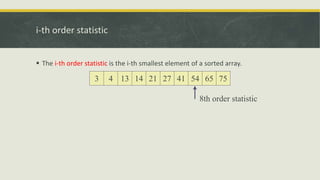
 The i-th order statistic is the i-th smallest element of a sorted array.
8th order statistic
3 4 13 14 21 27 41 54 65 75
Median
 Median is a halfway point of the set.
 N is odd, median is (n+1)/2-th order statistic
 N is even,
upper median
3 4 13 14 23 27 41
lower median
54 65 75
The lower median is the
𝑛+1
2
-th order statistic
The upper median is the
𝑛+1
2
-th order statistic
Minimum and maximum
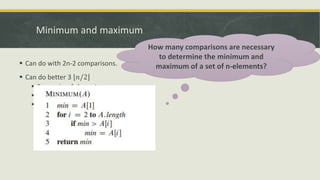
 Can do with 2n-2 comparisons.
 Can do better 3 𝑛/2
 Form pairs of elements
 Compare elements in each pair
 Pair (ai, ai+1), assume ai < ai+1, then
 Compare (min,ai), (ai+1,max)
 3 comparisions for each pair.
How many comparisons are necessary
to determine the minimum and
maximum of a set of n-elements?
Minimum and maximum
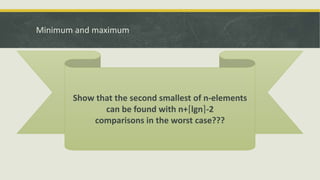
Show that the second smallest of n-elements
can be found with n+ lgn -2
comparisons in the worst case???
Selection Problem
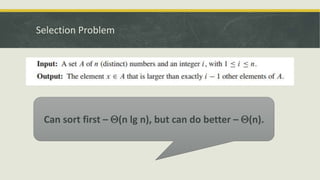
Can sort first – (n lg n), but can do better – (n).
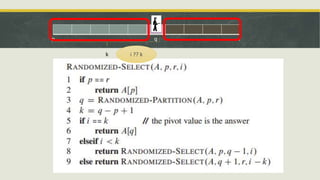
p rq
k i ?? k
Selection in expected linear time
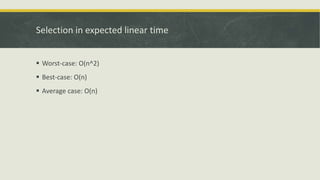
 Worst-case: O(n^2)
 Best-case: O(n)
 Average case: O(n)
Selection in worst-case linear time
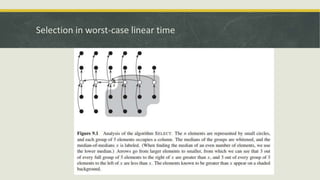
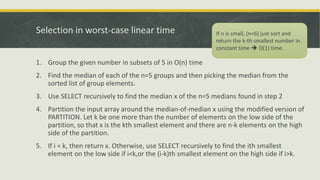
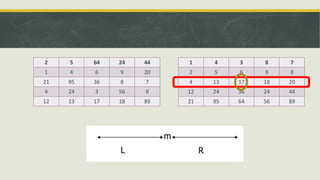
1. Group the given number in subsets of 5 in O(n) time
2. Find the median of each of the n=5 groups and then picking the median from the
sorted list of group elements.
3. Use SELECT recursively to find the median x of the n=5 medians found in step 2
4. Partition the input array around the median-of-median x using the modified version of
PARTITION. Let k be one more than the number of elements on the low side of the
partition, so that x is the kth smallest element and there are n-k elements on the high
side of the partition.
5. If i = k, then return x. Otherwise, use SELECT recursively to find the ith smallest
element on the low side if i<k,or the (i-k)th smallest element on the high side if i>k.
If n is small, (n<6) just sort and
return the k-th smallest number in
constant time  O(1) time.
2 5 64 24 44
1 4 6 9 20
21 95 36 8 7
4 24 3 56 8
12 13 17 18 89
1 4 3 8 7
2 5 6 9 8
4 13 17 18 20
12 24 36 24 44
21 95 64 56 89
Key points
 i-th order statistic
 Median
 Minimum and maximum
 Selection Problem
Q&A

Medians and Order Statistics

  • 1.
    Medians and Order Statistics Teacher:Nguyen Van Tuyen Student: Nguyen Phuong Hoa
  • 2.
    Outline: 1. i-th orderstatistic 2. Minimum and maximum 3. Selection Problem a. Selection in expected linear time b. Selection in worst-case linear time 4.Q&A
  • 3.
    i-th order statistic The i-th order statistic is the i-th smallest element of a sorted array. 8th order statistic 3 4 13 14 21 27 41 54 65 75
  • 4.
    Median  Median isa halfway point of the set.  N is odd, median is (n+1)/2-th order statistic  N is even, upper median 3 4 13 14 23 27 41 lower median 54 65 75 The lower median is the 𝑛+1 2 -th order statistic The upper median is the 𝑛+1 2 -th order statistic
  • 5.
    Minimum and maximum Can do with 2n-2 comparisons.  Can do better 3 𝑛/2  Form pairs of elements  Compare elements in each pair  Pair (ai, ai+1), assume ai < ai+1, then  Compare (min,ai), (ai+1,max)  3 comparisions for each pair. How many comparisons are necessary to determine the minimum and maximum of a set of n-elements?
  • 6.
    Minimum and maximum Showthat the second smallest of n-elements can be found with n+ lgn -2 comparisons in the worst case???
  • 7.
    Selection Problem Can sortfirst – (n lg n), but can do better – (n).
  • 8.
  • 9.
    Selection in expectedlinear time  Worst-case: O(n^2)  Best-case: O(n)  Average case: O(n)
  • 10.
  • 11.
    Selection in worst-caselinear time 1. Group the given number in subsets of 5 in O(n) time 2. Find the median of each of the n=5 groups and then picking the median from the sorted list of group elements. 3. Use SELECT recursively to find the median x of the n=5 medians found in step 2 4. Partition the input array around the median-of-median x using the modified version of PARTITION. Let k be one more than the number of elements on the low side of the partition, so that x is the kth smallest element and there are n-k elements on the high side of the partition. 5. If i = k, then return x. Otherwise, use SELECT recursively to find the ith smallest element on the low side if i<k,or the (i-k)th smallest element on the high side if i>k. If n is small, (n<6) just sort and return the k-th smallest number in constant time  O(1) time.
  • 12.
    2 5 6424 44 1 4 6 9 20 21 95 36 8 7 4 24 3 56 8 12 13 17 18 89 1 4 3 8 7 2 5 6 9 8 4 13 17 18 20 12 24 36 24 44 21 95 64 56 89
  • 13.
    Key points  i-thorder statistic  Median  Minimum and maximum  Selection Problem
  • 14.