Lesson 14 Introduction to Functions (Sect. 1.4) After completing this lesson, you should be able to: Determine if a mathematical relation represented by a schematic map, a table of values, or a set of ordered pairs is or is not a function.
Lesson 14 Introduction to Functions (Sect. 1.4) Def: A  function   is a mathematical relation between a collection of input values (the  domain ) and a collection of output values (the  range ) in which no value in the domain corresponds to more than one value in the range. A function is usually expressed as an equation that has been “solved for y” (EX: y = x 2  – 3x) A function can also be represented by a schematic drawing, a table of values, or a set of ordered pairs
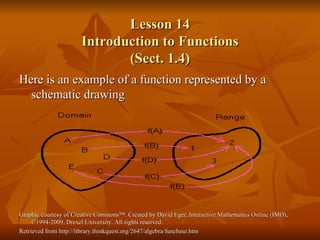
Lesson 14 Introduction to Functions (Sect. 1.4) Here is an example of a function represented by a schematic drawing Graphic courtesy of Creative Commons ™ . Created by David Eger, Interactive Mathematics Online (IMO),  ©1994-2009, Drexel University. All rights reserved. R etrieved from http://library.thinkquest.org/2647/algebra/funcbase.htm
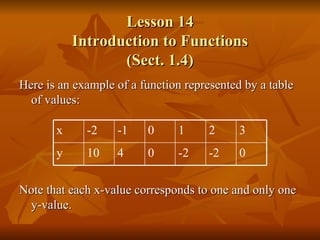
Lesson 14 Introduction to Functions (Sect. 1.4) Here is an example of a function represented by a table of values: Note that each x-value corresponds to one and only one y-value. 0 -2 -2 0 4 10 y 3 2 1 0 -1 -2 x
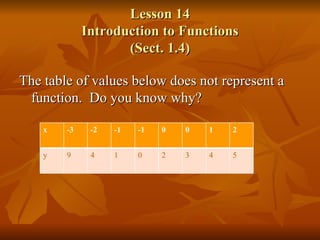
Lesson 14 Introduction to Functions (Sect. 1.4) The table of values below does not represent a function.  Do you know why? x -3 -2 -1 -1 0 0 1 2 y 9 4 1 0 2 3 4 5
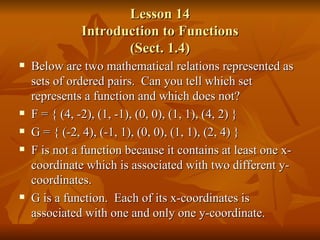
Below are two mathematical relations represented as sets of ordered pairs.  Can you tell which set represents a function and which does not? F = { (4, -2), (1, -1), (0, 0), (1, 1), (4, 2) } G = { (-2, 4), (-1, 1), (0, 0), (1, 1), (2, 4) } F is not a function because it contains at least one x-coordinate which is associated with two different y-coordinates. G is a function.  Each of its x-coordinates is associated with one and only one y-coordinate. Lesson 14 Introduction to Functions (Sect. 1.4)
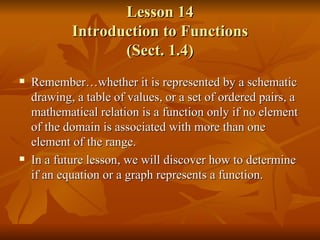
Lesson 14 Introduction to Functions (Sect. 1.4) Remember…whether it is represented by a schematic drawing, a table of values, or a set of ordered pairs, a mathematical relation is a function only if no element of the domain is associated with more than one element of the range. In a future lesson, we will discover how to determine if an equation or a graph represents a function.

Objective 1 - Identifying Functions

  • 1.
    Lesson 14 Introductionto Functions (Sect. 1.4) After completing this lesson, you should be able to: Determine if a mathematical relation represented by a schematic map, a table of values, or a set of ordered pairs is or is not a function.
  • 2.
    Lesson 14 Introductionto Functions (Sect. 1.4) Def: A function is a mathematical relation between a collection of input values (the domain ) and a collection of output values (the range ) in which no value in the domain corresponds to more than one value in the range. A function is usually expressed as an equation that has been “solved for y” (EX: y = x 2 – 3x) A function can also be represented by a schematic drawing, a table of values, or a set of ordered pairs
  • 3.
    Lesson 14 Introductionto Functions (Sect. 1.4) Here is an example of a function represented by a schematic drawing Graphic courtesy of Creative Commons ™ . Created by David Eger, Interactive Mathematics Online (IMO), ©1994-2009, Drexel University. All rights reserved. R etrieved from http://library.thinkquest.org/2647/algebra/funcbase.htm
  • 4.
    Lesson 14 Introductionto Functions (Sect. 1.4) Here is an example of a function represented by a table of values: Note that each x-value corresponds to one and only one y-value. 0 -2 -2 0 4 10 y 3 2 1 0 -1 -2 x
  • 5.
    Lesson 14 Introductionto Functions (Sect. 1.4) The table of values below does not represent a function. Do you know why? x -3 -2 -1 -1 0 0 1 2 y 9 4 1 0 2 3 4 5
  • 6.
    Below are twomathematical relations represented as sets of ordered pairs. Can you tell which set represents a function and which does not? F = { (4, -2), (1, -1), (0, 0), (1, 1), (4, 2) } G = { (-2, 4), (-1, 1), (0, 0), (1, 1), (2, 4) } F is not a function because it contains at least one x-coordinate which is associated with two different y-coordinates. G is a function. Each of its x-coordinates is associated with one and only one y-coordinate. Lesson 14 Introduction to Functions (Sect. 1.4)
  • 7.
    Lesson 14 Introductionto Functions (Sect. 1.4) Remember…whether it is represented by a schematic drawing, a table of values, or a set of ordered pairs, a mathematical relation is a function only if no element of the domain is associated with more than one element of the range. In a future lesson, we will discover how to determine if an equation or a graph represents a function.