MOFT Tutorials
Multi Object Filtering Multi Target Tracking
Multiple Hypothesis Tracking
Part-3 / Direct n-Best MHT
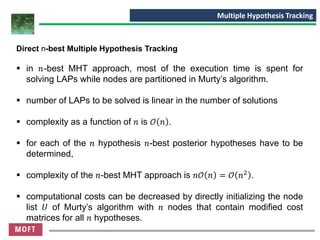
Direct n-best Multiple Hypothesis Tracking
▪ in 𝑛-best MHT approach, most of the execution time is spent for
solving LAPs while nodes are partitioned in Murty’s algorithm.
▪ number of LAPs to be solved is linear in the number of solutions
▪ complexity as a function of 𝑛 is 𝒪 𝑛 .
▪ for each of the 𝑛 hypothesis 𝑛-best posterior hypotheses have to be
determined,
▪ complexity of the 𝑛-best MHT approach is 𝑛𝒪 𝑛 = 𝒪 𝑛2 .
▪ computational costs can be decreased by directly initializing the node
list 𝑈 of Murty’s algorithm with 𝑛 nodes that contain modified cost
matrices for all 𝑛 hypotheses.
Multiple Hypothesis Tracking
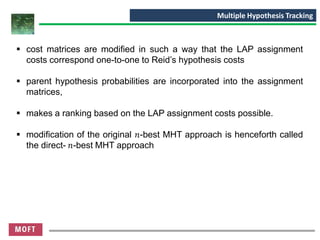
▪ cost matrices are modified in such a way that the LAP assignment
costs correspond one-to-one to Reid’s hypothesis costs
▪ parent hypothesis probabilities are incorporated into the assignment
matrices,
▪ makes a ranking based on the LAP assignment costs possible.
▪ modification of the original 𝑛-best MHT approach is henceforth called
the direct- 𝑛-best MHT approach
Multiple Hypothesis Tracking
Modified Data Association Matrix
▪ modified cost matrix 𝐿′
Ω𝑖
𝑘
∈ ℝ 𝑀 𝑘 𝑥 𝑁 𝑇𝐺𝑇+2𝑀 𝑘 of a hypothesis Ω𝑖
𝑘
is
constructed in the following way
▪ elements of the cost matrix correspond directly to the three
probabilities for
▪ track continuation,
▪ new target
▪ false target
associations of the original hypothesis
▪ given the probability for assigning a measurement z𝑖 𝑘 + 1 , 1 ≤ 𝑖 ≤
𝑀 𝑘 to an existing track 1 ≤ 𝑗 ≤ 𝑁 𝑇𝐺𝑇
𝑙𝑖𝑗
′
=
𝑃 𝐷 𝑓 𝒩 𝐻x 𝑗
𝑘
,S 𝑗
𝑘 𝑧𝑖 𝑘 + 1
1 − 𝑃 𝐷
Multiple Hypothesis Tracking
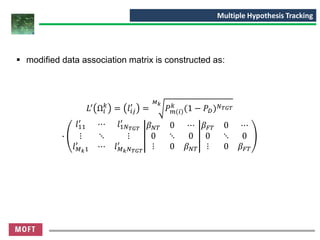
▪ modified data association matrix is constructed as:
𝐿′ Ω𝑖
𝑘
= 𝑙𝑖𝑗
′
=
𝑀 𝑘
𝑃 𝑚(𝑖)
𝑘
(1 − 𝑃 𝐷) 𝑁 𝑇𝐺𝑇
∙
𝑙11
′
⋯ 𝑙1𝑁 𝑇𝐺𝑇
′
⋮ ⋱ ⋮
𝑙 𝑀 𝑘1
′
⋯ 𝑙 𝑀 𝑘 𝑁 𝑇𝐺𝑇
′
𝛽 𝑁𝑇 0 ⋯
0 ⋱ 0
⋮ 0 𝛽 𝑁𝑇
𝛽 𝐹𝑇 0 ⋯
0 ⋱ 0
⋮ 0 𝛽 𝐹𝑇
Multiple Hypothesis Tracking
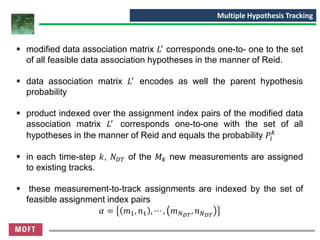
▪ modified data association matrix 𝐿′ corresponds one-to- one to the set
of all feasible data association hypotheses in the manner of Reid.
▪ data association matrix 𝐿′ encodes as well the parent hypothesis
probability
▪ product indexed over the assignment index pairs of the modified data
association matrix 𝐿′ corresponds one-to-one with the set of all
hypotheses in the manner of Reid and equals the probability 𝑃𝑖
𝑘
▪ in each time-step 𝑘, 𝑁 𝐷𝑇 of the 𝑀 𝑘 new measurements are assigned
to existing tracks.
▪ these measurement-to-track assignments are indexed by the set of
feasible assignment index pairs
𝛼 = 𝑚1, 𝑛1 , ⋯ , 𝑚 𝑁 𝐷𝑇
, 𝑛 𝑁 𝐷𝑇
Multiple Hypothesis Tracking
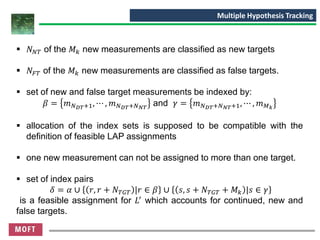
▪ 𝑁 𝑁𝑇 of the 𝑀 𝑘 new measurements are classified as new targets
▪ 𝑁𝐹𝑇 of the 𝑀 𝑘 new measurements are classified as false targets.
▪ set of new and false target measurements be indexed by:
𝛽 = 𝑚 𝑁 𝐷𝑇+1, ⋯ , 𝑚 𝑁 𝐷𝑇+𝑁 𝑁𝑇
and 𝛾 = 𝑚 𝑁 𝐷𝑇+𝑁 𝑁𝑇+1, ⋯ , 𝑚 𝑀 𝑘
▪ allocation of the index sets is supposed to be compatible with the
definition of feasible LAP assignments
▪ one new measurement can not be assigned to more than one target.
▪ set of index pairs
𝛿 = 𝛼 ∪ 𝑟, 𝑟 + 𝑁 𝑇𝐺𝑇 |𝑟 ∈ 𝛽 ∪ 𝑠, 𝑠 + 𝑁 𝑇𝐺𝑇 + 𝑀 𝑘 |𝑠 ∈ 𝛾
is a feasible assignment for 𝐿′ which accounts for continued, new and
false targets.
Multiple Hypothesis Tracking
▪ product over all matrix elements contained in the index pair set 𝛿 is
equal to the hypothesis probability due to Reid.
ෑ
(𝑡,𝑢)∈𝛿
𝑙 𝑡𝑢
′
=
𝑀 𝑘
𝑃 𝑚(𝑖)
𝑘
(1 − 𝑃 𝐷) 𝑁 𝑇𝐺𝑇
𝑁 𝐷𝑇+𝑁 𝑁𝑇+𝑁 𝐹𝑇
ෑ
(𝑚,𝑛)∈𝛼
𝑙 𝑚𝑛
′
𝛽 𝑁𝑇
𝑁 𝑁𝑇
𝛽 𝐹𝑇
𝑁 𝐹𝑇
= 𝑃 𝑚(𝑖)
𝑘
(1 − 𝑃 𝐷) 𝑁 𝑇𝐺𝑇 ෑ
𝑖=1
𝑁 𝐷𝑇
𝑃 𝐷 𝑓 𝒩 𝑧 𝑚𝑖
𝑘 + 1
1 − 𝑃 𝐷
𝛽 𝑁𝑇
𝑁 𝑁𝑇
𝛽 𝐹𝑇
𝑁 𝐹𝑇
= 𝑃 𝑚(𝑖)
𝑘 (1−𝑃 𝐷) 𝑁 𝑇𝐺𝑇
(1−𝑃 𝐷) 𝑁 𝐷𝑇
ς𝑖=1
𝑁 𝐷𝑇
𝑃 𝐷 𝑓 𝒩 𝑧 𝑚 𝑖
𝑘 + 1 𝛽 𝑁𝑇
𝑁 𝑁𝑇
𝛽 𝐹𝑇
𝑁 𝐹𝑇
= 𝑃 𝑚(𝑖)
𝑘
𝑃 𝐷
𝑁 𝐷𝑇(1 − 𝑃 𝐷) 𝑁 𝑇𝐺𝑇−𝑁 𝐷𝑇 ෑ
𝑖=1
𝑁 𝐷𝑇
𝑓 𝒩 𝑧 𝑚 𝑖
𝑘 + 1 𝛽 𝑁𝑇
𝑁 𝑁𝑇
𝛽 𝐹𝑇
𝑁 𝐹𝑇
= 𝑃𝑖
𝑘+1
Multiple Hypothesis Tracking
▪ any assignment returned by Murty’s algorithm consists of 𝑀 𝑘
measurement-to-target assignments
▪ total hypothesis probability in the manner of Reid can be obtained by
multiplying each matrix element by
𝑀 𝑘
𝑃 𝑚(𝑖)
𝑘
(1 − 𝑃 𝐷) 𝑁 𝑇𝐺𝑇
▪ square root disappears because exactly 𝑀 𝑘 factors are multiplied
▪ remaining factor 𝑃 𝑚(𝑖)
𝑘
(1 − 𝑃 𝐷) 𝑁 𝑇𝐺𝑇 incorporates the probability of the
parent hypothesis into the assignment costs
▪ probabilities of the hypothesis rating equation are connected by
multiplications
▪ assignment costs are the sums of matrix elements
Multiple Hypothesis Tracking
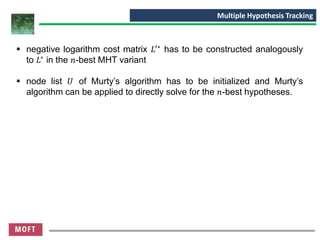
▪ negative logarithm cost matrix 𝐿′∗ has to be constructed analogously
to 𝐿∗
in the 𝑛-best MHT variant
▪ node list 𝑈 of Murty’s algorithm has to be initialized and Murty’s
algorithm can be applied to directly solve for the 𝑛-best hypotheses.
Multiple Hypothesis Tracking
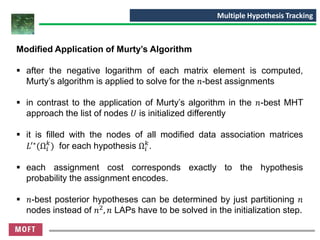
Modified Application of Murty’s Algorithm
▪ after the negative logarithm of each matrix element is computed,
Murty’s algorithm is applied to solve for the 𝑛-best assignments
▪ in contrast to the application of Murty’s algorithm in the 𝑛-best MHT
approach the list of nodes 𝑈 is initialized differently
▪ it is filled with the nodes of all modified data association matrices
𝐿′∗(Ω𝑖
𝑘
) for each hypothesis Ω𝑖
𝑘
.
▪ each assignment cost corresponds exactly to the hypothesis
probability the assignment encodes.
▪ 𝑛-best posterior hypotheses can be determined by just partitioning 𝑛
nodes instead of 𝑛2, 𝑛 LAPs have to be solved in the initialization step.
Multiple Hypothesis Tracking
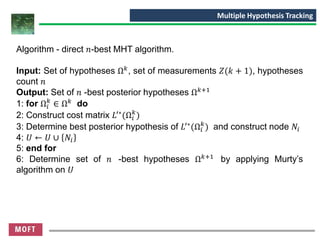
Algorithm - direct 𝑛-best MHT algorithm.
Input: Set of hypotheses Ω 𝑘, set of measurements 𝑍(𝑘 + 1), hypotheses
count 𝑛
Output: Set of 𝑛 -best posterior hypotheses Ω 𝑘+1
1: for Ω𝑖
𝑘
∈ Ω 𝑘 do
2: Construct cost matrix 𝐿′∗
(Ω𝑖
𝑘
)
3: Determine best posterior hypothesis of 𝐿′∗
(Ω𝑖
𝑘
) and construct node 𝑁𝑖
4: 𝑈 ← 𝑈 ∪ 𝑁𝑖
5: end for
6: Determine set of 𝑛 -best hypotheses Ω 𝑘+1 by applying Murty’s
algorithm on 𝑈
Multiple Hypothesis Tracking
▪ while-loop of Murty’s algorithm is dragged out of the for-loop running
over the set of hypotheses
▪ reduces the overall algorithmic complexity as a function of the number
of maintained hypotheses from 𝒪 𝑛2 to 𝒪 𝑛
Multiple Hypothesis Tracking
References
[1] David Geier, Development and Evaluation of a Real-time Capable
Multiple Hypothesis Tracker, Technische Universität Berlin,2012
[2] Y. Bar-Shalom, X. Rong Li, T. Kirubarajan, “Estimation with
Applications to Tracking and Navigation”, Wiley, 2001
[3] U. Orguner, “Target Tracking”, Lecture notes, Linköpings University,
2010.
[4] S.S. Blackman, R. Popoli, “Design and Analysis of Modern Tracking
Systems”, Artech House, 1999
Other MOFT Tutorials – Lists and Links
Introduction to Multi Target Tracking
Bayesian Inference and Filtering
Kalman Filtering
Sequential Monte Carlo (SMC) Methods and Particle Filtering
Single Object Filtering Single Target Tracking
Nearest Neighbor(NN) and Probabilistic Data Association Filter(PDAF)
Multi Object Filtering Multi Target Tracking
Global Nearest Neighbor and Joint Probabilistic Data Association Filter
Data Association in Multi Target Tracking
Multiple Hypothesis Tracking, MHT
Other MOFT Tutorials – Lists and Links
Random Finite Sets, RFS
Random Finite Set Based RFS Filters
RFS Filters, Probability Hypothesis Density, PHD
RFS Filters, Cardinalized Probability Hypothesis Density, CPHD Filter
RFS Filters, Multi Bernoulli MemBer and Cardinality Balanced MeMBer, CBMemBer Filter
RFS Labeled Filters, Generalized Labeled Multi Bernoulli, GLMB and Labeled Multi Bernoulli, LMB Filters
Multiple Model Methods in Multi Target Tracking
Multi Target Tracking Implementation
Multi Target Tracking Performance and Metrics
http://www.egniya.com/EN/MOFT/Tutorials/
moft@egniya.com

MHT Multi Hypothesis Tracking - Part3

  • 1.
    MOFT Tutorials Multi ObjectFiltering Multi Target Tracking Multiple Hypothesis Tracking Part-3 / Direct n-Best MHT
  • 2.
    Direct n-best MultipleHypothesis Tracking ▪ in 𝑛-best MHT approach, most of the execution time is spent for solving LAPs while nodes are partitioned in Murty’s algorithm. ▪ number of LAPs to be solved is linear in the number of solutions ▪ complexity as a function of 𝑛 is 𝒪 𝑛 . ▪ for each of the 𝑛 hypothesis 𝑛-best posterior hypotheses have to be determined, ▪ complexity of the 𝑛-best MHT approach is 𝑛𝒪 𝑛 = 𝒪 𝑛2 . ▪ computational costs can be decreased by directly initializing the node list 𝑈 of Murty’s algorithm with 𝑛 nodes that contain modified cost matrices for all 𝑛 hypotheses. Multiple Hypothesis Tracking
  • 3.
    ▪ cost matricesare modified in such a way that the LAP assignment costs correspond one-to-one to Reid’s hypothesis costs ▪ parent hypothesis probabilities are incorporated into the assignment matrices, ▪ makes a ranking based on the LAP assignment costs possible. ▪ modification of the original 𝑛-best MHT approach is henceforth called the direct- 𝑛-best MHT approach Multiple Hypothesis Tracking
  • 4.
    Modified Data AssociationMatrix ▪ modified cost matrix 𝐿′ Ω𝑖 𝑘 ∈ ℝ 𝑀 𝑘 𝑥 𝑁 𝑇𝐺𝑇+2𝑀 𝑘 of a hypothesis Ω𝑖 𝑘 is constructed in the following way ▪ elements of the cost matrix correspond directly to the three probabilities for ▪ track continuation, ▪ new target ▪ false target associations of the original hypothesis ▪ given the probability for assigning a measurement z𝑖 𝑘 + 1 , 1 ≤ 𝑖 ≤ 𝑀 𝑘 to an existing track 1 ≤ 𝑗 ≤ 𝑁 𝑇𝐺𝑇 𝑙𝑖𝑗 ′ = 𝑃 𝐷 𝑓 𝒩 𝐻x 𝑗 𝑘 ,S 𝑗 𝑘 𝑧𝑖 𝑘 + 1 1 − 𝑃 𝐷 Multiple Hypothesis Tracking
  • 5.
    ▪ modified dataassociation matrix is constructed as: 𝐿′ Ω𝑖 𝑘 = 𝑙𝑖𝑗 ′ = 𝑀 𝑘 𝑃 𝑚(𝑖) 𝑘 (1 − 𝑃 𝐷) 𝑁 𝑇𝐺𝑇 ∙ 𝑙11 ′ ⋯ 𝑙1𝑁 𝑇𝐺𝑇 ′ ⋮ ⋱ ⋮ 𝑙 𝑀 𝑘1 ′ ⋯ 𝑙 𝑀 𝑘 𝑁 𝑇𝐺𝑇 ′ 𝛽 𝑁𝑇 0 ⋯ 0 ⋱ 0 ⋮ 0 𝛽 𝑁𝑇 𝛽 𝐹𝑇 0 ⋯ 0 ⋱ 0 ⋮ 0 𝛽 𝐹𝑇 Multiple Hypothesis Tracking
  • 6.
    ▪ modified dataassociation matrix 𝐿′ corresponds one-to- one to the set of all feasible data association hypotheses in the manner of Reid. ▪ data association matrix 𝐿′ encodes as well the parent hypothesis probability ▪ product indexed over the assignment index pairs of the modified data association matrix 𝐿′ corresponds one-to-one with the set of all hypotheses in the manner of Reid and equals the probability 𝑃𝑖 𝑘 ▪ in each time-step 𝑘, 𝑁 𝐷𝑇 of the 𝑀 𝑘 new measurements are assigned to existing tracks. ▪ these measurement-to-track assignments are indexed by the set of feasible assignment index pairs 𝛼 = 𝑚1, 𝑛1 , ⋯ , 𝑚 𝑁 𝐷𝑇 , 𝑛 𝑁 𝐷𝑇 Multiple Hypothesis Tracking
  • 7.
    ▪ 𝑁 𝑁𝑇of the 𝑀 𝑘 new measurements are classified as new targets ▪ 𝑁𝐹𝑇 of the 𝑀 𝑘 new measurements are classified as false targets. ▪ set of new and false target measurements be indexed by: 𝛽 = 𝑚 𝑁 𝐷𝑇+1, ⋯ , 𝑚 𝑁 𝐷𝑇+𝑁 𝑁𝑇 and 𝛾 = 𝑚 𝑁 𝐷𝑇+𝑁 𝑁𝑇+1, ⋯ , 𝑚 𝑀 𝑘 ▪ allocation of the index sets is supposed to be compatible with the definition of feasible LAP assignments ▪ one new measurement can not be assigned to more than one target. ▪ set of index pairs 𝛿 = 𝛼 ∪ 𝑟, 𝑟 + 𝑁 𝑇𝐺𝑇 |𝑟 ∈ 𝛽 ∪ 𝑠, 𝑠 + 𝑁 𝑇𝐺𝑇 + 𝑀 𝑘 |𝑠 ∈ 𝛾 is a feasible assignment for 𝐿′ which accounts for continued, new and false targets. Multiple Hypothesis Tracking
  • 8.
    ▪ product overall matrix elements contained in the index pair set 𝛿 is equal to the hypothesis probability due to Reid. ෑ (𝑡,𝑢)∈𝛿 𝑙 𝑡𝑢 ′ = 𝑀 𝑘 𝑃 𝑚(𝑖) 𝑘 (1 − 𝑃 𝐷) 𝑁 𝑇𝐺𝑇 𝑁 𝐷𝑇+𝑁 𝑁𝑇+𝑁 𝐹𝑇 ෑ (𝑚,𝑛)∈𝛼 𝑙 𝑚𝑛 ′ 𝛽 𝑁𝑇 𝑁 𝑁𝑇 𝛽 𝐹𝑇 𝑁 𝐹𝑇 = 𝑃 𝑚(𝑖) 𝑘 (1 − 𝑃 𝐷) 𝑁 𝑇𝐺𝑇 ෑ 𝑖=1 𝑁 𝐷𝑇 𝑃 𝐷 𝑓 𝒩 𝑧 𝑚𝑖 𝑘 + 1 1 − 𝑃 𝐷 𝛽 𝑁𝑇 𝑁 𝑁𝑇 𝛽 𝐹𝑇 𝑁 𝐹𝑇 = 𝑃 𝑚(𝑖) 𝑘 (1−𝑃 𝐷) 𝑁 𝑇𝐺𝑇 (1−𝑃 𝐷) 𝑁 𝐷𝑇 ς𝑖=1 𝑁 𝐷𝑇 𝑃 𝐷 𝑓 𝒩 𝑧 𝑚 𝑖 𝑘 + 1 𝛽 𝑁𝑇 𝑁 𝑁𝑇 𝛽 𝐹𝑇 𝑁 𝐹𝑇 = 𝑃 𝑚(𝑖) 𝑘 𝑃 𝐷 𝑁 𝐷𝑇(1 − 𝑃 𝐷) 𝑁 𝑇𝐺𝑇−𝑁 𝐷𝑇 ෑ 𝑖=1 𝑁 𝐷𝑇 𝑓 𝒩 𝑧 𝑚 𝑖 𝑘 + 1 𝛽 𝑁𝑇 𝑁 𝑁𝑇 𝛽 𝐹𝑇 𝑁 𝐹𝑇 = 𝑃𝑖 𝑘+1 Multiple Hypothesis Tracking
  • 9.
    ▪ any assignmentreturned by Murty’s algorithm consists of 𝑀 𝑘 measurement-to-target assignments ▪ total hypothesis probability in the manner of Reid can be obtained by multiplying each matrix element by 𝑀 𝑘 𝑃 𝑚(𝑖) 𝑘 (1 − 𝑃 𝐷) 𝑁 𝑇𝐺𝑇 ▪ square root disappears because exactly 𝑀 𝑘 factors are multiplied ▪ remaining factor 𝑃 𝑚(𝑖) 𝑘 (1 − 𝑃 𝐷) 𝑁 𝑇𝐺𝑇 incorporates the probability of the parent hypothesis into the assignment costs ▪ probabilities of the hypothesis rating equation are connected by multiplications ▪ assignment costs are the sums of matrix elements Multiple Hypothesis Tracking
  • 10.
    ▪ negative logarithmcost matrix 𝐿′∗ has to be constructed analogously to 𝐿∗ in the 𝑛-best MHT variant ▪ node list 𝑈 of Murty’s algorithm has to be initialized and Murty’s algorithm can be applied to directly solve for the 𝑛-best hypotheses. Multiple Hypothesis Tracking
  • 11.
    Modified Application ofMurty’s Algorithm ▪ after the negative logarithm of each matrix element is computed, Murty’s algorithm is applied to solve for the 𝑛-best assignments ▪ in contrast to the application of Murty’s algorithm in the 𝑛-best MHT approach the list of nodes 𝑈 is initialized differently ▪ it is filled with the nodes of all modified data association matrices 𝐿′∗(Ω𝑖 𝑘 ) for each hypothesis Ω𝑖 𝑘 . ▪ each assignment cost corresponds exactly to the hypothesis probability the assignment encodes. ▪ 𝑛-best posterior hypotheses can be determined by just partitioning 𝑛 nodes instead of 𝑛2, 𝑛 LAPs have to be solved in the initialization step. Multiple Hypothesis Tracking
  • 12.
    Algorithm - direct𝑛-best MHT algorithm. Input: Set of hypotheses Ω 𝑘, set of measurements 𝑍(𝑘 + 1), hypotheses count 𝑛 Output: Set of 𝑛 -best posterior hypotheses Ω 𝑘+1 1: for Ω𝑖 𝑘 ∈ Ω 𝑘 do 2: Construct cost matrix 𝐿′∗ (Ω𝑖 𝑘 ) 3: Determine best posterior hypothesis of 𝐿′∗ (Ω𝑖 𝑘 ) and construct node 𝑁𝑖 4: 𝑈 ← 𝑈 ∪ 𝑁𝑖 5: end for 6: Determine set of 𝑛 -best hypotheses Ω 𝑘+1 by applying Murty’s algorithm on 𝑈 Multiple Hypothesis Tracking
  • 13.
    ▪ while-loop ofMurty’s algorithm is dragged out of the for-loop running over the set of hypotheses ▪ reduces the overall algorithmic complexity as a function of the number of maintained hypotheses from 𝒪 𝑛2 to 𝒪 𝑛 Multiple Hypothesis Tracking
  • 14.
    References [1] David Geier,Development and Evaluation of a Real-time Capable Multiple Hypothesis Tracker, Technische Universität Berlin,2012 [2] Y. Bar-Shalom, X. Rong Li, T. Kirubarajan, “Estimation with Applications to Tracking and Navigation”, Wiley, 2001 [3] U. Orguner, “Target Tracking”, Lecture notes, Linköpings University, 2010. [4] S.S. Blackman, R. Popoli, “Design and Analysis of Modern Tracking Systems”, Artech House, 1999
  • 15.
    Other MOFT Tutorials– Lists and Links Introduction to Multi Target Tracking Bayesian Inference and Filtering Kalman Filtering Sequential Monte Carlo (SMC) Methods and Particle Filtering Single Object Filtering Single Target Tracking Nearest Neighbor(NN) and Probabilistic Data Association Filter(PDAF) Multi Object Filtering Multi Target Tracking Global Nearest Neighbor and Joint Probabilistic Data Association Filter Data Association in Multi Target Tracking Multiple Hypothesis Tracking, MHT
  • 16.
    Other MOFT Tutorials– Lists and Links Random Finite Sets, RFS Random Finite Set Based RFS Filters RFS Filters, Probability Hypothesis Density, PHD RFS Filters, Cardinalized Probability Hypothesis Density, CPHD Filter RFS Filters, Multi Bernoulli MemBer and Cardinality Balanced MeMBer, CBMemBer Filter RFS Labeled Filters, Generalized Labeled Multi Bernoulli, GLMB and Labeled Multi Bernoulli, LMB Filters Multiple Model Methods in Multi Target Tracking Multi Target Tracking Implementation Multi Target Tracking Performance and Metrics
  • 17.