ASSIGNMENT
PROBLEM
ASSIGNMENT MODEL
• Assigning of jobs to factors (men or machine) to get
most optimum output or get least cost.
• Hungarian method is the mostly used method of
solving assignment problems.
• Types of Assignment problems:
(i) Balanced
(ii) Unbalanced
OBJECTIVES
•No workers is more than one job.
•No job is assigned to more than one
worker.
•Total time taken to complete a job is
minimum.
•The work done is cost effective and
BALANCED
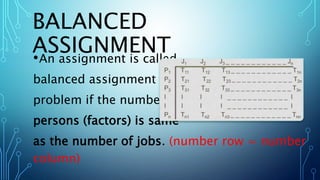
ASSIGNMENT•An assignment is called
balanced assignment
problem if the number of
persons (factors) is same
as the number of jobs. (number row = number
column)
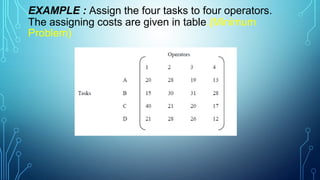
EXAMPLE : Assign the four tasks to four operators.
The assigning costs are given in table.(Minimum
Problem)
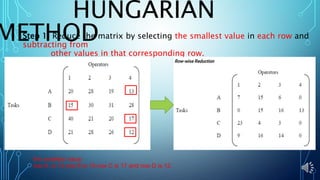
Step 1: Reduce the matrix by selecting the smallest value in each row and
subtracting from
other values in that corresponding row.
the smallest value:
row A, is 13,row B is 15,row C is 17 and row D is 12.
HUNGARIAN
METHOD
HUNGARIAN
METHOD
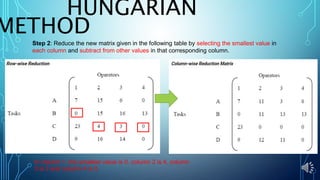
Step 2: Reduce the new matrix given in the following table by selecting the smallest value in
each column and subtract from other values in that corresponding column.
In column 1, the smallest value is 0, column 2 is 4, column
3 is 3 and column 4 is 0.
HUNGARIAN
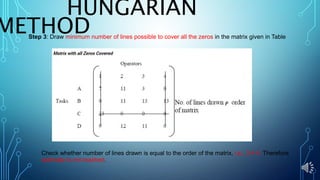
METHODStep 3: Draw minimum number of lines possible to cover all the zeros in the matrix given in Table
Check whether number of lines drawn is equal to the order of the matrix, i.e., 3 ≠ 4. Therefore
optimally is not reached.
HUNGARIAN
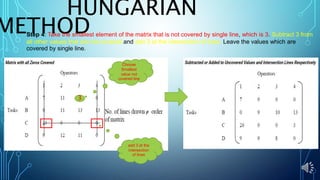
METHODStep 4: Take the smallest element of the matrix that is not covered by single line, which is 3. Subtract 3 from
all other values that are not covered and add 3 at the intersection of lines. Leave the values which are
covered by single line.
3
Choose
Smallest
value not
covered line
add 3 at the
intersection
of lines
HUNGARIAN
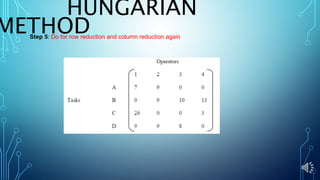
METHODStep 5: Do for row reduction and column reduction again
HUNGARIAN
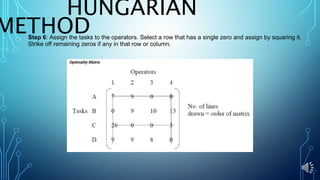
METHODStep 6: Assign the tasks to the operators. Select a row that has a single zero and assign by squaring it.
Strike off remaining zeros if any in that row or column.
HUNGARIAN
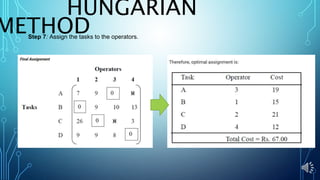
METHODStep 7: Assign the tasks to the operators.
UNBALANCED
ASSIGNMENT•An assignment is called unbalanced assignment
problem if the number of persons (factors) is not
same as the number of jobs. (number row ≠
number column)
(4 rows≠5 columnso unbalanced)
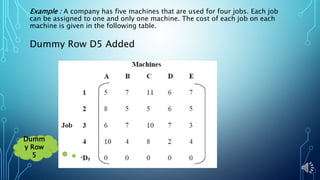
Example : A company has five machines that are used for four jobs. Each job
can be assigned to one and only one machine. The cost of each job on each
machine is given in the following table.
Dumm
y Row
5
Dummy Row D5 Added
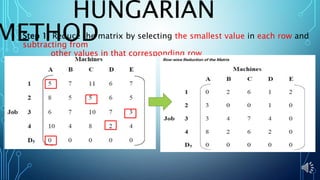
Step 1: Reduce the matrix by selecting the smallest value in each row and
subtracting from
other values in that corresponding row.
HUNGARIAN
METHOD
HUNGARIAN
METHOD
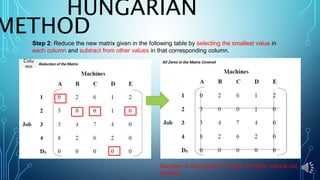
Step 2: Reduce the new matrix given in the following table by selecting the smallest value in
each column and subtract from other values in that corresponding column.
Colu
mn
Number of lines drawn ≠ Order of matrix. Hence not
optimal.
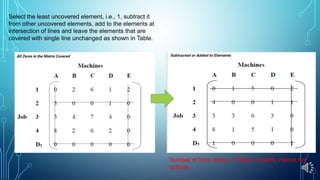
Select the least uncovered element, i.e., 1, subtract it
from other uncovered elements, add to the elements at
intersection of lines and leave the elements that are
covered with single line unchanged as shown in Table.
Number of lines drawn ≠ Order of matrix. Hence not
optimal.
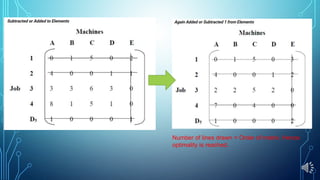
Number of lines drawn = Order of matrix. Hence
optimality is reached.
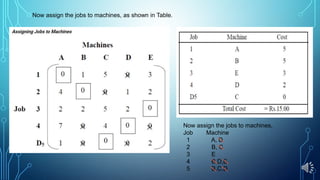
Now assign the jobs to machines, as shown in Table.
Now assign the jobs to machines,
Job Machine
1 A, D
2 B, C
3 E
4 B,D,E
5 B,C,D
THANK YOU

Assignment problem

  • 1.
  • 2.
    ASSIGNMENT MODEL • Assigningof jobs to factors (men or machine) to get most optimum output or get least cost. • Hungarian method is the mostly used method of solving assignment problems. • Types of Assignment problems: (i) Balanced (ii) Unbalanced
  • 3.
    OBJECTIVES •No workers ismore than one job. •No job is assigned to more than one worker. •Total time taken to complete a job is minimum. •The work done is cost effective and
  • 4.
    BALANCED ASSIGNMENT•An assignment iscalled balanced assignment problem if the number of persons (factors) is same as the number of jobs. (number row = number column)
  • 5.
    EXAMPLE : Assignthe four tasks to four operators. The assigning costs are given in table.(Minimum Problem)
  • 6.
    Step 1: Reducethe matrix by selecting the smallest value in each row and subtracting from other values in that corresponding row. the smallest value: row A, is 13,row B is 15,row C is 17 and row D is 12. HUNGARIAN METHOD
  • 7.
    HUNGARIAN METHOD Step 2: Reducethe new matrix given in the following table by selecting the smallest value in each column and subtract from other values in that corresponding column. In column 1, the smallest value is 0, column 2 is 4, column 3 is 3 and column 4 is 0.
  • 8.
    HUNGARIAN METHODStep 3: Drawminimum number of lines possible to cover all the zeros in the matrix given in Table Check whether number of lines drawn is equal to the order of the matrix, i.e., 3 ≠ 4. Therefore optimally is not reached.
  • 9.
    HUNGARIAN METHODStep 4: Takethe smallest element of the matrix that is not covered by single line, which is 3. Subtract 3 from all other values that are not covered and add 3 at the intersection of lines. Leave the values which are covered by single line. 3 Choose Smallest value not covered line add 3 at the intersection of lines
  • 10.
    HUNGARIAN METHODStep 5: Dofor row reduction and column reduction again
  • 11.
    HUNGARIAN METHODStep 6: Assignthe tasks to the operators. Select a row that has a single zero and assign by squaring it. Strike off remaining zeros if any in that row or column.
  • 12.
    HUNGARIAN METHODStep 7: Assignthe tasks to the operators.
  • 13.
    UNBALANCED ASSIGNMENT•An assignment iscalled unbalanced assignment problem if the number of persons (factors) is not same as the number of jobs. (number row ≠ number column) (4 rows≠5 columnso unbalanced)
  • 14.
    Example : Acompany has five machines that are used for four jobs. Each job can be assigned to one and only one machine. The cost of each job on each machine is given in the following table. Dumm y Row 5 Dummy Row D5 Added
  • 15.
    Step 1: Reducethe matrix by selecting the smallest value in each row and subtracting from other values in that corresponding row. HUNGARIAN METHOD
  • 16.
    HUNGARIAN METHOD Step 2: Reducethe new matrix given in the following table by selecting the smallest value in each column and subtract from other values in that corresponding column. Colu mn Number of lines drawn ≠ Order of matrix. Hence not optimal.
  • 17.
    Select the leastuncovered element, i.e., 1, subtract it from other uncovered elements, add to the elements at intersection of lines and leave the elements that are covered with single line unchanged as shown in Table. Number of lines drawn ≠ Order of matrix. Hence not optimal.
  • 18.
    Number of linesdrawn = Order of matrix. Hence optimality is reached.
  • 19.
    Now assign thejobs to machines, as shown in Table. Now assign the jobs to machines, Job Machine 1 A, D 2 B, C 3 E 4 B,D,E 5 B,C,D
  • 20.