Smt. Deepa K C
Assistant Professor
Department of B.Voc Multimedia
St. Mary’s College, Thrissur
1. Introduction
2. Compression
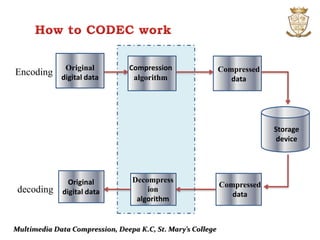
3. How to CODEC Work
4. Types of Compression
 Lossless
 Lossy
5. Reference
Multimedia Data Compression, Deepa K.C, St. Mary’s College
Compared to text files other media files like image, audio and
video take up a huge amount of disk space. A typical five page
document file occupy 75 KB of space, whereas a single image
can take up about 1.4 MB, a 1 minute audio clip can take up
over 10MB and a1 min video clip can take up 2 GB of disk
space.
Multimedia Data Compression, Deepa K.C, St. Mary’s College
 Data compression is a reduction in the number of bits
needed to represent data. Compressing data can save
storage capacity, speed up file transfer, and decrease costs
for storage hardware and network.
 Compression, or "data compression," is used to reduce the
size of one or more files. When a file is compressed, it
takes up less disk space than an uncompressed version and
can be transferred to other systems more quickly.
Introduction
Multimedia Data Compression, Deepa K.C, St. Mary’s College
Encoding
decoding
Original
digital data
Compression
algorithm
Compressed
data
Storage
device
Original
digital data
Decompress
ion
algorithm
Compressed
data
Multimedia Data Compression, Deepa K.C, St. Mary’s College
 After an analog quantity has been digitized, it is stored on
the disk as a digital file. Such files are referred to as raw or
uncompressed media data.
To compress the file and reduce its size, it needs to be filtered
through a specialized software called a CODEC
Compression/ Decompression or Coder / Decoder.
Multimedia Data Compression, Deepa K.C, St. Mary’s College
A codec is either a hardware device or a software-based
process that compresses and decompresses large amounts of
data used in voice over IP, video conferencing and streaming
media.
Compressions are based on different ideas, are suitable for
different types of data, and produce different results, but they
are all based on the same principle, namely they compress
data by removing redundancies from the original data in the
source file.
Multimedia Data Compression, Deepa K.C, St. Mary’s College
 Data compression is important because of the amount of
data that is transferred within a certain network. It makes the
transfer of data relatively easy. Based on the methodologies
compression can broadly be classified in to two types,
known as..
1) Lossy
2) lossless compression techniques
Multimedia Data Compression, Deepa K.C, St. Mary’s College
Lossless data compression makes use of data compression
algorithms that allows the exact original data to be
reconstructed from the compressed data. This can be
contrasted to lossy data compression, which does not allow
the exact original data to be reconstructed from the
compressed data. Lossless data compression is used in many
applications
Multimedia Data Compression, Deepa K.C, St. Mary’s College
Lossless compression implies the original data is not
changed permanently during compression. After
decompression therefore the original data can be retrieved
back exactly.
CODECs used for lossless compression are called lossless
CODECs.
Multimedia Data Compression, Deepa K.C, St. Mary’s College
The algorithms within these CODECs attempt to represent
the existing information in a more compact form without
actually discarding any data.
The advantage of lossless compression is that the original
data stays intact without degradation of quality and can be
reused.
Multimedia Data Compression, Deepa K.C, St. Mary’s College
 The disadvantage is that the compression achieved is not
very high and may be typically of the order of two to five
times.
 Lossless compression is used where media quality is of
utmost importance and the larger space requirements may
ne justified.
 Ex-LZ77 is a lossless compression file type.
Multimedia Data Compression, Deepa K.C, St. Mary’s College
 In lossy compression techniques, parts of the original data
are discarded permanently to reduce file size.
 After the decompression the original data cannot be
recovered which leads to a degradation of media quality.
 Lossy compression is usually used where media quality
may be sacrificed to a certain extent for reducing space
requirements, like in multimedia presentation and web
page content.
 Ex-JPEG is a format that uses lossy compression.
Multimedia Data Compression, Deepa K.C, St. Mary’s College
1. Principles of Multimedia – RANJAN PAREKH
2. Multimedia Making it work- Tay vaughan
3. Fundamentals of Multimedia-Ze-Nian Li Mark S. Drew.
4. https://www.ukessays.com/essays/computer-science/types-of-
data-compression-computer-science-essay.php
Multimedia Data Compression, Deepa K.C, St. Mary’s College

Multimedia:Multimedia compression

  • 1.
    Smt. Deepa KC Assistant Professor Department of B.Voc Multimedia St. Mary’s College, Thrissur
  • 2.
    1. Introduction 2. Compression 3.How to CODEC Work 4. Types of Compression  Lossless  Lossy 5. Reference Multimedia Data Compression, Deepa K.C, St. Mary’s College
  • 3.
    Compared to textfiles other media files like image, audio and video take up a huge amount of disk space. A typical five page document file occupy 75 KB of space, whereas a single image can take up about 1.4 MB, a 1 minute audio clip can take up over 10MB and a1 min video clip can take up 2 GB of disk space. Multimedia Data Compression, Deepa K.C, St. Mary’s College
  • 4.
     Data compressionis a reduction in the number of bits needed to represent data. Compressing data can save storage capacity, speed up file transfer, and decrease costs for storage hardware and network.  Compression, or "data compression," is used to reduce the size of one or more files. When a file is compressed, it takes up less disk space than an uncompressed version and can be transferred to other systems more quickly. Introduction Multimedia Data Compression, Deepa K.C, St. Mary’s College
  • 5.
  • 6.
     After ananalog quantity has been digitized, it is stored on the disk as a digital file. Such files are referred to as raw or uncompressed media data. To compress the file and reduce its size, it needs to be filtered through a specialized software called a CODEC Compression/ Decompression or Coder / Decoder. Multimedia Data Compression, Deepa K.C, St. Mary’s College
  • 7.
    Multimedia Data Compression,Deepa K.C, St. Mary’s College A codec is either a hardware device or a software-based process that compresses and decompresses large amounts of data used in voice over IP, video conferencing and streaming media.
  • 8.
    Compressions are basedon different ideas, are suitable for different types of data, and produce different results, but they are all based on the same principle, namely they compress data by removing redundancies from the original data in the source file. Multimedia Data Compression, Deepa K.C, St. Mary’s College
  • 9.
     Data compressionis important because of the amount of data that is transferred within a certain network. It makes the transfer of data relatively easy. Based on the methodologies compression can broadly be classified in to two types, known as.. 1) Lossy 2) lossless compression techniques Multimedia Data Compression, Deepa K.C, St. Mary’s College
  • 10.
    Lossless data compressionmakes use of data compression algorithms that allows the exact original data to be reconstructed from the compressed data. This can be contrasted to lossy data compression, which does not allow the exact original data to be reconstructed from the compressed data. Lossless data compression is used in many applications Multimedia Data Compression, Deepa K.C, St. Mary’s College
  • 11.
    Lossless compression impliesthe original data is not changed permanently during compression. After decompression therefore the original data can be retrieved back exactly. CODECs used for lossless compression are called lossless CODECs. Multimedia Data Compression, Deepa K.C, St. Mary’s College
  • 12.
    The algorithms withinthese CODECs attempt to represent the existing information in a more compact form without actually discarding any data. The advantage of lossless compression is that the original data stays intact without degradation of quality and can be reused. Multimedia Data Compression, Deepa K.C, St. Mary’s College
  • 13.
     The disadvantageis that the compression achieved is not very high and may be typically of the order of two to five times.  Lossless compression is used where media quality is of utmost importance and the larger space requirements may ne justified.  Ex-LZ77 is a lossless compression file type. Multimedia Data Compression, Deepa K.C, St. Mary’s College
  • 14.
     In lossycompression techniques, parts of the original data are discarded permanently to reduce file size.  After the decompression the original data cannot be recovered which leads to a degradation of media quality.  Lossy compression is usually used where media quality may be sacrificed to a certain extent for reducing space requirements, like in multimedia presentation and web page content.  Ex-JPEG is a format that uses lossy compression. Multimedia Data Compression, Deepa K.C, St. Mary’s College
  • 15.
    1. Principles ofMultimedia – RANJAN PAREKH 2. Multimedia Making it work- Tay vaughan 3. Fundamentals of Multimedia-Ze-Nian Li Mark S. Drew. 4. https://www.ukessays.com/essays/computer-science/types-of- data-compression-computer-science-essay.php Multimedia Data Compression, Deepa K.C, St. Mary’s College