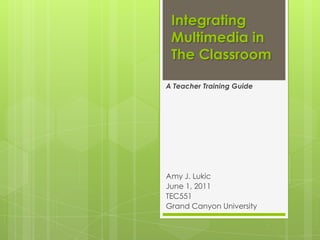
Integrating
 Multimedia in
 The Classroom

A Teacher Training Guide


Amy J. Lukic
June 1, 2011
TEC551
Grand Canyon University
Integrating Multimedia in
                                           The Classroom
 Introduction
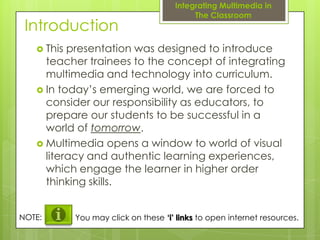
    This presentation was designed to introduce
     teacher trainees to the concept of integrating
     multimedia and technology into curriculum.
    In today’s emerging world, we are forced to
     consider our responsibility as educators, to
     prepare our students to be successful in a
     world of tomorrow.
    Multimedia opens a window to world of visual
     literacy and authentic learning experiences,
     which engage the learner in higher order
     thinking skills.


NOTE:       You may click on these ‘i’ links to open internet resources.
Integrating Multimedia in
                                          The Classroom
Purpose
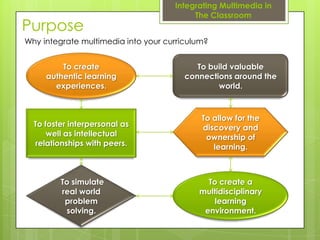
Why integrate multimedia into your curriculum?


         To create                         To build valuable
     authentic learning                 connections around the
       experiences.                             world.


                                            To allow for the
  To foster interpersonal as                discovery and
      well as intellectual                   ownership of
  relationships with peers.                    learning.


         To simulate                         To create a
         real world                        multidisciplinary
          problem                              learning
          solving.                          environment.
Integrating Multimedia in
                                            The Classroom
The Process
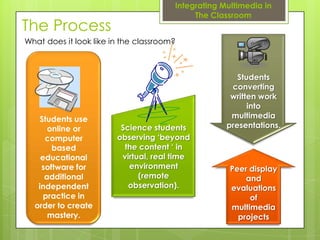
What does it look like in the classroom?


                                                       Students
                                                     converting
                                                     written work
                                                          into
   Students use                                      multimedia
      online or          Science students           presentations.
     computer           observing ‘beyond
       based              the content ‘ in
    educational          virtual, real time
    software for           environment               Peer display
     additional               (remote                    and
   independent             observation).             evaluations
     practice in                                          of
  order to create                                    multimedia
      mastery.                                         projects
Integrating Multimedia in
                                           The Classroom
The Process
…more examples of student activities…

     Students                        Social Studies students
     perform                     communicate with students from
    research                     other cultures around the world.
    online on
    any given
     topic to
    build new                                  Students create
   knowledge.                                    artifacts that
                                              demonstrate their
                                             knowledge through
                                                 WEBQUESTS.


   Students attend engaging VIRTUAL
 FIELDTRIPS where content is brought to
                  life.
Integrating Multimedia in
                                             The Classroom
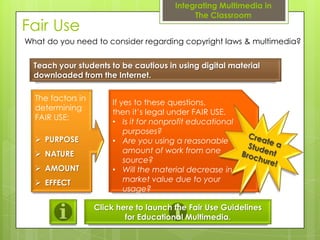
Fair Use
What do you need to consider regarding copyright laws & multimedia?


  Teach your students to be cautious in using digital material
  downloaded from the Internet.

  The factors in
                       If yes to these questions,
  determining
                       then it’s legal under FAIR USE.
  FAIR USE:
                       • Is it for nonprofit educational
                           purposes?
   PURPOSE            • Are you using a reasonable
   NATURE                 amount of work from one
                           source?
   AMOUNT             • Will the material decrease in
   EFFECT                 market value due to your
                           usage?

                   Click here to launch the Fair Use Guidelines
                           for Educational Multimedia.
Integrating Multimedia in
                                           The Classroom
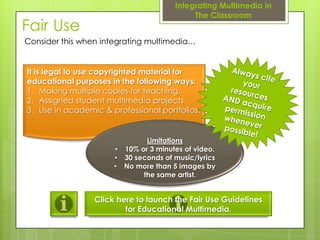
Fair Use
Consider this when integrating multimedia…


It is legal to use copyrighted material for
educational purposes in the following ways:
1. Making multiple copies for teaching.
2. Assigned student multimedia projects.
3. Use in academic & professional portfolios.


                              Limitations
                      • 10% or 3 minutes of video.
                      • 30 seconds of music/lyrics
                      • No more than 5 images by
                             the same artist.


                 Click here to launch the Fair Use Guidelines
                         for Educational Multimedia.
Integrating Multimedia in
                                    The Classroom
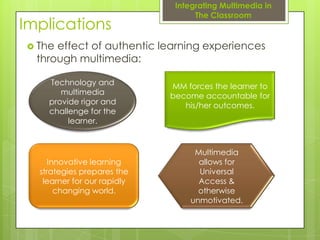
Implications
  Theeffect of authentic learning experiences
  through multimedia:

     Technology and           MM forces the learner to
        multimedia            become accountable for
     provide rigor and           his/her outcomes.
     challenge for the
          learner.


                                    Multimedia
      Innovative learning            allows for
   strategies prepares the           Universal
    learner for our rapidly          Access &
        changing world.              otherwise
                                   unmotivated.
Integrating Multimedia in
                                   The Classroom
Implications
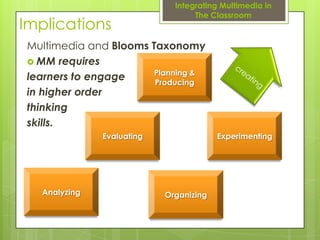
 Multimedia and Blooms Taxonomy
  MM requires
                        Planning &
 learners to engage     Producing
 in higher order
 thinking
 skills.
               Evaluating                Experimenting


   Analyzing                Organizing
Integrating Multimedia in
                                   The Classroom
Conclusion
   According the NETS for teachers (2008,
ISTE), we are charged with not only
facilitating and inspiring creativity, but
also designing digital-age learning
experiences. As educators of 21st century
learners, it is our duty to prepare our
students for the future. The integration of
multimedia and technology guarantees
our learners a leg up on today’s emerging
global market.
                                       More current
     ISTE/NETS for Teachers
                                       resources on
                                       next page.
Integrating Multimedia in
                                 The Classroom
Resources


 Internet4classrooms.com   Fair Use Guidelines for MM


     Brainpop.com            Blooms Taxonany


                           Discovery: Kathy Shrock
       WebQuests
Integrating Multimedia in
                                       The Classroom
References
Lombardi, Marilyn M. (2007). Authentic Learning for the 21st
Century: An Overview. Educause Learning
Initiative, advanced learning through IT innovation.

Bartrom, Linda. (2009). Mentoring of Media: Fair Use
Guidelines. Techtrends, Vol. 53, No. 5).

As cited in Van Oers, B., & Wardekker, K. (1999). On
becoming an authentic learner: Semiotic activity in the
early grades. Journal of Curriculum Studies, 31(2), 229-249.

ISTE, 2008. The ISTE NETS and Performance Indicators for
Teachers. International Society for Technology in Education.

Integrating multimedia in the classroom

  • 1.
    Integrating Multimedia in The Classroom A Teacher Training Guide Amy J. Lukic June 1, 2011 TEC551 Grand Canyon University
  • 2.
    Integrating Multimedia in The Classroom Introduction  This presentation was designed to introduce teacher trainees to the concept of integrating multimedia and technology into curriculum.  In today’s emerging world, we are forced to consider our responsibility as educators, to prepare our students to be successful in a world of tomorrow.  Multimedia opens a window to world of visual literacy and authentic learning experiences, which engage the learner in higher order thinking skills. NOTE: You may click on these ‘i’ links to open internet resources.
  • 3.
    Integrating Multimedia in The Classroom Purpose Why integrate multimedia into your curriculum? To create To build valuable authentic learning connections around the experiences. world. To allow for the To foster interpersonal as discovery and well as intellectual ownership of relationships with peers. learning. To simulate To create a real world multidisciplinary problem learning solving. environment.
  • 4.
    Integrating Multimedia in The Classroom The Process What does it look like in the classroom? Students converting written work into Students use multimedia online or Science students presentations. computer observing ‘beyond based the content ‘ in educational virtual, real time software for environment Peer display additional (remote and independent observation). evaluations practice in of order to create multimedia mastery. projects
  • 5.
    Integrating Multimedia in The Classroom The Process …more examples of student activities… Students Social Studies students perform communicate with students from research other cultures around the world. online on any given topic to build new Students create knowledge. artifacts that demonstrate their knowledge through WEBQUESTS. Students attend engaging VIRTUAL FIELDTRIPS where content is brought to life.
  • 6.
    Integrating Multimedia in The Classroom Fair Use What do you need to consider regarding copyright laws & multimedia? Teach your students to be cautious in using digital material downloaded from the Internet. The factors in If yes to these questions, determining then it’s legal under FAIR USE. FAIR USE: • Is it for nonprofit educational purposes?  PURPOSE • Are you using a reasonable  NATURE amount of work from one source?  AMOUNT • Will the material decrease in  EFFECT market value due to your usage? Click here to launch the Fair Use Guidelines for Educational Multimedia.
  • 7.
    Integrating Multimedia in The Classroom Fair Use Consider this when integrating multimedia… It is legal to use copyrighted material for educational purposes in the following ways: 1. Making multiple copies for teaching. 2. Assigned student multimedia projects. 3. Use in academic & professional portfolios. Limitations • 10% or 3 minutes of video. • 30 seconds of music/lyrics • No more than 5 images by the same artist. Click here to launch the Fair Use Guidelines for Educational Multimedia.
  • 8.
    Integrating Multimedia in The Classroom Implications  Theeffect of authentic learning experiences through multimedia: Technology and MM forces the learner to multimedia become accountable for provide rigor and his/her outcomes. challenge for the learner. Multimedia Innovative learning allows for strategies prepares the Universal learner for our rapidly Access & changing world. otherwise unmotivated.
  • 9.
    Integrating Multimedia in The Classroom Implications Multimedia and Blooms Taxonomy  MM requires Planning & learners to engage Producing in higher order thinking skills. Evaluating Experimenting Analyzing Organizing
  • 10.
    Integrating Multimedia in The Classroom Conclusion According the NETS for teachers (2008, ISTE), we are charged with not only facilitating and inspiring creativity, but also designing digital-age learning experiences. As educators of 21st century learners, it is our duty to prepare our students for the future. The integration of multimedia and technology guarantees our learners a leg up on today’s emerging global market. More current ISTE/NETS for Teachers resources on next page.
  • 11.
    Integrating Multimedia in The Classroom Resources Internet4classrooms.com Fair Use Guidelines for MM Brainpop.com Blooms Taxonany Discovery: Kathy Shrock WebQuests
  • 12.
    Integrating Multimedia in The Classroom References Lombardi, Marilyn M. (2007). Authentic Learning for the 21st Century: An Overview. Educause Learning Initiative, advanced learning through IT innovation. Bartrom, Linda. (2009). Mentoring of Media: Fair Use Guidelines. Techtrends, Vol. 53, No. 5). As cited in Van Oers, B., & Wardekker, K. (1999). On becoming an authentic learner: Semiotic activity in the early grades. Journal of Curriculum Studies, 31(2), 229-249. ISTE, 2008. The ISTE NETS and Performance Indicators for Teachers. International Society for Technology in Education.