A presentation on video
compression and applications
Ratul Prosad
Roll : ASH1811ME121M
Session : 2017-2018
Department of Information and Communication Engineering
Presentation layout
 Concept of video compression
 Video compression technique
 Video compression standards
 Applications
 Advantages
 Disadvantages
Video
Visual multimedia source that combines a sequence of
images to form a moving picture. The video transmits a
signal to a screen and processes the order in which the
screen captures should be shown. Videos usually have
audio components that correspond with the pictures being
shown on the screen.
Video Compression
Video compression is performed through a video codec
that works on one or more compression algorithms.
Usually video compression is done by removing repetitive
images, sounds and/or scenes from a video. For example,
a video may have the same background, image or sound
played several times or the data displayed/attached with
video file is not that important. Video compression will
remove all such data to reduce the video file size.
For example : MPEG, MPEG2, MPEG4, MPEG7 etc.
Video Compression
There are two types of video compression. These are :
i. Lossy video compression : Lossy compression means
that the compressed file has less data in it than the
original file. Images and sounds that repeat
throughout the video might be removed to effectively
cut out parts of the video that are seen as unneeded.
ii. Lossless video compression : Lossless compression is
exactly what it sounds like: the original and the
compressed versions are nearly identical. None of the
data is lost in the compression process.
 Raw video contains an immense amount of data
 Communication and storage capabilities are limited &
expensive
 Enabling communication between devices made by
different manufacturers
Why video compression is necessary?
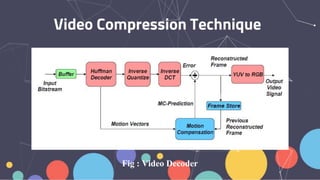
Video Compression Technique
 Compression(encoding) is a reversible conversion of
data that contains fewer bits. This allows a more
efficient storage and transmission of the data. The
inverse process is called Decompression(decoding).
 Software and Hardware that can encode and decode
are called decoders. Both combined form a codec and
should not be confused with the terms data container
or compression algorithms.
Video Compression Technique
The process of compression involves applying an
algorithm to the source video to create a compressed file
that is ready for transmission or storage. To play the
compressed file, an inverse algorithm is applied to
produce a video that shows virtually the same content as
the original source video.
Video Compression Technique
One approach to compress a video source is to apply the
JPEG algorithm to each frame independently. This is
known as moving JPEG or MPEG. There are three types
of compressed frames :
i. I-frames : Those that are compressed independently
ii. P-frame : Predictively coded frame, coded based on
previously coded frame
iii. B-frame : Bi-directionally predicted frame, coded
based on both previous and future coded frames
Video Compression Technique
 Arrows show prediction dependencies between frames
Video Compression Technique
 Exploiting the redundancies :
– Temporal : MC-prediction (P and B frames)
– Spatial : Block DCT
– Color : Color space conversion
 Scalar quantization of DCT coefficients
 Zigzag scanning, Runlength and Huffman coding of
the nonzero quantized DCT coefficients
Video Compression Technique
Fig : Video Encoder
Video Compression Technique
Fig : Video Decoder
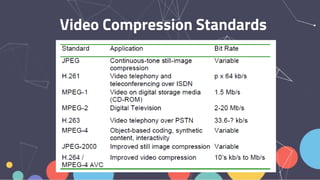
Video Compression Standards
Applications of Video Compression
 Cable TV distribution
 Interactive communications – videophone,
video conferencing, videotext etc.
 Digital storage media – CD-ROM, VCD, digital
VTR
 Video-on-demand
 Broadcasting
 Video surveillance
Video Compression Advantages
 Occupies less disk space
 Reading and writing faster
 File transferring is faster
 The order of bytes is independent
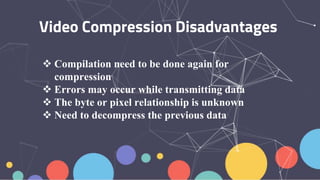
Video Compression Disadvantages
 Compilation need to be done again for
compression
 Errors may occur while transmitting data
 The byte or pixel relationship is unknown
 Need to decompress the previous data
Video compression
Video compression

Video compression

  • 1.
    A presentation onvideo compression and applications Ratul Prosad Roll : ASH1811ME121M Session : 2017-2018 Department of Information and Communication Engineering
  • 2.
    Presentation layout  Conceptof video compression  Video compression technique  Video compression standards  Applications  Advantages  Disadvantages
  • 3.
    Video Visual multimedia sourcethat combines a sequence of images to form a moving picture. The video transmits a signal to a screen and processes the order in which the screen captures should be shown. Videos usually have audio components that correspond with the pictures being shown on the screen.
  • 4.
    Video Compression Video compressionis performed through a video codec that works on one or more compression algorithms. Usually video compression is done by removing repetitive images, sounds and/or scenes from a video. For example, a video may have the same background, image or sound played several times or the data displayed/attached with video file is not that important. Video compression will remove all such data to reduce the video file size. For example : MPEG, MPEG2, MPEG4, MPEG7 etc.
  • 5.
    Video Compression There aretwo types of video compression. These are : i. Lossy video compression : Lossy compression means that the compressed file has less data in it than the original file. Images and sounds that repeat throughout the video might be removed to effectively cut out parts of the video that are seen as unneeded. ii. Lossless video compression : Lossless compression is exactly what it sounds like: the original and the compressed versions are nearly identical. None of the data is lost in the compression process.
  • 6.
     Raw videocontains an immense amount of data  Communication and storage capabilities are limited & expensive  Enabling communication between devices made by different manufacturers Why video compression is necessary?
  • 7.
    Video Compression Technique Compression(encoding) is a reversible conversion of data that contains fewer bits. This allows a more efficient storage and transmission of the data. The inverse process is called Decompression(decoding).  Software and Hardware that can encode and decode are called decoders. Both combined form a codec and should not be confused with the terms data container or compression algorithms.
  • 8.
    Video Compression Technique Theprocess of compression involves applying an algorithm to the source video to create a compressed file that is ready for transmission or storage. To play the compressed file, an inverse algorithm is applied to produce a video that shows virtually the same content as the original source video.
  • 9.
    Video Compression Technique Oneapproach to compress a video source is to apply the JPEG algorithm to each frame independently. This is known as moving JPEG or MPEG. There are three types of compressed frames : i. I-frames : Those that are compressed independently ii. P-frame : Predictively coded frame, coded based on previously coded frame iii. B-frame : Bi-directionally predicted frame, coded based on both previous and future coded frames
  • 10.
    Video Compression Technique Arrows show prediction dependencies between frames
  • 11.
    Video Compression Technique Exploiting the redundancies : – Temporal : MC-prediction (P and B frames) – Spatial : Block DCT – Color : Color space conversion  Scalar quantization of DCT coefficients  Zigzag scanning, Runlength and Huffman coding of the nonzero quantized DCT coefficients
  • 12.
  • 13.
  • 14.
  • 15.
    Applications of VideoCompression  Cable TV distribution  Interactive communications – videophone, video conferencing, videotext etc.  Digital storage media – CD-ROM, VCD, digital VTR  Video-on-demand  Broadcasting  Video surveillance
  • 16.
    Video Compression Advantages Occupies less disk space  Reading and writing faster  File transferring is faster  The order of bytes is independent
  • 17.
    Video Compression Disadvantages Compilation need to be done again for compression  Errors may occur while transmitting data  The byte or pixel relationship is unknown  Need to decompress the previous data