Energy: Forms and Changes


  •   The Nature of Energy
  •   Kinetic and Potential Energy
  •   Energy Conversions
  •   Conservation of Energy
  •   Physics and Energy
The Nature of Energy


  • Energy can be defined as the ability to
    do work.
  • Energy is often measured in Joules (J).
  • 1 Joule=1Kg-m2/sec2= 1 Nm
  • Energy comes in many forms. The
    main forms are: Mechanical, Heat,
    Chemical, Electromagnetic, and
    Nuclear.
The Nature of Energy
(continued)
  • Mechanical energy is energy of motion.
  • Examples include a moving car and
    sound.
  • Heat energy is energy of internal motion
    (movement of atoms).
  • Friction is one cause of heat energy.
  • Chemical energy is stored in the bonds
    that keep molecules together.
The Nature of Energy
(continued)
  • Electromagnetic energy is caused by
    moving charges.
  • Examples include electricity and light.
  • Nuclear energy is stored in the nucleus
    of an atom.
  • All stars (including our sun) run on
    nuclear energy.
Kinetic and Potential Energy


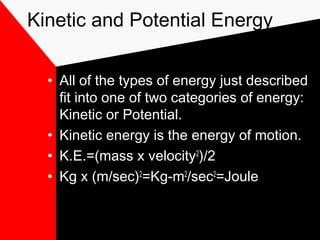
  • All of the types of energy just described
    fit into one of two categories of energy:
    Kinetic or Potential.
  • Kinetic energy is the energy of motion.
  • K.E.=(mass x velocity2)/2
  • Kg x (m/sec)2=Kg-m2/sec2=Joule
Kinetic and Potential Energy
(continued)
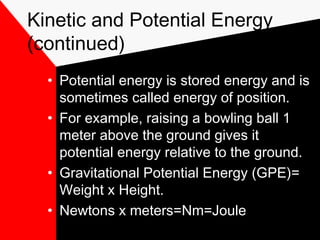
  • Potential energy is stored energy and is
    sometimes called energy of position.
  • For example, raising a bowling ball 1
    meter above the ground gives it
    potential energy relative to the ground.
  • Gravitational Potential Energy (GPE)=
    Weight x Height.
  • Newtons x meters=Nm=Joule
Energy Conversions


  • Energy can be converted from one form
    to another.
  • This process can happen over and over
    again.
  • For example, I can convert the
    mechanical energy of rubbing my hands
    together into heat energy.
Energy Conversions
(continued)
  • One of the most common energy
    conversions is Kinetic-Potential.
  • For example, by holding a 20 Newton
    bowling ball 1 meter above the ground,
    it has 20 Joules of gravitational potential
    energy.
  • By releasing the bowling ball, its
    potential energy is converted into
    kinetic energy as it gains velocity.
Energy Conversions
(continued)
  • As the bowling ball speeds up towards
    the ground, its gravitational potential
    energy is reduced, and its kinetic
    energy is increased until the instant
    before it hits the ground.
  • At that point, the bowling ball has
    converted all of its GPE into kinetic
    energy, so that it now has 20 Joules of
    kinetic energy.
Conservation of Energy


  • The previous example shows how
    energy is always conserved.
  • In fact the Law of Conservation of
    Energy says that energy can neither be
    created nor destroyed by ordinary
    means.
  • Albert Einstein showed how energy can
    be converted into mass and mass into
    energy using his famous “E=mc2”
Conservation of Energy
(continued)
  • The Law is consequently referred to as
    “The Law of Conservation of
    Mass-Energy.”
Physics and Energy


  • Understanding energy is critical to
    understanding the physical sciences.
  • Everything we have studied in MFE
    connects in some way to energy.
  • For example, the faster you move, the
    more momentum you have, the more
    kinetic energy you have, the higher your
    power, which means you consume
    energy faster.

Mfe chapter 5 notes

  • 1.
    Energy: Forms andChanges • The Nature of Energy • Kinetic and Potential Energy • Energy Conversions • Conservation of Energy • Physics and Energy
  • 2.
    The Nature ofEnergy • Energy can be defined as the ability to do work. • Energy is often measured in Joules (J). • 1 Joule=1Kg-m2/sec2= 1 Nm • Energy comes in many forms. The main forms are: Mechanical, Heat, Chemical, Electromagnetic, and Nuclear.
  • 3.
    The Nature ofEnergy (continued) • Mechanical energy is energy of motion. • Examples include a moving car and sound. • Heat energy is energy of internal motion (movement of atoms). • Friction is one cause of heat energy. • Chemical energy is stored in the bonds that keep molecules together.
  • 4.
    The Nature ofEnergy (continued) • Electromagnetic energy is caused by moving charges. • Examples include electricity and light. • Nuclear energy is stored in the nucleus of an atom. • All stars (including our sun) run on nuclear energy.
  • 5.
    Kinetic and PotentialEnergy • All of the types of energy just described fit into one of two categories of energy: Kinetic or Potential. • Kinetic energy is the energy of motion. • K.E.=(mass x velocity2)/2 • Kg x (m/sec)2=Kg-m2/sec2=Joule
  • 6.
    Kinetic and PotentialEnergy (continued) • Potential energy is stored energy and is sometimes called energy of position. • For example, raising a bowling ball 1 meter above the ground gives it potential energy relative to the ground. • Gravitational Potential Energy (GPE)= Weight x Height. • Newtons x meters=Nm=Joule
  • 7.
    Energy Conversions • Energy can be converted from one form to another. • This process can happen over and over again. • For example, I can convert the mechanical energy of rubbing my hands together into heat energy.
  • 8.
    Energy Conversions (continued) • One of the most common energy conversions is Kinetic-Potential. • For example, by holding a 20 Newton bowling ball 1 meter above the ground, it has 20 Joules of gravitational potential energy. • By releasing the bowling ball, its potential energy is converted into kinetic energy as it gains velocity.
  • 9.
    Energy Conversions (continued) • As the bowling ball speeds up towards the ground, its gravitational potential energy is reduced, and its kinetic energy is increased until the instant before it hits the ground. • At that point, the bowling ball has converted all of its GPE into kinetic energy, so that it now has 20 Joules of kinetic energy.
  • 10.
    Conservation of Energy • The previous example shows how energy is always conserved. • In fact the Law of Conservation of Energy says that energy can neither be created nor destroyed by ordinary means. • Albert Einstein showed how energy can be converted into mass and mass into energy using his famous “E=mc2”
  • 11.
    Conservation of Energy (continued) • The Law is consequently referred to as “The Law of Conservation of Mass-Energy.”
  • 12.
    Physics and Energy • Understanding energy is critical to understanding the physical sciences. • Everything we have studied in MFE connects in some way to energy. • For example, the faster you move, the more momentum you have, the more kinetic energy you have, the higher your power, which means you consume energy faster.