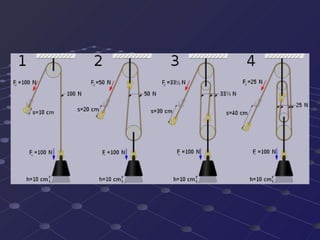
Without friction….. There would be no need for machines Input work would be greater than output work Actual mechanical advantage would equal the ideal mechanical advantage Output work would equal input work
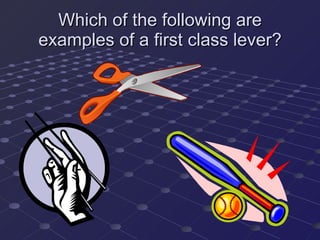
Which of the following are examples of a first class lever?
Which of the following are examples of a second class lever?
Which of the following are examples of a third class lever?
Simple machine? Wedges
What about these teeth?
Fulcrum?
How is this picture related to simple machines? Where’s the fulcrum? Where’s the load? Where’s the effort?
What is the mechanical advantage of a machine if the output force is 100 N and the input force is 25N? Output force divided by input force = 4
This rope and pulley  system supports the  400 lb weight.  How much tension  in the rope is needed  to hold the weight in  equilibrium? 400 -------  = 100 4
What is the mechanical advantage of this simple machine if the diameter of the wheel is 24 inches and the radius of the axle is 2 inches? 12 -------  =  6 2
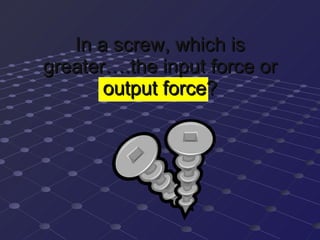
In a screw, which is greater….the input force or output force?
When using a baseball bat, which is greater….the input force or output force?
If the input arm is 5 cm long and the output arm is 1 cm long, what is the mechanical advantage of the lever? 5
With a mechanical advantage of 5, how much effort is needed to lift a 500 N load?  100
If the load is moved closer to the fulcrum, will the input force required to lift the load increase or decrease?
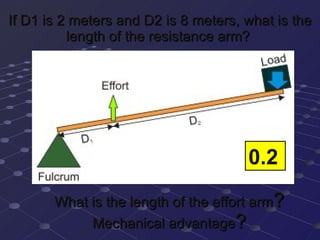
If D1 is 2 meters and D2 is 8 meters, what is the length of the resistance arm?  10 What is the length of the effort arm ?  2  Mechanical advantage ?  0.2
Which way would I need to move the load to decrease the amount of input force needed to move the load?
If the distance from the truck bed to the ground is 2 meters and the ramp’s length is 10 meters, what is the mechanical advantage? 5
Which lever arrangement requires the least effort force to raise a 500 N resistance?


Simple Machine Review

  • 1.
    Without friction….. Therewould be no need for machines Input work would be greater than output work Actual mechanical advantage would equal the ideal mechanical advantage Output work would equal input work
  • 2.
    Which of thefollowing are examples of a first class lever?
  • 3.
    Which of thefollowing are examples of a second class lever?
  • 4.
    Which of thefollowing are examples of a third class lever?
  • 5.
  • 6.
  • 7.
  • 8.
    How is thispicture related to simple machines? Where’s the fulcrum? Where’s the load? Where’s the effort?
  • 9.
    What is themechanical advantage of a machine if the output force is 100 N and the input force is 25N? Output force divided by input force = 4
  • 10.
    This rope andpulley system supports the 400 lb weight. How much tension in the rope is needed to hold the weight in equilibrium? 400 ------- = 100 4
  • 11.
    What is themechanical advantage of this simple machine if the diameter of the wheel is 24 inches and the radius of the axle is 2 inches? 12 ------- = 6 2
  • 12.
    In a screw,which is greater….the input force or output force?
  • 13.
    When using abaseball bat, which is greater….the input force or output force?
  • 14.
    If the inputarm is 5 cm long and the output arm is 1 cm long, what is the mechanical advantage of the lever? 5
  • 15.
    With a mechanicaladvantage of 5, how much effort is needed to lift a 500 N load? 100
  • 16.
    If the loadis moved closer to the fulcrum, will the input force required to lift the load increase or decrease?
  • 17.
    If D1 is2 meters and D2 is 8 meters, what is the length of the resistance arm? 10 What is the length of the effort arm ? 2 Mechanical advantage ? 0.2
  • 18.
    Which way wouldI need to move the load to decrease the amount of input force needed to move the load?
  • 19.
    If the distancefrom the truck bed to the ground is 2 meters and the ramp’s length is 10 meters, what is the mechanical advantage? 5
  • 20.
    Which lever arrangementrequires the least effort force to raise a 500 N resistance?
  • 21.
  • 22.
  • 23.
  • 24.