Application note


Simultaneous determination of mineral
acids, fluoride and silicate in etching baths
by ion chromatography with dual detection
The presented ion chromatographic method is used for the simultaneous determination of HF,
HNO3, H2SO4 , short-chain organic acids and H2SiF6 in acidic texturing baths that are used in the
wet chemical etching process of solar cell production. Fluoride, nitrate, sulphate and acetate are
determined by conductivity detection after chemical suppression, while the silicon present in the form
of hexafluorosilicate is detected spectrophotometrically as molybdosilicic acid after derivatization in the
same analysis. The analytical results are validated by titration.


Introduction                                                           This article describes an ion chromatographic method that
Energy production from renewable sources such as biomass,           separates all relevant components in the bath on an anion-
biogas, biofuels, water, wind and solar power is becoming           exchange column and identifies them by dual detection
increasingly important in our energy-hungry society.                in a single run. After suppressed conductivity detection of
Particular interest is given to solar energy, which by human        the acid anions, the undissociated silicic acid reacts in a
criteria is inexhaustible. Solar cells used in photovoltaic units   post-column reaction (PCR) to form molybdosilicic acid,
convert the radiation energy in sunlight directly into electric     which is determined spectrophotometrically at 410 nm.
energy.                                                             The concentrations of fluoride and hexafluorosilicate are
   Solar cells are manufactured from ultrapure mono- or             determined by way of a simple stoichiometric calculation that
polycristalline silicon wafers whose surface is treated in          is performed by the chromatography software.
acid etching baths (also known as texturing baths) before
being spiked with foreign atoms (P, B). The etching solutions       Instruments and Reagents
consist of various acids, which act as an oxidizing agent           a) Instrument setup
(HNO3), complexing agent (HF), stabilizer and wetting agent         •	 850 Professional IC Anion – MCS with post-column reactor
(CH 3 COOH), or buffers (H 3 PO4, CH 3 COOH) and determine          •	 858 Professional Sample Processor
the surface structure and thus the efficiency of the solar cells.   •	 Lambda 1010 UV/VIS Detector
The replenishment of components used up in the etching              •	 771 IC Compact Interface
process extends the bath life and saves costs, though it            •	 MagIC Net chromatography software
does require knowledge of the exact composition of the bath,        b) Reagents and eluent
especially the concentration of silicon and hexafluorosilicate.     The standard solutions were prepared with CertiPUR
By using titration and ion chromatography (IC), it is possible      standards from Merck (SiO2 in NaOH; solutions of NaF and
to determine the key components quickly and precisely.              NaNO3 in ultrapure water) and the TraceCERT standard from


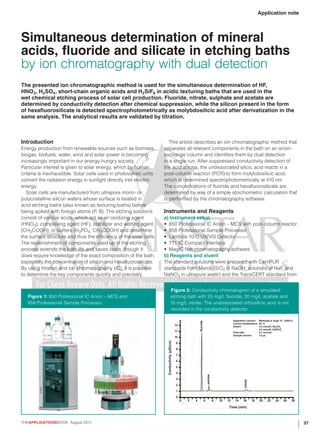
                                                                                Figure 2: Conductivity chromatogram of a simulated
   Figure 1: 850 Professional IC Anion – MCS and                                etching bath with 25 mg/L fluoride, 20 mg/L acetate and
   858 Professional Sample Processor.                                           10 mg/L nitrate. The undissociated orthosilicic acid is not
                                                                                recorded in the conductivity detector.

                                                                                                                                                    Separation column: Metrosep A Supp 15 - 250/4.0
                                                                                                             fluoride


                                                                                                                                                    Column temperature: 45 ˚C
                                                                                            12                                                      Eluent:             3.5 mmol/L Na2CO3
                                                                                                                                                                        3.0 mmol/L NaHCO3
                                                                                            11                                                      Flow-rate:          0.7 mL/min
                                                                                                                                                    Sample volume:      1.5 µL
                                                                                            10
                                                                     Conductivity (µS/cm)


                                                                                            9

                                                                                            8

                                                                                            7

                                                                                            6

                                                                                            5

                                                                                            4
                                                                                                                            acetate


                                                                                            3
                                                                                                                                                            nitrate


                                                                                            2

                                                                                            1

                                                                                            0
                                                                                                 0   2   4              6             8   10   12    14     16        18   20   22   24    26     28

                                                                                                                                                Time (min)


THEAPPLICATIONSBOOK August 2011                                                                                                                                                                        37
APPLICATION NOTE


                Figure 3: UV/vis chromatogram of a 10 mg/L silicic acid                                                                        Figure 4: (a) Conductivity and (b) UV/vis chromatograms
                standard. Silicic acid is derivatized to molybdosilicic acid                                                                   of etching bath sample 1 with 1:2000 dilution. The
                which is then detected spectrophotometrically.                                                                                 chromatographic parameters are the same as those of the
                                                                                                                                               prior chromatograms.
                                          silicate                    Separation column: Metrosep A Supp 15 - 250/4.0
                        1.0                                           Column temperature: 45 ˚C                                                                     (a)


                                                                                                                                                                                                                                                         sulphate
                                                                      Eluent:               3.5 mmol/L Na2CO3                                             30
                                                                                            3.0 mmol/L NaHCO3
                                                                      Flow-rate:            0.7 mL/min
                       0.5                                            Sample volume:        1.5 µL
                                                                      PCR reagent:          200 mmol/L HNO3                                               25
                                                                                            20 mmol/L Na2MoO4


                                                                                                                                  Conductivity (µS/cm)
                                                                      Flow-ratePCR reagent: 0.25 mL/min
                       0.0                                            Wavelength:           410 nm
      Intensity (mV)


                                                                                                                                                          20


                                                                                                                                                                                 fluoride
                       -0.5
                                                                                                                                                          15

                       -1.0


                                                                                                                                                                                                                               nitrate
                                                                                                                                                          10

                       -1.5
                                                                                                                                                           5

                       -2.0
                                                                                                                                                           0
                              0   2   4          6    8     10   12     14    16     18    20    22     24    26    28
                                                                                                                                                                0        2   4              6       8   10     12     14           16    18   20   22   24          26    28
                                                                  Time (min)                                                                                                                                       Time (min)

                                                                                                                                                                    (b)
     Fluka (acetate solution). All the standard and eluent solutions                                                                                     -0.0

     were prepared with ultrapure water with a specific resistance                                                                                       -0.2


                                                                                                                                                                                   silicate
     of more than 18 MΩ·cm. Etching bath samples were provided                                                                                           -0.4
     by a solar cell manufacturer from Germany.                                                                                                          -0.6
                                                                                                                                  Intensity (mV)


                                                                                                                                                         -0.8
     Etching of Silicon
                                                                                                                                                         -1.0
     In the wet chemical etching of silicon surfaces, nitric acid is
                                                                                                                                                         -1.2
     used to oxidize silicon to form silicon dioxide which is further
     etched by hydrofluoric acid.                                                                                                                        -1.4

                                                                                                                                                         -1.6

          3 Si + 4 HNO3 + 18 HF — 3 H2SiF6 + 4 NO + 8 H2O
                                >                                                                                                                        -1.8

                                                                                                                                                         -2.0
        During the etching process, the concentrations of HF and                                                                                                0        2   4              6       8   10     12     14          16     18   20   22   24          26    28

     HNO3 in the etching bath decrease and the concentrations of                                                                                                                                                   Time (min)

     water and hexafluorosilicate increase. To ensure a constant
     etching rate and surface properties, the etching bath can
     be regenerated a few times by subsequent replenishment                                                                     and determined by conductivity detection (Figure 2). In
     of spent acids. The increasing concentration of H2SiF6,                                                                    the alkaline eluent, the hexafluorosilicate is converted
     however, limits the number of possible recycling cycles. This                                                              into orthosilicic acid which is undissociated and therefore
     requires semi-continuous monitoring of the bath components,                                                                “invisible” in the conductivity detector.
     which can be achieved conveniently by automated ion
     chromatography.                                                                                                                   Na 2SiF6 + 4 NaOH — Si(OH)4 + 6 NaF
                                                                                                                                                         >

     Dual Detection                                                                                                                The undissociated orthosilicic acid is determined by way
     The acid anions present in the etching bath — mainly                                                                       of post-column reaction with an acid molybdate solution and
     fluoride and nitrate, though sometimes also sulphate and                                                                   subsequent UV/vis detection at 410 nm (Figure 3).
     acetate — are separated under alkaline elution conditions


               Table 1: Comparison of the concentrations of a few selected bath components determined by ion chromatography and titration.
                                                     Etching bath sample 1c                       Etching bath sample 2                                              Etching bath sample 3                                           Etching bath sample 4

                                                      Si              HF a
                                                                                   HNO3    b
                                                                                                 Si             HF      a
                                                                                                                                HNO3                       b
                                                                                                                                                                    Si                 HF       a
                                                                                                                                                                                                             HNO3     b
                                                                                                                                                                                                                                 Si            HFa                  HNO3b

      IC (g/L)                                        3.3         22.4             216.6         34.8           47.2            248.4                               17.6               98.9                  504.4               19.3          94.8                 516.8

      Titration (g/L)                                 3.7         26.4             224.3         28.1           48.4            255.9                               17.6               86.2                  476.1               18.1          80.7                 478.1

      RSDIC (%)                                       2.2             1.2          0.3           1.8            5.6             0.6                                 2.0                2.0                   0.4                 2.2           3.1                  0.7

      RSDTitration (%)                                1.2             3.3          0.3           0.5            2.4             1.1                                 0.4                1.3                   0.6                 0.2           1.8                  1.1
      a
       Calculated from fluoride and hexafluorosilicate concentrations. Determination via nitrate concentration. In etching bath sample 1,
                                                                                                                            b                                                                                              c


      also 651 g/L sulphuric acid were detected.

38                                                                                                                                                                                                             THEAPPLICATIONSBOOK August 2011
APPLICATION NOTE


  H4SiO4 + 12 MoO42− + 24 H+ — H4[Si(Mo3O10)4] + 12 H2O
                             >                                  Conclusion
                                                                Ion chromatography with dual detection allows determining
   The injection of SiF 62− produces a fluoride peak in the     the concentration of all relevant constituents of texturing
conductivity detector and a silicate peak in the UV/vis         baths for solar cell production in less than 30 minutes. The
detector. The mass balance derived from the respective          acids consumed in the texturing process can subsequently
peak areas confirms that the concentration of SiF 62− results   be replenished in a targeted way. This extends the life of
stoichiometrically from the determined fluoride and silicate    the etching baths, guarantees clean and reproducible wafer
concentrations, provided there are no other sources of          surfaces, cuts costs and protects the environment.
fluoride or silicate present. Thus the concentration of free
HF can be calculated as the difference between the total        References
fluoride concentration and the fluoride concentration from      1.   A. Henssge and J. Acker, Talanta, 73, 220–226 (2007).
the hexafluorosilicate:                                         2.   J. Acker and A. Henssge, Talanta, 72, 1540–1545 (2007).
                                                                3.   M. Zimmer et al., 22nd European Photovoltaic Solar Energy
                                                                     Conference and Exhibition, Milan, Italy (2007).
  [HF] = [F−]total − [F−]hexafluorosilicate                     4.   G. Bogenschütz, C. Wilde and C. Hack, Pittcon 2009 (http://www.
                                                                     metrohm.com/com/Applications, search for 8.000.6041EN).
Analysis of the Texturing Baths and Validation
After being diluted at ratios between 1:1000 and 1:5000,
four samples from different texturing baths are analysed for
their constituents by using the above IC method with dual
detection. Figure 4 shows the chromatograms of etching
bath sample 1 obtained by conductivity (a) and UV/vis (b)
detection.
    Table 1 provides an overview of the concentrations
of the relevant bath components determined by ion
chromatography with dual detection. For comparison, the                               Metrohm International Headquarters
concentrations obtained by titration are also shown. The                              Ionenstrasse, CH-9101 Herisau, Switzerland
potentiometric determination of acid concentrations and                                                    tel. +41 71 353 85 04
H 2SiF 6 content was carried out using aqueous acid-base                                               E-mail: aw@metrohm.com
titration with 1 mol/L NaOH solution.                                                                Website: www.metrohm.com


THEAPPLICATIONSBOOK August 2011                                                                                                        39

Ion Chromatography in determining mineral acids in Etching baths

  • 1.
    Application note Simultaneous determinationof mineral acids, fluoride and silicate in etching baths by ion chromatography with dual detection The presented ion chromatographic method is used for the simultaneous determination of HF, HNO3, H2SO4 , short-chain organic acids and H2SiF6 in acidic texturing baths that are used in the wet chemical etching process of solar cell production. Fluoride, nitrate, sulphate and acetate are determined by conductivity detection after chemical suppression, while the silicon present in the form of hexafluorosilicate is detected spectrophotometrically as molybdosilicic acid after derivatization in the same analysis. The analytical results are validated by titration. Introduction This article describes an ion chromatographic method that Energy production from renewable sources such as biomass, separates all relevant components in the bath on an anion- biogas, biofuels, water, wind and solar power is becoming exchange column and identifies them by dual detection increasingly important in our energy-hungry society. in a single run. After suppressed conductivity detection of Particular interest is given to solar energy, which by human the acid anions, the undissociated silicic acid reacts in a criteria is inexhaustible. Solar cells used in photovoltaic units post-column reaction (PCR) to form molybdosilicic acid, convert the radiation energy in sunlight directly into electric which is determined spectrophotometrically at 410 nm. energy. The concentrations of fluoride and hexafluorosilicate are Solar cells are manufactured from ultrapure mono- or determined by way of a simple stoichiometric calculation that polycristalline silicon wafers whose surface is treated in is performed by the chromatography software. acid etching baths (also known as texturing baths) before being spiked with foreign atoms (P, B). The etching solutions Instruments and Reagents consist of various acids, which act as an oxidizing agent a) Instrument setup (HNO3), complexing agent (HF), stabilizer and wetting agent • 850 Professional IC Anion – MCS with post-column reactor (CH 3 COOH), or buffers (H 3 PO4, CH 3 COOH) and determine • 858 Professional Sample Processor the surface structure and thus the efficiency of the solar cells. • Lambda 1010 UV/VIS Detector The replenishment of components used up in the etching • 771 IC Compact Interface process extends the bath life and saves costs, though it • MagIC Net chromatography software does require knowledge of the exact composition of the bath, b) Reagents and eluent especially the concentration of silicon and hexafluorosilicate. The standard solutions were prepared with CertiPUR By using titration and ion chromatography (IC), it is possible standards from Merck (SiO2 in NaOH; solutions of NaF and to determine the key components quickly and precisely. NaNO3 in ultrapure water) and the TraceCERT standard from Figure 2: Conductivity chromatogram of a simulated Figure 1: 850 Professional IC Anion – MCS and etching bath with 25 mg/L fluoride, 20 mg/L acetate and 858 Professional Sample Processor. 10 mg/L nitrate. The undissociated orthosilicic acid is not recorded in the conductivity detector. Separation column: Metrosep A Supp 15 - 250/4.0 fluoride Column temperature: 45 ˚C 12 Eluent: 3.5 mmol/L Na2CO3 3.0 mmol/L NaHCO3 11 Flow-rate: 0.7 mL/min Sample volume: 1.5 µL 10 Conductivity (µS/cm) 9 8 7 6 5 4 acetate 3 nitrate 2 1 0 0 2 4 6 8 10 12 14 16 18 20 22 24 26 28 Time (min) THEAPPLICATIONSBOOK August 2011 37
  • 2.
    APPLICATION NOTE Figure 3: UV/vis chromatogram of a 10 mg/L silicic acid Figure 4: (a) Conductivity and (b) UV/vis chromatograms standard. Silicic acid is derivatized to molybdosilicic acid of etching bath sample 1 with 1:2000 dilution. The which is then detected spectrophotometrically. chromatographic parameters are the same as those of the prior chromatograms. silicate Separation column: Metrosep A Supp 15 - 250/4.0 1.0 Column temperature: 45 ˚C (a) sulphate Eluent: 3.5 mmol/L Na2CO3 30 3.0 mmol/L NaHCO3 Flow-rate: 0.7 mL/min 0.5 Sample volume: 1.5 µL PCR reagent: 200 mmol/L HNO3 25 20 mmol/L Na2MoO4 Conductivity (µS/cm) Flow-ratePCR reagent: 0.25 mL/min 0.0 Wavelength: 410 nm Intensity (mV) 20 fluoride -0.5 15 -1.0 nitrate 10 -1.5 5 -2.0 0 0 2 4 6 8 10 12 14 16 18 20 22 24 26 28 0 2 4 6 8 10 12 14 16 18 20 22 24 26 28 Time (min) Time (min) (b) Fluka (acetate solution). All the standard and eluent solutions -0.0 were prepared with ultrapure water with a specific resistance -0.2 silicate of more than 18 MΩ·cm. Etching bath samples were provided -0.4 by a solar cell manufacturer from Germany. -0.6 Intensity (mV) -0.8 Etching of Silicon -1.0 In the wet chemical etching of silicon surfaces, nitric acid is -1.2 used to oxidize silicon to form silicon dioxide which is further etched by hydrofluoric acid. -1.4 -1.6 3 Si + 4 HNO3 + 18 HF — 3 H2SiF6 + 4 NO + 8 H2O > -1.8 -2.0 During the etching process, the concentrations of HF and 0 2 4 6 8 10 12 14 16 18 20 22 24 26 28 HNO3 in the etching bath decrease and the concentrations of Time (min) water and hexafluorosilicate increase. To ensure a constant etching rate and surface properties, the etching bath can be regenerated a few times by subsequent replenishment and determined by conductivity detection (Figure 2). In of spent acids. The increasing concentration of H2SiF6, the alkaline eluent, the hexafluorosilicate is converted however, limits the number of possible recycling cycles. This into orthosilicic acid which is undissociated and therefore requires semi-continuous monitoring of the bath components, “invisible” in the conductivity detector. which can be achieved conveniently by automated ion chromatography. Na 2SiF6 + 4 NaOH — Si(OH)4 + 6 NaF > Dual Detection The undissociated orthosilicic acid is determined by way The acid anions present in the etching bath — mainly of post-column reaction with an acid molybdate solution and fluoride and nitrate, though sometimes also sulphate and subsequent UV/vis detection at 410 nm (Figure 3). acetate — are separated under alkaline elution conditions Table 1: Comparison of the concentrations of a few selected bath components determined by ion chromatography and titration. Etching bath sample 1c Etching bath sample 2 Etching bath sample 3 Etching bath sample 4 Si HF a HNO3 b Si HF a HNO3 b Si HF a HNO3 b Si HFa HNO3b IC (g/L) 3.3 22.4 216.6 34.8 47.2 248.4 17.6 98.9 504.4 19.3 94.8 516.8 Titration (g/L) 3.7 26.4 224.3 28.1 48.4 255.9 17.6 86.2 476.1 18.1 80.7 478.1 RSDIC (%) 2.2 1.2 0.3 1.8 5.6 0.6 2.0 2.0 0.4 2.2 3.1 0.7 RSDTitration (%) 1.2 3.3 0.3 0.5 2.4 1.1 0.4 1.3 0.6 0.2 1.8 1.1 a Calculated from fluoride and hexafluorosilicate concentrations. Determination via nitrate concentration. In etching bath sample 1, b c also 651 g/L sulphuric acid were detected. 38 THEAPPLICATIONSBOOK August 2011
  • 3.
    APPLICATION NOTE H4SiO4 + 12 MoO42− + 24 H+ — H4[Si(Mo3O10)4] + 12 H2O > Conclusion Ion chromatography with dual detection allows determining The injection of SiF 62− produces a fluoride peak in the the concentration of all relevant constituents of texturing conductivity detector and a silicate peak in the UV/vis baths for solar cell production in less than 30 minutes. The detector. The mass balance derived from the respective acids consumed in the texturing process can subsequently peak areas confirms that the concentration of SiF 62− results be replenished in a targeted way. This extends the life of stoichiometrically from the determined fluoride and silicate the etching baths, guarantees clean and reproducible wafer concentrations, provided there are no other sources of surfaces, cuts costs and protects the environment. fluoride or silicate present. Thus the concentration of free HF can be calculated as the difference between the total References fluoride concentration and the fluoride concentration from 1. A. Henssge and J. Acker, Talanta, 73, 220–226 (2007). the hexafluorosilicate: 2. J. Acker and A. Henssge, Talanta, 72, 1540–1545 (2007). 3. M. Zimmer et al., 22nd European Photovoltaic Solar Energy Conference and Exhibition, Milan, Italy (2007). [HF] = [F−]total − [F−]hexafluorosilicate 4. G. Bogenschütz, C. Wilde and C. Hack, Pittcon 2009 (http://www. metrohm.com/com/Applications, search for 8.000.6041EN). Analysis of the Texturing Baths and Validation After being diluted at ratios between 1:1000 and 1:5000, four samples from different texturing baths are analysed for their constituents by using the above IC method with dual detection. Figure 4 shows the chromatograms of etching bath sample 1 obtained by conductivity (a) and UV/vis (b) detection. Table 1 provides an overview of the concentrations of the relevant bath components determined by ion chromatography with dual detection. For comparison, the Metrohm International Headquarters concentrations obtained by titration are also shown. The Ionenstrasse, CH-9101 Herisau, Switzerland potentiometric determination of acid concentrations and tel. +41 71 353 85 04 H 2SiF 6 content was carried out using aqueous acid-base E-mail: aw@metrohm.com titration with 1 mol/L NaOH solution. Website: www.metrohm.com THEAPPLICATIONSBOOK August 2011 39