DR. BHIM RAO AMBEDKAR, AGRA
B.Sc. (ZOOLOGY) THIRD YEAR SYALLBUS
PAPER – 302 Biotechnology, Immunology, Biological Tools & Techniques and Biostatistics
Unit-III Biological Tools and Techniques:
Principles and uses of instruments:
pH Meter, Calorimeter, Microtome, Spectrophotometer & Centrifuge.
Microscopy (light, transmission and scanning electron microscopy)
Chromatography and Electrophoresis.
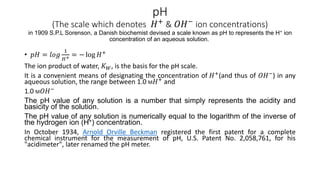
pH
(The scale which denotes 𝐻+
& 𝑂𝐻−
ion concentrations)
in 1909 S.P.L Sorenson, a Danish biochemist devised a scale known as pH to represents the H+ ion
concentration of an aqueous solution.
• 𝑝𝐻 = 𝑙𝑜𝑔
1
𝐻+ = − log 𝐻+
The ion product of water, 𝐾𝑊, is the basis for the pH scale.
It is a convenient means of designating the concentration of 𝐻+
(and thus of 𝑂𝐻−
) in any
aqueous solution, the range between 1.0 M𝐻+ and
1.0 M𝑂𝐻−
The pH value of any solution is a number that simply represents the acidity and
basicity of the solution.
The pH value of any solution is numerically equal to the logarithm of the inverse of
the hydrogen ion (H+) concentration.
In October 1934, Arnold Orville Beckman registered the first patent for a complete
chemical instrument for the measurement of pH, U.S. Patent No. 2,058,761, for his
"acidimeter", later renamed the pH meter.
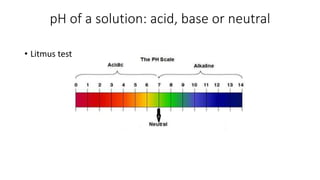
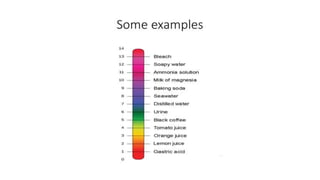
pH of a solution: acid, base or neutral
• Litmus test
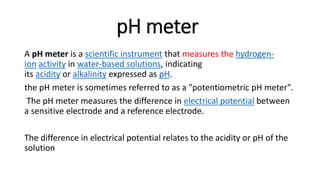
pH meter
A pH meter is a scientific instrument that measures the hydrogen-
ion activity in water-based solutions, indicating
its acidity or alkalinity expressed as pH.
the pH meter is sometimes referred to as a "potentiometric pH meter".
The pH meter measures the difference in electrical potential between
a sensitive electrode and a reference electrode.
The difference in electrical potential relates to the acidity or pH of the
solution
PRINCIPLE
• pH meters measure the voltage between two electrodes and display
the result converted into the corresponding pH value.
• They comprise a simple electronic amplifier and a pair of electrodes,
or alternatively a combination electrode, and some form of display
calibrated in pH units.
• It usually has a glass electrode and a reference electrode, or a
combination electrode.
• The electrodes, or probes, are inserted into the solution to be tested.
DESIGN OF THE ELECTRODES
• Electrodes are rod-like structures usually made of glass, with a bulb containing
the sensor at the bottom.
• The glass electrode (silver- silver chloride electrode)for measuring the pH has a
glass bulb specifically designed to be selective to hydrogen-ion concentration.
On immersion in the solution to be tested, hydrogen ions in the test solution
exchange for other positively charged ions on the glass bulb, creating an
electrochemical potential across the bulb.
• The reference electrode (Calomel electrode) is insensitive to the pH of the
solution, being composed of a metallic conductor, which connects to the display.
• The electronic amplifier detects the difference in electrical potential between
the two electrodes generated in the measurement and converts the potential
difference to pH units.
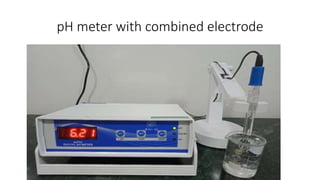
pH meter with combined electrode
Principle:
• On immersion of the glass electrode and the reference electrode in
the test solution, an electrical circuit is completed, in which there is a
potential difference created and detected by the voltmeter.
• The voltage depends on the potential difference created by the
difference in hydrogen-ion concentrations on each side of the glass
membrane between the test solution and the solution inside the glass
electrode.
• All other potential differences in the circuit do not vary with pH and
are corrected for by means of the calibration.
Calibration and Operation
• 1. Before measuring the pH of a solution, the electrodes are dipped in distilled water so that the
hydrogen ions in the test solution equilibrate with the ions on the surface of the bulb on the glass
electrode.
• This equilibration provides a stable pH measurement.
• 2. calibration is performed with at least two standard buffer solutions . For general purposes,
buffers at pH 4.00 and pH 10.00 are suitable. The pH meter has one calibration control to set the
meter reading equal to the value of the first standard buffer (and a second control to adjust the
meter reading to the value of the second buffer).
• Standard buffer sachets at various pH ranges are available from a variety of suppliers
• 3. A third control allows the temperature to be set.
• The pH meter is calibrated with solutions of known pH, typically before each use, to
ensure accuracy of measurement.
pH electrode and reference electrode design
• microstructure of the glass membrane of the pH electrode.
• Glass is a solid electrolyte, for which alkali-metal ions can carry current.
• The pH-sensitive glass membrane is generally spherical to simplify the manufacture of a uniform membrane.
• These membranes are up to 0.4 millimeters in thickness to render the probes durable.
• The glass has silicate chemical functionality on its surface, which provides binding sites for alkali-metal ions and
hydrogen ions from the solutions. This provides an ion-exchange capacity in the range of 10−6 to 10−8 mol/cm2.
• Selectivity for hydrogen ions (H+) arises from a balance of ionic charge, volume requirements versus other ions,
and the coordination number of other ions.
• ( Electrode manufacturers have developed compositions that suitably balance these factors, most notably lithium
glass.)
• The silver chloride electrode is most commonly used as a reference electrode in pH meters and the saturated
calomel electrode. The silver chloride electrode is simple to manufacture and provides high reproducibility.
• The reference electrode usually consists of a platinum wire that has contact with mercury mixture, which is
immersed in a potassium chloride solution. There is a ceramic plug, which serves as a contact to the test solution,
providing low resistance while preventing mixing of the two solutions.
• With these electrode designs, the voltmeter is detecting potential differences of ±1400 millivolts.[ The electrodes
are further designed to rapidly equilibrate with test solutions to facilitate ease of use.
• The equilibration times are typically less than one second, although equilibration times increase as the electrodes
age
Maintenance
• Because of the sensitivity of the electrodes to contaminants, cleanliness
of the probes is essential for accuracy and precision.
• Probes are generally kept moist when not in use with a medium
appropriate for the particular probe, which is typically an aqueous solution
available from probe manufacturers.
• Probe manufacturers provide instructions for cleaning and maintaining
their probe designs.
• For illustration, one maker of laboratory-grade pH gives cleaning
instructions for specific contaminants: general cleaning (15-minute soak in
a solution of bleach and detergent), salt (hydrochloric acid solution
followed by sodium hydroxide and water), grease (detergent or methanol),
clogged reference junction (KCl solution), protein deposits (pepsin and HCl,
1% solution), and air bubbles
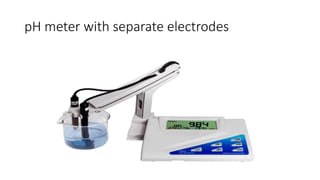
pH meter with separate electrodes
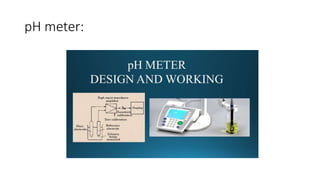
pH meter:
Electrodes:
• Now a days, pH meters are constructed using a combination probe,
constructed with the glass electrode and the reference electrode contained
within a single probe.
• At the present time: in most applications pH is measured with the help of a
glass electrode coupled with a standard calomel electrode.
• A glass electrode consists of a silver wire coated with silver chloride
immersed in a solution of hydrochloric acid solution of constant pH (buffer
solution) and placed inside a container made of special glass. The potential
of the glass electrode is found to change with the hydrogen ion
concentration of the solution in which it is immersed, i.e. it is reversible
with respect to the H+ ions.
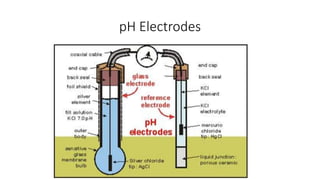
pH Electrodes
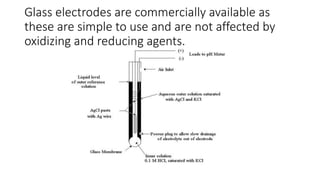
Glass electrodes are commercially available as
these are simple to use and are not affected by
oxidizing and reducing agents.
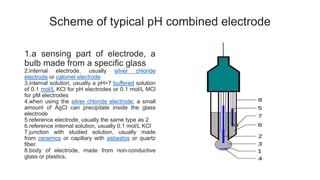
Scheme of typical pH combined electrode
1.a sensing part of electrode, a
bulb made from a specific glass
2.internal electrode, usually silver chloride
electrode or calomel electrode
3.internal solution, usually a pH=7 buffered solution
of 0.1 mol/L KCl for pH electrodes or 0.1 mol/L MCl
for pM electrodes
4.when using the silver chloride electrode, a small
amount of AgCl can precipitate inside the glass
electrode
5.reference electrode, usually the same type as 2
6.reference internal solution, usually 0.1 mol/L KCl
7.junction with studied solution, usually made
from ceramics or capillary with asbestos or quartz
fiber.
8.body of electrode, made from non-conductive
glass or plastics.
Measuring pH
• In order to determine the pH of an unknown solution the glass elec
• trode and the calomel electrode both are dipped in the solution
• the pH of an unknown solution can be easily determined by
measuring the e.m.f. of the cell
• in commercial pH meters the potential values are convened into
pH values which are directly read from the dial of the instrument.
Reference
• Text books on tools and techniques in Biology.
• Nelson D. L. and M.M. Cox, “Leninger Principles of Biochemistry”
Mc Milian Worth Publishers
• Wikipedia

JAndrew/PH meter.pptx

  • 1.
    DR. BHIM RAOAMBEDKAR, AGRA B.Sc. (ZOOLOGY) THIRD YEAR SYALLBUS PAPER – 302 Biotechnology, Immunology, Biological Tools & Techniques and Biostatistics Unit-III Biological Tools and Techniques: Principles and uses of instruments: pH Meter, Calorimeter, Microtome, Spectrophotometer & Centrifuge. Microscopy (light, transmission and scanning electron microscopy) Chromatography and Electrophoresis.
  • 2.
    pH (The scale whichdenotes 𝐻+ & 𝑂𝐻− ion concentrations) in 1909 S.P.L Sorenson, a Danish biochemist devised a scale known as pH to represents the H+ ion concentration of an aqueous solution. • 𝑝𝐻 = 𝑙𝑜𝑔 1 𝐻+ = − log 𝐻+ The ion product of water, 𝐾𝑊, is the basis for the pH scale. It is a convenient means of designating the concentration of 𝐻+ (and thus of 𝑂𝐻− ) in any aqueous solution, the range between 1.0 M𝐻+ and 1.0 M𝑂𝐻− The pH value of any solution is a number that simply represents the acidity and basicity of the solution. The pH value of any solution is numerically equal to the logarithm of the inverse of the hydrogen ion (H+) concentration. In October 1934, Arnold Orville Beckman registered the first patent for a complete chemical instrument for the measurement of pH, U.S. Patent No. 2,058,761, for his "acidimeter", later renamed the pH meter.
  • 3.
    pH of asolution: acid, base or neutral • Litmus test
  • 5.
    pH meter A pHmeter is a scientific instrument that measures the hydrogen- ion activity in water-based solutions, indicating its acidity or alkalinity expressed as pH. the pH meter is sometimes referred to as a "potentiometric pH meter". The pH meter measures the difference in electrical potential between a sensitive electrode and a reference electrode. The difference in electrical potential relates to the acidity or pH of the solution
  • 6.
    PRINCIPLE • pH metersmeasure the voltage between two electrodes and display the result converted into the corresponding pH value. • They comprise a simple electronic amplifier and a pair of electrodes, or alternatively a combination electrode, and some form of display calibrated in pH units. • It usually has a glass electrode and a reference electrode, or a combination electrode. • The electrodes, or probes, are inserted into the solution to be tested.
  • 7.
    DESIGN OF THEELECTRODES • Electrodes are rod-like structures usually made of glass, with a bulb containing the sensor at the bottom. • The glass electrode (silver- silver chloride electrode)for measuring the pH has a glass bulb specifically designed to be selective to hydrogen-ion concentration. On immersion in the solution to be tested, hydrogen ions in the test solution exchange for other positively charged ions on the glass bulb, creating an electrochemical potential across the bulb. • The reference electrode (Calomel electrode) is insensitive to the pH of the solution, being composed of a metallic conductor, which connects to the display. • The electronic amplifier detects the difference in electrical potential between the two electrodes generated in the measurement and converts the potential difference to pH units.
  • 8.
    pH meter withcombined electrode
  • 9.
    Principle: • On immersionof the glass electrode and the reference electrode in the test solution, an electrical circuit is completed, in which there is a potential difference created and detected by the voltmeter. • The voltage depends on the potential difference created by the difference in hydrogen-ion concentrations on each side of the glass membrane between the test solution and the solution inside the glass electrode. • All other potential differences in the circuit do not vary with pH and are corrected for by means of the calibration.
  • 10.
    Calibration and Operation •1. Before measuring the pH of a solution, the electrodes are dipped in distilled water so that the hydrogen ions in the test solution equilibrate with the ions on the surface of the bulb on the glass electrode. • This equilibration provides a stable pH measurement. • 2. calibration is performed with at least two standard buffer solutions . For general purposes, buffers at pH 4.00 and pH 10.00 are suitable. The pH meter has one calibration control to set the meter reading equal to the value of the first standard buffer (and a second control to adjust the meter reading to the value of the second buffer). • Standard buffer sachets at various pH ranges are available from a variety of suppliers • 3. A third control allows the temperature to be set. • The pH meter is calibrated with solutions of known pH, typically before each use, to ensure accuracy of measurement.
  • 11.
    pH electrode andreference electrode design • microstructure of the glass membrane of the pH electrode. • Glass is a solid electrolyte, for which alkali-metal ions can carry current. • The pH-sensitive glass membrane is generally spherical to simplify the manufacture of a uniform membrane. • These membranes are up to 0.4 millimeters in thickness to render the probes durable. • The glass has silicate chemical functionality on its surface, which provides binding sites for alkali-metal ions and hydrogen ions from the solutions. This provides an ion-exchange capacity in the range of 10−6 to 10−8 mol/cm2. • Selectivity for hydrogen ions (H+) arises from a balance of ionic charge, volume requirements versus other ions, and the coordination number of other ions. • ( Electrode manufacturers have developed compositions that suitably balance these factors, most notably lithium glass.) • The silver chloride electrode is most commonly used as a reference electrode in pH meters and the saturated calomel electrode. The silver chloride electrode is simple to manufacture and provides high reproducibility. • The reference electrode usually consists of a platinum wire that has contact with mercury mixture, which is immersed in a potassium chloride solution. There is a ceramic plug, which serves as a contact to the test solution, providing low resistance while preventing mixing of the two solutions. • With these electrode designs, the voltmeter is detecting potential differences of ±1400 millivolts.[ The electrodes are further designed to rapidly equilibrate with test solutions to facilitate ease of use. • The equilibration times are typically less than one second, although equilibration times increase as the electrodes age
  • 12.
    Maintenance • Because ofthe sensitivity of the electrodes to contaminants, cleanliness of the probes is essential for accuracy and precision. • Probes are generally kept moist when not in use with a medium appropriate for the particular probe, which is typically an aqueous solution available from probe manufacturers. • Probe manufacturers provide instructions for cleaning and maintaining their probe designs. • For illustration, one maker of laboratory-grade pH gives cleaning instructions for specific contaminants: general cleaning (15-minute soak in a solution of bleach and detergent), salt (hydrochloric acid solution followed by sodium hydroxide and water), grease (detergent or methanol), clogged reference junction (KCl solution), protein deposits (pepsin and HCl, 1% solution), and air bubbles
  • 13.
    pH meter withseparate electrodes
  • 14.
  • 15.
    Electrodes: • Now adays, pH meters are constructed using a combination probe, constructed with the glass electrode and the reference electrode contained within a single probe. • At the present time: in most applications pH is measured with the help of a glass electrode coupled with a standard calomel electrode. • A glass electrode consists of a silver wire coated with silver chloride immersed in a solution of hydrochloric acid solution of constant pH (buffer solution) and placed inside a container made of special glass. The potential of the glass electrode is found to change with the hydrogen ion concentration of the solution in which it is immersed, i.e. it is reversible with respect to the H+ ions.
  • 16.
  • 17.
    Glass electrodes arecommercially available as these are simple to use and are not affected by oxidizing and reducing agents.
  • 18.
    Scheme of typicalpH combined electrode 1.a sensing part of electrode, a bulb made from a specific glass 2.internal electrode, usually silver chloride electrode or calomel electrode 3.internal solution, usually a pH=7 buffered solution of 0.1 mol/L KCl for pH electrodes or 0.1 mol/L MCl for pM electrodes 4.when using the silver chloride electrode, a small amount of AgCl can precipitate inside the glass electrode 5.reference electrode, usually the same type as 2 6.reference internal solution, usually 0.1 mol/L KCl 7.junction with studied solution, usually made from ceramics or capillary with asbestos or quartz fiber. 8.body of electrode, made from non-conductive glass or plastics.
  • 19.
    Measuring pH • Inorder to determine the pH of an unknown solution the glass elec • trode and the calomel electrode both are dipped in the solution • the pH of an unknown solution can be easily determined by measuring the e.m.f. of the cell • in commercial pH meters the potential values are convened into pH values which are directly read from the dial of the instrument.
  • 20.
    Reference • Text bookson tools and techniques in Biology. • Nelson D. L. and M.M. Cox, “Leninger Principles of Biochemistry” Mc Milian Worth Publishers • Wikipedia