Methods to study Histology
                             Krishna T
Histology
 Cell
 Tissue
 Organ
 Organ system
 Homeostasis
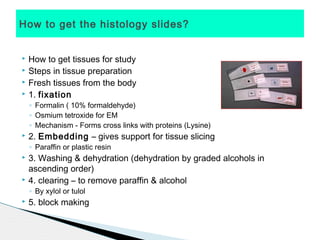
How to get the histology slides?


   How to get tissues for study
   Steps in tissue preparation
   Fresh tissues from the body
   1. fixation
    ◦ Formalin ( 10% formaldehyde)
    ◦ Osmium tetroxide for EM
    ◦ Mechanism - Forms cross links with proteins (Lysine)
   2. Embedding – gives support for tissue slicing
    ◦ Paraffin or plastic resin
   3. Washing & dehydration (dehydration by graded alcohols in
    ascending order)
   4. clearing – to remove paraffin & alcohol
    ◦ By xylol or tulol
   5. block making
How to get the histology slides?
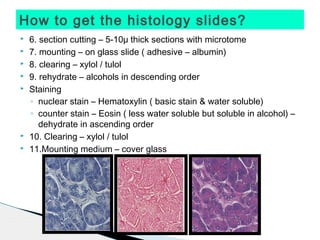
   6. section cutting – 5-10μ thick sections with microtome
   7. mounting – on glass slide ( adhesive – albumin)
   8. clearing – xylol / tulol
   9. rehydrate – alcohols in descending order
   Staining
    ◦ nuclear stain – Hematoxylin ( basic stain & water soluble)
    ◦ counter stain – Eosin ( less water soluble but soluble in alcohol) –
       dehydrate in ascending order
   10. Clearing – xylol / tulol
   11.Mounting medium – cover glass
Special situations
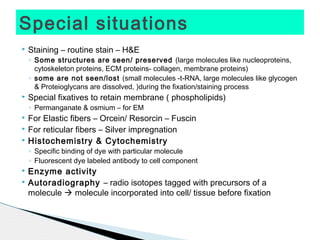
   Staining – routine stain – H&E
    ◦ Some structures are seen/ preserved (large molecules like nucleoproteins,
      cytoskeleton proteins, ECM proteins- collagen, membrane proteins)
    ◦ some are not seen/lost (small molecules -t-RNA, large molecules like glycogen
      & Proteioglycans are dissolved, )during the fixation/staining process
   Special fixatives to retain membrane ( phospholipids)
    ◦ Permanganate & osmium – for EM
 For Elastic fibers – Orcein/ Resorcin – Fuscin
 For reticular fibers – Silver impregnation

 Histochemistry & Cytochemistry

    ◦ Specific binding of dye with particular molecule
    ◦ Fluorescent dye labeled antibody to cell component
 Enzyme activity
 Autoradiography – radio isotopes tagged with precursors of a

  molecule  molecule incorporated into cell/ tissue before fixation
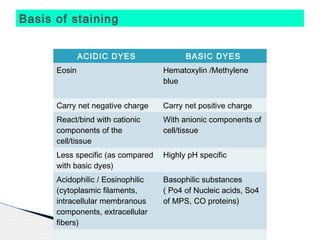
Basis of staining


              ACIDIC DYES                BASIC DYES
      Eosin                        Hematoxylin /Methylene
                                   blue


      Carry net negative charge    Carry net positive charge
      React/bind with cationic     With anionic components of
      components of the            cell/tissue
      cell/tissue
      Less specific (as compared   Highly pH specific
      with basic dyes)
      Acidophilic / Eosinophilic   Basophilic substances
      (cytoplasmic filaments,      ( Po4 of Nucleic acids, So4
      intracellular membranous     of MPS, CO proteins)
      components, extracellular
      fibers)
What is special about Hematoxylin?


 Mostly resembles basic dye but it is a mordant
  (helps to form links between tissue fragment & the
  dye)
 It will not dissociate in sequential staining process

   unlike other basic dyes
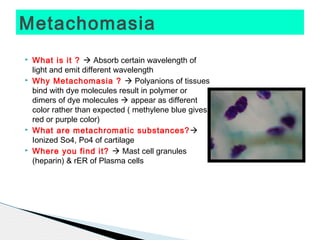
Metachomasia
   What is it ?  Absorb certain wavelength of
    light and emit different wavelength
   Why Metachomasia ?  Polyanions of tissues
    bind with dye molecules result in polymer or
    dimers of dye molecules  appear as different
    color rather than expected ( methylene blue gives
    red or purple color)
   What are metachromatic substances? 
    Ionized So4, Po4 of cartilage
   Where you find it?  Mast cell granules
    (heparin) & rER of Plasma cells
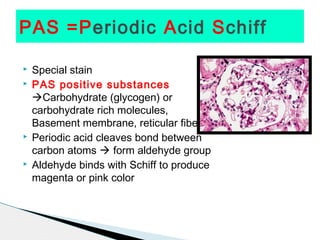
PAS =Periodic Acid Schiff

   Special stain
   PAS positive substances
    Carbohydrate (glycogen) or
    carbohydrate rich molecules,
    Basement membrane, reticular fibers
   Periodic acid cleaves bond between
    carbon atoms  form aldehyde group
   Aldehyde binds with Schiff to produce
    magenta or pink color
Feulgen stain for Nuclear Proteins

 Acid hydrolyses or cleaves proteins from
  deoxyribose of DNA  leads to opening of sugar
  group & formation of aldehyde
 Schiff binds and gives magenta color to aldehyde
 Can be useful to quantify amount of DNA ( by

  using spectrophotmetry of Feulgen stained tissue)


      Why RNA cannot be stained by Feulgen?
Enzymatic digestion
 For the confirmation of specific substances
 Pretreatment of sections with specific enzymes
 Diastase/amylase  for glycogen
 DNA ase  for DNA
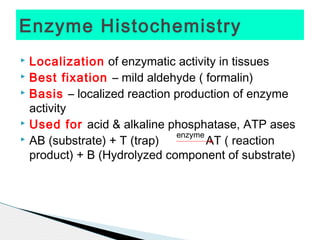
Enzyme Histochemistry
 Localization of enzymatic activity in tissues
 Best fixation – mild aldehyde ( formalin)
 Basis – localized reaction production of enzyme

  activity
 Used for acid & alkaline phosphatase, ATP ases
                             enzyme
 AB (substrate) + T (trap)         AT ( reaction
  product) + B (Hydrolyzed component of substrate)
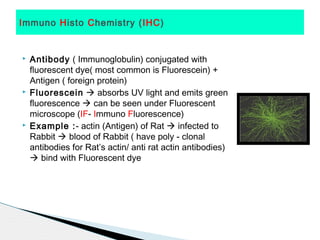
Immuno Histo Chemistry (IHC)


   Antibody ( Immunoglobulin) conjugated with
    fluorescent dye( most common is Fluorescein) +
    Antigen ( foreign protein)
   Fluorescein  absorbs UV light and emits green
    fluorescence  can be seen under Fluorescent
    microscope (IF- Immuno Fluorescence)
   Example :- actin (Antigen) of Rat  infected to
    Rabbit  blood of Rabbit ( have poly - clonal
    antibodies for Rat’s actin/ anti rat actin antibodies)
     bind with Fluorescent dye
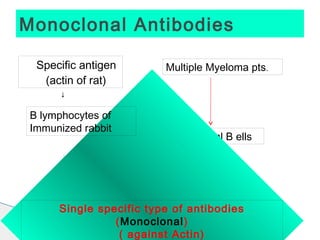
Monoclonal Antibodies

  Specific antigen          Multiple Myeloma pts.
   (actin of rat)
      ↓

 B lymphocytes of
 Immunized rabbit
                            Monoclonal B ells


                Hybridoma cells
                        ↓
      Single specific type of antibodies
                (Monoclonal)
                 ( against Actin)
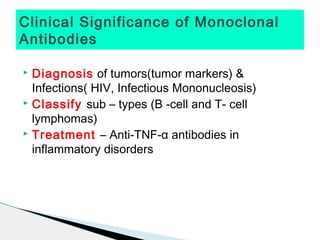
Clinical Significance of Monoclonal
Antibodies

 Diagnosis of tumors(tumor markers) &
  Infections( HIV, Infectious Mononucleosis)
 Classify sub – types (B -cell and T- cell

  lymphomas)
 Treatment – Anti-TNF-α antibodies in

  inflammatory disorders
Immunological Methods
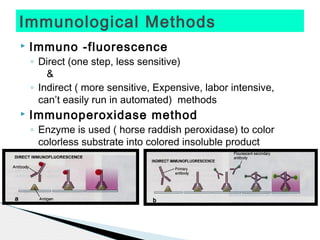
   Immuno -fluorescence
    ◦ Direct (one step, less sensitive)
        &
    ◦ Indirect ( more sensitive, Expensive, labor intensive,
      can’t easily run in automated) methods
   Immunoperoxidase method
    ◦ Enzyme is used ( horse raddish peroxidase) to color
      colorless substrate into colored insoluble product
Other Methods

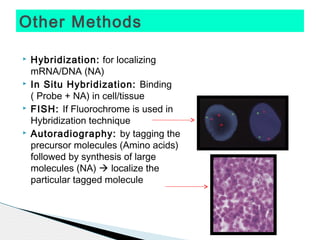
   Hybridization: for localizing
    mRNA/DNA (NA)
   In Situ Hybridization: Binding
    ( Probe + NA) in cell/tissue
   FISH: If Fluorochrome is used in
    Hybridization technique
   Autoradiography: by tagging the
    precursor molecules (Amino acids)
    followed by synthesis of large
    molecules (NA)  localize the
    particular tagged molecule
Microscopy
   Resolution/ Resolving power (RP): the
    distance by which two objects must be
    separated to be seen as two objects
    ◦ RP of
    ◦ Unaided Human retina    : 0.2 mm
    ◦ Light Microscope (LM)   : 0.2 μ
    ◦ Electro Microscope (EM) : 1.0 nm
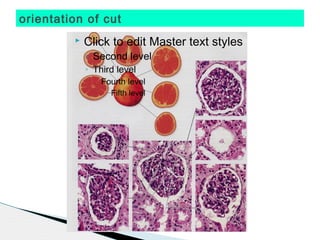
 LM: we see only two dimensional pictures,
  orientation of cut gives different patterns
 Artifacts: error in preparation process
orientation of cut
            Click to edit Master text styles
             ◦ Second level
             ◦ Third level
                Fourth level
                  Fifth level
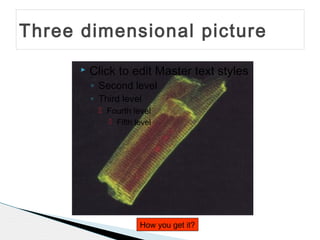
Three dimensional picture
         Click to edit Master text styles
          ◦ Second level
          ◦ Third level
             Fourth level
               Fifth level


                       How you get it?
Types & Advantages of Microscopes


   1. Phase contrast M:
    ◦ can see live (unstained) tissue
    ◦ Light passing thru denser tissue of higher refractory
      index  out of phase from the rest  look darker
    ◦ Uses : identify cells in tissue cultures
    ◦ Modification: Interference M: quantification of tissue
      masses helps in study of surface properties of cells


      What happens to the tissues during routine staining process?
Types & Advantages of
Microscopes
   2. dark Field M: special condenser illuminates specimen
    with strong oblique light
    ◦ Uses:
    ◦ In auto radiography
    ◦ Study crystals in urine
    ◦ Study microbes- slender spirochetes ( *Treponema pallidum )
   3. Fluorescent M: emits light in visible range when exposed to
    UV light
    ◦ Technique: filters are used between light source & specimen
    ◦ Naturally fluorescent substances: Vitamin “A”, Neuro- transmitters
    ◦ Uses
    ◦ Tracing pathways of nerve fibers,
    ◦ To detect growth markers of mineralized tissues

                 *What is the disease caused by this bug?
Types & Advantages of Microscopes


   4. Confocal scanning M:
    ◦ Conjugate with focal point of lens
    ◦ Computer software reconstitutes the image from the data
    ◦ Major difference from LM: addition of detector aperture (pin
      hole)
    ◦ Uses: can see 3D pictures
   5. ultra violet M:
    ◦ Depends on absorption of UVL by specimen
    ◦ Results are recorded photographically (can’t be seen directly –
      why?)
    ◦ Uses
    ◦ Study of nitrogen bases ( in NA)
    ◦ Study amount of DNA/RNA in cells *Clinically helps in study of ploidy in
      tumors


             Highly aneuploid tumor  What is its Significance ?
Types & Advantages of Microscopes


   6. Polarizing M: only difference is polarizer
    (polarizing filter)
    ◦ Birefringence: ability of crystalline or Para - crystalline
      material to rotate the phase of polarized light (double
      refraction)
    ◦ Skeletal muscle & Leydig cells
    ◦ *Amyloid protein: apple green
    ◦ ±Uric acid: negative
    ◦ ± ± Ca++ pyrophosphate
              * ,±, ± ±  clinical Significance ?
Types & Advantages of Microscopes


   7. Electron M (EM): specimen is in vacuum
    ◦ Types: Transmission (TEM), scanning (SEM)
    ◦ Mechanism: similar to LM except that beam of electrons replace
      light source
    ◦ Recording: photoelectric plate or video detector
    ◦ Specimen preparation:
    ◦ Fixation: Glutaraldehyde (cross links with proteins), Osmium tetroxide (reacts
      with *phospholipids) makes cell/tissue electron dense for image enhancement
    ◦ Other steps are same as routine tissue processing except
       Plastic is used for embedding
       ± Diamond knives are used in microtome ( not metal knives)
    ◦ To study membranes – Freeze fracture technique {-160°C with
      glycerol (to prevent ice crystal formation)}

                       • * Where you find ?
                       • ± why diamond knives are used in EM?
Types & Advantages of Microscopes


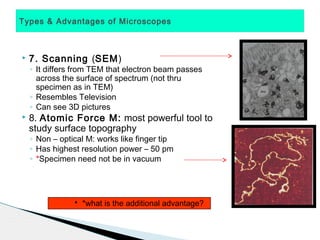
   7. Scanning (SEM)
    ◦ It differs from TEM that electron beam passes
      across the surface of spectrum (not thru
      specimen as in TEM)
    ◦ Resembles Television
    ◦ Can see 3D pictures
   8. Atomic Force M: most powerful tool to
    study surface topography
    ◦ Non – optical M: works like finger tip
    ◦ Has highest resolution power – 50 pm
    ◦ *Specimen need not be in vacuum


                • *what is the additional advantage?

Methods to-study-histology

  • 1.
    Methods to studyHistology Krishna T
  • 2.
    Histology  Cell  Tissue Organ  Organ system  Homeostasis
  • 3.
    How to getthe histology slides?  How to get tissues for study  Steps in tissue preparation  Fresh tissues from the body  1. fixation ◦ Formalin ( 10% formaldehyde) ◦ Osmium tetroxide for EM ◦ Mechanism - Forms cross links with proteins (Lysine)  2. Embedding – gives support for tissue slicing ◦ Paraffin or plastic resin  3. Washing & dehydration (dehydration by graded alcohols in ascending order)  4. clearing – to remove paraffin & alcohol ◦ By xylol or tulol  5. block making
  • 4.
    How to getthe histology slides?  6. section cutting – 5-10μ thick sections with microtome  7. mounting – on glass slide ( adhesive – albumin)  8. clearing – xylol / tulol  9. rehydrate – alcohols in descending order  Staining ◦ nuclear stain – Hematoxylin ( basic stain & water soluble) ◦ counter stain – Eosin ( less water soluble but soluble in alcohol) – dehydrate in ascending order  10. Clearing – xylol / tulol  11.Mounting medium – cover glass
  • 5.
    Special situations  Staining – routine stain – H&E ◦ Some structures are seen/ preserved (large molecules like nucleoproteins, cytoskeleton proteins, ECM proteins- collagen, membrane proteins) ◦ some are not seen/lost (small molecules -t-RNA, large molecules like glycogen & Proteioglycans are dissolved, )during the fixation/staining process  Special fixatives to retain membrane ( phospholipids) ◦ Permanganate & osmium – for EM  For Elastic fibers – Orcein/ Resorcin – Fuscin  For reticular fibers – Silver impregnation  Histochemistry & Cytochemistry ◦ Specific binding of dye with particular molecule ◦ Fluorescent dye labeled antibody to cell component  Enzyme activity  Autoradiography – radio isotopes tagged with precursors of a molecule  molecule incorporated into cell/ tissue before fixation
  • 6.
    Basis of staining ACIDIC DYES BASIC DYES Eosin Hematoxylin /Methylene blue Carry net negative charge Carry net positive charge React/bind with cationic With anionic components of components of the cell/tissue cell/tissue Less specific (as compared Highly pH specific with basic dyes) Acidophilic / Eosinophilic Basophilic substances (cytoplasmic filaments, ( Po4 of Nucleic acids, So4 intracellular membranous of MPS, CO proteins) components, extracellular fibers)
  • 7.
    What is specialabout Hematoxylin?  Mostly resembles basic dye but it is a mordant (helps to form links between tissue fragment & the dye)  It will not dissociate in sequential staining process  unlike other basic dyes
  • 8.
    Metachomasia  What is it ?  Absorb certain wavelength of light and emit different wavelength  Why Metachomasia ?  Polyanions of tissues bind with dye molecules result in polymer or dimers of dye molecules  appear as different color rather than expected ( methylene blue gives red or purple color)  What are metachromatic substances?  Ionized So4, Po4 of cartilage  Where you find it?  Mast cell granules (heparin) & rER of Plasma cells
  • 9.
    PAS =Periodic AcidSchiff  Special stain  PAS positive substances Carbohydrate (glycogen) or carbohydrate rich molecules, Basement membrane, reticular fibers  Periodic acid cleaves bond between carbon atoms  form aldehyde group  Aldehyde binds with Schiff to produce magenta or pink color
  • 10.
    Feulgen stain forNuclear Proteins  Acid hydrolyses or cleaves proteins from deoxyribose of DNA  leads to opening of sugar group & formation of aldehyde  Schiff binds and gives magenta color to aldehyde  Can be useful to quantify amount of DNA ( by using spectrophotmetry of Feulgen stained tissue) Why RNA cannot be stained by Feulgen?
  • 11.
    Enzymatic digestion  Forthe confirmation of specific substances  Pretreatment of sections with specific enzymes  Diastase/amylase  for glycogen  DNA ase  for DNA
  • 12.
    Enzyme Histochemistry  Localizationof enzymatic activity in tissues  Best fixation – mild aldehyde ( formalin)  Basis – localized reaction production of enzyme activity  Used for acid & alkaline phosphatase, ATP ases enzyme  AB (substrate) + T (trap) AT ( reaction product) + B (Hydrolyzed component of substrate)
  • 13.
    Immuno Histo Chemistry(IHC)  Antibody ( Immunoglobulin) conjugated with fluorescent dye( most common is Fluorescein) + Antigen ( foreign protein)  Fluorescein  absorbs UV light and emits green fluorescence  can be seen under Fluorescent microscope (IF- Immuno Fluorescence)  Example :- actin (Antigen) of Rat  infected to Rabbit  blood of Rabbit ( have poly - clonal antibodies for Rat’s actin/ anti rat actin antibodies)  bind with Fluorescent dye
  • 14.
    Monoclonal Antibodies Specific antigen Multiple Myeloma pts. (actin of rat) ↓ B lymphocytes of Immunized rabbit Monoclonal B ells Hybridoma cells ↓ Single specific type of antibodies (Monoclonal) ( against Actin)
  • 15.
    Clinical Significance ofMonoclonal Antibodies  Diagnosis of tumors(tumor markers) & Infections( HIV, Infectious Mononucleosis)  Classify sub – types (B -cell and T- cell lymphomas)  Treatment – Anti-TNF-α antibodies in inflammatory disorders
  • 16.
    Immunological Methods  Immuno -fluorescence ◦ Direct (one step, less sensitive) & ◦ Indirect ( more sensitive, Expensive, labor intensive, can’t easily run in automated) methods  Immunoperoxidase method ◦ Enzyme is used ( horse raddish peroxidase) to color colorless substrate into colored insoluble product
  • 17.
    Other Methods  Hybridization: for localizing mRNA/DNA (NA)  In Situ Hybridization: Binding ( Probe + NA) in cell/tissue  FISH: If Fluorochrome is used in Hybridization technique  Autoradiography: by tagging the precursor molecules (Amino acids) followed by synthesis of large molecules (NA)  localize the particular tagged molecule
  • 18.
    Microscopy  Resolution/ Resolving power (RP): the distance by which two objects must be separated to be seen as two objects ◦ RP of ◦ Unaided Human retina : 0.2 mm ◦ Light Microscope (LM) : 0.2 μ ◦ Electro Microscope (EM) : 1.0 nm  LM: we see only two dimensional pictures, orientation of cut gives different patterns  Artifacts: error in preparation process
  • 19.
    orientation of cut  Click to edit Master text styles ◦ Second level ◦ Third level  Fourth level  Fifth level
  • 20.
    Three dimensional picture  Click to edit Master text styles ◦ Second level ◦ Third level  Fourth level  Fifth level How you get it?
  • 21.
    Types & Advantagesof Microscopes  1. Phase contrast M: ◦ can see live (unstained) tissue ◦ Light passing thru denser tissue of higher refractory index  out of phase from the rest  look darker ◦ Uses : identify cells in tissue cultures ◦ Modification: Interference M: quantification of tissue masses helps in study of surface properties of cells What happens to the tissues during routine staining process?
  • 22.
    Types & Advantagesof Microscopes  2. dark Field M: special condenser illuminates specimen with strong oblique light ◦ Uses: ◦ In auto radiography ◦ Study crystals in urine ◦ Study microbes- slender spirochetes ( *Treponema pallidum )  3. Fluorescent M: emits light in visible range when exposed to UV light ◦ Technique: filters are used between light source & specimen ◦ Naturally fluorescent substances: Vitamin “A”, Neuro- transmitters ◦ Uses ◦ Tracing pathways of nerve fibers, ◦ To detect growth markers of mineralized tissues *What is the disease caused by this bug?
  • 23.
    Types & Advantagesof Microscopes  4. Confocal scanning M: ◦ Conjugate with focal point of lens ◦ Computer software reconstitutes the image from the data ◦ Major difference from LM: addition of detector aperture (pin hole) ◦ Uses: can see 3D pictures  5. ultra violet M: ◦ Depends on absorption of UVL by specimen ◦ Results are recorded photographically (can’t be seen directly – why?) ◦ Uses ◦ Study of nitrogen bases ( in NA) ◦ Study amount of DNA/RNA in cells *Clinically helps in study of ploidy in tumors Highly aneuploid tumor  What is its Significance ?
  • 24.
    Types & Advantagesof Microscopes  6. Polarizing M: only difference is polarizer (polarizing filter) ◦ Birefringence: ability of crystalline or Para - crystalline material to rotate the phase of polarized light (double refraction) ◦ Skeletal muscle & Leydig cells ◦ *Amyloid protein: apple green ◦ ±Uric acid: negative ◦ ± ± Ca++ pyrophosphate * ,±, ± ±  clinical Significance ?
  • 25.
    Types & Advantagesof Microscopes  7. Electron M (EM): specimen is in vacuum ◦ Types: Transmission (TEM), scanning (SEM) ◦ Mechanism: similar to LM except that beam of electrons replace light source ◦ Recording: photoelectric plate or video detector ◦ Specimen preparation: ◦ Fixation: Glutaraldehyde (cross links with proteins), Osmium tetroxide (reacts with *phospholipids) makes cell/tissue electron dense for image enhancement ◦ Other steps are same as routine tissue processing except  Plastic is used for embedding  ± Diamond knives are used in microtome ( not metal knives) ◦ To study membranes – Freeze fracture technique {-160°C with glycerol (to prevent ice crystal formation)} • * Where you find ? • ± why diamond knives are used in EM?
  • 26.
    Types & Advantagesof Microscopes  7. Scanning (SEM) ◦ It differs from TEM that electron beam passes across the surface of spectrum (not thru specimen as in TEM) ◦ Resembles Television ◦ Can see 3D pictures  8. Atomic Force M: most powerful tool to study surface topography ◦ Non – optical M: works like finger tip ◦ Has highest resolution power – 50 pm ◦ *Specimen need not be in vacuum • *what is the additional advantage?