Synopsis
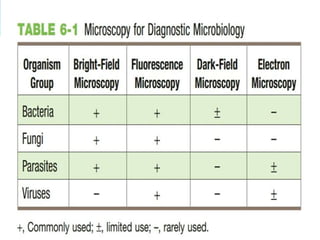
 Fluorescence Microscopy
 Electron Microscopy
• Transmission Electron Microscope
• Scanning Electron Microscope
 Newer Modifications in Microscopy
• Confocal Microscopy
• Scanning Probe Microscopy
* Scanning Tunneling Microscope
* Atomic Force Microscope
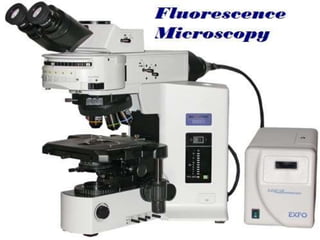
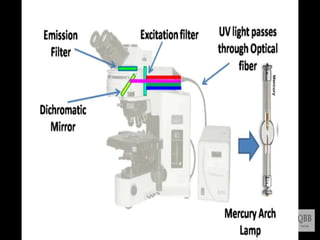
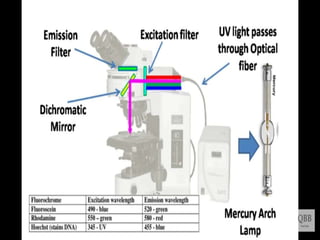
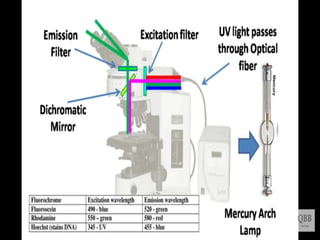
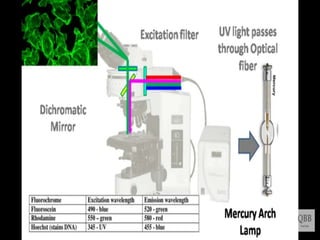
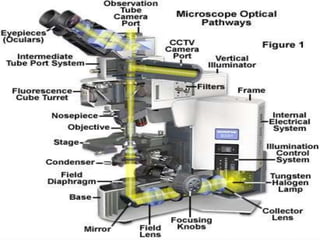
 It is an optical microscope that uses fluorescing property
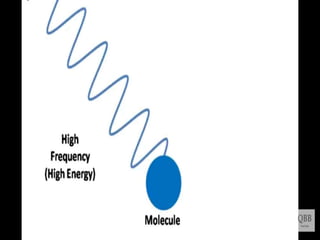
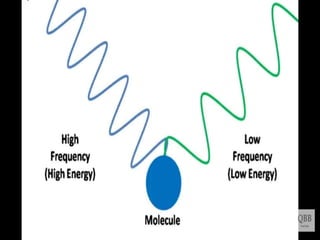
 Fluorochromes / Fluorophores: Are dyes that absorb light of
shorter wavelength (UV light / excitation light / invisible light)
& raised to higher energy level
 When they return to normal ( low energy state), Release energy
in the form of visible light ( fluorescent light)
 Organisms stained with these fluorescent dyes glow
(fluoresce ) against a dark background
 This effect depends on its excitation short wave radiation & PH
of the medium
Working Principle:
 Developed by Haitinger and Coons
 Difference from ordinary microscope
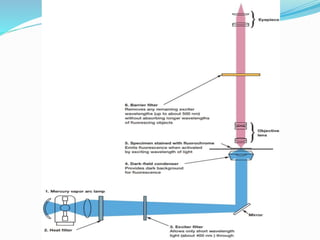
 Light source
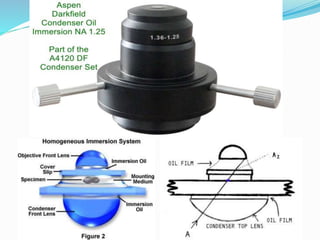
 Dark Field Immersion condenser ( non fluorescing
immersion oil)
 Three sets of Filter (block the heat & eliminate IR
light, interference filter, eliminate UV light )
 Specimen : coated with fluorochromes
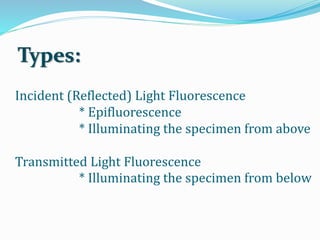
Incident (Reflected) Light Fluorescence
* Epifluorescence
* Illuminating the specimen from above
Transmitted Light Fluorescence
* Illuminating the specimen from below
Types:
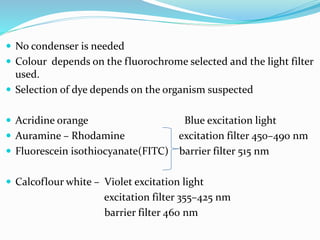
 No condenser is needed
 Colour depends on the fluorochrome selected and the light filter
used.
 Selection of dye depends on the organism suspected
 Acridine orange Blue excitation light
 Auramine – Rhodamine excitation filter 450–490 nm
 Fluorescein isothiocyanate(FITC) barrier filter 515 nm
 Calcoflour white – Violet excitation light
excitation filter 355–425 nm
barrier filter 460 nm
Applications:
 Autofluorescence
 Staining Techniques
* Fluorochroming
* Immunofluorescence
 Fluorescent In situ Hybridisation ( FISH)
 Studies in bacterial cell division
 Ecological studies
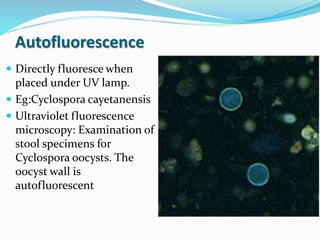
Autofluorescence
 Directly fluoresce when
placed under UV lamp.
 Eg:Cyclospora cayetanensis
 Ultraviolet fluorescence
microscopy: Examination of
stool specimens for
Cyclospora oocysts. The
oocyst wall is
autofluorescent
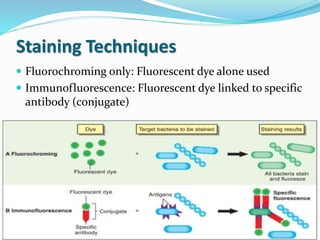
Staining Techniques
 Fluorochroming only: Fluorescent dye alone used
 Immunofluorescence: Fluorescent dye linked to specific
antibody (conjugate)
Fluorochroming
 Direct chemical interaction between fluorochrome
dye and bacterial cell
 Enchance the contrast & amplifies 10 fold greater than
light microscope
 Eg: minimum concentration of 10⁵ microorganisms/ml
is required to visualise by light microscopy
 In fluorescence microscopy the requirement is
decreased to 10⁴ microorganisms/ml
 Stains: Auramine – Rhodamine
Acridine Orange
Calcoflour white
Auramine – Rhodamine Stain
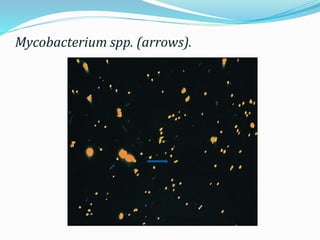
 Binds with Waxy mycolic acid in cell wall of mycobacteria
 For examining sputum & CSF
 Acid fast stain - Stains orange or yellow in green background
 Advantage: More sensitive than carbol fuschin stains
 18% culture positive case show smear positive in AR stain
but negative in Ziehl Neelson / Kinyoun method
 Limitation: Non specifically bind to all acid fast organisms
Eg: Nocardia, Legionella, Rhodococcus
 Rapidly growing mycobacteria may not stain at all with
fluorochromes - stain with carbol fuschin and weaker
decolouriser
Mycobacterium spp. (arrows).
Acridine Orange Stain
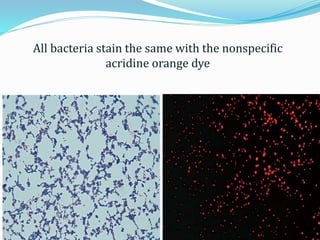
 Nonspecifically Binds to nucleic acid of cell wall and fluoresce
as bright orange
 stains bacteria, fungi and all cellular materials
 In neutral PH – reddish orange
 In acidic PH – remains reddish orange but background
material stains greenish yellow
 Stains both gram positive gram negative; living and dead cells
 Uses: to confirm the presence of bacteria in blood culture
when gram stain is difficult to interpret
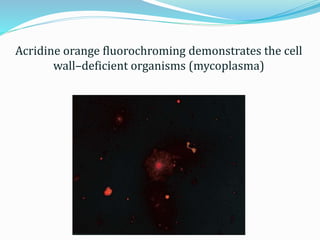
 Detect cell wall deficient bacteria Eg: mycoplasma
 Limited in application
Acridine orange fluorochroming demonstrates the cell
wall–deficient organisms (mycoplasma)
All bacteria stain the same with the nonspecific
acridine orange dye
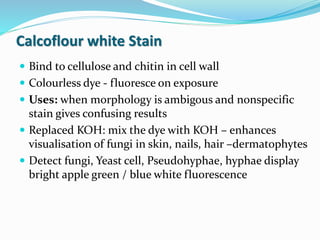
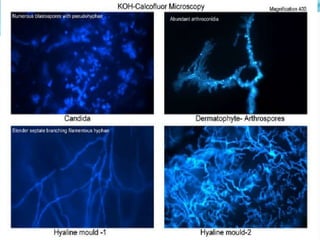
Calcoflour white Stain
 Bind to cellulose and chitin in cell wall
 Colourless dye - fluoresce on exposure
 Uses: when morphology is ambigous and nonspecific
stain gives confusing results
 Replaced KOH: mix the dye with KOH – enhances
visualisation of fungi in skin, nails, hair –dermatophytes
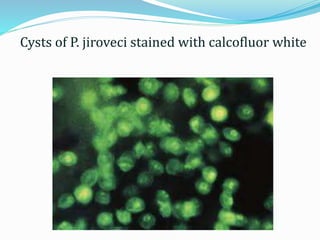
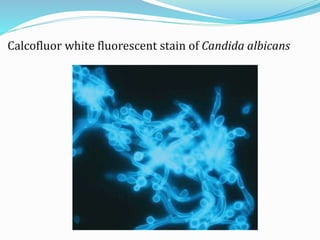
 Detect fungi, Yeast cell, Pseudohyphae, hyphae display
bright apple green / blue white fluorescence
Cysts of P. jiroveci stained with calcofluor white
Calcofluor white fluorescent stain of Candida albicans
Immunofluorescence
 Fluorescent dye tagged with Ig to detect Ag / Ab
 Combines amplified contrast by fluorescence
and specificity of antigen antibody binding
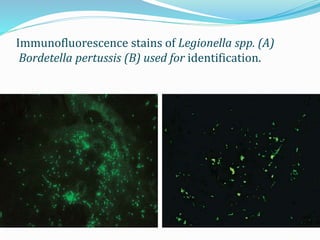
 Identify slow growing organisms eg: Legionella,
Bordetella pertusis, Chlamydia trachomatis
Immunofluorescence stains of Legionella spp. (A)
Bordetella pertussis (B) used for identification.
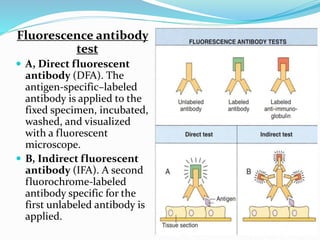
Fluorescence antibody
test
 A, Direct fluorescent
antibody (DFA). The
antigen-specific–labeled
antibody is applied to the
fixed specimen, incubated,
washed, and visualized
with a fluorescent
microscope.
 B, Indirect fluorescent
antibody (IFA). A second
fluorochrome-labeled
antibody specific for the
first unlabeled antibody is
applied.
Direct Fluorescent Antibody Test
 Detect agent inside the infected cells
 Legionella, Giardia, Cryptosporidium, Pneumocystis jirovecii,
HSV, CMV, VZV, RSV
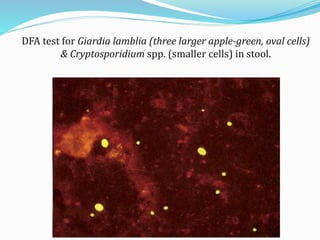
DFA test for Giardia lamblia (three larger apple-green, oval cells)
& Cryptosporidium spp. (smaller cells) in stool.
Indirect Fluorescent Antibody Test
 Two –step (sandwich) technique.
 More sensitive than the DFA method,
 DFA method is faster(single incubation).
 Widely applied method of detecting diverse antibodies.
 Legionella spp., Borrelia burgdorferi, T. gondii, VZV,
CMV, EBV capsid antigen, HSV types 1 and 2,
rubella virus, Mycoplasma pneumoniae, T. pallidum
(the fluorescent treponemal antibody absorption test
[FTA-ABS])
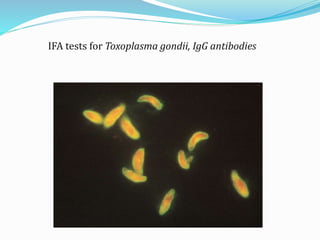
IFA tests for Toxoplasma gondii, IgG antibodies
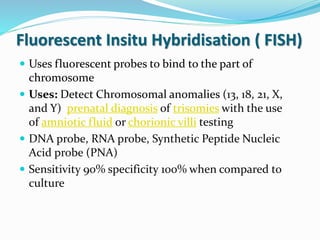
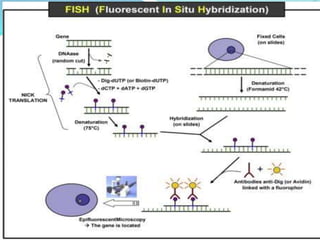
Fluorescent Insitu Hybridisation ( FISH)
 Uses fluorescent probes to bind to the part of
chromosome
 Uses: Detect Chromosomal anomalies (13, 18, 21, X,
and Y) prenatal diagnosis of trisomies with the use
of amniotic fluid or chorionic villi testing
 DNA probe, RNA probe, Synthetic Peptide Nucleic
Acid probe (PNA)
 Sensitivity 90% specificity 100% when compared to
culture
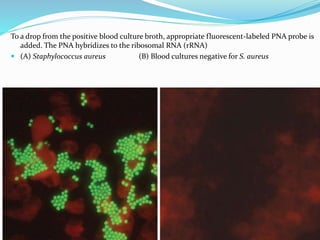
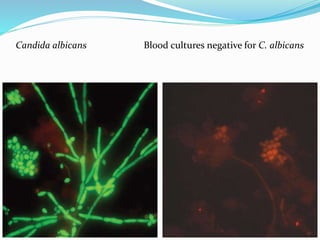
To a drop from the positive blood culture broth, appropriate fluorescent-labeled PNA probe is
added. The PNA hybridizes to the ribosomal RNA (rRNA)
 (A) Staphylococcus aureus (B) Blood cultures negative for S. aureus
Candida albicans Blood cultures negative for C. albicans
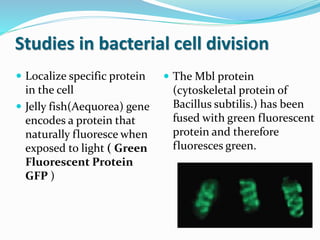
Studies in bacterial cell division
 Localize specific protein
in the cell
 Jelly fish(Aequorea) gene
encodes a protein that
naturally fluoresce when
exposed to light ( Green
Fluorescent Protein
GFP )
 The Mbl protein
(cytoskeletal protein of
Bacillus subtilis.) has been
fused with green fluorescent
protein and therefore
fluoresces green.
Ecological studies:
 Used to observe microorganisms stained with:
* fluorochrome labelled probes
* fluorochromes – acridine orange
DAPI ( diamidino-2-phenylindole)
( DNA specific stain )
 Will fluoresce orange / green - detected even in midst of
particulate material
 Visualise photosynthetic microbes as their pigments
naturally fluoresce when excited by light
Limitations
 High cost
 Technical complexity
 Not rapid (1 – 4 hrs)
 Need Fluorescent microscope / dark room
 Fluorescent dye fades
 Not easy for automation
Disadvantage
 Photobleaching: Fading. Permanent loss of
fluorescence due to chemical damage to flurochrome
 Quenching: transfer of light energy to nearby
molecules ( free radicals, salt, heavy metal, halogen)
• rectified by: * adding chemical scavengers to
mounting fluid
* storing fluorescent slides in dark
container & refrigerated at 2-8°C
* Digital Photgraphy - permanent record
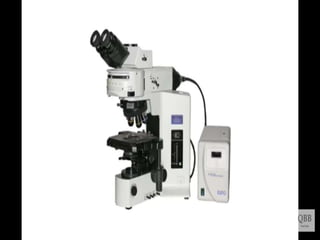
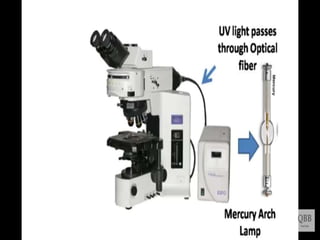
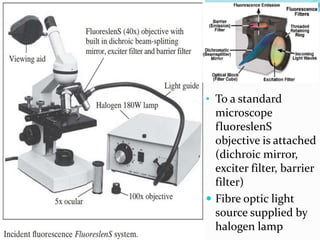
• To a standard
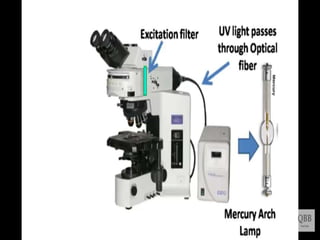
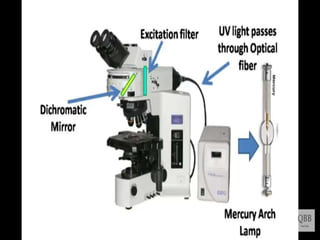
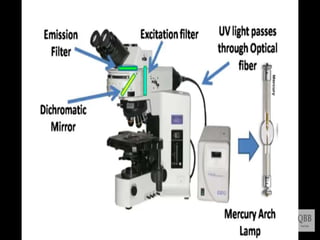
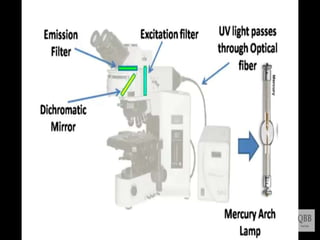
microscope
fluoreslenS
objective is attached
(dichroic mirror,
exciter filter, barrier
filter)
 Fibre optic light
source supplied by
halogen lamp
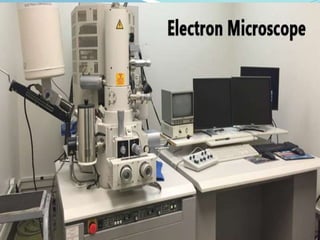
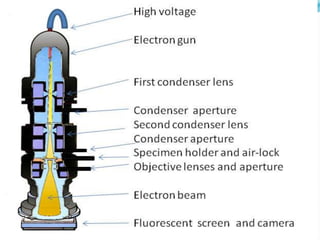
 Invented by German Physicist Ernst Ruska in 1931
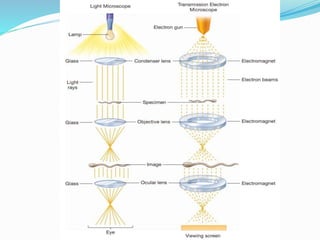
 Source of illumination : Accelerated Electrons
 Wavelength of electrons 100,000 shorter than visible
light photons
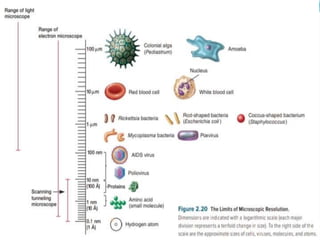
 Better resolving power than light microscope
 Reveals flagella, fimbriae, intracellular structures of a
cell
 Powerful research tool, to study new morphological
features
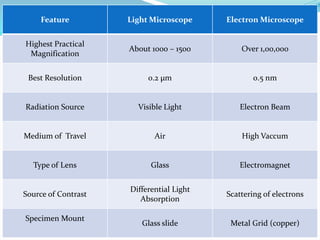
Feature Light Microscope Electron Microscope
Highest Practical
Magnification
About 1000 – 1500 Over 1,00,000
Best Resolution 0.2 µm 0.5 nm
Radiation Source Visible Light Electron Beam
Medium of Travel Air High Vaccum
Type of Lens Glass Electromagnet
Source of Contrast
Differential Light
Absorption
Scattering of electrons
Specimen Mount
Glass slide Metal Grid (copper)
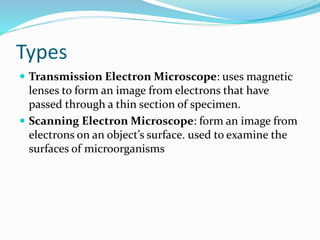
Types
 Transmission Electron Microscope: uses magnetic
lenses to form an image from electrons that have
passed through a thin section of specimen.
 Scanning Electron Microscope: form an image from
electrons on an object’s surface. used to examine the
surfaces of microorganisms
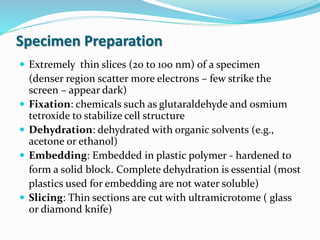
Specimen Preparation
 Extremely thin slices (20 to 100 nm) of a specimen
(denser region scatter more electrons – few strike the
screen – appear dark)
 Fixation: chemicals such as glutaraldehyde and osmium
tetroxide to stabilize cell structure
 Dehydration: dehydrated with organic solvents (e.g.,
acetone or ethanol)
 Embedding: Embedded in plastic polymer - hardened to
form a solid block. Complete dehydration is essential (most
plastics used for embedding are not water soluble)
 Slicing: Thin sections are cut with ultramicrotome ( glass
or diamond knife)
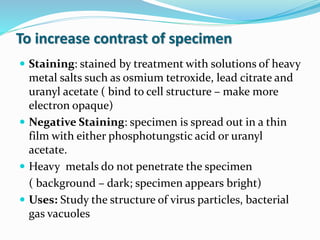
To increase contrast of specimen
 Staining: stained by treatment with solutions of heavy
metal salts such as osmium tetroxide, lead citrate and
uranyl acetate ( bind to cell structure – make more
electron opaque)
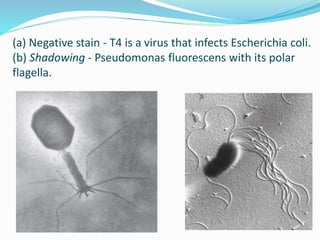
 Negative Staining: specimen is spread out in a thin
film with either phosphotungstic acid or uranyl
acetate.
 Heavy metals do not penetrate the specimen
( background – dark; specimen appears bright)
 Uses: Study the structure of virus particles, bacterial
gas vacuoles
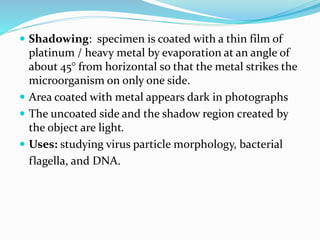
 Shadowing: specimen is coated with a thin film of
platinum / heavy metal by evaporation at an angle of
about 45° from horizontal so that the metal strikes the
microorganism on only one side.
 Area coated with metal appears dark in photographs
 The uncoated side and the shadow region created by
the object are light.
 Uses: studying virus particle morphology, bacterial
flagella, and DNA.
(a) Negative stain - T4 is a virus that infects Escherichia coli.
(b) Shadowing - Pseudomonas fluorescens with its polar
flagella.
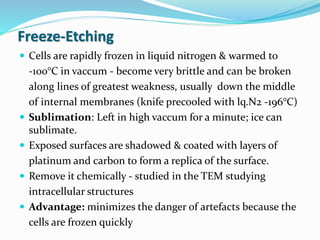
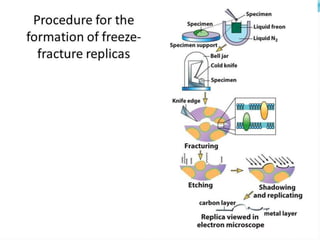
Freeze-Etching
 Cells are rapidly frozen in liquid nitrogen & warmed to
-100°C in vaccum - become very brittle and can be broken
along lines of greatest weakness, usually down the middle
of internal membranes (knife precooled with lq.N2 -196°C)
 Sublimation: Left in high vaccum for a minute; ice can
sublimate.
 Exposed surfaces are shadowed & coated with layers of
platinum and carbon to form a replica of the surface.
 Remove it chemically - studied in the TEM studying
intracellular structures
 Advantage: minimizes the danger of artefacts because the
cells are frozen quickly
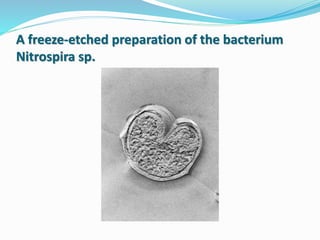
A freeze-etched preparation of the bacterium
Nitrospira sp.
Applications
 researchers view samples on a molecular level, to analyze structure and
texture.
 study of crystals and metals
Advantages
 Most powerful magnification, over one million times
 Wide-range of applications - scientific, educational and industrial fields
 Images are high-quality and detailed
 Able to yield information of surface features, shape, size and structure
Disadvantages:
 large and very expensive
 Laborious sample preparation
 Potential artefacts from sample preparation
 Operation and analysis requires special training
 Samples should be electron transparent, able to tolerate the vacuum
chamber and small enough to fit in the chamber
 Require special housing and maintenance
 Images are black and white
Scanning Electron Microscope
 Uses: study external surface features of microorganisms
 Specimen preparation: specimen is fixed, dehydrated,
and dried
 Dried samples are mounted and coated with a thin layer
of metal to prevent the build up of an electrical charge
on the surface.
 Air-dried material can be examined directly
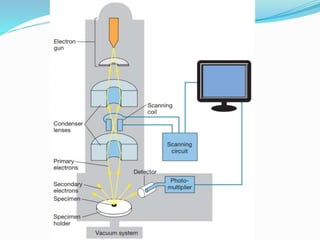
 SEM scans a narrow, tapered electron beam back & forth
over the specimen
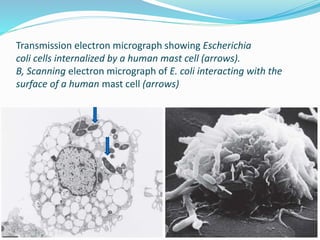
Transmission electron micrograph showing Escherichia
coli cells internalized by a human mast cell (arrows).
B, Scanning electron micrograph of E. coli interacting with the
surface of a human mast cell (arrows)
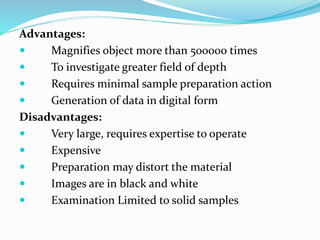
Advantages:
 Magnifies object more than 500000 times
 To investigate greater field of depth
 Requires minimal sample preparation action
 Generation of data in digital form
Disadvantages:
 Very large, requires expertise to operate
 Expensive
 Preparation may distort the material
 Images are in black and white
 Examination Limited to solid samples
Modifications in Microscope
 Confocal Microscope
 Scanning Probe Microscope
* Scanning Tunneling Microscope
* Atomic Force Microscope
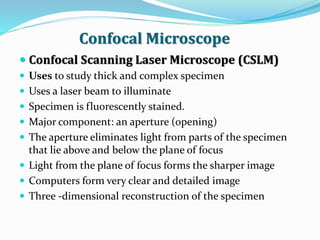
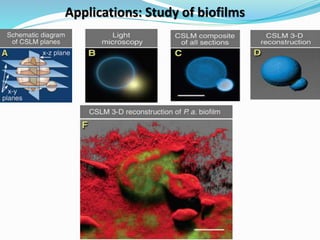
Confocal Microscope
 Confocal Scanning Laser Microscope (CSLM)
 Uses to study thick and complex specimen
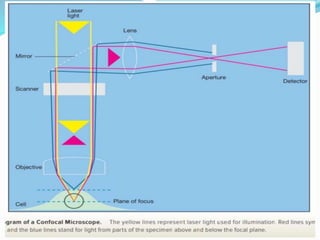
 Uses a laser beam to illuminate
 Specimen is fluorescently stained.
 Major component: an aperture (opening)
 The aperture eliminates light from parts of the specimen
that lie above and below the plane of focus
 Light from the plane of focus forms the sharper image
 Computers form very clear and detailed image
 Three -dimensional reconstruction of the specimen
Applications: Study of biofilms
Scanning Probe Microscope
 Measures surface features of an object by moving a
sharp probe over the object’s surface.
* Scanning Tunneling Microscope
* Atomic Force Microscope
Scanning Tunneling Microscope
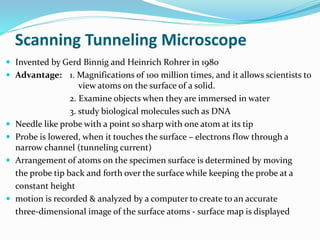
 Invented by Gerd Binnig and Heinrich Rohrer in 1980
 Advantage: 1. Magnifications of 100 million times, and it allows scientists to
view atoms on the surface of a solid.
2. Examine objects when they are immersed in water
3. study biological molecules such as DNA
 Needle like probe with a point so sharp with one atom at its tip
 Probe is lowered, when it touches the surface – electrons flow through a
narrow channel (tunneling current)
 Arrangement of atoms on the specimen surface is determined by moving
the probe tip back and forth over the surface while keeping the probe at a
constant height
 motion is recorded & analyzed by a computer to create to an accurate
three-dimensional image of the surface atoms - surface map is displayed
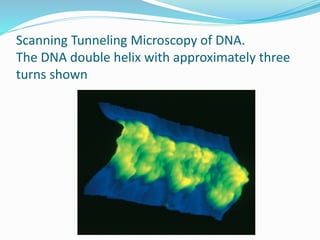
Scanning Tunneling Microscopy of DNA.
The DNA double helix with approximately three
turns shown
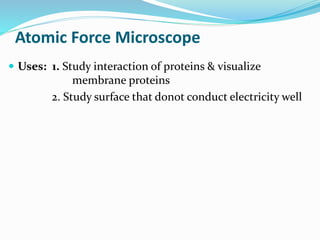
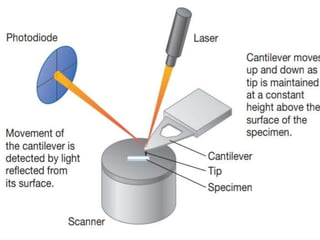
 Uses: 1. Study interaction of proteins & visualize
membrane proteins
2. Study surface that donot conduct electricity well
Atomic Force Microscope
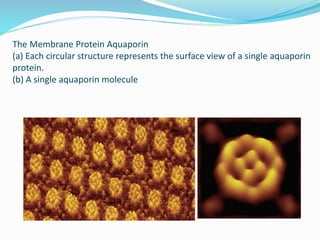
The Membrane Protein Aquaporin
(a) Each circular structure represents the surface view of a single aquaporin
protein.
(b) A single aquaporin molecule
References:
 Prescott’s Microbiology 10th Edition
 Bailey & Scott’s Diagnostic Microbiology 14th Edition
 Connie Mahon’s Textbook Of Diagnostic Microbiology
5th Edition
 Murray’s Microbiology 7th Edition
 Monica Cheesbrough’s District Laboratory Practice In
Tropical Countries 2nd Edition
 Apurba Sankar Sastry’s Essentials Of Medical
Microbiology 2nd Edition
Thank you...

Microscope

  • 2.
    Synopsis  Fluorescence Microscopy Electron Microscopy • Transmission Electron Microscope • Scanning Electron Microscope  Newer Modifications in Microscopy • Confocal Microscopy • Scanning Probe Microscopy * Scanning Tunneling Microscope * Atomic Force Microscope
  • 7.
     It isan optical microscope that uses fluorescing property  Fluorochromes / Fluorophores: Are dyes that absorb light of shorter wavelength (UV light / excitation light / invisible light) & raised to higher energy level  When they return to normal ( low energy state), Release energy in the form of visible light ( fluorescent light)  Organisms stained with these fluorescent dyes glow (fluoresce ) against a dark background  This effect depends on its excitation short wave radiation & PH of the medium Working Principle:
  • 8.
     Developed byHaitinger and Coons  Difference from ordinary microscope  Light source  Dark Field Immersion condenser ( non fluorescing immersion oil)  Three sets of Filter (block the heat & eliminate IR light, interference filter, eliminate UV light )  Specimen : coated with fluorochromes
  • 9.
    Incident (Reflected) LightFluorescence * Epifluorescence * Illuminating the specimen from above Transmitted Light Fluorescence * Illuminating the specimen from below Types:
  • 21.
     No condenseris needed  Colour depends on the fluorochrome selected and the light filter used.  Selection of dye depends on the organism suspected  Acridine orange Blue excitation light  Auramine – Rhodamine excitation filter 450–490 nm  Fluorescein isothiocyanate(FITC) barrier filter 515 nm  Calcoflour white – Violet excitation light excitation filter 355–425 nm barrier filter 460 nm
  • 26.
    Applications:  Autofluorescence  StainingTechniques * Fluorochroming * Immunofluorescence  Fluorescent In situ Hybridisation ( FISH)  Studies in bacterial cell division  Ecological studies
  • 27.
    Autofluorescence  Directly fluorescewhen placed under UV lamp.  Eg:Cyclospora cayetanensis  Ultraviolet fluorescence microscopy: Examination of stool specimens for Cyclospora oocysts. The oocyst wall is autofluorescent
  • 28.
    Staining Techniques  Fluorochromingonly: Fluorescent dye alone used  Immunofluorescence: Fluorescent dye linked to specific antibody (conjugate)
  • 29.
    Fluorochroming  Direct chemicalinteraction between fluorochrome dye and bacterial cell  Enchance the contrast & amplifies 10 fold greater than light microscope  Eg: minimum concentration of 10⁵ microorganisms/ml is required to visualise by light microscopy  In fluorescence microscopy the requirement is decreased to 10⁴ microorganisms/ml  Stains: Auramine – Rhodamine Acridine Orange Calcoflour white
  • 30.
    Auramine – RhodamineStain  Binds with Waxy mycolic acid in cell wall of mycobacteria  For examining sputum & CSF  Acid fast stain - Stains orange or yellow in green background  Advantage: More sensitive than carbol fuschin stains  18% culture positive case show smear positive in AR stain but negative in Ziehl Neelson / Kinyoun method  Limitation: Non specifically bind to all acid fast organisms Eg: Nocardia, Legionella, Rhodococcus  Rapidly growing mycobacteria may not stain at all with fluorochromes - stain with carbol fuschin and weaker decolouriser
  • 31.
  • 32.
    Acridine Orange Stain Nonspecifically Binds to nucleic acid of cell wall and fluoresce as bright orange  stains bacteria, fungi and all cellular materials  In neutral PH – reddish orange  In acidic PH – remains reddish orange but background material stains greenish yellow  Stains both gram positive gram negative; living and dead cells  Uses: to confirm the presence of bacteria in blood culture when gram stain is difficult to interpret  Detect cell wall deficient bacteria Eg: mycoplasma  Limited in application
  • 33.
    Acridine orange fluorochromingdemonstrates the cell wall–deficient organisms (mycoplasma)
  • 34.
    All bacteria stainthe same with the nonspecific acridine orange dye
  • 35.
    Calcoflour white Stain Bind to cellulose and chitin in cell wall  Colourless dye - fluoresce on exposure  Uses: when morphology is ambigous and nonspecific stain gives confusing results  Replaced KOH: mix the dye with KOH – enhances visualisation of fungi in skin, nails, hair –dermatophytes  Detect fungi, Yeast cell, Pseudohyphae, hyphae display bright apple green / blue white fluorescence
  • 36.
    Cysts of P.jiroveci stained with calcofluor white
  • 37.
    Calcofluor white fluorescentstain of Candida albicans
  • 39.
    Immunofluorescence  Fluorescent dyetagged with Ig to detect Ag / Ab  Combines amplified contrast by fluorescence and specificity of antigen antibody binding  Identify slow growing organisms eg: Legionella, Bordetella pertusis, Chlamydia trachomatis
  • 40.
    Immunofluorescence stains ofLegionella spp. (A) Bordetella pertussis (B) used for identification.
  • 41.
    Fluorescence antibody test  A,Direct fluorescent antibody (DFA). The antigen-specific–labeled antibody is applied to the fixed specimen, incubated, washed, and visualized with a fluorescent microscope.  B, Indirect fluorescent antibody (IFA). A second fluorochrome-labeled antibody specific for the first unlabeled antibody is applied.
  • 42.
    Direct Fluorescent AntibodyTest  Detect agent inside the infected cells  Legionella, Giardia, Cryptosporidium, Pneumocystis jirovecii, HSV, CMV, VZV, RSV
  • 43.
    DFA test forGiardia lamblia (three larger apple-green, oval cells) & Cryptosporidium spp. (smaller cells) in stool.
  • 44.
    Indirect Fluorescent AntibodyTest  Two –step (sandwich) technique.  More sensitive than the DFA method,  DFA method is faster(single incubation).  Widely applied method of detecting diverse antibodies.  Legionella spp., Borrelia burgdorferi, T. gondii, VZV, CMV, EBV capsid antigen, HSV types 1 and 2, rubella virus, Mycoplasma pneumoniae, T. pallidum (the fluorescent treponemal antibody absorption test [FTA-ABS])
  • 45.
    IFA tests forToxoplasma gondii, IgG antibodies
  • 46.
    Fluorescent Insitu Hybridisation( FISH)  Uses fluorescent probes to bind to the part of chromosome  Uses: Detect Chromosomal anomalies (13, 18, 21, X, and Y) prenatal diagnosis of trisomies with the use of amniotic fluid or chorionic villi testing  DNA probe, RNA probe, Synthetic Peptide Nucleic Acid probe (PNA)  Sensitivity 90% specificity 100% when compared to culture
  • 48.
    To a dropfrom the positive blood culture broth, appropriate fluorescent-labeled PNA probe is added. The PNA hybridizes to the ribosomal RNA (rRNA)  (A) Staphylococcus aureus (B) Blood cultures negative for S. aureus
  • 49.
    Candida albicans Bloodcultures negative for C. albicans
  • 50.
    Studies in bacterialcell division  Localize specific protein in the cell  Jelly fish(Aequorea) gene encodes a protein that naturally fluoresce when exposed to light ( Green Fluorescent Protein GFP )  The Mbl protein (cytoskeletal protein of Bacillus subtilis.) has been fused with green fluorescent protein and therefore fluoresces green.
  • 51.
    Ecological studies:  Usedto observe microorganisms stained with: * fluorochrome labelled probes * fluorochromes – acridine orange DAPI ( diamidino-2-phenylindole) ( DNA specific stain )  Will fluoresce orange / green - detected even in midst of particulate material  Visualise photosynthetic microbes as their pigments naturally fluoresce when excited by light
  • 52.
    Limitations  High cost Technical complexity  Not rapid (1 – 4 hrs)  Need Fluorescent microscope / dark room  Fluorescent dye fades  Not easy for automation
  • 53.
    Disadvantage  Photobleaching: Fading.Permanent loss of fluorescence due to chemical damage to flurochrome  Quenching: transfer of light energy to nearby molecules ( free radicals, salt, heavy metal, halogen) • rectified by: * adding chemical scavengers to mounting fluid * storing fluorescent slides in dark container & refrigerated at 2-8°C * Digital Photgraphy - permanent record
  • 54.
    • To astandard microscope fluoreslenS objective is attached (dichroic mirror, exciter filter, barrier filter)  Fibre optic light source supplied by halogen lamp
  • 56.
     Invented byGerman Physicist Ernst Ruska in 1931  Source of illumination : Accelerated Electrons  Wavelength of electrons 100,000 shorter than visible light photons  Better resolving power than light microscope  Reveals flagella, fimbriae, intracellular structures of a cell  Powerful research tool, to study new morphological features
  • 57.
    Feature Light MicroscopeElectron Microscope Highest Practical Magnification About 1000 – 1500 Over 1,00,000 Best Resolution 0.2 µm 0.5 nm Radiation Source Visible Light Electron Beam Medium of Travel Air High Vaccum Type of Lens Glass Electromagnet Source of Contrast Differential Light Absorption Scattering of electrons Specimen Mount Glass slide Metal Grid (copper)
  • 59.
    Types  Transmission ElectronMicroscope: uses magnetic lenses to form an image from electrons that have passed through a thin section of specimen.  Scanning Electron Microscope: form an image from electrons on an object’s surface. used to examine the surfaces of microorganisms
  • 63.
    Specimen Preparation  Extremelythin slices (20 to 100 nm) of a specimen (denser region scatter more electrons – few strike the screen – appear dark)  Fixation: chemicals such as glutaraldehyde and osmium tetroxide to stabilize cell structure  Dehydration: dehydrated with organic solvents (e.g., acetone or ethanol)  Embedding: Embedded in plastic polymer - hardened to form a solid block. Complete dehydration is essential (most plastics used for embedding are not water soluble)  Slicing: Thin sections are cut with ultramicrotome ( glass or diamond knife)
  • 64.
    To increase contrastof specimen  Staining: stained by treatment with solutions of heavy metal salts such as osmium tetroxide, lead citrate and uranyl acetate ( bind to cell structure – make more electron opaque)  Negative Staining: specimen is spread out in a thin film with either phosphotungstic acid or uranyl acetate.  Heavy metals do not penetrate the specimen ( background – dark; specimen appears bright)  Uses: Study the structure of virus particles, bacterial gas vacuoles
  • 65.
     Shadowing: specimenis coated with a thin film of platinum / heavy metal by evaporation at an angle of about 45° from horizontal so that the metal strikes the microorganism on only one side.  Area coated with metal appears dark in photographs  The uncoated side and the shadow region created by the object are light.  Uses: studying virus particle morphology, bacterial flagella, and DNA.
  • 66.
    (a) Negative stain- T4 is a virus that infects Escherichia coli. (b) Shadowing - Pseudomonas fluorescens with its polar flagella.
  • 67.
    Freeze-Etching  Cells arerapidly frozen in liquid nitrogen & warmed to -100°C in vaccum - become very brittle and can be broken along lines of greatest weakness, usually down the middle of internal membranes (knife precooled with lq.N2 -196°C)  Sublimation: Left in high vaccum for a minute; ice can sublimate.  Exposed surfaces are shadowed & coated with layers of platinum and carbon to form a replica of the surface.  Remove it chemically - studied in the TEM studying intracellular structures  Advantage: minimizes the danger of artefacts because the cells are frozen quickly
  • 69.
    A freeze-etched preparationof the bacterium Nitrospira sp.
  • 70.
    Applications  researchers viewsamples on a molecular level, to analyze structure and texture.  study of crystals and metals Advantages  Most powerful magnification, over one million times  Wide-range of applications - scientific, educational and industrial fields  Images are high-quality and detailed  Able to yield information of surface features, shape, size and structure Disadvantages:  large and very expensive  Laborious sample preparation  Potential artefacts from sample preparation  Operation and analysis requires special training  Samples should be electron transparent, able to tolerate the vacuum chamber and small enough to fit in the chamber  Require special housing and maintenance  Images are black and white
  • 72.
    Scanning Electron Microscope Uses: study external surface features of microorganisms  Specimen preparation: specimen is fixed, dehydrated, and dried  Dried samples are mounted and coated with a thin layer of metal to prevent the build up of an electrical charge on the surface.  Air-dried material can be examined directly  SEM scans a narrow, tapered electron beam back & forth over the specimen
  • 76.
    Transmission electron micrographshowing Escherichia coli cells internalized by a human mast cell (arrows). B, Scanning electron micrograph of E. coli interacting with the surface of a human mast cell (arrows)
  • 77.
    Advantages:  Magnifies objectmore than 500000 times  To investigate greater field of depth  Requires minimal sample preparation action  Generation of data in digital form Disadvantages:  Very large, requires expertise to operate  Expensive  Preparation may distort the material  Images are in black and white  Examination Limited to solid samples
  • 79.
    Modifications in Microscope Confocal Microscope  Scanning Probe Microscope * Scanning Tunneling Microscope * Atomic Force Microscope
  • 80.
    Confocal Microscope  ConfocalScanning Laser Microscope (CSLM)  Uses to study thick and complex specimen  Uses a laser beam to illuminate  Specimen is fluorescently stained.  Major component: an aperture (opening)  The aperture eliminates light from parts of the specimen that lie above and below the plane of focus  Light from the plane of focus forms the sharper image  Computers form very clear and detailed image  Three -dimensional reconstruction of the specimen
  • 82.
  • 83.
    Scanning Probe Microscope Measures surface features of an object by moving a sharp probe over the object’s surface. * Scanning Tunneling Microscope * Atomic Force Microscope
  • 84.
    Scanning Tunneling Microscope Invented by Gerd Binnig and Heinrich Rohrer in 1980  Advantage: 1. Magnifications of 100 million times, and it allows scientists to view atoms on the surface of a solid. 2. Examine objects when they are immersed in water 3. study biological molecules such as DNA  Needle like probe with a point so sharp with one atom at its tip  Probe is lowered, when it touches the surface – electrons flow through a narrow channel (tunneling current)  Arrangement of atoms on the specimen surface is determined by moving the probe tip back and forth over the surface while keeping the probe at a constant height  motion is recorded & analyzed by a computer to create to an accurate three-dimensional image of the surface atoms - surface map is displayed
  • 85.
    Scanning Tunneling Microscopyof DNA. The DNA double helix with approximately three turns shown
  • 86.
     Uses: 1.Study interaction of proteins & visualize membrane proteins 2. Study surface that donot conduct electricity well Atomic Force Microscope
  • 88.
    The Membrane ProteinAquaporin (a) Each circular structure represents the surface view of a single aquaporin protein. (b) A single aquaporin molecule
  • 89.
    References:  Prescott’s Microbiology10th Edition  Bailey & Scott’s Diagnostic Microbiology 14th Edition  Connie Mahon’s Textbook Of Diagnostic Microbiology 5th Edition  Murray’s Microbiology 7th Edition  Monica Cheesbrough’s District Laboratory Practice In Tropical Countries 2nd Edition  Apurba Sankar Sastry’s Essentials Of Medical Microbiology 2nd Edition
  • 90.