Professor Emsley 
Spring 2014
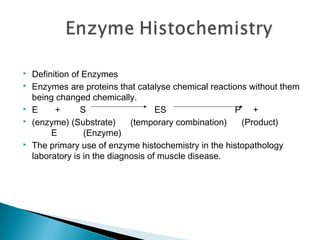
 Definition of Enzymes 
 Enzymes are proteins that catalyse chemical reactions without them 
being changed chemically. 
 E + S ES P + 
 (enzyme) (Substrate) (temporary combination) (Product) 
E (Enzyme) 
 The primary use of enzyme histochemistry in the histopathology 
laboratory is in the diagnosis of muscle disease.
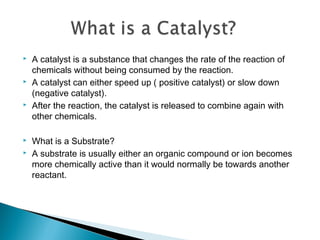
 A catalyst is a substance that changes the rate of the reaction of 
chemicals without being consumed by the reaction. 
 A catalyst can either speed up ( positive catalyst) or slow down 
(negative catalyst). 
 After the reaction, the catalyst is released to combine again with 
other chemicals. 
 What is a Substrate? 
 A substrate is usually either an organic compound or ion becomes 
more chemically active than it would normally be towards another 
reactant.
 Enzymes are usually very specific to their substrates.
1. Enzymes are removed or destroyed by fixation, while others are sensitive 
to freezing and thawing, so compromises have to be made. 
2. Non-optimal substrate: sometimes optimal substrate concentration can’t 
be obtained because of poor substrate solubility. 
3. Non-optimal temperature: there is an optimal temperature for enzyme 
activity, and sometimes, especially in azo dye simultaneous couple 
techniques, a different temperature must be used. Enzyme activity is 
usually destroyed at temperatures. greater than 56°C . 
4. Non-optimal pH: most enzymes are best demonstrated at a pH near 7.0 , 
however, there are exceptions, as with acid and alkaline phosphatases. 
5. Inhibitors: an excess of diazonium salts in the substrate, fixatives, heat 
and some metallic ion may decrease or completely abolish enzyme activity.
 Enzymes are specific as to the type of reaction they catalyze. 
 With the exception of ( trypsin and pepsin) enzymes are usually named by 
adding “ase” to the specific substrate or molecule on which the enzyme acts. 
 There are 6 basic reaction classifications. 
 (a) Oxidoreductases, (b) transferases, (c) hydrolases, (d) lyases, (e) 
isomerases, and (f) ligases. 
 Lyases add chemical groups to double bonds, isomerases rearranges 
chemical groups on a substrate, ligases combine 2 substrates. These 
enzymes are used in other reactions in the body, but are not enzymes for 
which we stain in muscle system. The important enzymes in histopathology 
and hematopathology are (A) Oxidoreductases, (B) hydrolases, and (C) 
transferases.
 A. Oxidoreductases: include I Oxidases:- use molecular oxygen 
as the hydrogen acceptor with water forming. 
 II Peroxidases:- catalyze the oxidation of substrates by hydrogen 
peroxide. 
 III Dehydrogenases:- remove hydrogen atoms ( a proton and 
electron) from an organic substrate. 
 4H+ + 4e- + O2 2H2O
 Hydrolases:- act on various substrates, usually through the addition of 
water however, in some instances, water may be removed. 
 I. Esterases: - catalyze the hydrolyses of ester linkages; break the bond 
between carboxylic acid and alcohol , phenols and napthols. 
 II. Phosphatases:- hydrolyze esters of phosphoric acid 
 III. Peptidases:- attack peptide bonds
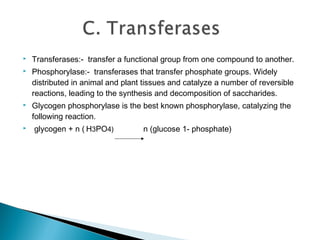
 Transferases:- transfer a functional group from one compound to another. 
 Phosphorylase:- transferases that transfer phosphate groups. Widely 
distributed in animal and plant tissues and catalyze a number of reversible 
reactions, leading to the synthesis and decomposition of saccharides. 
 Glycogen phosphorylase is the best known phosphorylase, catalyzing the 
following reaction. 
 glycogen + n ( H3PO4) n (glucose 1- phosphate)
 In Vivo, phosphorylase is a cytoplasmic enzyme functioning only n 
the degradation of glycogen. 
 In Vitro, muscle phosphorylase catalyze the synthesis and 
hydrolysis of an unbranched polysaccharide of amylose type.
1. For what purpose is enzyme immunochemistry techniques used? 
2. What are the characteristics that distinguish skeletal muscles? 
3. Can pathologic changes in muscle be seen in H&E stains? 
4. Define Catalyst 
5. Define Enzyme 
6. What is meant by positive catalyst? 
7. What is meant by negative catalyst? 
8. What are enzymes? 
9. What is a substrate? 
10. List the 5 Properties that affect enzymes 
11. Why is it necessary to fix tissue for enzyme demonstration? 
12. How are muscle biopsies fixed?
13. What is the usual way of classifying enzymes? 
14. How many basic reaction classifications are there? 
15. List the basic reaction classifications 
16. What groups are of major importance in histopathology and 
hematopathology? 
17. Define hydrolases 
18. What are the subclasses of hydrolases? 
19. Define oxidoreductases 
20. What are the subclasses of oxidoreductases? 
21. Define Transferases 
22. What is the subclass of Transferases?

Enzyme histochemistry

  • 1.
  • 2.
     Definition ofEnzymes  Enzymes are proteins that catalyse chemical reactions without them being changed chemically.  E + S ES P +  (enzyme) (Substrate) (temporary combination) (Product) E (Enzyme)  The primary use of enzyme histochemistry in the histopathology laboratory is in the diagnosis of muscle disease.
  • 3.
     A catalystis a substance that changes the rate of the reaction of chemicals without being consumed by the reaction.  A catalyst can either speed up ( positive catalyst) or slow down (negative catalyst).  After the reaction, the catalyst is released to combine again with other chemicals.  What is a Substrate?  A substrate is usually either an organic compound or ion becomes more chemically active than it would normally be towards another reactant.
  • 4.
     Enzymes areusually very specific to their substrates.
  • 5.
    1. Enzymes areremoved or destroyed by fixation, while others are sensitive to freezing and thawing, so compromises have to be made. 2. Non-optimal substrate: sometimes optimal substrate concentration can’t be obtained because of poor substrate solubility. 3. Non-optimal temperature: there is an optimal temperature for enzyme activity, and sometimes, especially in azo dye simultaneous couple techniques, a different temperature must be used. Enzyme activity is usually destroyed at temperatures. greater than 56°C . 4. Non-optimal pH: most enzymes are best demonstrated at a pH near 7.0 , however, there are exceptions, as with acid and alkaline phosphatases. 5. Inhibitors: an excess of diazonium salts in the substrate, fixatives, heat and some metallic ion may decrease or completely abolish enzyme activity.
  • 6.
     Enzymes arespecific as to the type of reaction they catalyze.  With the exception of ( trypsin and pepsin) enzymes are usually named by adding “ase” to the specific substrate or molecule on which the enzyme acts.  There are 6 basic reaction classifications.  (a) Oxidoreductases, (b) transferases, (c) hydrolases, (d) lyases, (e) isomerases, and (f) ligases.  Lyases add chemical groups to double bonds, isomerases rearranges chemical groups on a substrate, ligases combine 2 substrates. These enzymes are used in other reactions in the body, but are not enzymes for which we stain in muscle system. The important enzymes in histopathology and hematopathology are (A) Oxidoreductases, (B) hydrolases, and (C) transferases.
  • 7.
     A. Oxidoreductases:include I Oxidases:- use molecular oxygen as the hydrogen acceptor with water forming.  II Peroxidases:- catalyze the oxidation of substrates by hydrogen peroxide.  III Dehydrogenases:- remove hydrogen atoms ( a proton and electron) from an organic substrate.  4H+ + 4e- + O2 2H2O
  • 8.
     Hydrolases:- acton various substrates, usually through the addition of water however, in some instances, water may be removed.  I. Esterases: - catalyze the hydrolyses of ester linkages; break the bond between carboxylic acid and alcohol , phenols and napthols.  II. Phosphatases:- hydrolyze esters of phosphoric acid  III. Peptidases:- attack peptide bonds
  • 9.
     Transferases:- transfera functional group from one compound to another.  Phosphorylase:- transferases that transfer phosphate groups. Widely distributed in animal and plant tissues and catalyze a number of reversible reactions, leading to the synthesis and decomposition of saccharides.  Glycogen phosphorylase is the best known phosphorylase, catalyzing the following reaction.  glycogen + n ( H3PO4) n (glucose 1- phosphate)
  • 10.
     In Vivo,phosphorylase is a cytoplasmic enzyme functioning only n the degradation of glycogen.  In Vitro, muscle phosphorylase catalyze the synthesis and hydrolysis of an unbranched polysaccharide of amylose type.
  • 11.
    1. For whatpurpose is enzyme immunochemistry techniques used? 2. What are the characteristics that distinguish skeletal muscles? 3. Can pathologic changes in muscle be seen in H&E stains? 4. Define Catalyst 5. Define Enzyme 6. What is meant by positive catalyst? 7. What is meant by negative catalyst? 8. What are enzymes? 9. What is a substrate? 10. List the 5 Properties that affect enzymes 11. Why is it necessary to fix tissue for enzyme demonstration? 12. How are muscle biopsies fixed?
  • 12.
    13. What isthe usual way of classifying enzymes? 14. How many basic reaction classifications are there? 15. List the basic reaction classifications 16. What groups are of major importance in histopathology and hematopathology? 17. Define hydrolases 18. What are the subclasses of hydrolases? 19. Define oxidoreductases 20. What are the subclasses of oxidoreductases? 21. Define Transferases 22. What is the subclass of Transferases?