Department of Natural Sciences
   University of St. La Salle
MICROSCOPIC ANATOMY
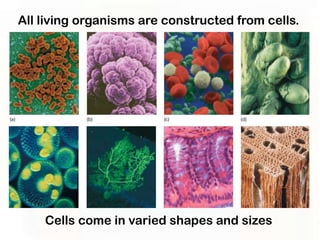
All living organisms are constructed from cells.


    Cells come in varied shapes and sizes
MICROSCOPY
 Interaction of probe used (photons: light,
  phase contrast, polarizing & fluorescence
  microscopy; electron beams: EM), and tissue
  components produce image
 Considerations in microscopic analysis:
   that the probe being utilized must not be
     larger than the detail to be seen
   that the probe and object being
     investigated must interact
   it must be possible to observe and
     interpret this interaction
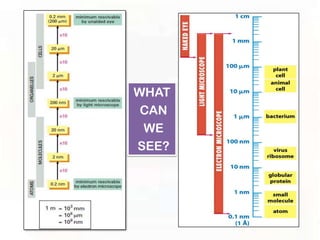
 Units for measuring microscopic dimensions:
WHAT
 CAN
 WE
SEE?
IMPORTANT TERMS IN MICROSCOPY
 Magnification – increases the apparent size
  of the specimen; a property of both ocular
  & objective lenses
 Working distance is the distance between
  the specimen and the magnifying lens.
 Depth of field is a measure of the amount
  of a specimen that can be in focus. Highly
  sensitive video cameras enhance power of
  microscopes, and create digitized images
  that can be fed into computers for
  quantitative image analysis
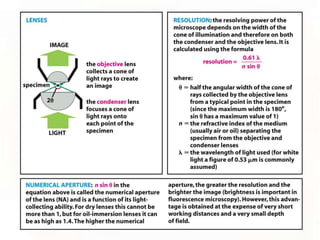
• Numerical aperture – a measure of the size or
  angle of the cone of light delivered by the
  illuminating condenser lens to the object
  plane and of the cone of light emerging from
  the object.
• Resolving power – a measure of linear
  distance of the smallest degree of separation
  at which 2 details can still be distinguished
  from each other; dependent on quality of
  objective lens; R also varies according to the
  refractive index at the interface of the media
  used
• Generally resolution increases with
  magnification, although there comes a point
  of diminishing returns where magnification is
PREPARATION OF TISSUES FOR MICROSCOPIC
    EXAMINATION (MICROTECHNIQUE)
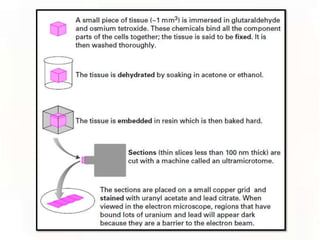
1.Fixation - prompt treatment of tissues in
  fixatives for about 12 hrs. (depending on
  tissue size) prevent autolysis by enzymes or
  bacteria, and preserve their morphologic
  and molecular composition.
• To render the structural components
  insoluble, chemicals that precipitate the
  proteins are used.
• The best fixatives are those that produce
  fine precipitates, e.g. buffered isotonic
  solution of 4% formaldehyde and
  glutaraldehyde react with amine groups
  (NH2) of proteins, or cross-link with protein
 Gross distortions without basis in the
  structure of the living cell are termed
  fixation artifacts.
 Examples of artifacts:
    • swelling and shrinkage of tissue
      components due to poor fixation,
      dehydration and/or embedding
      techniques;
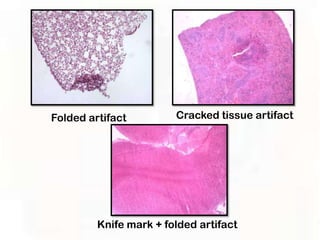
    • wrinkles, tears, air bubbles due to poor
      sectioning technique;
    • dust and stain precipitate in section
      resulting from use of old stain solutions,
      use of improperly filtered or unfiltered
      stain solutions, mistakes made during
      preparation of the stain, or poor
Folded artifact         Cracked tissue artifact


         Knife mark + folded artifact
2.Dehydration and Clearing
    Bathing of tissue in graded
     concentrations of organic solvents (70-
     100% ethanol) to replace tissue water
     within 6-24 hrs.
    Ethanol is then replaced with solvent
     miscible in embedding medium (xylene,
     benzene, toluene)
    WHY? Most fixatives are water soluble,
     most embedding media are non-polar and
     are not miscible with water.
    Dehydration moves the tissue from a polar
     (water-based) medium to a non-polar
     medium (e.g. toluene) that is miscible with
     the embedding medium.
3.Embedding in melted paraffin at 58-600C, or
  plastic resin at room temperature
    Tissue will be sectioned, and needs to be
     durable enough to withstand the
     sectioning process.
    Embedding in wax or plastic immobilizes
     structural components of tissue. Holds
     them in place as sectioning is done.
    Embedding medium must penetrate all
     cellular/intercellular spaces to impart
    rigid consistency to tissue before
    sectioning
   Tissue shrinkage and artifacts may result
    from heat needed for paraffin embedding;
    virtually absent in resin embedding
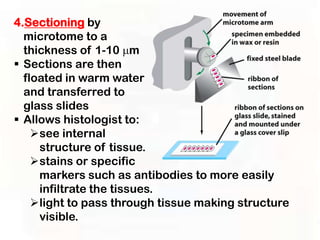
4.Sectioning by
  microtome to a
  thickness of 1-10 m
 Sections are then
  floated in warm water
  and transferred to
  glass slides
 Allows histologist to:
    see internal
     structure of tissue.
    stains or specific
     markers such as antibodies to more easily
     infiltrate the tissues.
    light to pass through tissue making structure
     visible.
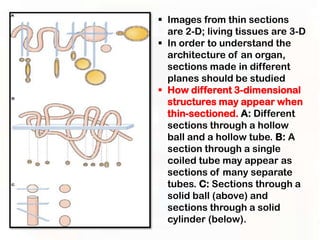
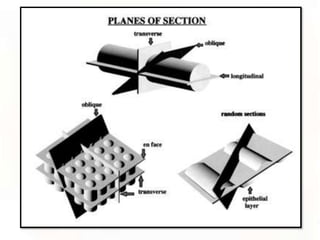
 Images from thin sections
  are 2-D; living tissues are 3-D
 In order to understand the
  architecture of an organ,
  sections made in different
  planes should be studied
 How different 3-dimensional
  structures may appear when
  thin-sectioned. A: Different
  sections through a hollow
  ball and a hollow tube. B: A
  section through a single
  coiled tube may appear as
  sections of many separate
  tubes. C: Sections through a
  solid ball (above) and
  sections through a solid
  cylinder (below).
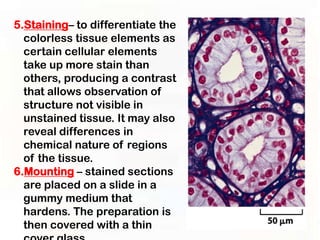
5.Staining– to differentiate the
  colorless tissue elements as
  certain cellular elements
  take up more stain than
  others, producing a contrast
  that allows observation of
  structure not visible in
  unstained tissue. It may also
  reveal differences in
  chemical nature of regions
  of the tissue.
6.Mounting – stained sections
  are placed on a slide in a
  gummy medium that
  hardens. The preparation is
  then covered with a thin
TYPES OF
    MICROSCOPES
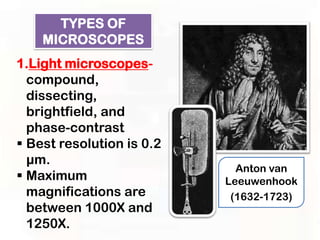
1.Light microscopes-
  compound,
  dissecting,
  brightfield, and
  phase-contrast
 Best resolution is 0.2
  µm.
                             Anton van
 Maximum                  Leeuwenhook
  magnifications are        (1632-1723)
  between 1000X and
  1250X.
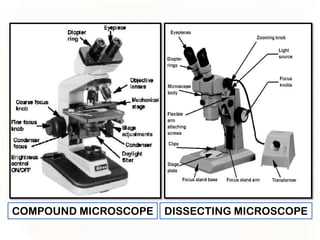
COMPOUND MICROSCOPE   DISSECTING MICROSCOPE
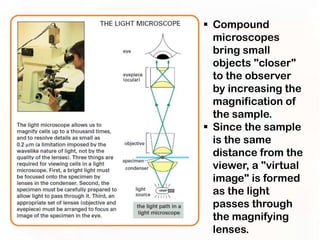
 Compound
  microscopes
  bring small
  objects "closer"
  to the observer
  by increasing the
  magnification of
  the sample.
 Since the sample
  is the same
  distance from the
  viewer, a "virtual
  image" is formed
  as the light
  passes through
  the magnifying
  lenses.
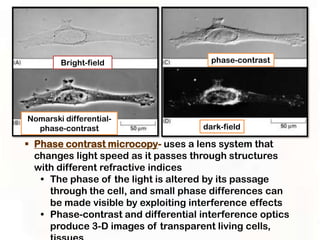
Bright-field                   phase-contrast


Nomarski differential-
  phase-contrast                     dark-field

 Phase contrast microcopy- uses a lens system that
  changes light speed as it passes through structures
  with different refractive indices
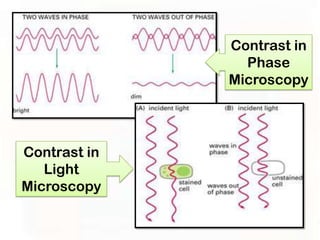
   • The phase of the light is altered by its passage
     through the cell, and small phase differences can
     be made visible by exploiting interference effects
   • Phase-contrast and differential interference optics
     produce 3-D images of transparent living cells,
Contrast in
                Phase
              Microscopy


Contrast in
   Light
Microscopy
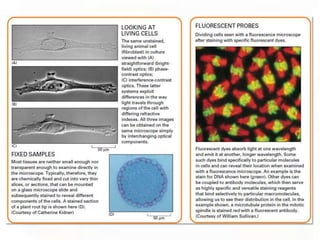
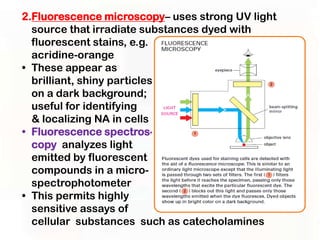
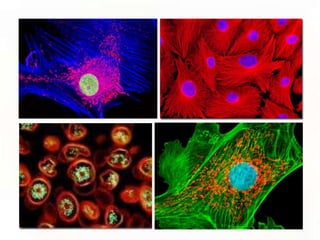
2.Fluorescence microscopy– uses strong UV light
  source that irradiate substances dyed with
  fluorescent stains, e.g.
  acridine-orange
• These appear as
  brilliant, shiny particles
  on a dark background;
  useful for identifying
  & localizing NA in cells
• Fluorescence spectros-
  copy analyzes light
  emitted by fluorescent
  compounds in a micro-
  spectrophotometer
• This permits highly
  sensitive assays of
  cellular substances such as catecholamines
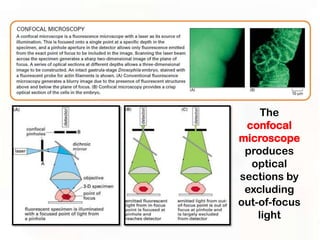
The
 confocal
microscope
 produces
  optical
sections by
 excluding
out-of-focus
    light
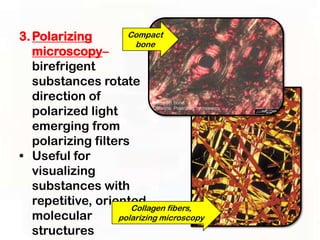
3. Polarizing        Compact
                       bone
   microscopy–
   birefrigent
   substances rotate
   direction of
   polarized light
   emerging from
   polarizing filters
• Useful for
   visualizing
   substances with
   repetitive, oriented
                      Collagen fibers,
   molecular       polarizing microscopy
   structures
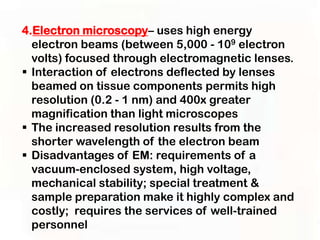
4.Electron microscopy– uses high energy
  electron beams (between 5,000 - 109 electron
  volts) focused through electromagnetic lenses.
 Interaction of electrons deflected by lenses
  beamed on tissue components permits high
  resolution (0.2 - 1 nm) and 400x greater
  magnification than light microscopes
 The increased resolution results from the
  shorter wavelength of the electron beam
 Disadvantages of EM: requirements of a
  vacuum-enclosed system, high voltage,
  mechanical stability; special treatment &
  sample preparation make it highly complex and
  costly; requires the services of well-trained
  personnel
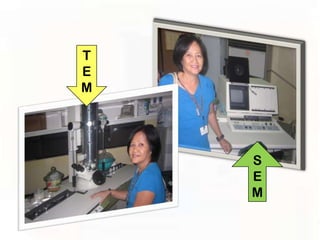
T
E
M


    S
    E
    M
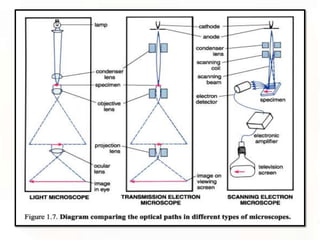
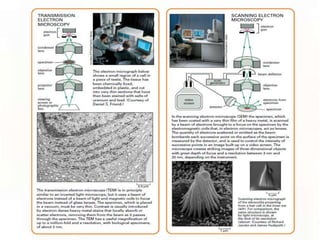
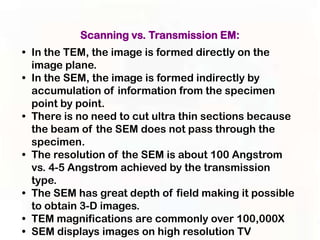
Scanning vs. Transmission EM:
• In the TEM, the image is formed directly on the
  image plane.
• In the SEM, the image is formed indirectly by
  accumulation of information from the specimen
  point by point.
• There is no need to cut ultra thin sections because
  the beam of the SEM does not pass through the
  specimen.
• The resolution of the SEM is about 100 Angstrom
  vs. 4-5 Angstrom achieved by the transmission
  type.
• The SEM has great depth of field making it possible
  to obtain 3-D images.
• TEM magnifications are commonly over 100,000X
• SEM displays images on high resolution TV
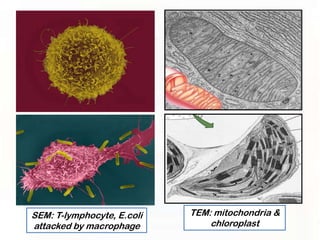
SEM: T-lymphocyte, E.coli   TEM: mitochondria &
attacked by macrophage          chloroplast
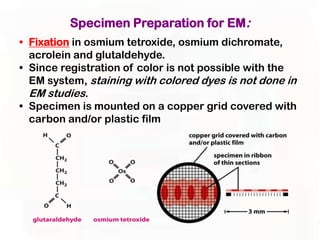
Specimen Preparation for EM:
• Fixation in osmium tetroxide, osmium dichromate,
  acrolein and glutaldehyde.
• Since registration of color is not possible with the
  EM system, staining with colored dyes is not done in
  EM studies.
• Specimen is mounted on a copper grid covered with
  carbon and/or plastic film
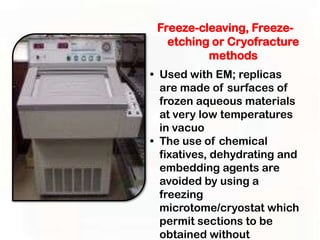
Freeze-cleaving, Freeze-
   etching or Cryofracture
          methods
• Used with EM; replicas
  are made of surfaces of
  frozen aqueous materials
  at very low temperatures
  in vacuo
• The use of chemical
  fixatives, dehydrating and
  embedding agents are
  avoided by using a
  freezing
  microtome/cryostat which
  permit sections to be
  obtained without
• Freezing does not
 inactivate most enzymes,
 hinders diffusion of small
 molecules, eliminates
 dissolution of tissue lipids
 by solvents
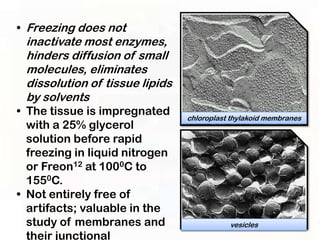
• The tissue is impregnated     chloroplast thylakoid membranes
  with a 25% glycerol
  solution before rapid
  freezing in liquid nitrogen
  or Freon12 at 1000C to
  1550C.
• Not entirely free of
  artifacts; valuable in the
  study of membranes and                   vesicles
  their junctional
QUESTIONS?

Microscopy

  • 1.
    Department of NaturalSciences University of St. La Salle
  • 2.
  • 3.
    All living organismsare constructed from cells. Cells come in varied shapes and sizes
  • 5.
    MICROSCOPY  Interaction ofprobe used (photons: light, phase contrast, polarizing & fluorescence microscopy; electron beams: EM), and tissue components produce image  Considerations in microscopic analysis: that the probe being utilized must not be larger than the detail to be seen that the probe and object being investigated must interact it must be possible to observe and interpret this interaction  Units for measuring microscopic dimensions:
  • 6.
  • 7.
    IMPORTANT TERMS INMICROSCOPY  Magnification – increases the apparent size of the specimen; a property of both ocular & objective lenses  Working distance is the distance between the specimen and the magnifying lens.  Depth of field is a measure of the amount of a specimen that can be in focus. Highly sensitive video cameras enhance power of microscopes, and create digitized images that can be fed into computers for quantitative image analysis
  • 8.
    • Numerical aperture– a measure of the size or angle of the cone of light delivered by the illuminating condenser lens to the object plane and of the cone of light emerging from the object. • Resolving power – a measure of linear distance of the smallest degree of separation at which 2 details can still be distinguished from each other; dependent on quality of objective lens; R also varies according to the refractive index at the interface of the media used • Generally resolution increases with magnification, although there comes a point of diminishing returns where magnification is
  • 10.
    PREPARATION OF TISSUESFOR MICROSCOPIC EXAMINATION (MICROTECHNIQUE) 1.Fixation - prompt treatment of tissues in fixatives for about 12 hrs. (depending on tissue size) prevent autolysis by enzymes or bacteria, and preserve their morphologic and molecular composition. • To render the structural components insoluble, chemicals that precipitate the proteins are used. • The best fixatives are those that produce fine precipitates, e.g. buffered isotonic solution of 4% formaldehyde and glutaraldehyde react with amine groups (NH2) of proteins, or cross-link with protein
  • 11.
     Gross distortionswithout basis in the structure of the living cell are termed fixation artifacts.  Examples of artifacts: • swelling and shrinkage of tissue components due to poor fixation, dehydration and/or embedding techniques; • wrinkles, tears, air bubbles due to poor sectioning technique; • dust and stain precipitate in section resulting from use of old stain solutions, use of improperly filtered or unfiltered stain solutions, mistakes made during preparation of the stain, or poor
  • 12.
    Folded artifact Cracked tissue artifact Knife mark + folded artifact
  • 13.
    2.Dehydration and Clearing  Bathing of tissue in graded concentrations of organic solvents (70- 100% ethanol) to replace tissue water within 6-24 hrs.  Ethanol is then replaced with solvent miscible in embedding medium (xylene, benzene, toluene)  WHY? Most fixatives are water soluble, most embedding media are non-polar and are not miscible with water.  Dehydration moves the tissue from a polar (water-based) medium to a non-polar medium (e.g. toluene) that is miscible with the embedding medium.
  • 14.
    3.Embedding in meltedparaffin at 58-600C, or plastic resin at room temperature  Tissue will be sectioned, and needs to be durable enough to withstand the sectioning process.  Embedding in wax or plastic immobilizes structural components of tissue. Holds them in place as sectioning is done.  Embedding medium must penetrate all cellular/intercellular spaces to impart rigid consistency to tissue before sectioning  Tissue shrinkage and artifacts may result from heat needed for paraffin embedding; virtually absent in resin embedding
  • 15.
    4.Sectioning by microtome to a thickness of 1-10 m  Sections are then floated in warm water and transferred to glass slides  Allows histologist to: see internal structure of tissue. stains or specific markers such as antibodies to more easily infiltrate the tissues. light to pass through tissue making structure visible.
  • 16.
     Images fromthin sections are 2-D; living tissues are 3-D  In order to understand the architecture of an organ, sections made in different planes should be studied  How different 3-dimensional structures may appear when thin-sectioned. A: Different sections through a hollow ball and a hollow tube. B: A section through a single coiled tube may appear as sections of many separate tubes. C: Sections through a solid ball (above) and sections through a solid cylinder (below).
  • 18.
    5.Staining– to differentiatethe colorless tissue elements as certain cellular elements take up more stain than others, producing a contrast that allows observation of structure not visible in unstained tissue. It may also reveal differences in chemical nature of regions of the tissue. 6.Mounting – stained sections are placed on a slide in a gummy medium that hardens. The preparation is then covered with a thin
  • 19.
    TYPES OF MICROSCOPES 1.Light microscopes- compound, dissecting, brightfield, and phase-contrast  Best resolution is 0.2 µm. Anton van  Maximum Leeuwenhook magnifications are (1632-1723) between 1000X and 1250X.
  • 20.
    COMPOUND MICROSCOPE DISSECTING MICROSCOPE
  • 21.
     Compound microscopes bring small objects "closer" to the observer by increasing the magnification of the sample.  Since the sample is the same distance from the viewer, a "virtual image" is formed as the light passes through the magnifying lenses.
  • 23.
    Bright-field phase-contrast Nomarski differential- phase-contrast dark-field  Phase contrast microcopy- uses a lens system that changes light speed as it passes through structures with different refractive indices • The phase of the light is altered by its passage through the cell, and small phase differences can be made visible by exploiting interference effects • Phase-contrast and differential interference optics produce 3-D images of transparent living cells,
  • 24.
    Contrast in Phase Microscopy Contrast in Light Microscopy
  • 25.
    2.Fluorescence microscopy– usesstrong UV light source that irradiate substances dyed with fluorescent stains, e.g. acridine-orange • These appear as brilliant, shiny particles on a dark background; useful for identifying & localizing NA in cells • Fluorescence spectros- copy analyzes light emitted by fluorescent compounds in a micro- spectrophotometer • This permits highly sensitive assays of cellular substances such as catecholamines
  • 27.
    The confocal microscope produces optical sections by excluding out-of-focus light
  • 28.
    3. Polarizing Compact bone microscopy– birefrigent substances rotate direction of polarized light emerging from polarizing filters • Useful for visualizing substances with repetitive, oriented Collagen fibers, molecular polarizing microscopy structures
  • 29.
    4.Electron microscopy– useshigh energy electron beams (between 5,000 - 109 electron volts) focused through electromagnetic lenses.  Interaction of electrons deflected by lenses beamed on tissue components permits high resolution (0.2 - 1 nm) and 400x greater magnification than light microscopes  The increased resolution results from the shorter wavelength of the electron beam  Disadvantages of EM: requirements of a vacuum-enclosed system, high voltage, mechanical stability; special treatment & sample preparation make it highly complex and costly; requires the services of well-trained personnel
  • 32.
    T E M S E M
  • 33.
    Scanning vs. TransmissionEM: • In the TEM, the image is formed directly on the image plane. • In the SEM, the image is formed indirectly by accumulation of information from the specimen point by point. • There is no need to cut ultra thin sections because the beam of the SEM does not pass through the specimen. • The resolution of the SEM is about 100 Angstrom vs. 4-5 Angstrom achieved by the transmission type. • The SEM has great depth of field making it possible to obtain 3-D images. • TEM magnifications are commonly over 100,000X • SEM displays images on high resolution TV
  • 34.
    SEM: T-lymphocyte, E.coli TEM: mitochondria & attacked by macrophage chloroplast
  • 35.
    Specimen Preparation forEM: • Fixation in osmium tetroxide, osmium dichromate, acrolein and glutaldehyde. • Since registration of color is not possible with the EM system, staining with colored dyes is not done in EM studies. • Specimen is mounted on a copper grid covered with carbon and/or plastic film
  • 37.
    Freeze-cleaving, Freeze- etching or Cryofracture methods • Used with EM; replicas are made of surfaces of frozen aqueous materials at very low temperatures in vacuo • The use of chemical fixatives, dehydrating and embedding agents are avoided by using a freezing microtome/cryostat which permit sections to be obtained without
  • 38.
    • Freezing doesnot inactivate most enzymes, hinders diffusion of small molecules, eliminates dissolution of tissue lipids by solvents • The tissue is impregnated chloroplast thylakoid membranes with a 25% glycerol solution before rapid freezing in liquid nitrogen or Freon12 at 1000C to 1550C. • Not entirely free of artifacts; valuable in the study of membranes and vesicles their junctional
  • 39.