Submitted by :
Fatima 2016-1544
Submitted to:
Miss Ummara saher
DEPARTMENT OF BUSINESS EDUCATION INSTITUTE OF EDUCATION AND RESEARCH
UNIVERSITY OF THE PUNJAB, LAHORE.
METHODS OF INTERPRETING TEST SCORES
Test Interpretation
Test Interpretation is the process
of analyzing scores in a test and
translating qualitative data into quantitative
And grading into numerical . Score
interpretation is same as test interpretation.
Scores:
“A summary of the evidence contained in an
examinee's responses to the items of a test that
are related to the construct or constructs being
measured."
Types of Scores:
 Raw scores
 Scales Scores
• Raw Scores:
The number of points received on a test when the test has
been scored according to direction.
Example:
Ali got 10 out of a 20 scores in item quiz.
Raw scores reflect an immediate interpretation as a response to the scores.
It does not yield a meaningful interpretation because its just raw scores.
Thus, we have to interpret Ali’s score in a more descriptive and meaningful way.
• Scaled Scores:
Scaled scores are the results of transformation (usually
transformed through a consistent scale)
Methods of Interpreting Test
Scores
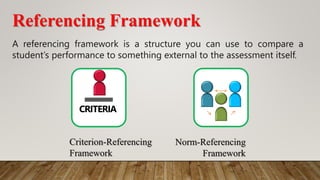
CRITERIA
Criterion Referenced
Interpretation
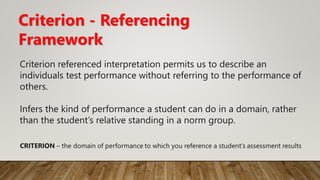
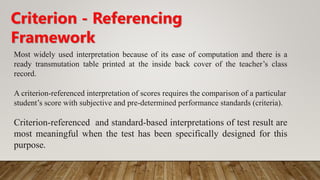
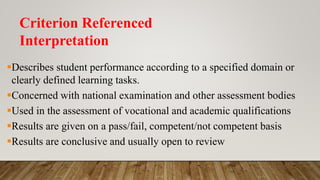
Describes student performance according to a specified domain or
clearly defined learning tasks.
Concerned with national examination and other assessment bodies
Used in the assessment of vocational and academic qualifications
Results are given on a pass/fail, competent/not competent basis
Results are conclusive and usually open to review
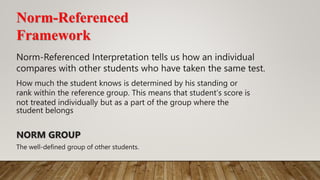
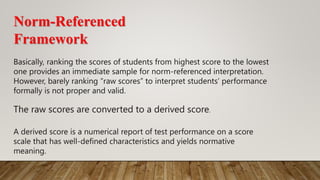
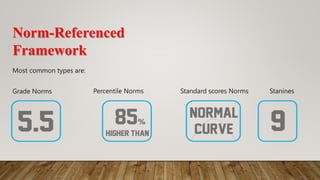
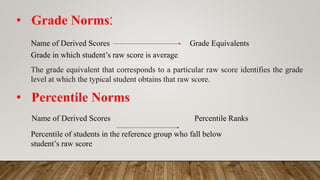
• Grade Norms:
Name of Derived Scores Grade Equivalents
Grade in which student’s raw score is average.
• Percentile Norms
Percentile of students in the reference group who fall below
student’s raw score
Name of Derived Scores Percentile Ranks
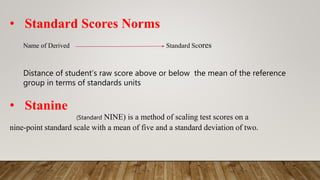
• Standard Scores Norms
Name of Derived Standard Scores
Distance of student’s raw score above or below the mean of the reference
group in terms of standards units
• Stanine
(Standard NINE) is a method of scaling test scores on a
nine-point standard scale with a mean of five and a standard deviation of two.
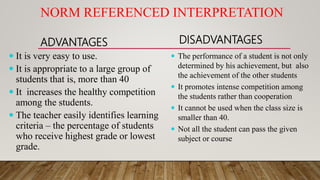
NORM REFERENCED INTERPRETATION
ADVANTAGES
 It is very easy to use.
 It is appropriate to a large group of
students that is, more than 40
 It increases the healthy competition
among the students.
 The teacher easily identifies learning
criteria – the percentage of students
who receive highest grade or lowest
grade.
DISADVANTAGES
 The performance of a student is not only
determined by his achievement, but also
the achievement of the other students
 It promotes intense competition among
the students rather than cooperation
 It cannot be used when the class size is
smaller than 40.
 Not all the student can pass the given
subject or course
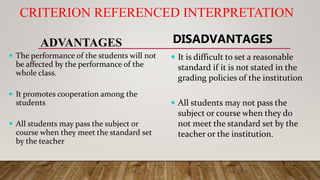
CRITERION REFERENCED INTERPRETATION
ADVANTAGES
 The performance of the students will not
be affected by the performance of the
whole class.
 It promotes cooperation among the
students
 All students may pass the subject or
course when they meet the standard set
by the teacher
DISADVANTAGES
 It is difficult to set a reasonable
standard if it is not stated in the
grading policies of the institution
 All students may not pass the
subject or course when they do
not meet the standard set by the
teacher or the institution.
Thank You !
For listening…. 
Test interpretation

Test interpretation

  • 2.
    Submitted by : Fatima2016-1544 Submitted to: Miss Ummara saher DEPARTMENT OF BUSINESS EDUCATION INSTITUTE OF EDUCATION AND RESEARCH UNIVERSITY OF THE PUNJAB, LAHORE. METHODS OF INTERPRETING TEST SCORES
  • 3.
    Test Interpretation Test Interpretationis the process of analyzing scores in a test and translating qualitative data into quantitative And grading into numerical . Score interpretation is same as test interpretation.
  • 4.
    Scores: “A summary ofthe evidence contained in an examinee's responses to the items of a test that are related to the construct or constructs being measured." Types of Scores:  Raw scores  Scales Scores
  • 5.
    • Raw Scores: Thenumber of points received on a test when the test has been scored according to direction. Example: Ali got 10 out of a 20 scores in item quiz. Raw scores reflect an immediate interpretation as a response to the scores. It does not yield a meaningful interpretation because its just raw scores. Thus, we have to interpret Ali’s score in a more descriptive and meaningful way. • Scaled Scores: Scaled scores are the results of transformation (usually transformed through a consistent scale)
  • 6.
  • 7.
  • 10.
    Criterion Referenced Interpretation Describes studentperformance according to a specified domain or clearly defined learning tasks. Concerned with national examination and other assessment bodies Used in the assessment of vocational and academic qualifications Results are given on a pass/fail, competent/not competent basis Results are conclusive and usually open to review
  • 14.
    • Grade Norms: Nameof Derived Scores Grade Equivalents Grade in which student’s raw score is average. • Percentile Norms Percentile of students in the reference group who fall below student’s raw score Name of Derived Scores Percentile Ranks
  • 15.
    • Standard ScoresNorms Name of Derived Standard Scores Distance of student’s raw score above or below the mean of the reference group in terms of standards units • Stanine (Standard NINE) is a method of scaling test scores on a nine-point standard scale with a mean of five and a standard deviation of two.
  • 16.
    NORM REFERENCED INTERPRETATION ADVANTAGES It is very easy to use.  It is appropriate to a large group of students that is, more than 40  It increases the healthy competition among the students.  The teacher easily identifies learning criteria – the percentage of students who receive highest grade or lowest grade. DISADVANTAGES  The performance of a student is not only determined by his achievement, but also the achievement of the other students  It promotes intense competition among the students rather than cooperation  It cannot be used when the class size is smaller than 40.  Not all the student can pass the given subject or course
  • 17.
    CRITERION REFERENCED INTERPRETATION ADVANTAGES The performance of the students will not be affected by the performance of the whole class.  It promotes cooperation among the students  All students may pass the subject or course when they meet the standard set by the teacher DISADVANTAGES  It is difficult to set a reasonable standard if it is not stated in the grading policies of the institution  All students may not pass the subject or course when they do not meet the standard set by the teacher or the institution.
  • 18.
    Thank You ! Forlistening…. 