Supervised by:
Prof. Dr/Eman
Taha.
Prepared by:.
Marwa Mohamed
Safia Said
D
GRADING & REPORTING SYSTEM
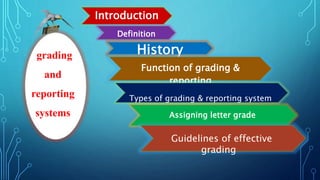
Introduction
Definition
History
Function of grading &
reporting
Types of grading & reporting system
Assigning letter grade
Guidelines of effective
grading
grading
and
reporting
systems
Teachers, parents, students,
administrators, and community
members all agree that we need
better grading and reporting
systems.
Grading and reporting student
progress is frustrating and anxiety
producing for both students and
teachers.
The main aim of grading and
reporting system is provide
results in brief, understandable
from for varied users.
Besides the traditional teacher record
book, new computer software offers.
Guskey and Bailey offer
four pillars of successful
grading and reporting
systems:
Communication is the primary goal of
grading and reporting
Grading and reporting are integral
parts of the instructional process
Creating change in grading and
reporting requires creating a multi-
faceted reporting system.
Good reporting is based on good
evidence
There are a number of
grading that may options
be adopted
letter grades, pass-fail, checklists of
objectives, letters to parents or
guardians, portfolios of student work,
and parent-teacher conferences.
History
of
Grading system
In the 1800’s students were taught in one
room classrooms.
Teachers reported student's progress orally
to parents.
Students remained on their grade level
until they mastered the curriculum.
 Secondary schools began using
percentages for academic assessment
cont.
In 1912, two researchers Starch &
Elliot experimented on the
subjectivity of teacher assessment.
cont.
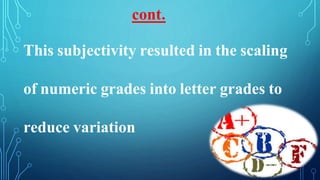
This subjectivity resulted in the scaling
of numeric grades into letter grades to
reduce variation
cont.
What is Grading System?
Grading System
Reporting System
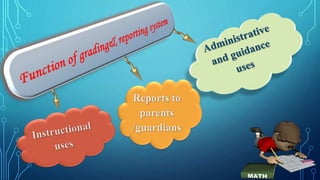
Instructional uses
 Clarifying instructional
objectives for them.
 Showing students’ strengths
& weaknesses.
 Enhancing students’
motivation (e.g., short-term
goals).
 Indicating where teaching
might be modified.
Best achieved by:
day-to-day tests and
feedback, plus periodic
integrated summaries.
Reports to parents
 Inform parents about
success, failure of their
children enables them to
give emotional support
and encouragement.
Communicate
objectives to parents,
so they can cooperate
with the school to
meet it.
Inform parents/
guardians on the
progress of their
child.
Administrative and
guidance uses
Help decide promotion,
graduation, athletic
eligibility.
Report
achievement to
other schools or to
employers.
Provide input for
realistic educational,
vocational, and
personal counseling.
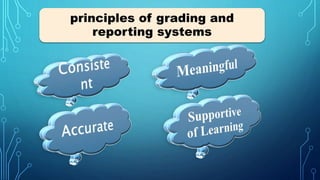
principles of grading and
reporting systems
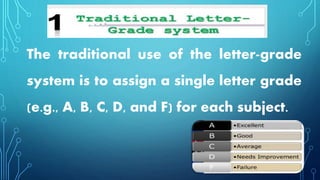
The traditional use of the letter-grade
system is to assign a single letter grade
(e.g., A, B, C, D, and F) for each subject.
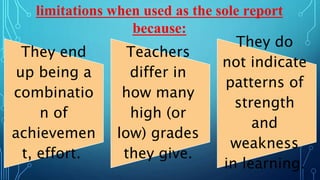
They end
up being a
combinatio
n of
achievemen
t, effort.
Teachers
differ in
how many
high (or
low) grades
they give.
They do
not indicate
patterns of
strength
and
weakness
in learning.
limitations when used as the sole report
because:
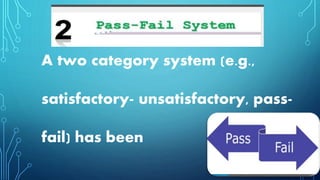
A two category system (e.g.,
satisfactory- unsatisfactory, pass-
fail) has been
 Used to allow exploration in high
school/college
 Removing the fear of a lower grade
 This system easy to use.
 Its value for describing present
performance or predicting future
achievements is lost
Some schools have replaced or
supplemented the traditional
grading system with a list of
objectives to be checked or rated.
o Each item in the checklist can be
rated: Outstanding, Satisfactory, and
Unsatisfactory; A, B, C, etc.
o .
o It provides a detailed analysis of the
students' strengths and weaknesses
o Problem is to keep the list manageable
and understandable by all users.
Multiple grading systems
Guidelines for developing a multiple grading
& reporting system
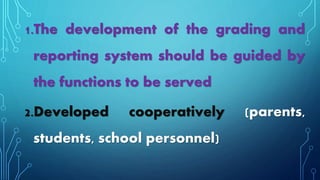
1.The development of the grading and
reporting system should be guided by
the functions to be served
2.Developed cooperatively (parents,
students, school personnel)
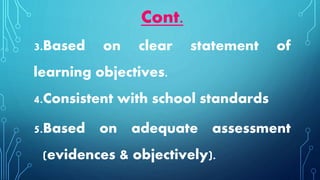
3.Based on clear statement of
learning objectives.
4.Consistent with school standards
5.Based on adequate assessment
(evidences & objectively).
Cont.
6.Based on the right level of detail
 detailed enough to be diagnostic,
but compact enough to be practical
7.Providing for parent-teacher
conferences as needed
Cont.
Types of reporting
system
 Useful supplement to grades.
 Provide greater flexibility.
 Report on strengths, weakness
of each students.
1- Letters to parents/guardians
 Very time consuming.
 Accounts of weaknesses often
misinterpreted.
 Not systematic or cumulative.
Limitedvalue as sole report,
because:
Useful for:
a.showing student’s strengths and
weaknesses
b.illustrating range of student work
Portfolios
Useful for:
c. showing progress over time or
stages of a project
d. teaching students about
objectives/standards they are to
meet
2-Portfolios
To overcome the limitation information
provided by the traditional report card and
to establish better cooperation teachers
and parents.
3-Parent-teacher conferences
o Used mostly in elementary school
o Portfolio (when used ) are useful
basis for discuss
Parent-teacher conferences
a.Provide two way communications
between home, schools.
b.getting more information and
cooperation from parents
c.Overcome any misunderstanding.
Useful for discussion.
a.time consuming
b.provides no systematic
record of progress
c.some parents won’t come
Limited in value as the major report, because
Guidelines
for a good
conference
1.Make plans
 Review your goals
 Organize the information to present
 Make list of points to cover and questions
to ask
 If bring portfolios, select and review
carefully
2.Start positive—and maintain a positive
focus
3.Present student’s strong points first
· Helpful to have example of work
to show strengths and needs
· Compare early vs. later work to
show improvement
4.Encourage parents to participate and
share information
5. Summarize at the end
6.End with positive comment
7.Use good human relations skills
Be friendly and informal
Be positive in approach
Be willing to explain in understandable terms
Be willing to listen
Be willing to accept parents’ feelings
Be careful about giving advice
DO
 Argue, get angry
Ask embarrassing questions
Talk about other students, parents
and teachers
Bluff if you don’t know
Reject parents’ suggestions
Be a know-it-all with pat answers
DON’T
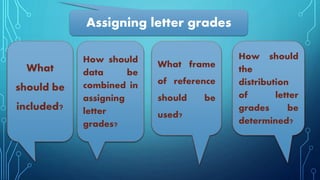
What
should be
included?
How should
data be
combined in
assigning
letter
grades?
How should
the
distribution
of letter
grades be
determined?
What frame
of reference
should be
used?
Assigning letter grades
What to include?
1.Must include only achievement
2.Avoid temptation to include effort
for less able students.
What to include?
3.There are some drawbacks as:
a.It is difficult for teacher to assess
effort/potential
What to include?
b. It is difficult to distinguish ability
between achievement and aptitude.
c. Using different bases of grading for
different students may be unfair.
How to combine data?
 Properly weight each
component to create a
composite
 Normally agreed upon by
school officials: (30%)Quiz
(25%) Project/Assignment
(15%) Class Participation (30%)
Periodic test.
1. Norm-Referenced Grading System
(Relative grading system)
2. Criterion-Referenced Grading System
(Absolute grading system)
3. Score compared to learning potential.
What frame of
reference?
1.Grades may reflect relative performance
2.Score compared to other students (rank)
3.Grade depends on what group you are
in, not just your own performance
Norm-Referenced Grading System
(Relative grading system)
5.Widely used in classroom
testing .
Norm-Referenced Grading System
(Relative grading system)
1.Grades may reflect absolute performance
 Score compared to specified
performance standards (what you can
do)
2.Criterion-Referenced
Grading System
2. Grade does not depend on what group
you are in, but only on your own
performance compared to a set of
performance standards
2.Criterion-Referenced
Grading System
3.Grades must:
 Clearly define the domain
 Clearly define and justify the
performance standards
 Be based on criterion-referenced
Cont.
 Widely used in elementary schools
 Inconsistent with a standards-based
system (each child is their own
standard)
3. Score compared to learning
“potential” or past performance
Reliably estimating learning ability
(separate from achievement) is
very difficult
3. Score compared to learning
“potential” or past performance
Norm-Referenced or Relative grading system (have
ranked the students).
 Distribution is a big issue
a. Ranking the students in order to achievement.
b. Assign grades on the basis of normal curve.
What distribution of grades?
Normal curve defensible only when have
large, unselected group
When “grading on the curve,” school
staff should set fair ranges of grades for
different groups and courses
c. When “grading on the curve,” any
pass-fail decision should be based on an
absolute standard (i.e., failed the
minimum essentials)
What distribution of grades?
a. System seldom uses letter grades
alone
b. Often includes checklists of what has
been mastered
c. Distribution of grades is not
predetermined
2. Criterion-Referenced Or
Absolute grading system
Guidelines for
effective
grading
Guidelines for effective grading
1.Describe grading procedures to students
at beginning of instruction.
2. Clarify that course grade will be
based on achievement only.
3. Explain how other factors (effort,
work habits, etc.) will be reported.
cont.
4. Relate grading procedures to
intended learning outcomes
5. Obtain valid evidence (tests, etc.) for
assigning grades.
6. Try to prevent cheating.
Cont.
7. Return and review all test results as soon
as possible.
8. Properly weight the various types of
achievements included in the grade.
Cont.
9. Be fair. Avoid bias. When in doubt,
review the evidence. If still in doubt,
give the higher grade
Cont.
Record Keeping and
grading software
Record Keeping and
grading software
Test Administration
Outlines
1- Introduction.
2- Recording test items.
3-Reviewing test items and assessment
tasks.
4-Arranging Items in the test.
5- Preparing Directions for the
test or Assessment.
6- Reproducing the test .
7- Test administration.
• The only way we can ensure that a
classroom test will serve its intended
purpose is to identify the learning
outcomes.
• then construct test items and assessments tasks.
• We must also assemble the items and tasks, prepare
directions, administer the instrument, score the
students responses, interpret and appraise the results.
Our goal throughout the
preparation and use of
classroom tests and
assessments is to obtain
valid evidence of student
learning
N.B
1- Recording test items
The item record should contain information
concerning the instructional objective, the
specific learning outcome and the content
measured by the item
Cont…,
• The flexibility of this recording
system also makes it easy to add
the items to a computer item bank.
2- Reviewing test items and
assessment tasks
We focus so closely on some
aspects of item or task construction
that we overlook others .
Cont…,
• This results in an accumulation of
unwanted errors that may distort
the function of the item or task.
Such technical
defects can be most
easily detected by:-
Cont…,
(a) Reviewing the items and tasks
after they have been set aside for a
few days.
(b) Asking a fellow teacher to
review and criticize them.
The following questions
will help you analyze the
quality of each item or
task.
1- Is the format appropriate for
the learning outcome being
measured?
Cont…,
2- Does the knowledge, understanding,
or thinking item or task match the
specific learning outcome and subject-
matter content being measured?
Cont…,
3- Is the point of the item or task
clear?
4- Is the item or task free from
excessive verbiage?
Cont…,
5- Does the item have an answer that
would be agreed on by experts?
Cont…,
6- Is the item or task free from
technical errors and irrelevant clues?
Cont…,
7- Is the item or task free from ethnic
and gender bias?
•Most of the time, we find ways of dealing with such
problems in living by talking to family, friends,
neighbors, priests or our family doctor
3- Arranging Items in the
test
•Most of the time, we find ways of dealing with such
problems in living by talking to family, friends,
neighbors, priests or our family doctor
Cont…,
• keeping the simpler item types
together and placing the more
complex ones in the test as
follows :
Cont…,
• True-false or alternative- response
items
• Matching items
• Short-answer items
Cont…,
• Multiple –choice items
• Interpretive exercises
• Restricted – response essay questions
• Restricted-response performance tasks.
4- Preparing Directions for the
test or Assessment
Many teachers include no written directions with
their test, assuming either that the items are self-
explanatory or that students are conditioned to
answering the types of item used in the
test.
Cont…,
some teachers also use oral Whether
written, oral, or both, the directions
should include at least the following
points .
Cont…,
• Purpose of the test or assessment
• Time allowed for completing the test
or performing the task
• Directions for responding
Cont…,
• How to record the answers
• What to do about guessing for
selection-type test items
• The basis for scoring open-ended or
extended responses.
• All test items should have generous
borders. Multiple-choice items should
have the alternatives listed in a vertical
column beneath the stem of the item
rather than across the page
5- Reproducing the test
Items should not be split ,
with parts of the item on two
different pages .
• Test items should be numbered
consecutively throughout the
test.
6-Test administration
• Administering the written test is perhaps
the most important aspect of the
examining process performance.
• The atmosphere the test
administrator creates in the test
room and the attitude the test
administrator displays in
performing his/her duties is
extremely important.
A teacher's test administration
procedures can have great impact
on students test performance.

Steps in the
administration of test:-
General Principles of Client-Centered
Counseling
• Client-centered counseling: the focus is on the client's
concerns and interests.
• Context: The impact of counseling will be enhanced when
counselors are able to explore and assess the physical and
emotional circumstances under which clients' lives.
1-Before the test
2-After distributing test
papers
3-During the test
4- After the test
5- Collect the test materials
promptly
.
Environmental
condition
Motivate the
students to do their
best.
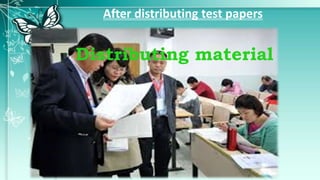
After distributing test papers
Distributing material
Keep time accurately
During the test
Answering questions
during test
Preventing cheating
After the test
Record any significant events
that might influence test scores
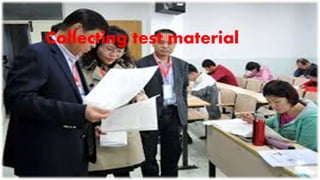
Collecting test material
Grading & test adminstration

Grading & test adminstration

  • 2.
    Supervised by: Prof. Dr/Eman Taha. Preparedby:. Marwa Mohamed Safia Said
  • 3.
  • 4.
    Introduction Definition History Function of grading& reporting Types of grading & reporting system Assigning letter grade Guidelines of effective grading grading and reporting systems
  • 5.
    Teachers, parents, students, administrators,and community members all agree that we need better grading and reporting systems.
  • 6.
    Grading and reportingstudent progress is frustrating and anxiety producing for both students and teachers.
  • 7.
    The main aimof grading and reporting system is provide results in brief, understandable from for varied users.
  • 8.
    Besides the traditionalteacher record book, new computer software offers.
  • 9.
    Guskey and Baileyoffer four pillars of successful grading and reporting systems:
  • 10.
    Communication is theprimary goal of grading and reporting Grading and reporting are integral parts of the instructional process
  • 11.
    Creating change ingrading and reporting requires creating a multi- faceted reporting system. Good reporting is based on good evidence
  • 12.
    There are anumber of grading that may options be adopted
  • 13.
    letter grades, pass-fail,checklists of objectives, letters to parents or guardians, portfolios of student work, and parent-teacher conferences.
  • 14.
  • 15.
    In the 1800’sstudents were taught in one room classrooms. Teachers reported student's progress orally to parents. Students remained on their grade level until they mastered the curriculum.
  • 16.
     Secondary schoolsbegan using percentages for academic assessment cont.
  • 17.
    In 1912, tworesearchers Starch & Elliot experimented on the subjectivity of teacher assessment. cont.
  • 18.
    This subjectivity resultedin the scaling of numeric grades into letter grades to reduce variation cont.
  • 19.
  • 20.
  • 21.
  • 23.
    Instructional uses  Clarifyinginstructional objectives for them.  Showing students’ strengths & weaknesses.
  • 24.
     Enhancing students’ motivation(e.g., short-term goals).  Indicating where teaching might be modified.
  • 25.
    Best achieved by: day-to-daytests and feedback, plus periodic integrated summaries.
  • 26.
    Reports to parents Inform parents about success, failure of their children enables them to give emotional support and encouragement.
  • 27.
    Communicate objectives to parents, sothey can cooperate with the school to meet it.
  • 28.
    Inform parents/ guardians onthe progress of their child.
  • 29.
    Administrative and guidance uses Helpdecide promotion, graduation, athletic eligibility.
  • 30.
  • 31.
    Provide input for realisticeducational, vocational, and personal counseling.
  • 33.
    principles of gradingand reporting systems
  • 35.
    The traditional useof the letter-grade system is to assign a single letter grade (e.g., A, B, C, D, and F) for each subject.
  • 36.
    They end up beinga combinatio n of achievemen t, effort. Teachers differ in how many high (or low) grades they give. They do not indicate patterns of strength and weakness in learning. limitations when used as the sole report because:
  • 37.
    A two categorysystem (e.g., satisfactory- unsatisfactory, pass- fail) has been
  • 38.
     Used toallow exploration in high school/college  Removing the fear of a lower grade  This system easy to use.
  • 39.
     Its valuefor describing present performance or predicting future achievements is lost
  • 40.
    Some schools havereplaced or supplemented the traditional grading system with a list of objectives to be checked or rated.
  • 41.
    o Each itemin the checklist can be rated: Outstanding, Satisfactory, and Unsatisfactory; A, B, C, etc.
  • 42.
    o . o Itprovides a detailed analysis of the students' strengths and weaknesses o Problem is to keep the list manageable and understandable by all users.
  • 43.
  • 44.
    Guidelines for developinga multiple grading & reporting system
  • 45.
    1.The development ofthe grading and reporting system should be guided by the functions to be served 2.Developed cooperatively (parents, students, school personnel)
  • 46.
    3.Based on clearstatement of learning objectives. 4.Consistent with school standards 5.Based on adequate assessment (evidences & objectively). Cont.
  • 47.
    6.Based on theright level of detail  detailed enough to be diagnostic, but compact enough to be practical 7.Providing for parent-teacher conferences as needed Cont.
  • 48.
  • 49.
     Useful supplementto grades.  Provide greater flexibility.  Report on strengths, weakness of each students. 1- Letters to parents/guardians
  • 50.
     Very timeconsuming.  Accounts of weaknesses often misinterpreted.  Not systematic or cumulative. Limitedvalue as sole report, because:
  • 51.
    Useful for: a.showing student’sstrengths and weaknesses b.illustrating range of student work Portfolios
  • 52.
    Useful for: c. showingprogress over time or stages of a project d. teaching students about objectives/standards they are to meet 2-Portfolios
  • 53.
    To overcome thelimitation information provided by the traditional report card and to establish better cooperation teachers and parents. 3-Parent-teacher conferences
  • 54.
    o Used mostlyin elementary school o Portfolio (when used ) are useful basis for discuss Parent-teacher conferences
  • 55.
    a.Provide two waycommunications between home, schools. b.getting more information and cooperation from parents c.Overcome any misunderstanding. Useful for discussion.
  • 56.
    a.time consuming b.provides nosystematic record of progress c.some parents won’t come Limited in value as the major report, because
  • 57.
  • 58.
    1.Make plans  Reviewyour goals  Organize the information to present  Make list of points to cover and questions to ask  If bring portfolios, select and review carefully
  • 59.
    2.Start positive—and maintaina positive focus 3.Present student’s strong points first · Helpful to have example of work to show strengths and needs · Compare early vs. later work to show improvement
  • 60.
    4.Encourage parents toparticipate and share information 5. Summarize at the end
  • 61.
    6.End with positivecomment 7.Use good human relations skills
  • 62.
    Be friendly andinformal Be positive in approach Be willing to explain in understandable terms Be willing to listen Be willing to accept parents’ feelings Be careful about giving advice DO
  • 63.
     Argue, getangry Ask embarrassing questions Talk about other students, parents and teachers Bluff if you don’t know Reject parents’ suggestions Be a know-it-all with pat answers DON’T
  • 64.
    What should be included? How should databe combined in assigning letter grades? How should the distribution of letter grades be determined? What frame of reference should be used? Assigning letter grades
  • 65.
    What to include? 1.Mustinclude only achievement 2.Avoid temptation to include effort for less able students.
  • 66.
    What to include? 3.Thereare some drawbacks as: a.It is difficult for teacher to assess effort/potential
  • 67.
    What to include? b.It is difficult to distinguish ability between achievement and aptitude. c. Using different bases of grading for different students may be unfair.
  • 68.
    How to combinedata?  Properly weight each component to create a composite
  • 69.
     Normally agreedupon by school officials: (30%)Quiz (25%) Project/Assignment (15%) Class Participation (30%) Periodic test.
  • 70.
    1. Norm-Referenced GradingSystem (Relative grading system) 2. Criterion-Referenced Grading System (Absolute grading system) 3. Score compared to learning potential. What frame of reference?
  • 71.
    1.Grades may reflectrelative performance 2.Score compared to other students (rank) 3.Grade depends on what group you are in, not just your own performance Norm-Referenced Grading System (Relative grading system)
  • 72.
    5.Widely used inclassroom testing . Norm-Referenced Grading System (Relative grading system)
  • 73.
    1.Grades may reflectabsolute performance  Score compared to specified performance standards (what you can do) 2.Criterion-Referenced Grading System
  • 74.
    2. Grade doesnot depend on what group you are in, but only on your own performance compared to a set of performance standards 2.Criterion-Referenced Grading System
  • 75.
    3.Grades must:  Clearlydefine the domain  Clearly define and justify the performance standards  Be based on criterion-referenced Cont.
  • 76.
     Widely usedin elementary schools  Inconsistent with a standards-based system (each child is their own standard) 3. Score compared to learning “potential” or past performance
  • 77.
    Reliably estimating learningability (separate from achievement) is very difficult 3. Score compared to learning “potential” or past performance
  • 78.
    Norm-Referenced or Relativegrading system (have ranked the students).  Distribution is a big issue a. Ranking the students in order to achievement. b. Assign grades on the basis of normal curve. What distribution of grades?
  • 79.
    Normal curve defensibleonly when have large, unselected group When “grading on the curve,” school staff should set fair ranges of grades for different groups and courses
  • 80.
    c. When “gradingon the curve,” any pass-fail decision should be based on an absolute standard (i.e., failed the minimum essentials) What distribution of grades?
  • 81.
    a. System seldomuses letter grades alone b. Often includes checklists of what has been mastered c. Distribution of grades is not predetermined 2. Criterion-Referenced Or Absolute grading system
  • 82.
  • 83.
    Guidelines for effectivegrading 1.Describe grading procedures to students at beginning of instruction.
  • 84.
    2. Clarify thatcourse grade will be based on achievement only. 3. Explain how other factors (effort, work habits, etc.) will be reported. cont.
  • 85.
    4. Relate gradingprocedures to intended learning outcomes 5. Obtain valid evidence (tests, etc.) for assigning grades. 6. Try to prevent cheating. Cont.
  • 86.
    7. Return andreview all test results as soon as possible. 8. Properly weight the various types of achievements included in the grade. Cont.
  • 87.
    9. Be fair.Avoid bias. When in doubt, review the evidence. If still in doubt, give the higher grade Cont.
  • 89.
  • 90.
  • 91.
  • 92.
    Outlines 1- Introduction. 2- Recordingtest items. 3-Reviewing test items and assessment tasks. 4-Arranging Items in the test.
  • 93.
    5- Preparing Directionsfor the test or Assessment. 6- Reproducing the test . 7- Test administration.
  • 94.
    • The onlyway we can ensure that a classroom test will serve its intended purpose is to identify the learning outcomes.
  • 95.
    • then constructtest items and assessments tasks. • We must also assemble the items and tasks, prepare directions, administer the instrument, score the students responses, interpret and appraise the results.
  • 96.
    Our goal throughoutthe preparation and use of classroom tests and assessments is to obtain valid evidence of student learning N.B
  • 97.
    1- Recording testitems The item record should contain information concerning the instructional objective, the specific learning outcome and the content measured by the item
  • 98.
    Cont…, • The flexibilityof this recording system also makes it easy to add the items to a computer item bank.
  • 99.
    2- Reviewing testitems and assessment tasks We focus so closely on some aspects of item or task construction that we overlook others .
  • 100.
    Cont…, • This resultsin an accumulation of unwanted errors that may distort the function of the item or task.
  • 101.
    Such technical defects canbe most easily detected by:-
  • 102.
    Cont…, (a) Reviewing theitems and tasks after they have been set aside for a few days. (b) Asking a fellow teacher to review and criticize them.
  • 103.
    The following questions willhelp you analyze the quality of each item or task.
  • 104.
    1- Is theformat appropriate for the learning outcome being measured?
  • 105.
    Cont…, 2- Does theknowledge, understanding, or thinking item or task match the specific learning outcome and subject- matter content being measured?
  • 106.
    Cont…, 3- Is thepoint of the item or task clear? 4- Is the item or task free from excessive verbiage?
  • 107.
    Cont…, 5- Does theitem have an answer that would be agreed on by experts?
  • 108.
    Cont…, 6- Is theitem or task free from technical errors and irrelevant clues?
  • 109.
    Cont…, 7- Is theitem or task free from ethnic and gender bias?
  • 110.
    •Most of thetime, we find ways of dealing with such problems in living by talking to family, friends, neighbors, priests or our family doctor 3- Arranging Items in the test
  • 111.
    •Most of thetime, we find ways of dealing with such problems in living by talking to family, friends, neighbors, priests or our family doctor
  • 112.
    Cont…, • keeping thesimpler item types together and placing the more complex ones in the test as follows :
  • 113.
    Cont…, • True-false oralternative- response items • Matching items • Short-answer items
  • 114.
    Cont…, • Multiple –choiceitems • Interpretive exercises • Restricted – response essay questions • Restricted-response performance tasks.
  • 115.
    4- Preparing Directionsfor the test or Assessment Many teachers include no written directions with their test, assuming either that the items are self- explanatory or that students are conditioned to answering the types of item used in the test.
  • 116.
    Cont…, some teachers alsouse oral Whether written, oral, or both, the directions should include at least the following points .
  • 117.
    Cont…, • Purpose ofthe test or assessment • Time allowed for completing the test or performing the task • Directions for responding
  • 118.
    Cont…, • How torecord the answers • What to do about guessing for selection-type test items • The basis for scoring open-ended or extended responses.
  • 119.
    • All testitems should have generous borders. Multiple-choice items should have the alternatives listed in a vertical column beneath the stem of the item rather than across the page 5- Reproducing the test
  • 120.
    Items should notbe split , with parts of the item on two different pages .
  • 121.
    • Test itemsshould be numbered consecutively throughout the test.
  • 122.
    6-Test administration • Administeringthe written test is perhaps the most important aspect of the examining process performance.

  • 123.
    • The atmospherethe test administrator creates in the test room and the attitude the test administrator displays in performing his/her duties is extremely important.
  • 124.
    A teacher's testadministration procedures can have great impact on students test performance.

  • 125.

  • 126.
    General Principles ofClient-Centered Counseling • Client-centered counseling: the focus is on the client's concerns and interests. • Context: The impact of counseling will be enhanced when counselors are able to explore and assess the physical and emotional circumstances under which clients' lives. 1-Before the test 2-After distributing test papers 3-During the test 4- After the test 5- Collect the test materials promptly
  • 127.
  • 128.
    After distributing testpapers Distributing material
  • 129.
  • 130.
    During the test Answeringquestions during test
  • 131.
  • 132.
    After the test Recordany significant events that might influence test scores
  • 133.