Reflect Relative Performance
 Example: Score compared to other
students or ranking performance
 “Where you rank”

Grades may reflect relative performance
score compared to other students
(where you rank).
 In such a system:


› A. Grade depends on what group you are

in.
› B. Typical grade may be shifted up or
down, depending on group’s ability.
› C. Widely used because much classroom
testing is norm reference.
They easy for instructors to use
 They work well in situations requiring rigid
differentiation among students
 They are generally appropriate in large
courses



An individual's grade is determined not
only by his/her achievements, but also
by the achievements of others.
› 15% of the students will receive a mark of

excellence, which in class of 100 enrolled
students will be 15 persons:








1.0 (Excellent)
1.50 (Good)
2.0 (Average)
3.0 ( Poor, pass)
5.0 (Failure)

= Top 15 % of the class
= Next 15 % of the class
= Next 45 % of the class
= Next 15 % of the class
= Bottom 10 % of class
Reflect absolute performance
 Example: score compared to specified
standards
 “what you can do”

Grades may also reflect absolute performance score
compared to specified performance standards (what you
can do).
 In such a system:
› A. Grades does not depend on what group you are
in, but only on your own performance standards.
› B. Grading is a complex task, because grades must:
› i. clearly defined the domain
› ii. clearly defined and justify the performance standards.
› iii. Be based on criterion referenced assessment.
› C. conditions are hard to meet, except in complete
mystery.
›

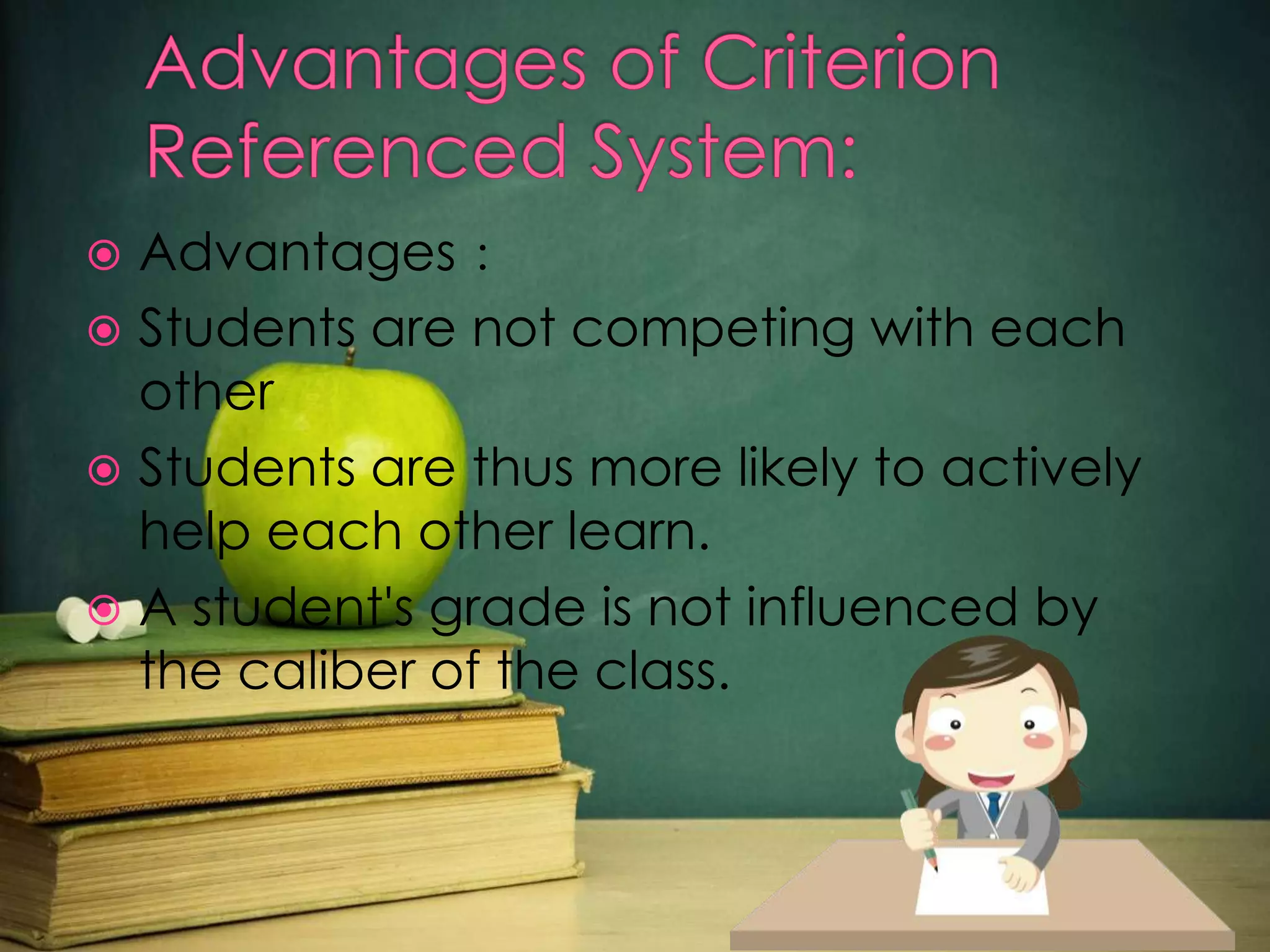
Advantages:
 Students are not competing with each
other
 Students are thus more likely to actively
help each other learn.
 A student's grade is not influenced by
the caliber of the class.

It is difficult to set a reasonable standard
for students
 Most experienced faculty set criteria
based on their knowledge of how
students usually perform
 Criterion-referenced systems often
become fairly similar to norm-referenced
systems.

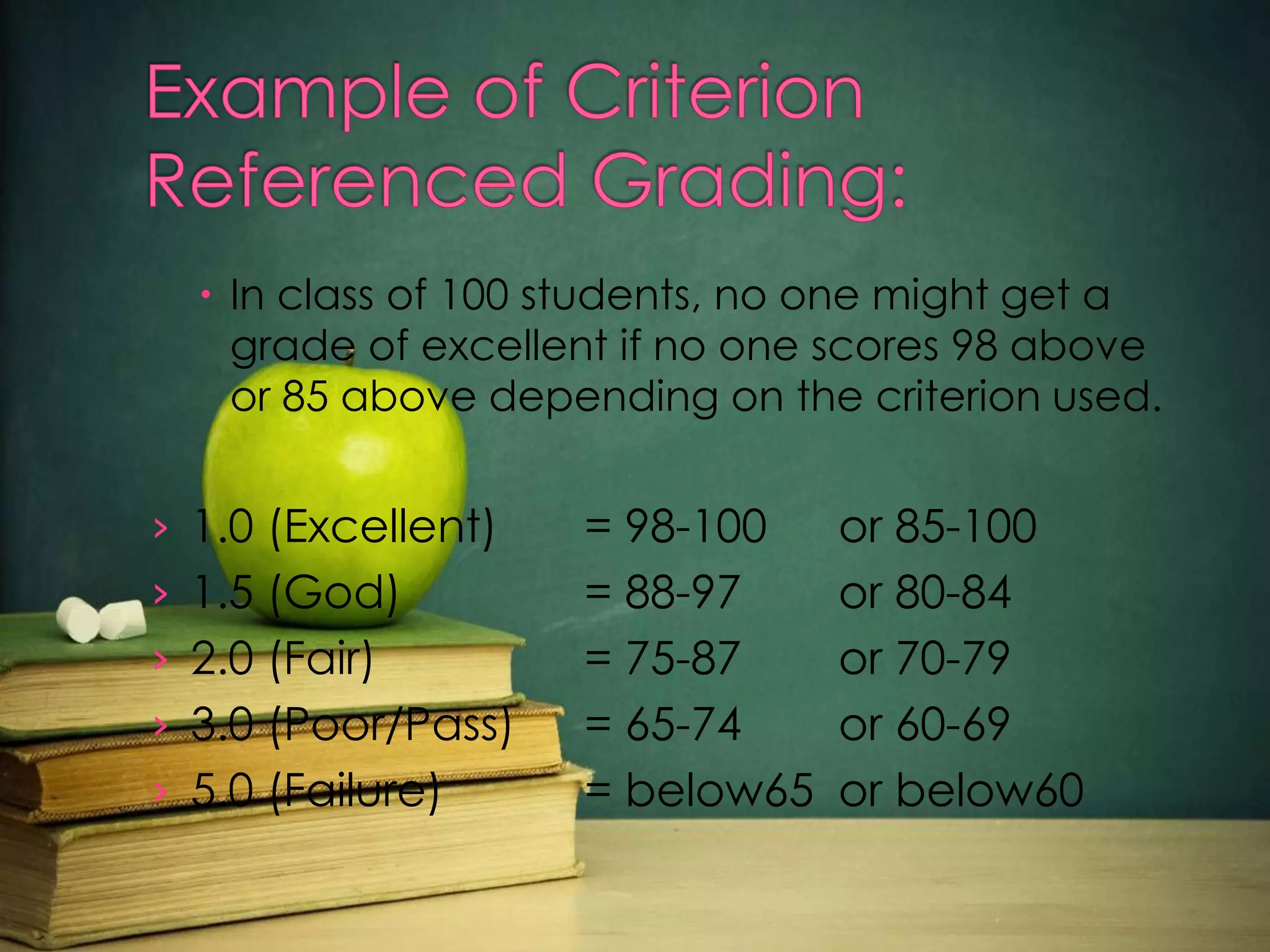
 In class of 100 students, no one might get a
grade of excellent if no one scores 98 above
or 85 above depending on the criterion used.

› 1.0 (Excellent)
› 1.5 (God)
› 2.0 (Fair)

› 3.0 (Poor/Pass)
› 5.0 (Failure)

= 98-100
= 88-97
= 75-87
= 65-74
= below65

or 85-100
or 80-84
or 70-79
or 60-69
or below60
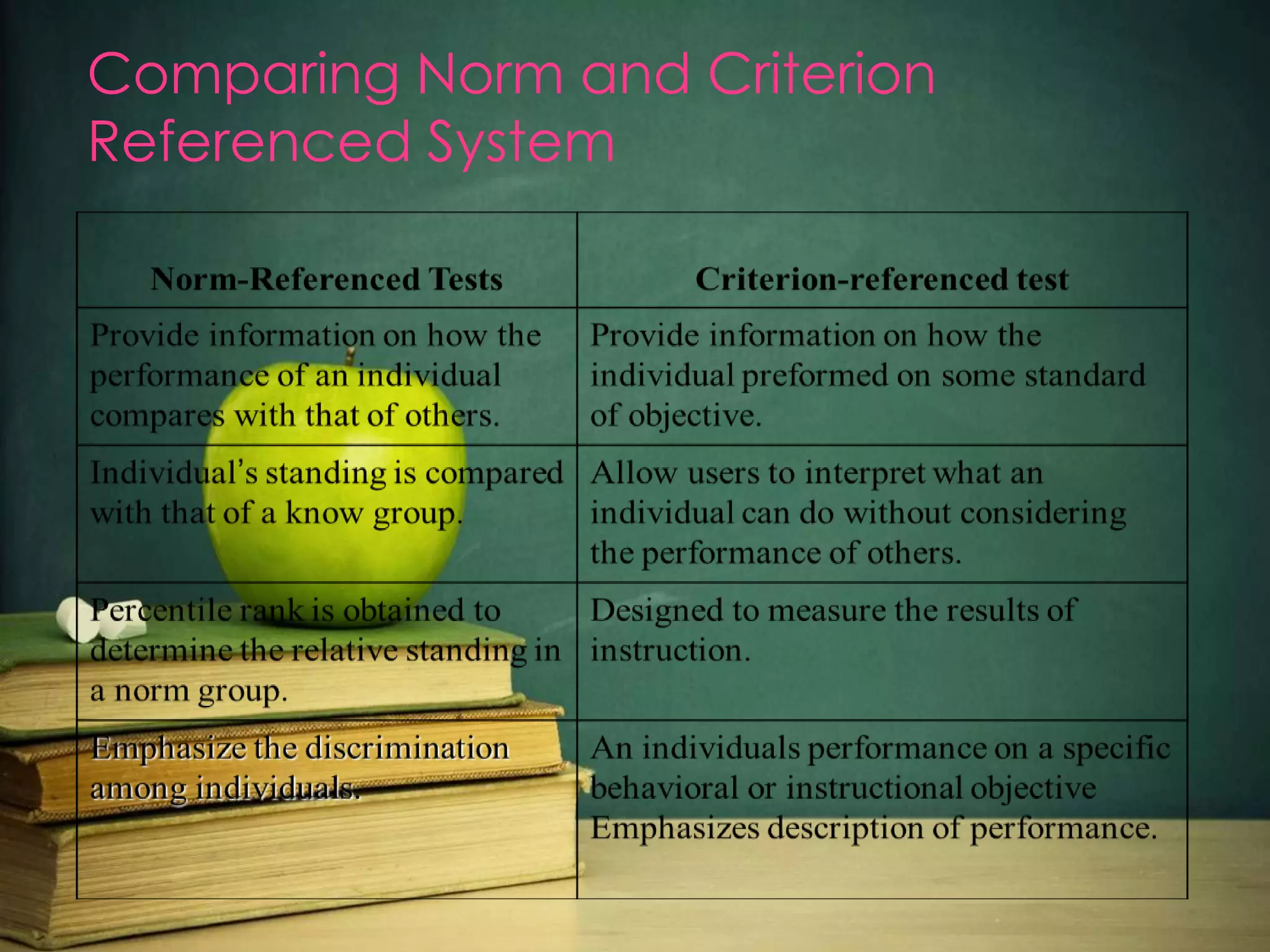
Comparing Norm and Criterion
Referenced System
› A. Grades are inconsistent with a standard-

based system because now, each child is
his/her own standard.
› B. Reliably estimating learning ability
(separate from achievement) is very difficult.
› C. One cannot reliably measure change
with classroom measures.
› D. Therefore, should only be used as a
supplement.
Norm or criterion referenced grading

Norm or criterion referenced grading

  • 2.
    Reflect Relative Performance Example: Score compared to other students or ranking performance  “Where you rank” 
  • 3.
    Grades may reflectrelative performance score compared to other students (where you rank).  In such a system:  › A. Grade depends on what group you are in. › B. Typical grade may be shifted up or down, depending on group’s ability. › C. Widely used because much classroom testing is norm reference.
  • 4.
    They easy forinstructors to use  They work well in situations requiring rigid differentiation among students  They are generally appropriate in large courses 
  • 5.
     An individual's gradeis determined not only by his/her achievements, but also by the achievements of others.
  • 6.
    › 15% ofthe students will receive a mark of excellence, which in class of 100 enrolled students will be 15 persons:      1.0 (Excellent) 1.50 (Good) 2.0 (Average) 3.0 ( Poor, pass) 5.0 (Failure) = Top 15 % of the class = Next 15 % of the class = Next 45 % of the class = Next 15 % of the class = Bottom 10 % of class
  • 7.
    Reflect absolute performance Example: score compared to specified standards  “what you can do” 
  • 8.
    Grades may alsoreflect absolute performance score compared to specified performance standards (what you can do).  In such a system: › A. Grades does not depend on what group you are in, but only on your own performance standards. › B. Grading is a complex task, because grades must: › i. clearly defined the domain › ii. clearly defined and justify the performance standards. › iii. Be based on criterion referenced assessment. › C. conditions are hard to meet, except in complete mystery. › 
  • 9.
    Advantages:  Students arenot competing with each other  Students are thus more likely to actively help each other learn.  A student's grade is not influenced by the caliber of the class. 
  • 10.
    It is difficultto set a reasonable standard for students  Most experienced faculty set criteria based on their knowledge of how students usually perform  Criterion-referenced systems often become fairly similar to norm-referenced systems. 
  • 11.
     In classof 100 students, no one might get a grade of excellent if no one scores 98 above or 85 above depending on the criterion used. › 1.0 (Excellent) › 1.5 (God) › 2.0 (Fair) › 3.0 (Poor/Pass) › 5.0 (Failure) = 98-100 = 88-97 = 75-87 = 65-74 = below65 or 85-100 or 80-84 or 70-79 or 60-69 or below60
  • 12.
    Comparing Norm andCriterion Referenced System
  • 13.
    › A. Gradesare inconsistent with a standard- based system because now, each child is his/her own standard. › B. Reliably estimating learning ability (separate from achievement) is very difficult. › C. One cannot reliably measure change with classroom measures. › D. Therefore, should only be used as a supplement.