Gulam Mohd
&
Bhoj R Singh
Division of Epidemiology
Indian Veterinary Research Institute,
Izatnagar- 243 122, India
Gulam Mohd
&
Bhoj R Singh
Division of Epidemiology
Indian Veterinary Research Institute,
Izatnagar- 243 122, India
Methods for Determining Fractional
Inhibitory Concentration (FIC)
Test to determine interaction between two or more drugs intended to be
used in combination
• Fractional inhibitory concentration (FIC):- It is
the test to estimate the interaction between two
or more drugs intended to be used in
combination.
• Purpose: Testing new antimicrobial agents in
combination with existing for determining the
Synergistic effect, Additive effect and
Antagonism.
Why FIC is measured ?
Combination therapy and drug
interaction
Synergistic Effect: When two drugs are used in combination. At
least one of the two drugs must show minimum 4-fold increase in
antibacterial activities (or a decrease in minimum inhibitory
concentration, MIC to ¼).
Additive Effect: When two antimicrobial agents with the same
mechanisms of action are used the effect is usually additive .
Antagonism: Usually bacteriostatic antibiotics are antagonistic to
bactericidal agents. (e.g. Chloramphenicol antagonize the bactericidal
activities of penicillin in the treatment of Pneumococcal meningitis.
• To widen the antibacterial activity of the treatment.
• To reduce the probability of selection of resistant mutant.
• To get the advantage of synergy of different antibacterial
drugs, which may be helpful in reducing the toxic effects
associated with large doses of the drugs when used alone.
• Common Antibacterial drug combinations: Amoxicillin/
clavulinic acid, Ampicillin/sulbactam, Trimethoprim/
sulfonamide, Trimetoprim/ sulfadimethoxine, Florfenicol/
tylosin etc. (Escudero et al., 1996; Fernández-Varón et al.,
2005; Kim et al., 2008)
Why combination of drugs?
Selection of FIC methodology
 Ease of performance.
 Adaptability to automated or semi-automated
platforms.
 Cost (economy).
 Reliability (repeatability).
 Accuracy.
Methods of synergy testing
(White et al., 1996)
• Checkerboard dilution assays :- measure of the
inhibitory activity
• Time kill curve methods :- assesses bactericidal
activity
• Multiple combination bactericidal testing
(MCBT)
• Synergy testing using E (epsilometer) tests
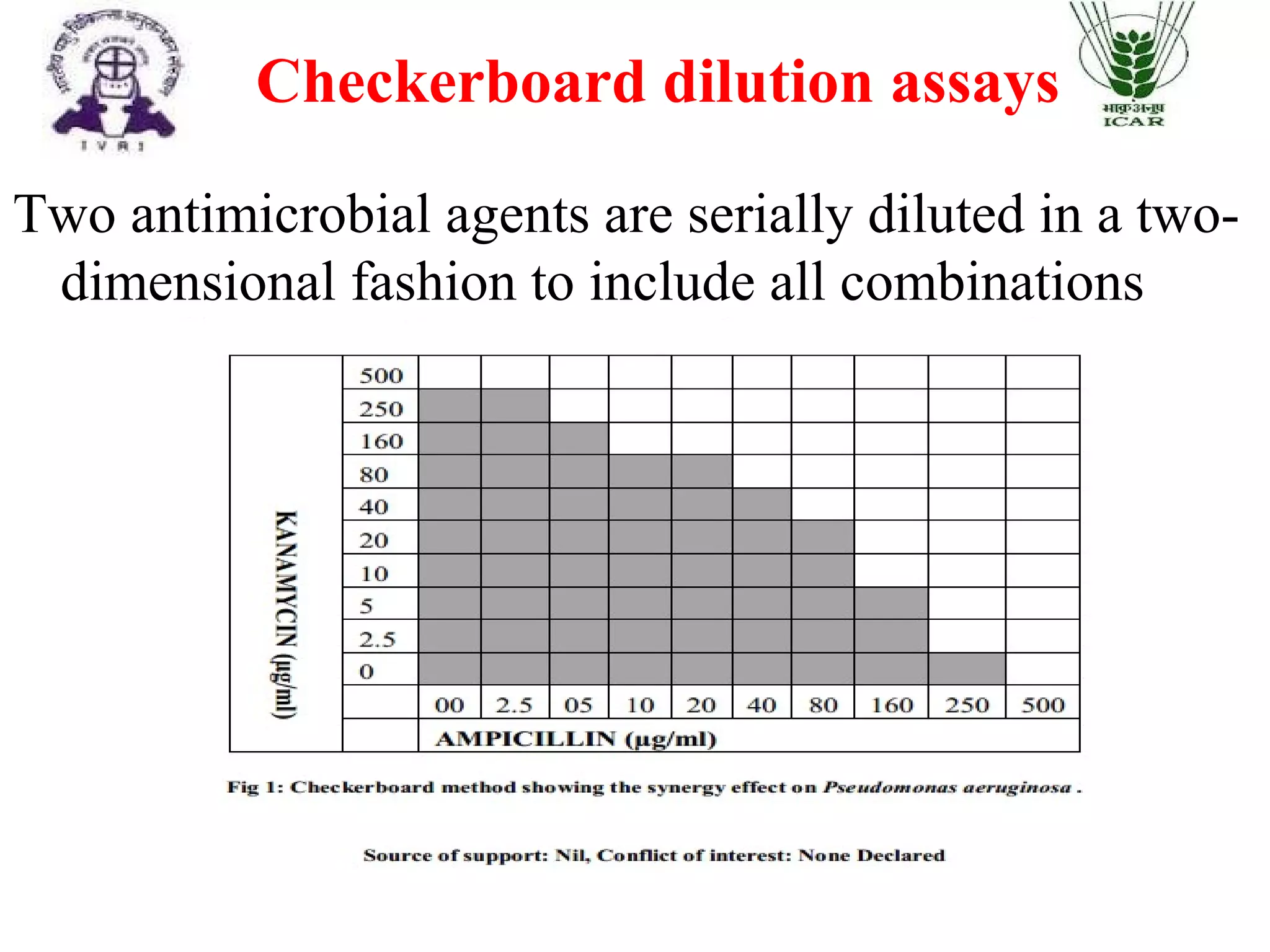
Checkerboard dilution assays
Two antimicrobial agents are serially diluted in a two-
dimensional fashion to include all combinations
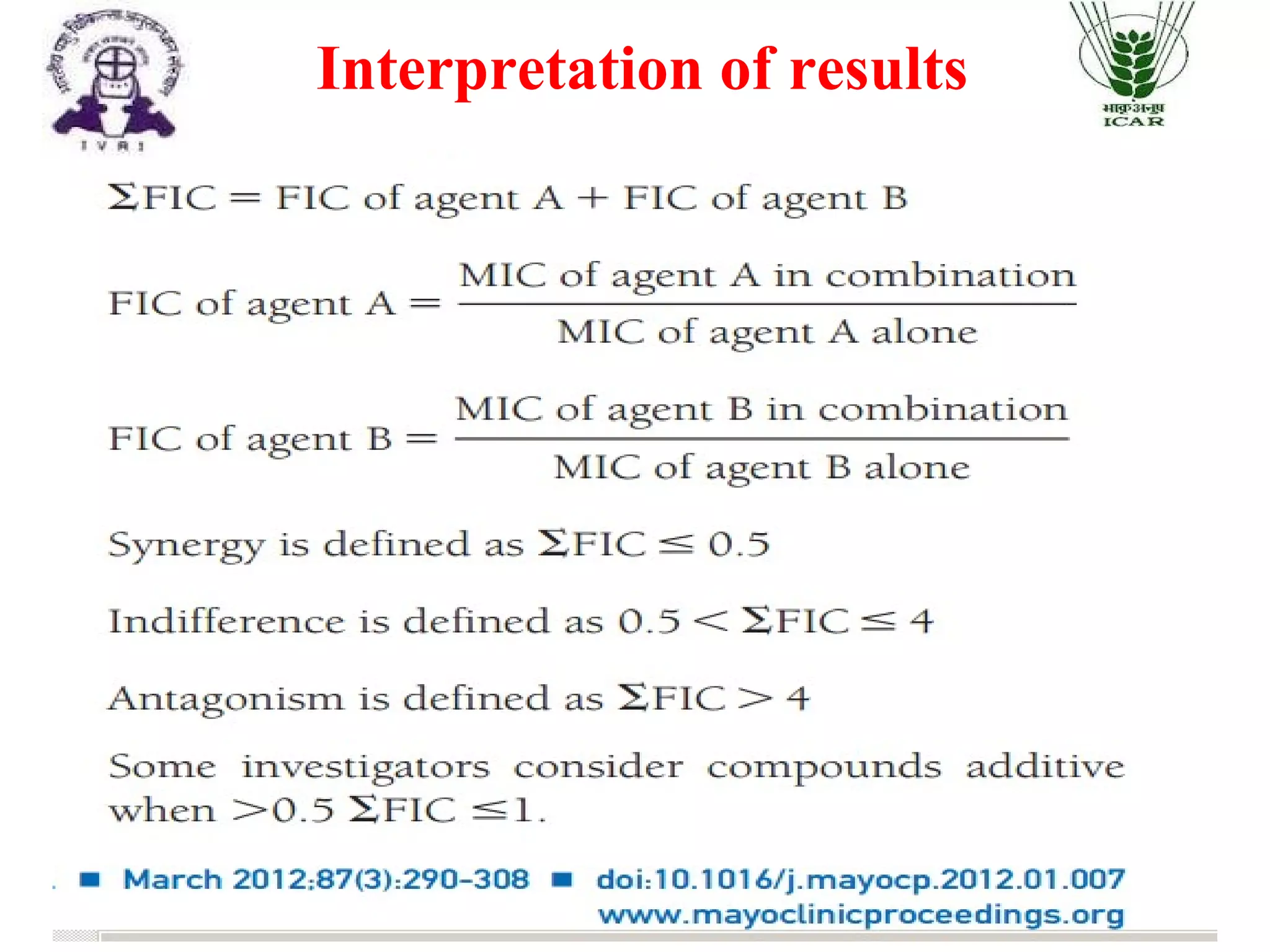
Interpretation of results
Advantages
 Easy test to perform; however, it is merely a gauge of
inhibitory activity.
 Convenience of having prepared panels
 The economy of reagents and space that occurs due to
the miniaturization of the test
 There is also assistance in generating computerized
reports if an automated panel reader is used
Disadvantages
Time-consuming
Labor-intensive
Gradient do not know because dilution in
twofold only
Not validated in clinical trial
The possibility of errors in preparation of the
antibiotic Solutions
 The relatively large amount of reagents and
space required for each test
Time kill curve method
• Killing effect of drug can be expressed as rate
of killing of microbes by fixed concentration
of drug under controlled conditions.
• The rate of killing is determined by counting
the viable bacteria at various time interval.
• Resulting graphical depiction is called as time-
kill curve
• Has been used in evaluation of antibacterial
drug interaction
Time kill method for synergistic
action of drug
 MIC of each antibacterial agent is determined
 Broth-macrodilution of agent.
Containing single agent ranging from 1/4X to 2X of MIC
Containing two agents with different concentration ranging
from 1/4X to 2X of MIC as in checkerboard
A defined inoculum of the strain (5×10⁵
colony forming
units/ml) is then inoculated into the tubes.
Aliquots of the samples from 0 hours of incubation to 24
hrs are collected.
Aliquots are serially diluted, inoculated on plate & cfu/ ml
are calculated in all preparations.
Interpretation
Results are plotted on semi-log curve
• Synergy was defined as a ≥100-fold or 2 log10decrease
in colony count at 24 h by the combination compared
with that by the most active single agent and as a ≥
100-fold decrease in colony count compared with the
starting inoculum.
• Antagonism was defined as a ≥ 100-fold increase in
colony count at 24 h by the combination compared
with that by the most active drug alone.
Advantages
 The time-kill method of synergy testing
assesses bactericidal activity
 Tests bactericidal concentrations
 Methodology defined by National Committee
on Clinical Laboratory Standards
Disadvantages
Time-consuming
Labor-intensive
A limited number of agents can be tested.
E (epsilometer) test
 The Epsilometer, or E test:- Agar diffusion method for
performing antimicrobial susceptibility testing.
 It employs strips coated with a continuous concentration
gradient of a specific antimicrobial agent that is placed on
an agar plate inoculated with the bacterial strain of interest.
 After overnight incubation, elliptical zone of ‘no growth’
develops around the strip.
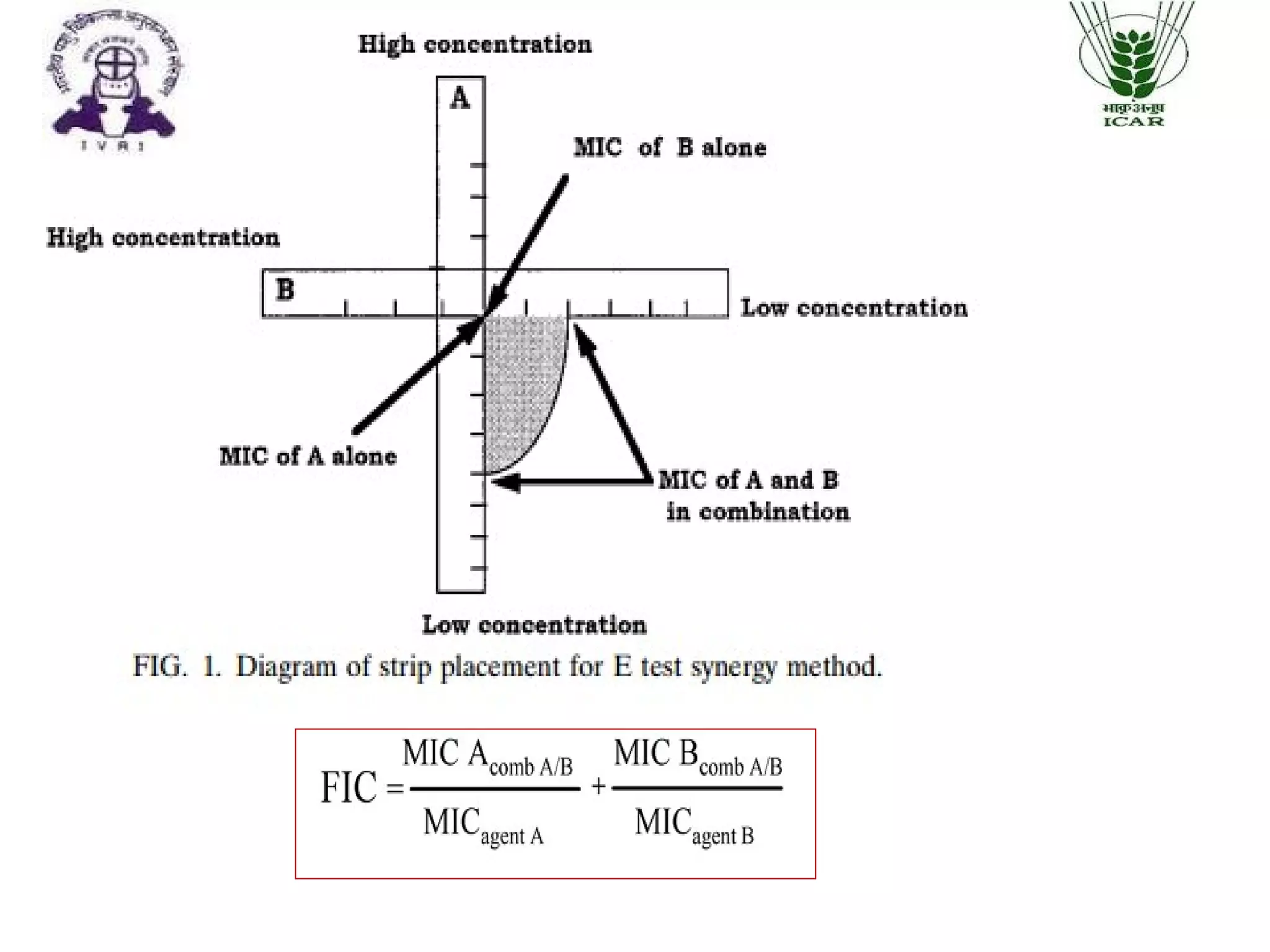
 Interpretation of the MIC:- Read at the intersection of the
zone of lysis with the strip.
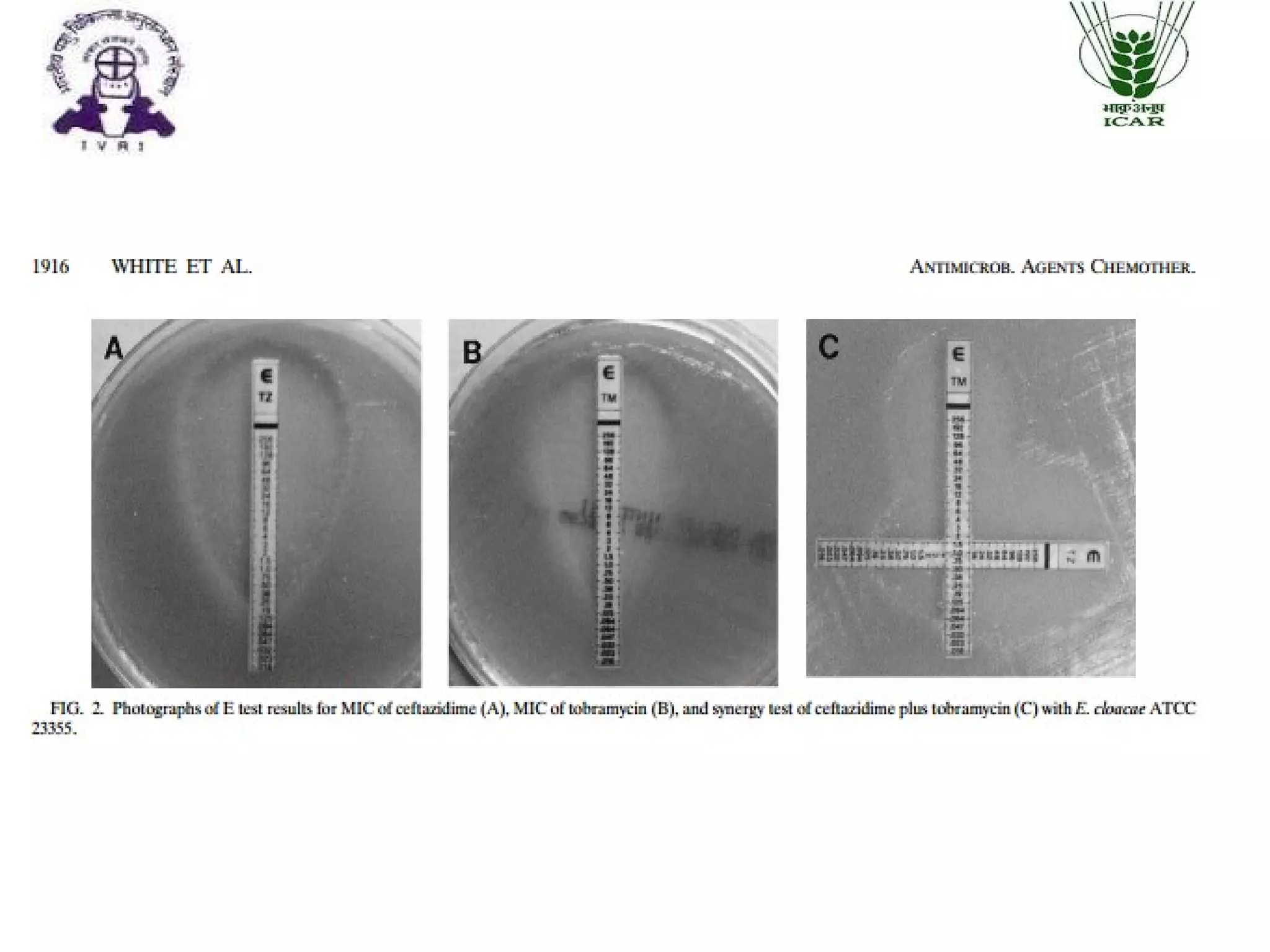
 To assess synergy, two strips of different agents are placed
at 90° at the intersection of the MIC of each agent for the
bacterial strain of interest
 Commercially available
 Quantitative test
 Can be performed in clinical microbiology laboratories
 Simplicity that does not require any special equipment.
 The provision of categorical results easily interpreted by all
clinicians.
 Flexibility in selection of disks for testing.
Disadvantages
Advantages
 Tests bacteriostatic concentrations
 The lack of mechanization or automation of the test
 All fastidious and slow growing bacteria can not be
accurately tested by this method.
 MCBT combines two or three drugs in microtitre wells.
 The peak serum concentration of each agent is tested and the
bactericidal activities determined.
 To detect synergy, one, two or three agents are added to the
appropriate wells, and a standardized inoculum (5×10⁵
colony
forming units/ml) of the bacterial strain of interest is added to
each well, the plates then being incubated. Wells without visible
turbidity are sampled by streaking a 10 µl aliquot on an agar
plate, incubating the plate for a day and observing for 99.9%
killing (bactericidal activity).
 Synergistic activity:- Those combinations with demonstrable
bactericidal activity reveals synergism.
Multiple combination bactericidal
testing (MCBT)
Advantages
Tests bactericidal concentrations.
Disadvantages
 Tests peak serum concentrations, which may not reflect
concentrations obtained in vivo.

Methods for Determining Fractional Inhibitory Concentration (FIC)

  • 1.
    Gulam Mohd & Bhoj RSingh Division of Epidemiology Indian Veterinary Research Institute, Izatnagar- 243 122, India Gulam Mohd & Bhoj R Singh Division of Epidemiology Indian Veterinary Research Institute, Izatnagar- 243 122, India Methods for Determining Fractional Inhibitory Concentration (FIC) Test to determine interaction between two or more drugs intended to be used in combination
  • 2.
    • Fractional inhibitoryconcentration (FIC):- It is the test to estimate the interaction between two or more drugs intended to be used in combination. • Purpose: Testing new antimicrobial agents in combination with existing for determining the Synergistic effect, Additive effect and Antagonism. Why FIC is measured ?
  • 3.
    Combination therapy anddrug interaction Synergistic Effect: When two drugs are used in combination. At least one of the two drugs must show minimum 4-fold increase in antibacterial activities (or a decrease in minimum inhibitory concentration, MIC to ¼). Additive Effect: When two antimicrobial agents with the same mechanisms of action are used the effect is usually additive . Antagonism: Usually bacteriostatic antibiotics are antagonistic to bactericidal agents. (e.g. Chloramphenicol antagonize the bactericidal activities of penicillin in the treatment of Pneumococcal meningitis.
  • 4.
    • To widenthe antibacterial activity of the treatment. • To reduce the probability of selection of resistant mutant. • To get the advantage of synergy of different antibacterial drugs, which may be helpful in reducing the toxic effects associated with large doses of the drugs when used alone. • Common Antibacterial drug combinations: Amoxicillin/ clavulinic acid, Ampicillin/sulbactam, Trimethoprim/ sulfonamide, Trimetoprim/ sulfadimethoxine, Florfenicol/ tylosin etc. (Escudero et al., 1996; Fernández-Varón et al., 2005; Kim et al., 2008) Why combination of drugs?
  • 5.
    Selection of FICmethodology  Ease of performance.  Adaptability to automated or semi-automated platforms.  Cost (economy).  Reliability (repeatability).  Accuracy.
  • 6.
    Methods of synergytesting (White et al., 1996) • Checkerboard dilution assays :- measure of the inhibitory activity • Time kill curve methods :- assesses bactericidal activity • Multiple combination bactericidal testing (MCBT) • Synergy testing using E (epsilometer) tests
  • 7.
    Checkerboard dilution assays Twoantimicrobial agents are serially diluted in a two- dimensional fashion to include all combinations
  • 8.
  • 9.
    Advantages  Easy testto perform; however, it is merely a gauge of inhibitory activity.  Convenience of having prepared panels  The economy of reagents and space that occurs due to the miniaturization of the test  There is also assistance in generating computerized reports if an automated panel reader is used
  • 10.
    Disadvantages Time-consuming Labor-intensive Gradient do notknow because dilution in twofold only Not validated in clinical trial The possibility of errors in preparation of the antibiotic Solutions  The relatively large amount of reagents and space required for each test
  • 11.
    Time kill curvemethod • Killing effect of drug can be expressed as rate of killing of microbes by fixed concentration of drug under controlled conditions. • The rate of killing is determined by counting the viable bacteria at various time interval. • Resulting graphical depiction is called as time- kill curve • Has been used in evaluation of antibacterial drug interaction
  • 12.
    Time kill methodfor synergistic action of drug  MIC of each antibacterial agent is determined  Broth-macrodilution of agent. Containing single agent ranging from 1/4X to 2X of MIC Containing two agents with different concentration ranging from 1/4X to 2X of MIC as in checkerboard A defined inoculum of the strain (5×10⁵ colony forming units/ml) is then inoculated into the tubes. Aliquots of the samples from 0 hours of incubation to 24 hrs are collected. Aliquots are serially diluted, inoculated on plate & cfu/ ml are calculated in all preparations.
  • 13.
    Interpretation Results are plottedon semi-log curve • Synergy was defined as a ≥100-fold or 2 log10decrease in colony count at 24 h by the combination compared with that by the most active single agent and as a ≥ 100-fold decrease in colony count compared with the starting inoculum. • Antagonism was defined as a ≥ 100-fold increase in colony count at 24 h by the combination compared with that by the most active drug alone.
  • 14.
    Advantages  The time-killmethod of synergy testing assesses bactericidal activity  Tests bactericidal concentrations  Methodology defined by National Committee on Clinical Laboratory Standards Disadvantages Time-consuming Labor-intensive A limited number of agents can be tested.
  • 15.
    E (epsilometer) test The Epsilometer, or E test:- Agar diffusion method for performing antimicrobial susceptibility testing.  It employs strips coated with a continuous concentration gradient of a specific antimicrobial agent that is placed on an agar plate inoculated with the bacterial strain of interest.  After overnight incubation, elliptical zone of ‘no growth’ develops around the strip.  Interpretation of the MIC:- Read at the intersection of the zone of lysis with the strip.  To assess synergy, two strips of different agents are placed at 90° at the intersection of the MIC of each agent for the bacterial strain of interest
  • 18.
     Commercially available Quantitative test  Can be performed in clinical microbiology laboratories  Simplicity that does not require any special equipment.  The provision of categorical results easily interpreted by all clinicians.  Flexibility in selection of disks for testing. Disadvantages Advantages  Tests bacteriostatic concentrations  The lack of mechanization or automation of the test  All fastidious and slow growing bacteria can not be accurately tested by this method.
  • 19.
     MCBT combinestwo or three drugs in microtitre wells.  The peak serum concentration of each agent is tested and the bactericidal activities determined.  To detect synergy, one, two or three agents are added to the appropriate wells, and a standardized inoculum (5×10⁵ colony forming units/ml) of the bacterial strain of interest is added to each well, the plates then being incubated. Wells without visible turbidity are sampled by streaking a 10 µl aliquot on an agar plate, incubating the plate for a day and observing for 99.9% killing (bactericidal activity).  Synergistic activity:- Those combinations with demonstrable bactericidal activity reveals synergism. Multiple combination bactericidal testing (MCBT)
  • 20.
    Advantages Tests bactericidal concentrations. Disadvantages Tests peak serum concentrations, which may not reflect concentrations obtained in vivo.