MICROBIOLOGY
ANTIMICROBIAL TECHNIQUE
         MEMBERS :
    IMRAN KHAN SULAIMAN
       CHE ABDUL HALIM
        MUHD HUZAIFAH
     NURUL ATIQA IBRAHIM
     NADHIRAHTUL HUSNA
          NOR ZAFIFAH
         ROSE AMALINA
What is antimicrobial ?


             • kills or inhibits the growth
                of microorganism such
                       as bacteria
                  , fungi, or protozoa
kill microbes
     (microbiocidal)


prevent growth of
microbes (microbiostatic).
antimicrobial substances
used on non-living objects
   or outside the body.
Why antimicrobial technique is needed ?

• Bacteria have the ability to
  develop resistance following
  repeated or subclinical
  (insufficient) doses
• so more advanced
  antibiotics and synthetic
  antimicrobials are
  continually required to
  overcome them.
Technique in testing for Antibiotic
                sensitivity
• The method includes several steps including :
• obtaining a bacterial sample
• identifying the type of bacteria in the bacterial
  sample
• selecting a set of antibiotics based on the
  identity of the bacteria in the bacterial sample
• obtaining a control sample from the bacterial
  sample
Antimicrobial technique .
           ..
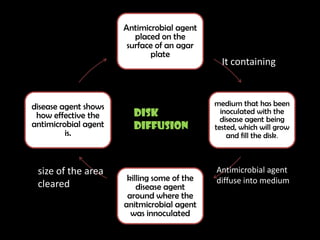
Antimicrobial agent
                         placed on the
                       surface of an agar
                             plate
                                               It containing


disease agent shows                          medium that has been
                        Disk                   inoculated with the
 how effective the                             disease agent being
antimicrobial agent     diffusion            tested, which will grow
         is.                                     and fill the disk.


 size of the area                            Antimicrobial agent
                       killing some of the   diffuse into medium
 cleared                  disease agent
                       around where the
                      anitmicrobial agent
                        was innoculated
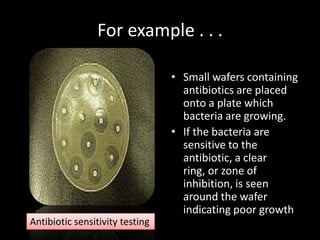
For example . . .

                                 • Small wafers containing
                                   antibiotics are placed
                                   onto a plate which
                                   bacteria are growing.
                                 • If the bacteria are
                                   sensitive to the
                                   antibiotic, a clear
                                   ring, or zone of
                                   inhibition, is seen
                                   around the wafer
                                   indicating poor growth
Antibiotic sensitivity testing
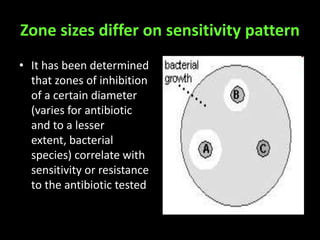
Zone sizes differ on sensitivity pattern
• It has been determined
  that zones of inhibition
  of a certain diameter
  (varies for antibiotic
  and to a lesser
  extent, bacterial
  species) correlate with
  sensitivity or resistance
  to the antibiotic tested
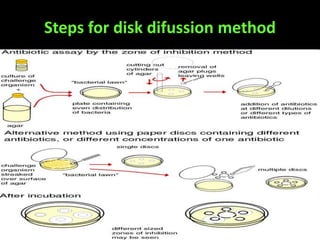
Steps for disk difussion method
Epsilometer test
• to determine whether or not a specific strain
  of bacterium or fungus is susceptible to the
  action of a specific antibiotic.
• commonly used in the setting of
  medicine, where a particular organism has
  been found to infect a patient, and the
  doctor treating the patient is seeking
  guidance on what concentration of antibiotic
  is suitable.
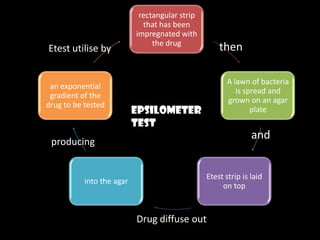
rectangular strip
                             that has been
                           impregnated with
                                the drug
Etest utilise by                                    then

                                                       A lawn of bacteria
 an exponential
                                                          is spread and
 gradient of the
                                                       grown on an agar
drug to be tested
                           Epsilometer                         plate
                           test
                                                               and
 producing


                                                Etest strip is laid
           into the agar
                                                     on top


                           Drug diffuse out
As a result . . .
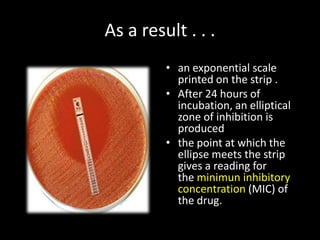
         • an exponential scale
           printed on the strip .
         • After 24 hours of
           incubation, an elliptical
           zone of inhibition is
           produced
         • the point at which the
           ellipse meets the strip
           gives a reading for
           the minimun inhibitory
           concentration (MIC) of
           the drug.
Dilution plating technique

• to reduce the concentration of
  microscopic organisms or cells in a
  sample
• A series of cultures is tested with
  various concentration pf an antibiotic
  to determine minimum inhibiting
  concentration of antibiotic
spread bacteria over a
                     wide area


The numbers of bacteria
                               count the number of
  colonies that grow on
                                colonies that grow
 each plate are counted


                bacterial cell in the
              original sample should
              produce a single colony
Stokes’ Method
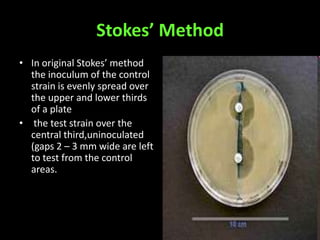
• In original Stokes’ method
  the inoculum of the control
  strain is evenly spread over
  the upper and lower thirds
  of a plate
• the test strain over the
  central third,uninoculated
  (gaps 2 – 3 mm wide are left
  to test from the control
  areas.
For example . .
• In the Stokes controlled
  sensitivity test, a control
  organism is inoculated on part of
  a plate
• the test organism is plated on
  the remainder.
• Disks are placed at the interface
  and the zones of inhibition are
  compared.
• The use of a sensitive control
  shows that the antibiotic is active
• if the test organism grows up to
  the disk it may safely be assumed
  that the test organism is resistant
  to that drug.
Testing Minimum Inhibitory
                Concentration
• In alternative measure of susceptibility is to
  determine the Minimum Inhibitory Concentration
  (MIC) and the Minimum Bactericidal Concentration
  (MBC) of a drug.
• Both are mixed with serially diluted antibiotic
  solutions and a standard inoculum is applied.
• After incubation, the MIC is the first broth in which
  growth of the organism has been
What is Minimum
Inhibitory concentration
• Minimum inhibitory concentration (MIC), in is
  the lowest concentration of an antimicrobial
  that will inhibit the visible growth of a micro
  organism after overnight incubation.
• Minimum inhibitory concentrations are
  important in diagnostic laboratories to
  confirm resistance of micro organisms to an
  antimicrobial agent and also to monitor the
  activity of new antimicrobial agents.
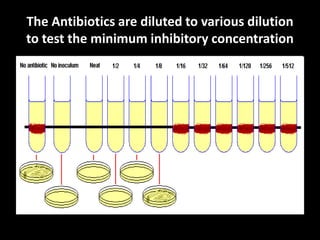
The Antibiotics are diluted to various dilution
to test the minimum inhibitory concentration
antimicrobial technique

antimicrobial technique

  • 1.
    MICROBIOLOGY ANTIMICROBIAL TECHNIQUE MEMBERS : IMRAN KHAN SULAIMAN CHE ABDUL HALIM MUHD HUZAIFAH NURUL ATIQA IBRAHIM NADHIRAHTUL HUSNA NOR ZAFIFAH ROSE AMALINA
  • 2.
    What is antimicrobial? • kills or inhibits the growth of microorganism such as bacteria , fungi, or protozoa
  • 3.
    kill microbes (microbiocidal) prevent growth of microbes (microbiostatic).
  • 4.
    antimicrobial substances used onnon-living objects or outside the body.
  • 5.
    Why antimicrobial techniqueis needed ? • Bacteria have the ability to develop resistance following repeated or subclinical (insufficient) doses • so more advanced antibiotics and synthetic antimicrobials are continually required to overcome them.
  • 7.
    Technique in testingfor Antibiotic sensitivity • The method includes several steps including : • obtaining a bacterial sample • identifying the type of bacteria in the bacterial sample • selecting a set of antibiotics based on the identity of the bacteria in the bacterial sample • obtaining a control sample from the bacterial sample
  • 8.
  • 9.
    Antimicrobial agent placed on the surface of an agar plate It containing disease agent shows medium that has been Disk inoculated with the how effective the disease agent being antimicrobial agent diffusion tested, which will grow is. and fill the disk. size of the area Antimicrobial agent killing some of the diffuse into medium cleared disease agent around where the anitmicrobial agent was innoculated
  • 10.
    For example .. . • Small wafers containing antibiotics are placed onto a plate which bacteria are growing. • If the bacteria are sensitive to the antibiotic, a clear ring, or zone of inhibition, is seen around the wafer indicating poor growth Antibiotic sensitivity testing
  • 11.
    Zone sizes differon sensitivity pattern • It has been determined that zones of inhibition of a certain diameter (varies for antibiotic and to a lesser extent, bacterial species) correlate with sensitivity or resistance to the antibiotic tested
  • 12.
    Steps for diskdifussion method
  • 13.
    Epsilometer test • todetermine whether or not a specific strain of bacterium or fungus is susceptible to the action of a specific antibiotic. • commonly used in the setting of medicine, where a particular organism has been found to infect a patient, and the doctor treating the patient is seeking guidance on what concentration of antibiotic is suitable.
  • 14.
    rectangular strip that has been impregnated with the drug Etest utilise by then A lawn of bacteria an exponential is spread and gradient of the grown on an agar drug to be tested Epsilometer plate test and producing Etest strip is laid into the agar on top Drug diffuse out
  • 15.
    As a result. . . • an exponential scale printed on the strip . • After 24 hours of incubation, an elliptical zone of inhibition is produced • the point at which the ellipse meets the strip gives a reading for the minimun inhibitory concentration (MIC) of the drug.
  • 16.
    Dilution plating technique •to reduce the concentration of microscopic organisms or cells in a sample • A series of cultures is tested with various concentration pf an antibiotic to determine minimum inhibiting concentration of antibiotic
  • 17.
    spread bacteria overa wide area The numbers of bacteria count the number of colonies that grow on colonies that grow each plate are counted bacterial cell in the original sample should produce a single colony
  • 18.
    Stokes’ Method • Inoriginal Stokes’ method the inoculum of the control strain is evenly spread over the upper and lower thirds of a plate • the test strain over the central third,uninoculated (gaps 2 – 3 mm wide are left to test from the control areas.
  • 19.
    For example .. • In the Stokes controlled sensitivity test, a control organism is inoculated on part of a plate • the test organism is plated on the remainder. • Disks are placed at the interface and the zones of inhibition are compared. • The use of a sensitive control shows that the antibiotic is active • if the test organism grows up to the disk it may safely be assumed that the test organism is resistant to that drug.
  • 20.
    Testing Minimum Inhibitory Concentration • In alternative measure of susceptibility is to determine the Minimum Inhibitory Concentration (MIC) and the Minimum Bactericidal Concentration (MBC) of a drug. • Both are mixed with serially diluted antibiotic solutions and a standard inoculum is applied. • After incubation, the MIC is the first broth in which growth of the organism has been
  • 21.
    What is Minimum Inhibitoryconcentration • Minimum inhibitory concentration (MIC), in is the lowest concentration of an antimicrobial that will inhibit the visible growth of a micro organism after overnight incubation. • Minimum inhibitory concentrations are important in diagnostic laboratories to confirm resistance of micro organisms to an antimicrobial agent and also to monitor the activity of new antimicrobial agents.
  • 22.
    The Antibiotics arediluted to various dilution to test the minimum inhibitory concentration