E-test (Gradient Diffusion)
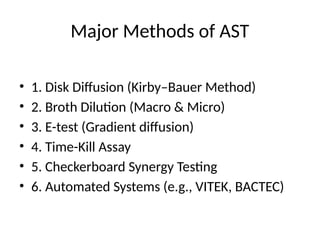
•Combines principles of diffusion and dilution.
• Plastic strip with predefined antibiotic
gradient on inoculated agar.
• MIC read at point where elliptical zone
intersects strip.
7.
Time-Kill Assay
• Purpose:Study bactericidal activity over time.
• Method: Count viable cells at intervals after
antibiotic exposure.
• Interpretation:
• • 3-log₁₀ CFU/mL reduction = bactericidal
• • Synergy = ≥2-log₁₀ CFU/mL reduction vs
single agent
8.
Checkerboard Synergy Testing
•Used for evaluating antibiotic combinations.
• Principle: Two drugs tested in 2D dilution
matrix.
• Result expressed as FIC Index (FICI):
• • FICI ≤ 0.5 → Synergy
• • FICI > 4.0 → Antagonism
9.
Interpretation & Reporting
•Follow CLSI M7-A6 standards.
• Interpret MIC or zone size using breakpoints.
• Report categories:
• • S – Susceptible
• • I – Intermediate
• • R – Resistant
• Confirm atypical resistance (e.g., ESBL, MRSA,
VRE).
10.
Quality Control
• QCStrains: E. coli ATCC 25922, S. aureus ATCC
25923, etc.
• Check media pH, disk potency, and inoculum
density.
• Maintain QC logs and investigate deviations.
11.
Limitations
• In vitroresults may not always predict in vivo
outcomes.
• Resistant subpopulations may be missed.
• Fastidious organisms may need special
methods.