Mesopotamia:    “The Cradle of Civilization”
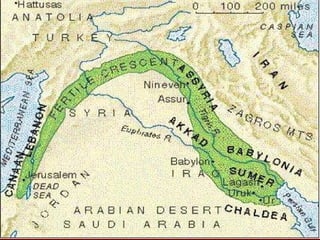
Earliest Civilization:  the Fertile Crescent earliest of all civilizations  permanent settlements Mesopotamia Greek for  “between the rivers” Tigris River and Euphrates River   present day Iraq Lasted for approximately 3000 years Its peoples were the first to invent the wheel work with metal devise a written law code irrigate fields devise a system of writing develop mathematics
 
Geographic Conditions Little rainfall  Hot and dry climate  Wind and rain storms muddy river valleys in winter catastrophic flooding in spring Arid soil containing little minerals No stone or timber resources
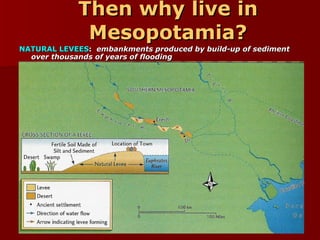
Then why live in Mesopotamia? NATURAL LEVEES :  embankments produced by build-up of sediment over thousands of years of flooding
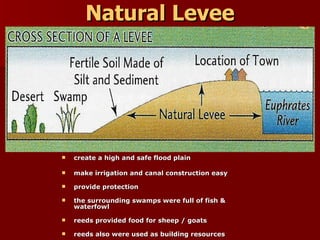
Natural Levee create a high and safe flood plain  make irrigation and canal construction easy  provide protection the surrounding swamps were full of fish &  waterfowl  reeds provided food for sheep / goats  reeds also were used as building resources
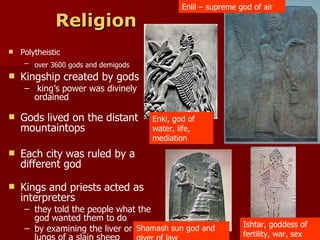
Religion Polytheistic  over 3600 gods and demigods   Kingship created by gods  king’s power was divinely ordained Gods lived on the distant mountaintops  Each city was ruled by a different god  Kings and priests acted as interpreters  they told the people what the god wanted them to do  by examining the liver or lungs of a slain sheep Ishtar, goddess of fertility, war, sex Enki, god of water, life, mediation Enlil – supreme god of air Shamash sun god and giver of law
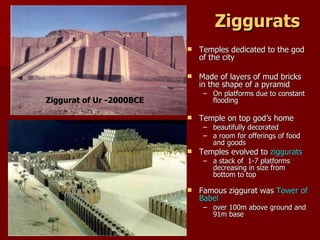
Ziggurats Temples dedicated to the god of the city Made of layers of mud bricks in the shape of a pyramid  On platforms due to constant flooding Temple on top god’s home beautifully decorated a room for offerings of food and goods Temples evolved to  ziggurats   a stack of  1-7 platforms decreasing in size from bottom to top Famous ziggurat was  Tower of Babel   over 100m above ground and 91m base Ziggurat of Ur -2000BCE
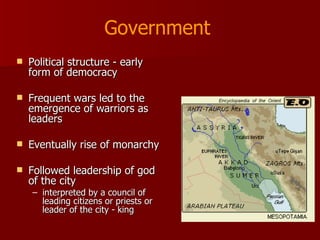
Political structure - early form of democracy Frequent wars led to the emergence of warriors as leaders Eventually rise of monarchy Followed leadership of god of the city  interpreted by a council of leading citizens or priests or leader of the city - king Government
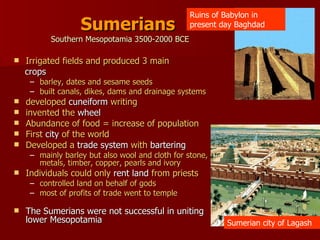
Sumerians Southern Mesopotamia 3500-2000 BCE Irrigated fields and produced 3 main crops  barley, dates and sesame seeds built canals, dikes, dams and drainage systems developed  cuneiform  writing invented the  wheel Abundance of food = increase of population First  city  of the world Developed a  trade system  with  bartering mainly barley but also wool and cloth for stone, metals, timber, copper, pearls and ivory Individuals could only  rent land  from priests controlled land on behalf of gods most of profits of trade went to temple The Sumerians were not successful in uniting lower Mesopotamia Ruins of Babylon in present day Baghdad Sumerian city of Lagash
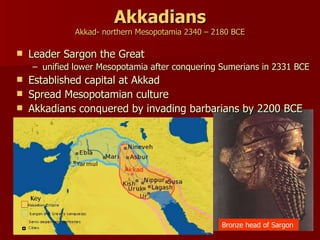
Akkadians Akkad- northern Mesopotamia 2340 – 2180 BCE Leader Sargon the Great unified lower Mesopotamia after conquering Sumerians in 2331 BCE Established capital at Akkad Spread Mesopotamian culture  Akkadians conquered by invading barbarians by 2200 BCE Bronze head of Sargon
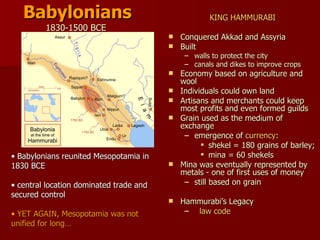
Babylonians 1830-1500 BCE  KING HAMMURABI Conquered Akkad and Assyria  Built  walls to protect the city  canals and dikes to improve crops Economy based on agriculture and wool  Individuals could own land  Artisans and merchants could keep most profits and even formed guilds  Grain used as the medium of exchange  emergence of  currency :  shekel = 180 grains of barley; mina = 60 shekels Mina was eventually represented by metals - one of first uses of money  still based on grain Hammurabi’s Legacy law code Babylonians reunited Mesopotamia in 1830 BCE central location dominated trade and secured control YET AGAIN, Mesopotamia was not unified for long…
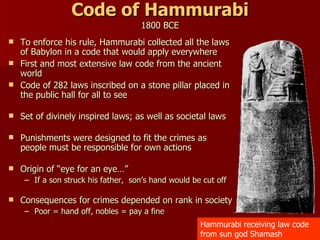
Code of Hammurabi 1800 BCE To enforce his rule, Hammurabi collected all the laws of Babylon in a code that would apply everywhere First and most extensive law code from the ancient world  Code of 282 laws inscribed on a stone pillar placed in the public hall for all to see Set of divinely inspired laws; as well as societal laws Punishments were designed to fit the crimes as people must be responsible for own actions  Origin of “eye for an eye…”  If a son struck his father,  son’s hand would be cut off Consequences for crimes depended on rank in society  Poor = hand off, nobles = pay a fine Hammurabi receiving law code from sun god Shamash
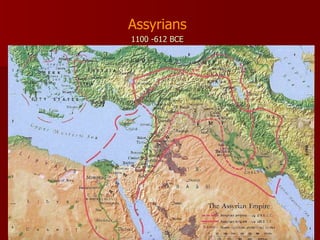
City of  Assur - became important trading and political centre After Hammurabi’s death, Babylon fell apart and kings of Assur controlled more of surrounding area and came to dominate  Made conquered lands pay  taxes  food, animals, metals or timber Rule by fear first to have a  permanent army  made up of professional soldiers  estimated 200 000 men Iron  changed lifestyles in Mesopotamia  replaced wooden wheels and applied to horse drawn chariots Superior weapons States began to revolt  Assyrian Empire collapsed by late 7th century BCE By 539 BCE, Mesopotamia was part of the vast Persian Empire  Led by Cyrus the Great Persian Empire dominated for 800 years until Alexander the Great Assyrians 1100 -612 BCE
Development Of  WRITING
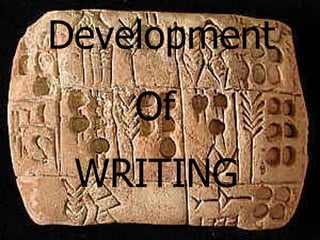
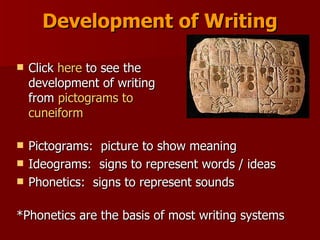
Development of Writing Click  here  to see the  development of writing from  pictograms to  cuneiform Pictograms:  picture to show meaning  Ideograms:  signs to represent words / ideas Phonetics:  signs to represent sounds *Phonetics are the basis of most writing systems
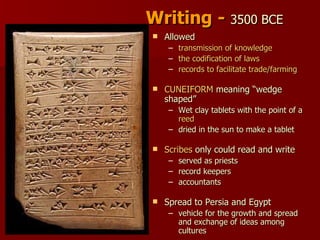
Writing -  3500 BCE Allowed transmission of knowledge the codification of laws records to facilitate trade/farming CUNEIFORM  meaning “wedge shaped” Wet clay tablets with the point of a  reed dried in the sun to make a tablet Scribes  only could read and write  served as priests record keepers accountants Spread to Persia and Egypt  vehicle for the growth and spread and exchange of ideas among cultures
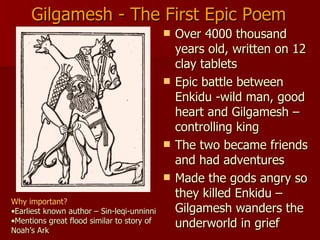
Gilgamesh - The First Epic Poem Over 4000 thousand years old, written on 12 clay tablets Epic battle between Enkidu -wild man, good heart and Gilgamesh – controlling king The two became friends and had adventures Made the gods angry so they killed Enkidu – Gilgamesh wanders the underworld in grief Why important? Earliest known author – Sin-leqi-unninni Mentions great flood similar to story of Noah’s Ark
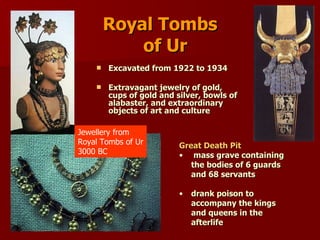
Royal Tombs   of Ur Excavated from 1922 to 1934  Extravagant jewelry of gold, cups of gold and silver, bowls of alabaster, and extraordinary objects of art and culture  Jewellery from Royal Tombs of Ur 3000 BC Great Death Pit   mass grave containing the bodies of 6 guards and 68 servants drank poison to accompany the kings and queens in the afterlife
Mathematics and Science Mesopotamia, specifically Babylon used a mathematical system based on sixty  Some parts of the ‘base-sixty’ system still remain today 360 degrees in a circle 60 seconds in a minute  60 minutes in 1 hour Calendar based on cycles of the moon number of days between the appearance of two new moons was set as a month 12 cycles made up a year
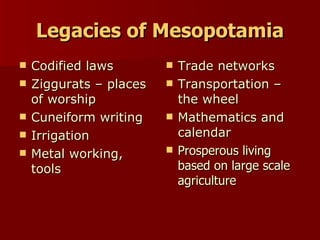
Legacies of Mesopotamia Codified laws Ziggurats – places of worship Cuneiform writing Irrigation Metal working, tools Trade networks Transportation – the wheel Mathematics and calendar Prosperous living based on large scale agriculture

Mesopotamia

  • 1.
    Mesopotamia: “The Cradle of Civilization”
  • 2.
    Earliest Civilization: the Fertile Crescent earliest of all civilizations permanent settlements Mesopotamia Greek for “between the rivers” Tigris River and Euphrates River present day Iraq Lasted for approximately 3000 years Its peoples were the first to invent the wheel work with metal devise a written law code irrigate fields devise a system of writing develop mathematics
  • 3.
  • 4.
    Geographic Conditions Littlerainfall Hot and dry climate Wind and rain storms muddy river valleys in winter catastrophic flooding in spring Arid soil containing little minerals No stone or timber resources
  • 5.
    Then why livein Mesopotamia? NATURAL LEVEES : embankments produced by build-up of sediment over thousands of years of flooding
  • 6.
    Natural Levee createa high and safe flood plain make irrigation and canal construction easy provide protection the surrounding swamps were full of fish & waterfowl reeds provided food for sheep / goats reeds also were used as building resources
  • 7.
    Religion Polytheistic over 3600 gods and demigods Kingship created by gods king’s power was divinely ordained Gods lived on the distant mountaintops Each city was ruled by a different god Kings and priests acted as interpreters they told the people what the god wanted them to do by examining the liver or lungs of a slain sheep Ishtar, goddess of fertility, war, sex Enki, god of water, life, mediation Enlil – supreme god of air Shamash sun god and giver of law
  • 8.
    Ziggurats Temples dedicatedto the god of the city Made of layers of mud bricks in the shape of a pyramid On platforms due to constant flooding Temple on top god’s home beautifully decorated a room for offerings of food and goods Temples evolved to ziggurats a stack of 1-7 platforms decreasing in size from bottom to top Famous ziggurat was Tower of Babel over 100m above ground and 91m base Ziggurat of Ur -2000BCE
  • 9.
    Political structure -early form of democracy Frequent wars led to the emergence of warriors as leaders Eventually rise of monarchy Followed leadership of god of the city interpreted by a council of leading citizens or priests or leader of the city - king Government
  • 10.
    Sumerians Southern Mesopotamia3500-2000 BCE Irrigated fields and produced 3 main crops barley, dates and sesame seeds built canals, dikes, dams and drainage systems developed cuneiform writing invented the wheel Abundance of food = increase of population First city of the world Developed a trade system with bartering mainly barley but also wool and cloth for stone, metals, timber, copper, pearls and ivory Individuals could only rent land from priests controlled land on behalf of gods most of profits of trade went to temple The Sumerians were not successful in uniting lower Mesopotamia Ruins of Babylon in present day Baghdad Sumerian city of Lagash
  • 11.
    Akkadians Akkad- northernMesopotamia 2340 – 2180 BCE Leader Sargon the Great unified lower Mesopotamia after conquering Sumerians in 2331 BCE Established capital at Akkad Spread Mesopotamian culture Akkadians conquered by invading barbarians by 2200 BCE Bronze head of Sargon
  • 12.
    Babylonians 1830-1500 BCE KING HAMMURABI Conquered Akkad and Assyria Built walls to protect the city canals and dikes to improve crops Economy based on agriculture and wool Individuals could own land Artisans and merchants could keep most profits and even formed guilds Grain used as the medium of exchange emergence of currency : shekel = 180 grains of barley; mina = 60 shekels Mina was eventually represented by metals - one of first uses of money still based on grain Hammurabi’s Legacy law code Babylonians reunited Mesopotamia in 1830 BCE central location dominated trade and secured control YET AGAIN, Mesopotamia was not unified for long…
  • 13.
    Code of Hammurabi1800 BCE To enforce his rule, Hammurabi collected all the laws of Babylon in a code that would apply everywhere First and most extensive law code from the ancient world Code of 282 laws inscribed on a stone pillar placed in the public hall for all to see Set of divinely inspired laws; as well as societal laws Punishments were designed to fit the crimes as people must be responsible for own actions Origin of “eye for an eye…” If a son struck his father, son’s hand would be cut off Consequences for crimes depended on rank in society Poor = hand off, nobles = pay a fine Hammurabi receiving law code from sun god Shamash
  • 14.
    City of Assur - became important trading and political centre After Hammurabi’s death, Babylon fell apart and kings of Assur controlled more of surrounding area and came to dominate Made conquered lands pay taxes food, animals, metals or timber Rule by fear first to have a permanent army made up of professional soldiers estimated 200 000 men Iron changed lifestyles in Mesopotamia replaced wooden wheels and applied to horse drawn chariots Superior weapons States began to revolt Assyrian Empire collapsed by late 7th century BCE By 539 BCE, Mesopotamia was part of the vast Persian Empire Led by Cyrus the Great Persian Empire dominated for 800 years until Alexander the Great Assyrians 1100 -612 BCE
  • 15.
  • 16.
    Development of WritingClick here to see the development of writing from pictograms to cuneiform Pictograms: picture to show meaning Ideograms: signs to represent words / ideas Phonetics: signs to represent sounds *Phonetics are the basis of most writing systems
  • 17.
    Writing - 3500 BCE Allowed transmission of knowledge the codification of laws records to facilitate trade/farming CUNEIFORM meaning “wedge shaped” Wet clay tablets with the point of a reed dried in the sun to make a tablet Scribes only could read and write served as priests record keepers accountants Spread to Persia and Egypt vehicle for the growth and spread and exchange of ideas among cultures
  • 18.
    Gilgamesh - TheFirst Epic Poem Over 4000 thousand years old, written on 12 clay tablets Epic battle between Enkidu -wild man, good heart and Gilgamesh – controlling king The two became friends and had adventures Made the gods angry so they killed Enkidu – Gilgamesh wanders the underworld in grief Why important? Earliest known author – Sin-leqi-unninni Mentions great flood similar to story of Noah’s Ark
  • 19.
    Royal Tombs of Ur Excavated from 1922 to 1934 Extravagant jewelry of gold, cups of gold and silver, bowls of alabaster, and extraordinary objects of art and culture Jewellery from Royal Tombs of Ur 3000 BC Great Death Pit mass grave containing the bodies of 6 guards and 68 servants drank poison to accompany the kings and queens in the afterlife
  • 20.
    Mathematics and ScienceMesopotamia, specifically Babylon used a mathematical system based on sixty Some parts of the ‘base-sixty’ system still remain today 360 degrees in a circle 60 seconds in a minute 60 minutes in 1 hour Calendar based on cycles of the moon number of days between the appearance of two new moons was set as a month 12 cycles made up a year
  • 21.
    Legacies of MesopotamiaCodified laws Ziggurats – places of worship Cuneiform writing Irrigation Metal working, tools Trade networks Transportation – the wheel Mathematics and calendar Prosperous living based on large scale agriculture

Editor's Notes

  • #3 Categorized as the earliest of all civilizations as people formed permanent settlements Mesopotamia is a Greek word that means “between the rivers” Specifically, the area between the Tigris River and Euphrates River (present day Iraq) Mesopotamia is not within the "Fertile crescent“, it is in the more desert area that the "Fertile crescent" arcs around
  • #5 Little rainfall for crops Hot and dry climate in the summers Winters brought fierce windstorms leaving muddy river valleys Springs brought catastrophic flooding of the rivers Arid soil containing little minerals No stone or timber resources
  • #8 Shows diversity of religion from different regions Yet all of Mesopotamia shared the same religion and the same prominent gods
  • #9 Important for gods to be honoured by religious ceremonies Ceremonies performed by priests in sacred temples Temples created from mud brick and placed on platforms due to constant flooding Temples evolved to ziggurats- a stack of 1-7 platforms decreasing in size from bottom to top Famous ziggurat was Tower of Babel (over 100m above ground and 91m base)
  • #11 Established the social, economic and intellectual basis of Mesopotamia First to develop writing in the form of cuneiform Sumerians are credited to have invented the wheel Became the first city of the world However, the Sumerians were not successful in uniting lower Mesopotamia
  • #12 Leader: Sargon the Great Sargon’s greatest achievement was the unification of lower Mesopotamia (after conquering Sumerians in 2331 BCE) Established capital at Akkad Spread Mesopotamian culture throughout Fertile Crescent Yet dynasty established by Sargon was short-lived… Akkadians were conquered by the invading barbarians by 2200 BCE
  • #15 10 th century BCE, Assyria emerged as dominant force Assyrian reunited Mesopotamia and established the first true empire Assyrian army was most feared due to their brutal, bloodthirsty & terrorizing tactics and use of iron weapons, battering rams, chariots Assyrian Empire stretched from Persian Gulf north and West to Syria, Palestine and Egypt However, states began to revolt and ONCE AGAIN, Assyrian Empire collapsed by late 7 th century BCE By 539 BCE, Mesopotamia part of the vast Persian Empire (led by Cyrus the Great) Persian Empire dominated for 800 years until Alexander the Great
  • #20 From 1922 to 1934, an archaeologist named C. Leonard Woolley excavated the site of the ancient Sumerian city of Ur City famed in Bible as the home of patriarch Abraham many great discoveries such as extravagant jewelry of gold, cups of gold and silver, bowls of alabaster, and extraordinary objects of art and culture opened the world's eyes to the full glory of ancient Sumerian culture Great Death Pit Found at Ur was a mass grave containing the bodies of 6 guards and 68 court ladies (servants of kings and queens) servants walked down into the grave in a great funeral procession they drank a   poisoned  drink and fell asleep never to wake again, choosing to accompany the kings and queens in the afterlife
  • #22 codified laws the concept of kinship and the city-state the building of places of worship (ziggurats) the birthplace of writing (cuneiform) Invention of the wheel Oldest written records of a story of creation date back to Mesopotamia First civilization to make a prosperous living based on large scale agriculture