Mesopotamia
5000 BCE – 600 BCE
Overview: Mesopotamia
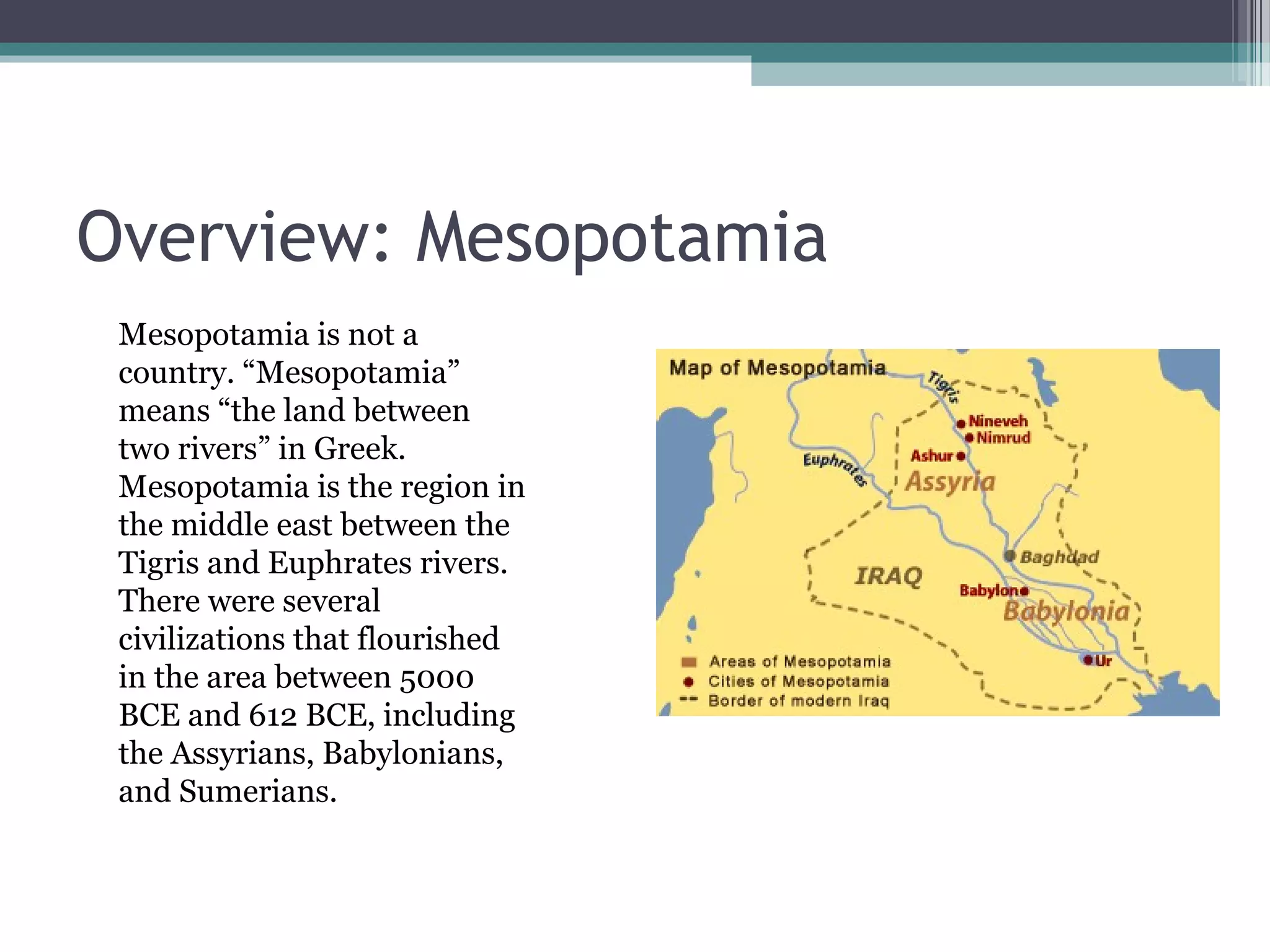
 Mesopotamia is not a
 country. “Mesopotamia”
 means “the land between
 two rivers” in Greek.
 Mesopotamia is the region in
 the middle east between the
 Tigris and Euphrates rivers.
 There were several
 civilizations that flourished
 in the area between 5000
 BCE and 612 BCE, including
 the Assyrians, Babylonians,
 and Sumerians.
Timeline: 4 major kingdoms of
Mesopotamia
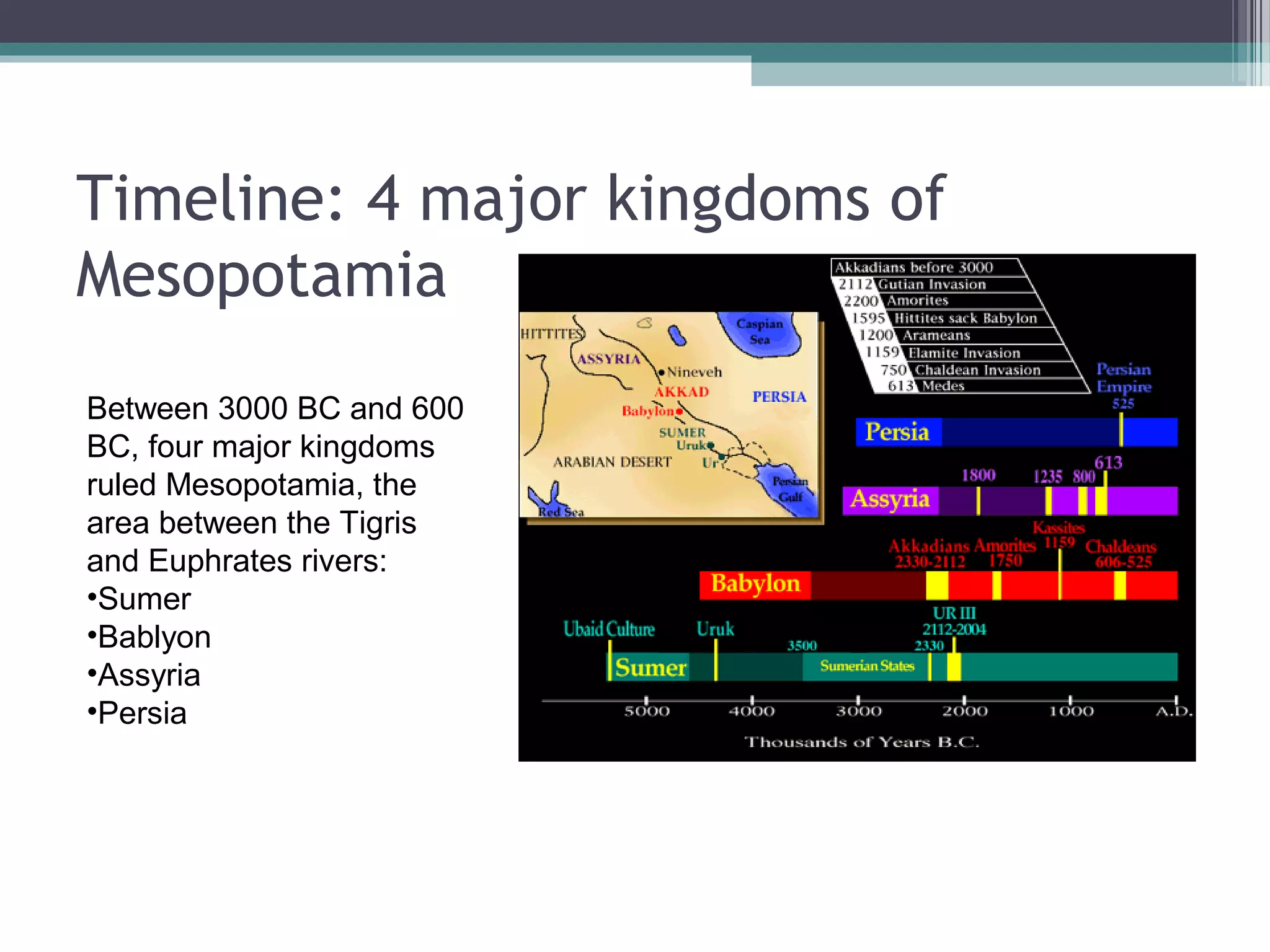
Between 3000 BC and 600
BC, four major kingdoms
ruled Mesopotamia, the
area between the Tigris
and Euphrates rivers:
•Sumer
•Bablyon
•Assyria
•Persia
Location: Modern-day Iraq
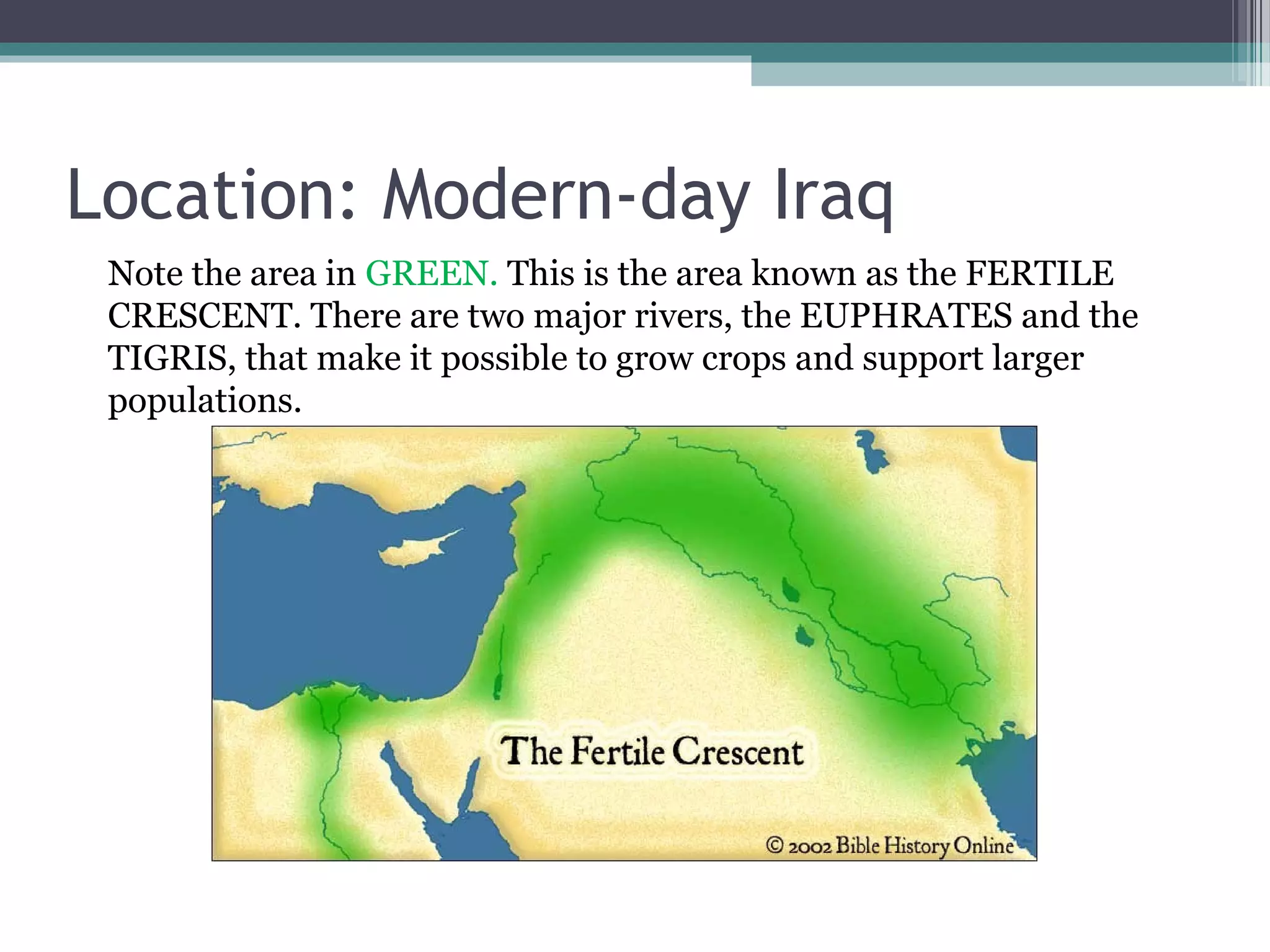
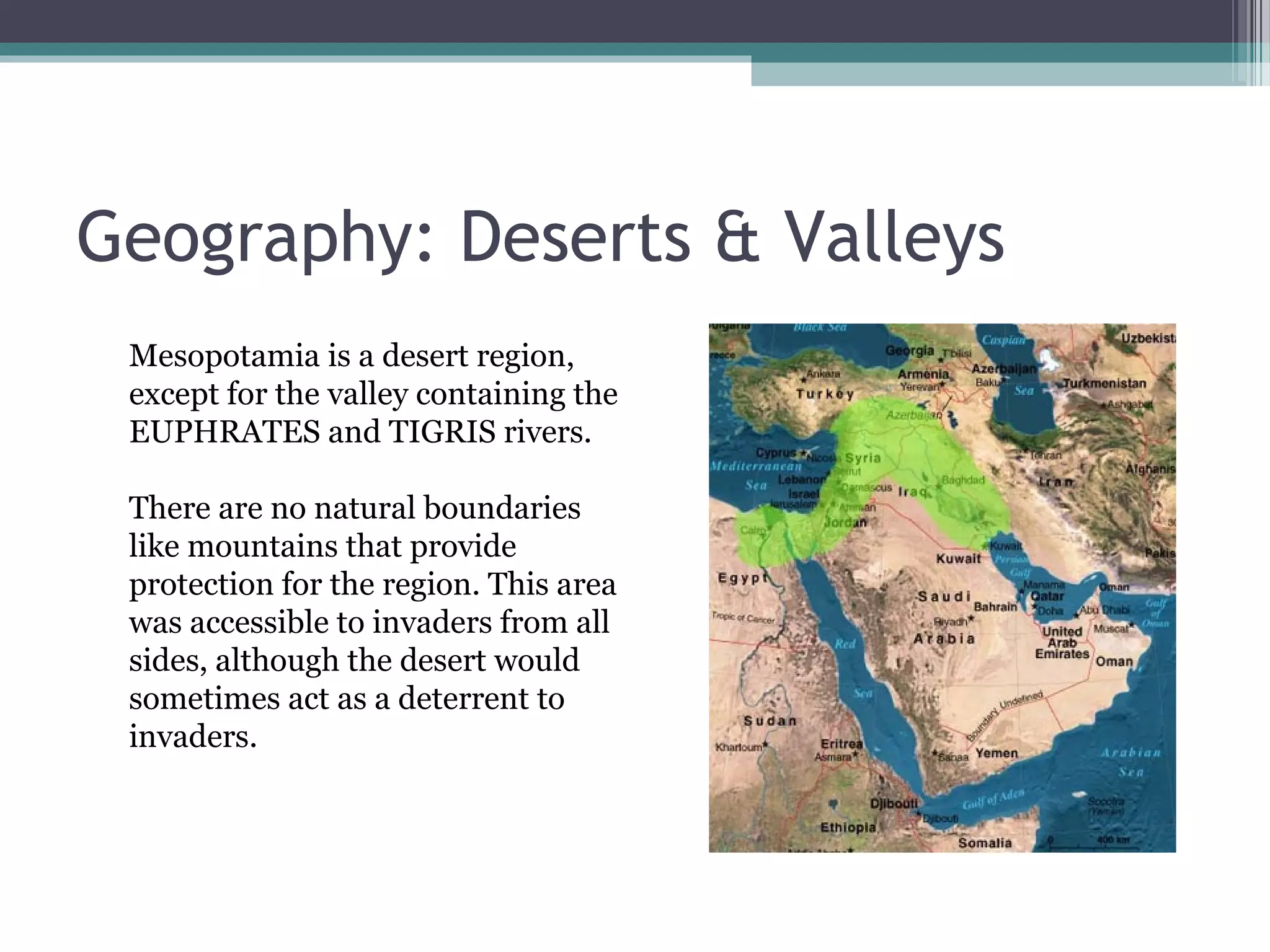
 Note the area in GREEN. This is the area known as the FERTILE
 CRESCENT. There are two major rivers, the EUPHRATES and the
 TIGRIS, that make it possible to grow crops and support larger
 populations.
Geography: Deserts & Valleys
 Mesopotamia is a desert region,
 except for the valley containing the
 EUPHRATES and TIGRIS rivers.

 There are no natural boundaries
 like mountains that provide
 protection for the region. This area
 was accessible to invaders from all
 sides, although the desert would
 sometimes act as a deterrent to
 invaders.
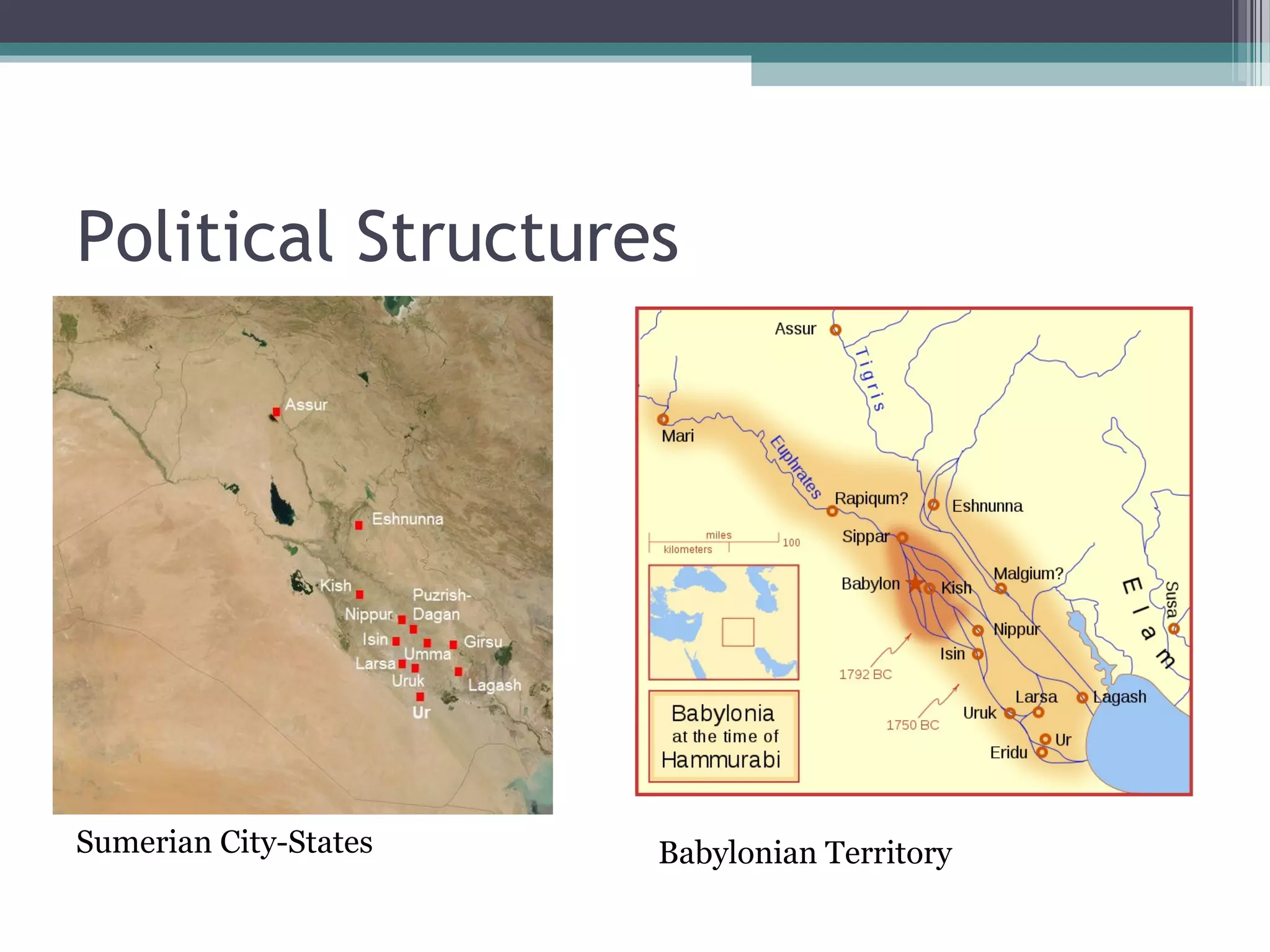
Political Structures


Sumerian City-States   Babylonian Territory
Political Structures:
       Sumerians, 5000-1900s BCE
• Sumer was divided          •Each city-state was
  into city-states,          ruled by a priest-king
  meaning that each          or a king who was the
  city had it’s own ruler,
  laws, and social           head of the city
  customs.                   government and the
• Each city-state was        temple.
  centered around a          •Kings had both civic
  temple dedicated to        and religious
  a god or goddess.          responsibilities.
Political Structures:
          Babylonia, 1700s – 1400s BCE
• Babylon was a city in south-central   •The Code of Hammurabi
  Mesopotamia that united most of       used a strict system based on
  Mesopotamia by the 1700s BCE.         moral and economic values.
• In approximately 1728 BCE, a king     For example, if someone were
  named Hammurabi ruled the city        to damage (or kill) someone
  of Babylon and the territory of       else’s slave, they must make
  Babylonia.                            reparations – meaning they
• Hammurabi created a bureaucracy       must pay back the value of the
  (system of government workers),       slave.
  centralized the government around     •The Code of Hammurabi is
  the capital city of Babylon, and      one of the first examples of
  created a taxation system. However,   codified law – law that is
  he is most famous for his system of   organized and written down –
  laws, called HAMMURABI’S              a precursor to modern
  CODE.                                 constitutions.
Political Structures
Assyrians, 2000 BCE – 612 BCE
• Assyria was made up of small city-states, like
  Sumer.
• Each city-state was led by a king.
• By the 1500s BCE, Assyria was a powerful
  kingdom that competed with Babylonia for
  territory and resources.
• In 612 BCE, Assyria was once again conquered
  by the Chaldeans from Babylonia.
Economics: Mesopotamia
• Mesopotamia’s            •Mesopotamian’s
  economy was based        traded their natural
  on agriculture and       resources and excess
  trade.                   crops for things that
• Mesopotamian’s           were scarce in
  traded natural           Mesopotamia, like
  resources, like jewels   wood.
  and precious stones.     •Mesopotamian’s also
                           traded art, pottery,
                           jewelry, and slaves.
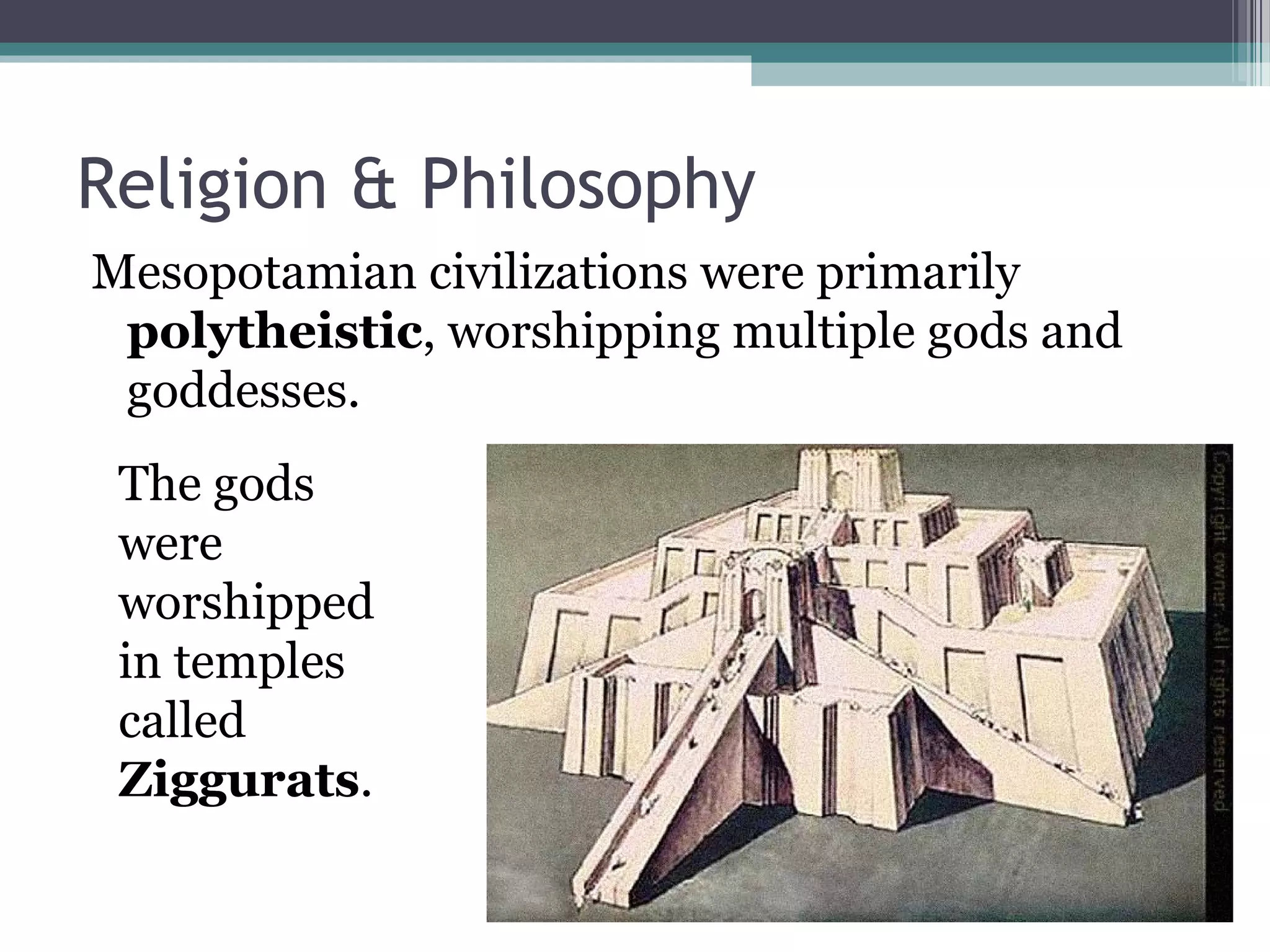
Religion & Philosophy
Mesopotamian civilizations were primarily
 polytheistic, worshipping multiple gods and
 goddesses.
 The gods
 were
 worshipped
 in temples
 called
 Ziggurats.
Society
• Society in ancient Mesopotamia was patriarchal (led
  by men) and male-dominated.
• Priests and Kings were the highest ranked people in
  Mesopotamian society.
• Warriors and tradesmen made up the middle class,
  along with educated bureaucrats in Babylon.
• Women and slaves made up the bottom strata of
  society.
• However, the basic structure of Mesopotamian
  society was divided into two classes: free people and
  slaves.
Inventions & Technology - Sumer
• Sumerians developed cuneiform, the oldest
  known written human language.
• Sumerians are responsible for the beginnings of
  mathematics – arithmetic, geometry, and
  algebra.
• Sumerians also invented or developed the
  wheel, irrigation systems, and many tools
  and weapons, such as hoes, axes, knives,
  arrowheads, swords, chariots, sandals,
  and more.
Inventions & Technology - Babylonia

• Babylonians were known for their metalwork,
  glassmaking, weaving, irrigation, and armor.
• One of the reasons the Babylonians were able to rule
  so many city-states was because of their metal
  weapons and armor, including daggers, swords, and
  spears.
• The Babylonians left behind evidence of the practice
  of medicine, astronomy, and architecture.
Inventions & Technology - Assyria
• Like the Sumerians and Babylonians, the
  Assyrians developed metal weapons and armor.
• The Assyrians were also known for their jewelry
  making abilities.
• Some archaeologists believe the Assyrians may
  have developed a telescope, as there is evidence
  of a glass shaped as a large lens, like one would
  use in a telescope.
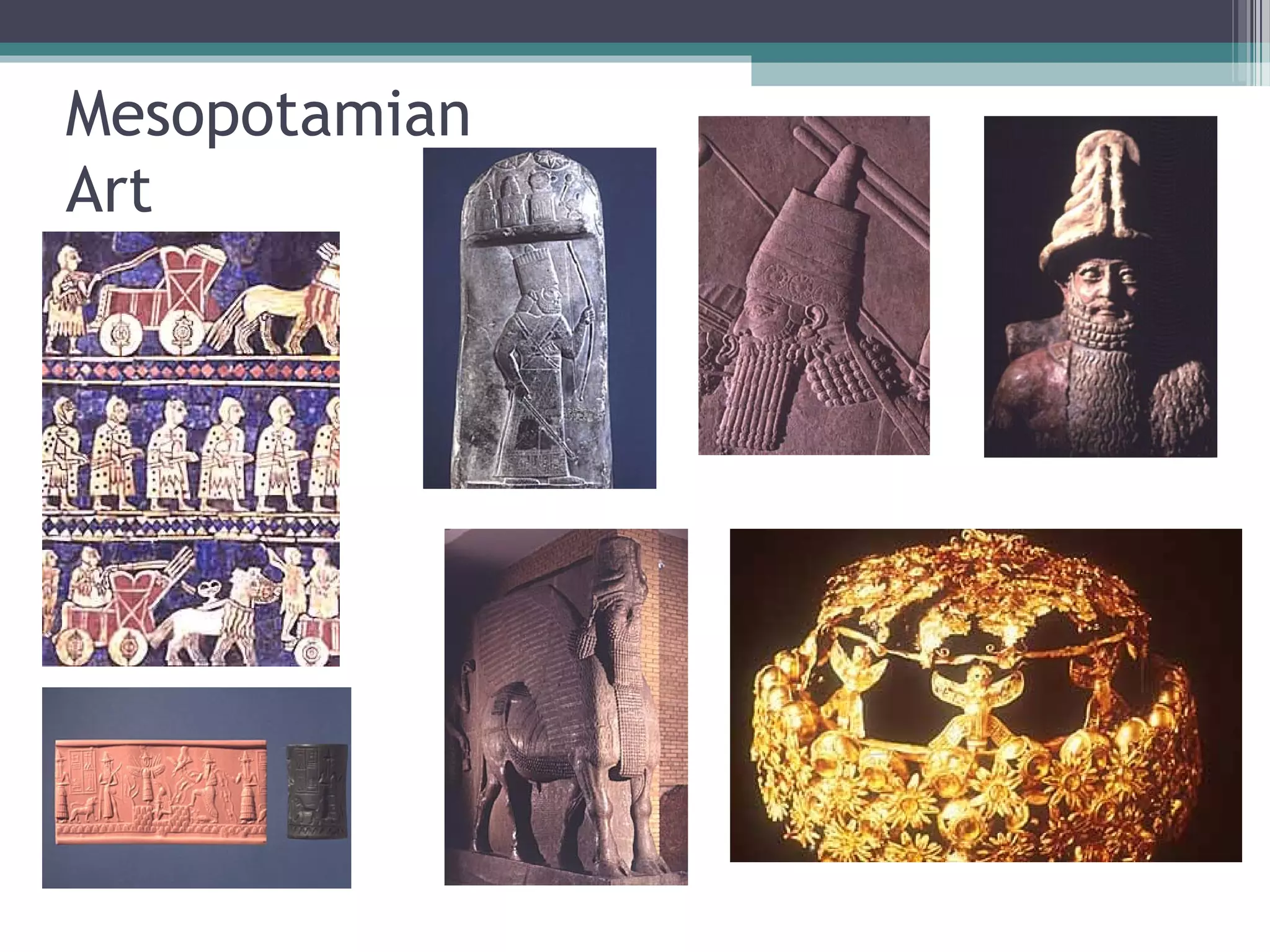
Art
• Sumerians developed many art forms, including
  literature, painting, pottery, architecture,
  and jewelry.
• Babylonians also had literature, weaving,
  sculpture, painting, pottery, and jewelry.
• The Assyrians were known for their sculptures
  and reliefs (carvings on walls) depicting battle
  scenes and religious ceremonies. They were also
  known for jewelry, sculpture, and other art
  forms.
Mesopotamian
Art

Mesopotamia

  • 1.
  • 2.
    Overview: Mesopotamia Mesopotamiais not a country. “Mesopotamia” means “the land between two rivers” in Greek. Mesopotamia is the region in the middle east between the Tigris and Euphrates rivers. There were several civilizations that flourished in the area between 5000 BCE and 612 BCE, including the Assyrians, Babylonians, and Sumerians.
  • 3.
    Timeline: 4 majorkingdoms of Mesopotamia Between 3000 BC and 600 BC, four major kingdoms ruled Mesopotamia, the area between the Tigris and Euphrates rivers: •Sumer •Bablyon •Assyria •Persia
  • 4.
    Location: Modern-day Iraq Note the area in GREEN. This is the area known as the FERTILE CRESCENT. There are two major rivers, the EUPHRATES and the TIGRIS, that make it possible to grow crops and support larger populations.
  • 5.
    Geography: Deserts &Valleys Mesopotamia is a desert region, except for the valley containing the EUPHRATES and TIGRIS rivers. There are no natural boundaries like mountains that provide protection for the region. This area was accessible to invaders from all sides, although the desert would sometimes act as a deterrent to invaders.
  • 6.
  • 7.
    Political Structures: Sumerians, 5000-1900s BCE • Sumer was divided •Each city-state was into city-states, ruled by a priest-king meaning that each or a king who was the city had it’s own ruler, laws, and social head of the city customs. government and the • Each city-state was temple. centered around a •Kings had both civic temple dedicated to and religious a god or goddess. responsibilities.
  • 8.
    Political Structures: Babylonia, 1700s – 1400s BCE • Babylon was a city in south-central •The Code of Hammurabi Mesopotamia that united most of used a strict system based on Mesopotamia by the 1700s BCE. moral and economic values. • In approximately 1728 BCE, a king For example, if someone were named Hammurabi ruled the city to damage (or kill) someone of Babylon and the territory of else’s slave, they must make Babylonia. reparations – meaning they • Hammurabi created a bureaucracy must pay back the value of the (system of government workers), slave. centralized the government around •The Code of Hammurabi is the capital city of Babylon, and one of the first examples of created a taxation system. However, codified law – law that is he is most famous for his system of organized and written down – laws, called HAMMURABI’S a precursor to modern CODE. constitutions.
  • 9.
    Political Structures Assyrians, 2000BCE – 612 BCE • Assyria was made up of small city-states, like Sumer. • Each city-state was led by a king. • By the 1500s BCE, Assyria was a powerful kingdom that competed with Babylonia for territory and resources. • In 612 BCE, Assyria was once again conquered by the Chaldeans from Babylonia.
  • 10.
    Economics: Mesopotamia • Mesopotamia’s •Mesopotamian’s economy was based traded their natural on agriculture and resources and excess trade. crops for things that • Mesopotamian’s were scarce in traded natural Mesopotamia, like resources, like jewels wood. and precious stones. •Mesopotamian’s also traded art, pottery, jewelry, and slaves.
  • 11.
    Religion & Philosophy Mesopotamiancivilizations were primarily polytheistic, worshipping multiple gods and goddesses. The gods were worshipped in temples called Ziggurats.
  • 12.
    Society • Society inancient Mesopotamia was patriarchal (led by men) and male-dominated. • Priests and Kings were the highest ranked people in Mesopotamian society. • Warriors and tradesmen made up the middle class, along with educated bureaucrats in Babylon. • Women and slaves made up the bottom strata of society. • However, the basic structure of Mesopotamian society was divided into two classes: free people and slaves.
  • 13.
    Inventions & Technology- Sumer • Sumerians developed cuneiform, the oldest known written human language. • Sumerians are responsible for the beginnings of mathematics – arithmetic, geometry, and algebra. • Sumerians also invented or developed the wheel, irrigation systems, and many tools and weapons, such as hoes, axes, knives, arrowheads, swords, chariots, sandals, and more.
  • 14.
    Inventions & Technology- Babylonia • Babylonians were known for their metalwork, glassmaking, weaving, irrigation, and armor. • One of the reasons the Babylonians were able to rule so many city-states was because of their metal weapons and armor, including daggers, swords, and spears. • The Babylonians left behind evidence of the practice of medicine, astronomy, and architecture.
  • 15.
    Inventions & Technology- Assyria • Like the Sumerians and Babylonians, the Assyrians developed metal weapons and armor. • The Assyrians were also known for their jewelry making abilities. • Some archaeologists believe the Assyrians may have developed a telescope, as there is evidence of a glass shaped as a large lens, like one would use in a telescope.
  • 16.
    Art • Sumerians developedmany art forms, including literature, painting, pottery, architecture, and jewelry. • Babylonians also had literature, weaving, sculpture, painting, pottery, and jewelry. • The Assyrians were known for their sculptures and reliefs (carvings on walls) depicting battle scenes and religious ceremonies. They were also known for jewelry, sculpture, and other art forms.
  • 17.