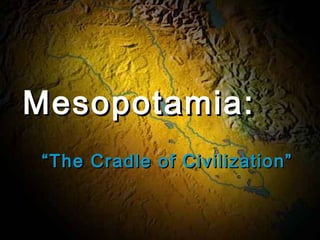
Mesopotamia:Mesopotamia:
“The Cradle of Civilization”“The Cradle of Civilization”
Earliest Civilization: theEarliest Civilization: the
Fertile Crescent(arc)Fertile Crescent(arc)
 earliest of all civilizations as people formedearliest of all civilizations as people formed
permanent settlementspermanent settlements
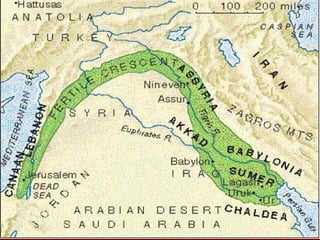
 MesopotamiaMesopotamia is a Greek word that meansis a Greek word that means
“between the rivers”,“between the rivers”, specifically, the areaspecifically, the area
between thebetween the Tigris River and Euphrates RiverTigris River and Euphrates River
(present day Iraq)(present day Iraq)
 Lasted(continued) for approximately 3000 yearsLasted(continued) for approximately 3000 years
 Its peoples were the first to irrigate fields,Its peoples were the first to irrigate fields,
devised(invented) a system of writing, developeddevised(invented) a system of writing, developed
mathematics, invented the wheel and learned tomathematics, invented the wheel and learned to
work with metalwork with metal
Geographic ConditionsGeographic Conditions
 Little rainfallLittle rainfall
 Hot and dry climateHot and dry climate
 windstorms leaving muddy river valleys inwindstorms leaving muddy river valleys in
winterwinter
 catastrophic flooding of the riverscatastrophic flooding of the rivers
in springin spring
 Arid(dry) soil containing little mineralsArid(dry) soil containing little minerals
 No stone or timber resourcesNo stone or timber resources
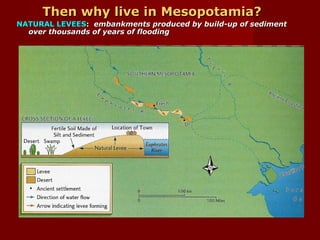
Then why live in Mesopotamia?Then why live in Mesopotamia?
NATURAL LEVEESNATURAL LEVEES:: embankments produced by build-up of sedimentembankments produced by build-up of sediment
over thousands of years of floodingover thousands of years of flooding
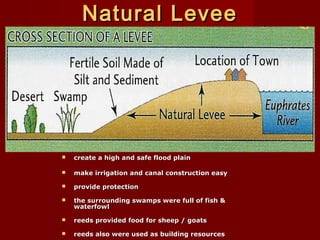
Natural LeveeNatural Levee
 create a high and safe flood plaincreate a high and safe flood plain
 make irrigation and canal construction easymake irrigation and canal construction easy
 provide protectionprovide protection
 the surrounding swamps were full of fish &the surrounding swamps were full of fish &
waterfowlwaterfowl
 reeds provided food for sheep / goatsreeds provided food for sheep / goats
 reeds also were used as building resourcesreeds also were used as building resources
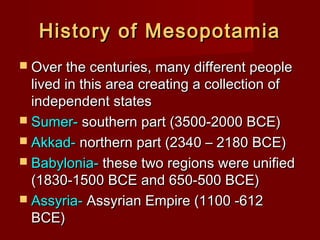
History of MesopotamiaHistory of Mesopotamia
 Over the centuries, many different peopleOver the centuries, many different people
lived in this area creating a collection oflived in this area creating a collection of
independent statesindependent states
 Sumer-Sumer- southern part (3500-2000 BCE)southern part (3500-2000 BCE)
 Akkad-Akkad- northern part (2340 – 2180 BCE)northern part (2340 – 2180 BCE)
 Babylonia-Babylonia- these two regions were unifiedthese two regions were unified
(1830-1500 BCE and 650-500 BCE)(1830-1500 BCE and 650-500 BCE)
 Assyria-Assyria- Assyrian Empire (1100 -612Assyrian Empire (1100 -612
BCE)BCE)
ReligionReligion Position of King was enhancedPosition of King was enhanced
and supported by religionand supported by religion
 Kingship(crown) believed to beKingship(crown) believed to be
created by gods and the king’screated by gods and the king’s
power was divinely(well)power was divinely(well)
ordained(designed)ordained(designed)
 Belief that gods lived on theBelief that gods lived on the
distant mountaintopsdistant mountaintops
 Each god had control of certainEach god had control of certain
things and each city was ruledthings and each city was ruled
by a different godby a different god
 Kings and priests acted asKings and priests acted as
interpreters as they told theinterpreters as they told the
people what the god wantedpeople what the god wanted
them to do (ie. by examining thethem to do (ie. by examining the
liver or lungs of a slain sheep)liver or lungs of a slain sheep)
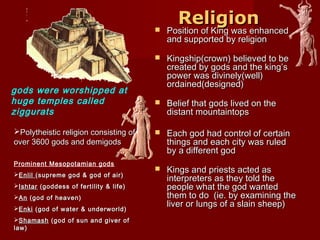
gods were worshipped at
huge temples called
ziggurats
Polytheistic religion consisting ofPolytheistic religion consisting of
over 3600 gods and demigodsover 3600 gods and demigods
Prominent Mesopotamian gods
EnlilEnlil (supreme god & god of air)(supreme god & god of air)
IshtarIshtar (goddess of fertility & life)(goddess of fertility & life)
AnAn (god of heaven)(god of heaven)
EnkiEnki (god of water & underworld)(god of water & underworld)
ShamashShamash (god of sun and giver of(god of sun and giver of
law)law)
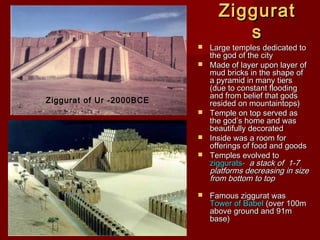
ZigguratZiggurat
ss
 Large temples dedicated toLarge temples dedicated to
the god of the citythe god of the city
 Made of layer upon layer ofMade of layer upon layer of
mud bricks in the shape ofmud bricks in the shape of
a pyramid in many tiersa pyramid in many tiers
(due to constant flooding(due to constant flooding
and from belief that godsand from belief that gods
resided on mountaintops)resided on mountaintops)
 Temple on top served asTemple on top served as
the god’s home and wasthe god’s home and was
beautifully decoratedbeautifully decorated
 Inside was a room forInside was a room for
offerings of food and goodsofferings of food and goods
 Temples evolved toTemples evolved to
ziggurats-ziggurats- a stack of 1-7a stack of 1-7
platforms decreasing in sizeplatforms decreasing in size
from bottom to topfrom bottom to top
 Famous ziggurat wasFamous ziggurat was
Tower of BabelTower of Babel (over 100m(over 100m
above ground and 91mabove ground and 91m
base)base)
Ziggurat of Ur -2000BCE
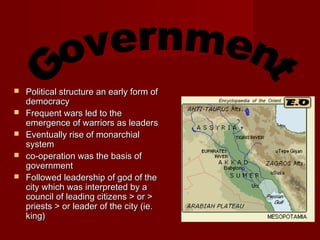
 Political structure an early form ofPolitical structure an early form of
democracydemocracy
 Frequent wars led to theFrequent wars led to the
emergence of warriors as leadersemergence of warriors as leaders
 Eventually rise of monarchialEventually rise of monarchial
systemsystem
 co-operation was the basis ofco-operation was the basis of
governmentgovernment
 Followed leadership of god of theFollowed leadership of god of the
city which was interpreted by acity which was interpreted by a
council of leading citizens > or >council of leading citizens > or >
priests > or leader of the city (ie.priests > or leader of the city (ie.
king)king)
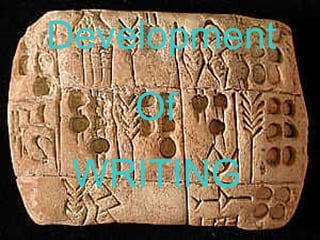
Development
Of
WRITING
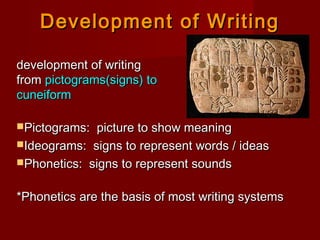
Development of WritingDevelopment of Writing
development of writingdevelopment of writing
fromfrom pictograms(signs) topictograms(signs) to
cuneiformcuneiform
Pictograms: picture to show meaningPictograms: picture to show meaning
Ideograms: signs to represent words / ideasIdeograms: signs to represent words / ideas
Phonetics: signs to represent soundsPhonetics: signs to represent sounds
*Phonetics are the basis of most writing systems*Phonetics are the basis of most writing systems
WritingWriting Greatest contribution of Mesopotamia toGreatest contribution of Mesopotamia to
western civilization was the invention ofwestern civilization was the invention of
writingwriting
 allowed theallowed the transmission of knowledge,transmission of knowledge,
the codification of laws, records tothe codification of laws, records to
facilitate trade / farmingfacilitate trade / farming
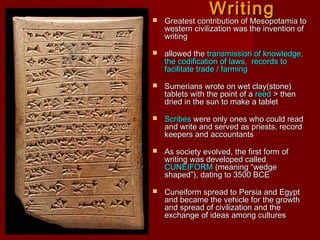
 Sumerians wrote on wet clay(stone)Sumerians wrote on wet clay(stone)
tablets with the point of atablets with the point of a reedreed > then> then
dried in the sun to make a tabletdried in the sun to make a tablet
 ScribesScribes were only ones who could readwere only ones who could read
and write and served as priests, recordand write and served as priests, record
keepers and accountantskeepers and accountants
 As society evolved, the first form ofAs society evolved, the first form of
writing was developed calledwriting was developed called
CUNEIFORMCUNEIFORM (meaning “wedge(meaning “wedge
shaped”), dating to 3500 BCEshaped”), dating to 3500 BCE
 Cuneiform spread to Persia and EgyptCuneiform spread to Persia and Egypt
and became the vehicle for the growthand became the vehicle for the growth
and spread of civilization and theand spread of civilization and the
exchange of ideas among culturesexchange of ideas among cultures
Interesting Facts!Interesting Facts!
 Mesopotamia, specifically Babylon used aMesopotamia, specifically Babylon used a
mathematical system based on sixty as all theirmathematical system based on sixty as all their
numbers were expressed as parts of or multiplesnumbers were expressed as parts of or multiples
of sixtyof sixty
 Some parts of the ‘base-sixty’ system still remainSome parts of the ‘base-sixty’ system still remain
today: 360 degrees in a circle, 60 seconds in atoday: 360 degrees in a circle, 60 seconds in a
minute and 60 minutes in 1 hourminute and 60 minutes in 1 hour
 Devised a calendar base on cycles of the moonDevised a calendar base on cycles of the moon
(number of days between the appearance of two(number of days between the appearance of two
new moons was set as a month; 12 cycles madenew moons was set as a month; 12 cycles made
up a yearup a year
Who was the best?Who was the best?
SumerSumer
 Closely tied toClosely tied to
environmentenvironment
 IrrigationIrrigation
techniques fortechniques for
farmingfarming
 wheelwheel
 Trade- barteringTrade- bartering
 Writing- cuneiformWriting- cuneiform
 Religion tied toReligion tied to
government asgovernment as
priests and kingspriests and kings
made decision formade decision for
godsgods
 zigguratsziggurats
BabylonBabylon
 Production of foodProduction of food
through farmingthrough farming
 Private ownershipPrivate ownership
of land vsof land vs
ownership by theownership by the
godsgods
 DevelopedDeveloped
mathematics andmathematics and
calendar systemcalendar system
and system of unitsand system of units
for currencyfor currency
 Hammurabi’s lawHammurabi’s law
codecode
Assyria
 Kings conqueredKings conquered
lands to createlands to create
empire of Assyriaempire of Assyria
 Cooler climate couldCooler climate could
produce crops withproduce crops with
little irrigationlittle irrigation
 Deposits of oreDeposits of ore
allowed forallowed for
development and usedevelopment and use
of ironof iron
 Assyrian armyAssyrian army
became mostbecame most
effective militaryeffective military
forceforce
Legacies of MesopotamiaLegacies of Mesopotamia
Revolutionary innovationsRevolutionary innovations emerged inemerged in
Mesopotamia such as:Mesopotamia such as:
 codified lawscodified laws
 zigguratsziggurats
 CuneiformCuneiform
 IrrigationIrrigation
 Metal working, toolsMetal working, tools
 TradeTrade
 transportationtransportation
 wheelwheel
 WritingWriting
 mathematicsmathematics
 prosperous living based on large scale agricultureprosperous living based on large scale agriculture