Mesh Networks |
    Hacking The T3lc0 Model


            http://arig.org.il
                     
What's a Mesh Anyway ?
   Mesh = topology. anything not a star / bus / ring / tree
       Nodes = routers, smart phones, cars – anything wi-fi enabled
       Links = wireless connections
   Mesh Network Attributes:
       Self-organizing
       Self-healing
       Scalable
       Robust, hard to disconnect


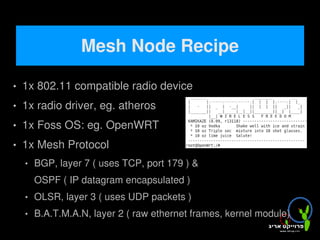
Mesh Node Recipe

   1x 802.11 compatible radio device
   1x radio driver, eg. atheros
   1x Foss OS: eg. OpenWRT
   1x Mesh Protocol
       BGP, layer 7 ( uses TCP, port 179 ) &
        OSPF ( IP datagram encapsulated )
       OLSR, layer 3 ( uses UDP packets )
       B.A.T.M.A.N, layer 2 ( raw ethernet frames, kernel module)
                                     
Radio

   Use of public 2.4GHz & 5GHz bands
   No special license to operation
   3.7GHz also recently made available
   Open Spectrum: public radio frequency access



       Open Source Cell Phone Network at $2 per month
                              
Mesh Protocols
       Protocol Tasks:
           Node announcement
           Neighbor sensing
           Routing table upkeep
           Routing decisions
       Protocol Efficiency Metrics
            maximize: raw data
            minimize: control Data / ( control Data + raw Data )
       > 70 implementation, lots of academic Interest
                                             
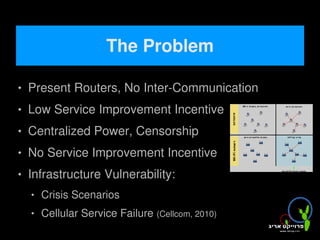
The Problem

       Present Routers, No Inter-Communication
       Low Service Improvement Incentive
       Centralized Power, Censorship
       No Service Improvement Incentive
       Infrastructure Vulnerability:
           Crisis Scenarios
           Cellular Service Failure (Cellcom, 2010)
                                       
The Solution
        part of a Solution: Mesh Network

       Open Mesh:
           Open Source, Open Standards
           Affordable
       Community Owned
       User Operated
       Induce ISP Service Improvement (mozilla effect)
                               
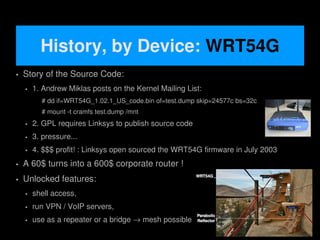
History, by Device: WRT54G
   Story of the Source Code:
       1. Andrew Miklas posts on the Kernel Mailing List:
          # dd if=WRT54G_1.02.1_US_code.bin of=test.dump skip=24577c bs=32c
          # mount -t cramfs test.dump /mnt
       2. GPL requires Linksys to publish source code
       3. pressure...
       4. $$$ profit! : Linksys open sourced the WRT54G firmware in July 2003
   A 60$ turns into a 600$ corporate router !
   Unlocked features:
       shell access,
       run VPN / VoIP servers,
       use as a repeater or a bridge → mesh possible
                                             
History, by Device - XO-1
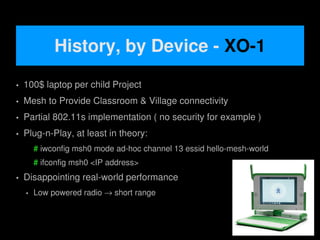
   100$ laptop per child Project
   Mesh to Provide Classroom & Village connectivity
   Partial 802.11s implementation ( no security for example )
   Plug-n-Play, at least in theory:
        # iwconfig msh0 mode ad-hoc channel 13 essid hello-mesh-world
        # ifconfig msh0 <IP address>
   Disappointing real-world performance
       Low powered radio → short range


History, by Network: Consume.net
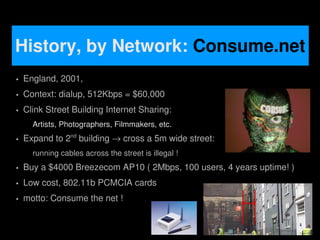
   England, 2001, 1000+ list members, ~200 nodes
   Context: dialup, 512Kbps = $60,000
   Clink Street Building Internet Sharing:
      Artists, Photographers, Filmmakers, etc.
   Expand to 2nd building → cross a 5m wide street:
      running cables across the street is illegal !
   Buy a $4000 Breezecom AP10 ( 2Mbps, 100 users, 4 years uptime! )
   Low cost, 802.11b PCMCIA cards
   motto: Consume the net !

                                              
Pico-Peering Agreement

       Written by the Consume.net founders. Key points:
           Free Transit:
               Owner agrees to provide free transit across their free network.
               Owner agrees not to modify/interfere with data as it passes through their free network.
           Open Communication:
               The owner agrees to publish the information necessary for peering to take place
               This information shall be published under a free license
               The owner agrees to be contactable and will provide at least an email adress
           No Warranty
           Terms of Use:
               The owner is entitled to formulate an 'acceptable use policy'
               This may or may not contain information about additional services provided
                                                         
History, by Network: Freifunk
   Germany, 2002
   Context: Post Unification, East-Germany:
       Fiber Internet project:
          1. rip out all PSTN copper
          2. install fiber lines
       Project budget overrun → end users left with nothing !
   Early Start: PCs on rooftops
   Very fast adoption
   Active today, strong hacking culture

                                            
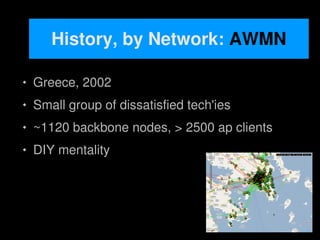
History, by Network: AWMN

       Greece, 2002
       Small group of dissatisfied tech'ies
       ~1120 backbone nodes, > 2500 ap clients
       DIY mentality


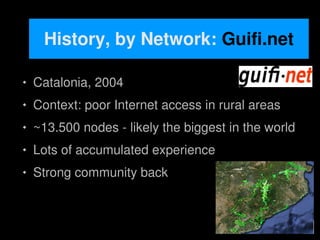
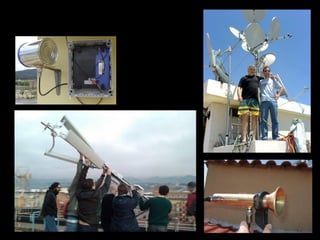
History, by Network: Guifi.net

       Catalonia, 2004
       Context: poor Internet access in rural areas
       ~13.500 nodes - likely the biggest in the world
       Lots of accumulated experience
       Strong community back


Mesh Network Services
       Network wide: IP assignment, DNS
       Mass Communication:
           VoIP
           Municipal Notification Service, e.g. Shderot
           Broadcast, Multicast: local radio, podcasts, etc.
       P2P services: file sharing, social networks
       Distributed Services: cache, backup, DNS
       Sensor Networks
                                         
In the News...
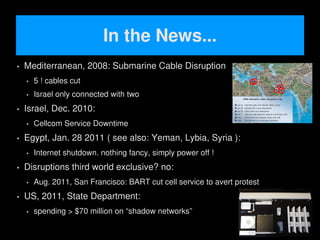
   Mediterranean, 2008: Submarine Cable Disruption
       5 ! cables cut
       Israel only connected with two
   Israel, Dec. 2010:
       Cellcom Service Downtime
   Egypt, Jan. 28 2011 ( see also: Yeman, Lybia, Syria ):
       Internet shutdown. nothing fancy, simply power off !
   Disruptions third world exclusive? no:
       Aug. 2011, San Francisco: BART cut cell service to avert protest
   US, 2011, State Department:
       spending > $70 million on “shadow networks”
                                             
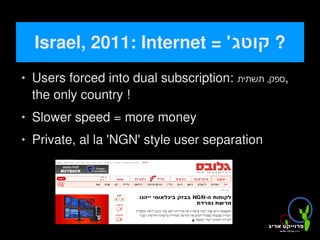
Israel, 2011: Internet = '‫? קוטג‬
       Users forced into dual subscription: ‫,ספק, תשתית‬
        the only country !
       Slower speed = more money
       Private, al la 'NGN' style user separation


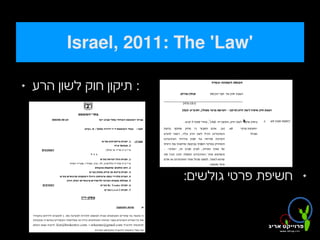
‫'‪Israel, 2011: The 'Law‬‬

    ‫‪‬‬   ‫: תיקון חוק לשון הרע‬


                                   ‫חשיפת פרטי גולשים:‬   ‫‪‬‬


‫ ‬                              ‫ ‬
Are we happy with this
          design ?


‫פרוייקט אריג‬
       Israel is way behind - about ~10 years !
       Vision:
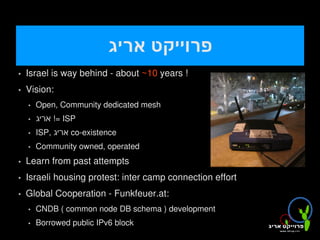
           Open, Community dedicated mesh
           ‫ =! אריג‬ISP
           ISP, ‫ אריג‬co-existence
           Community owned, operated
       Learn from past attempts
       Israeli housing protest: inter camp connection effort
       Global Cooperation - Funkfeuer.at:
           CNDB ( common node DB schema ) development
           Borrowed public IPv6 block    
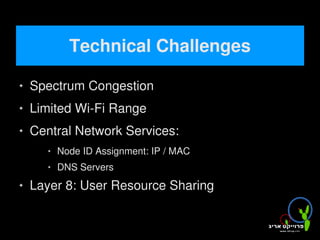
Technical Challenges
       Spectrum Congestion
       Limited Wi-Fi Range
       Central Network Services:
              Node ID Assignment: IP / MAC
              DNS Servers
       Layer 8: User Resource Sharing

                                     
Sustainability is Key
    ++node operators, not nodes.
    ++mesh communities, not mesh networks.


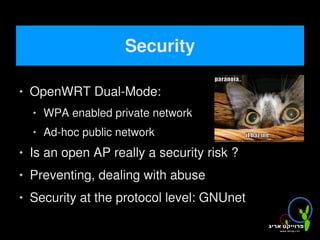
Security

       OpenWRT Dual-Mode:
           WPA enabled private network
           Ad-hoc public network
       Is an open AP really a security risk ?
       Preventing, dealing with abuse
       Security at the protocol level: GNUnet
                                     
The End,
    Thank You
     http://arig.org.il


Mesh network presentation

  • 1.
    Mesh Networks | Hacking The T3lc0 Model http://arig.org.il    
  • 2.
    What's a MeshAnyway ?  Mesh = topology. anything not a star / bus / ring / tree  Nodes = routers, smart phones, cars – anything wi-fi enabled  Links = wireless connections  Mesh Network Attributes:  Self-organizing  Self-healing  Scalable  Robust, hard to disconnect    
  • 3.
    Mesh Node Recipe  1x 802.11 compatible radio device  1x radio driver, eg. atheros  1x Foss OS: eg. OpenWRT  1x Mesh Protocol  BGP, layer 7 ( uses TCP, port 179 ) & OSPF ( IP datagram encapsulated )  OLSR, layer 3 ( uses UDP packets )  B.A.T.M.A.N, layer 2 ( raw ethernet frames, kernel module)    
  • 4.
    Radio  Use of public 2.4GHz & 5GHz bands  No special license to operation  3.7GHz also recently made available  Open Spectrum: public radio frequency access   Open Source Cell Phone Network at $2 per month    
  • 5.
    Mesh Protocols  Protocol Tasks:  Node announcement  Neighbor sensing  Routing table upkeep  Routing decisions  Protocol Efficiency Metrics maximize: raw data minimize: control Data / ( control Data + raw Data )  > 70 implementation, lots of academic Interest    
  • 6.
    The Problem  Present Routers, No Inter-Communication  Low Service Improvement Incentive  Centralized Power, Censorship  No Service Improvement Incentive  Infrastructure Vulnerability:  Crisis Scenarios  Cellular Service Failure (Cellcom, 2010)    
  • 7.
    The Solution part of a Solution: Mesh Network  Open Mesh:  Open Source, Open Standards  Affordable  Community Owned  User Operated  Induce ISP Service Improvement (mozilla effect)    
  • 8.
    History, by Device:WRT54G  Story of the Source Code:  1. Andrew Miklas posts on the Kernel Mailing List: # dd if=WRT54G_1.02.1_US_code.bin of=test.dump skip=24577c bs=32c # mount -t cramfs test.dump /mnt  2. GPL requires Linksys to publish source code  3. pressure...  4. $$$ profit! : Linksys open sourced the WRT54G firmware in July 2003  A 60$ turns into a 600$ corporate router !  Unlocked features:  shell access,  run VPN / VoIP servers,    use as a repeater or a bridge → mesh possible  
  • 9.
    History, by Device- XO-1  100$ laptop per child Project  Mesh to Provide Classroom & Village connectivity  Partial 802.11s implementation ( no security for example )  Plug-n-Play, at least in theory: # iwconfig msh0 mode ad-hoc channel 13 essid hello-mesh-world # ifconfig msh0 <IP address>  Disappointing real-world performance  Low powered radio → short range    
  • 10.
    History, by Network:Consume.net  England, 2001, 1000+ list members, ~200 nodes  Context: dialup, 512Kbps = $60,000  Clink Street Building Internet Sharing: Artists, Photographers, Filmmakers, etc.  Expand to 2nd building → cross a 5m wide street: running cables across the street is illegal !  Buy a $4000 Breezecom AP10 ( 2Mbps, 100 users, 4 years uptime! )  Low cost, 802.11b PCMCIA cards  motto: Consume the net !    
  • 11.
    Pico-Peering Agreement  Written by the Consume.net founders. Key points:  Free Transit:  Owner agrees to provide free transit across their free network.  Owner agrees not to modify/interfere with data as it passes through their free network.  Open Communication:  The owner agrees to publish the information necessary for peering to take place  This information shall be published under a free license  The owner agrees to be contactable and will provide at least an email adress  No Warranty  Terms of Use:  The owner is entitled to formulate an 'acceptable use policy'  This may or may not contain information about additional services provided    
  • 12.
    History, by Network:Freifunk  Germany, 2002  Context: Post Unification, East-Germany:  Fiber Internet project: 1. rip out all PSTN copper 2. install fiber lines  Project budget overrun → end users left with nothing !  Early Start: PCs on rooftops  Very fast adoption  Active today, strong hacking culture    
  • 13.
    History, by Network:AWMN  Greece, 2002  Small group of dissatisfied tech'ies  ~1120 backbone nodes, > 2500 ap clients  DIY mentality    
  • 14.
    History, by Network:Guifi.net  Catalonia, 2004  Context: poor Internet access in rural areas  ~13.500 nodes - likely the biggest in the world  Lots of accumulated experience  Strong community back    
  • 15.
       
  • 16.
    Mesh Network Services  Network wide: IP assignment, DNS  Mass Communication:  VoIP  Municipal Notification Service, e.g. Shderot  Broadcast, Multicast: local radio, podcasts, etc.  P2P services: file sharing, social networks  Distributed Services: cache, backup, DNS  Sensor Networks    
  • 17.
    In the News...  Mediterranean, 2008: Submarine Cable Disruption  5 ! cables cut  Israel only connected with two  Israel, Dec. 2010:  Cellcom Service Downtime  Egypt, Jan. 28 2011 ( see also: Yeman, Lybia, Syria ):  Internet shutdown. nothing fancy, simply power off !  Disruptions third world exclusive? no:  Aug. 2011, San Francisco: BART cut cell service to avert protest  US, 2011, State Department:  spending > $70 million on “shadow networks”    
  • 18.
    Israel, 2011: Internet= '‫? קוטג‬  Users forced into dual subscription: ‫,ספק, תשתית‬ the only country !  Slower speed = more money  Private, al la 'NGN' style user separation    
  • 19.
    ‫'‪Israel, 2011: The'Law‬‬ ‫‪‬‬ ‫: תיקון חוק לשון הרע‬ ‫חשיפת פרטי גולשים:‬ ‫‪‬‬ ‫ ‬ ‫ ‬
  • 20.
    Are we happywith this design ?    
  • 21.
    ‫פרוייקט אריג‬  Israel is way behind - about ~10 years !  Vision:  Open, Community dedicated mesh  ‫ =! אריג‬ISP  ISP, ‫ אריג‬co-existence  Community owned, operated  Learn from past attempts  Israeli housing protest: inter camp connection effort  Global Cooperation - Funkfeuer.at:  CNDB ( common node DB schema ) development    Borrowed public IPv6 block  
  • 22.
    Technical Challenges  Spectrum Congestion  Limited Wi-Fi Range  Central Network Services:  Node ID Assignment: IP / MAC  DNS Servers  Layer 8: User Resource Sharing    
  • 23.
    Sustainability is Key ++node operators, not nodes. ++mesh communities, not mesh networks.    
  • 24.
    Security  OpenWRT Dual-Mode:  WPA enabled private network  Ad-hoc public network  Is an open AP really a security risk ?  Preventing, dealing with abuse  Security at the protocol level: GNUnet    
  • 25.
    The End, Thank You http://arig.org.il