Bridging the Information Divide Victor Bahl Senior Researcher Manager, Networking Group Microsoft Research January 2005
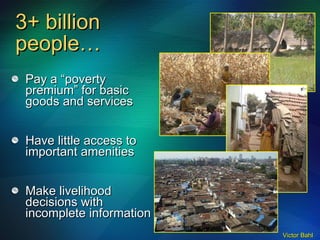
3+ billion people… Pay a “poverty premium” for basic goods and services Have little access to important amenities Make livelihood decisions with incomplete information
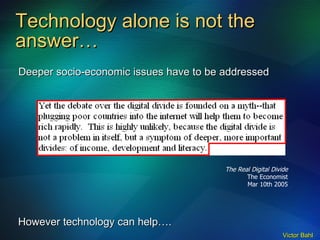
Technology alone is not the answer… The Real Digital Divide The Economist Mar 10th 2005 Deeper socio-economic issues have to be addressed However technology can help….
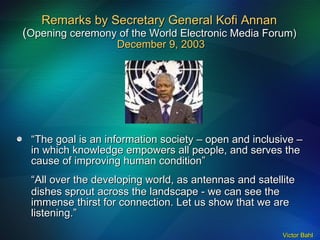
Remarks by Secretary General Kofi Annan  ( Opening ceremony of the World Electronic Media Forum)   December 9, 2003 “ The goal is an information society – open and inclusive – in which knowledge empowers all people, and serves the cause of improving human condition” “ All over the developing world, as antennas and satellite dishes sprout across the landscape - we can see the immense thirst for connection. Let us show that we are listening.”
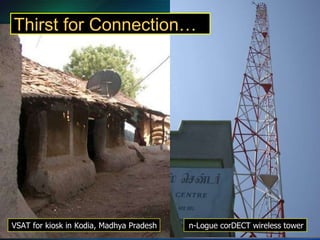
Thirst for Connection… VSAT for kiosk in Kodia, Madhya Pradesh n-Logue corDECT wireless tower
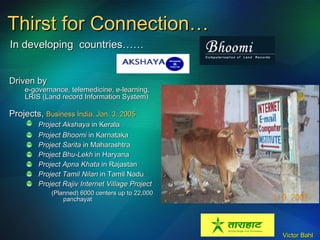
Thirst for Connection… Driven by e-governance, telemedicine, e-learning, LRIS (Land record Information System) Projects,  Business India, Jan. 3, 2005 Project Akshaya  in Kerala   Project Bhoomi  in Karnataka Project Sarita  in Maharashtra Project Bhu-Lekh  in Haryana Project Apna Khata  in Rajastan Project Tamil Nilan  in Tamil Nadu Project Rajiv Internet Village Project (Planned) 6000 centers up to 22,000 panchayat In developing  countries……
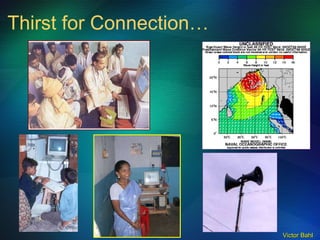
Thirst for Connection…
Thirst for Connection… New Orleans launches free Wi-Fi service,  Associated Press, November 30, 2005   “ Biggest such effort by a major city yet” San Francisco Keeps Pushing City Wide WiFi,  CNET News.com, August 17, 2005 “ San Francisco Mayor Gavin Newsom wants to make Wi-Fi coverage in the city as ubiquitous as the fog that blankets its neighborhoods.”   Wi-Fi Hits the Hinterlands ,  BusinessWeek Online, July 5, 2004 “ Who needs DSL or cable? New “mesh” technology is turning entire small towns into broadband hot spots”  Rio Rancho N.M., population 60,000, 500 routers covering 103 miles 2 NYC wireless network will be unprecedented ,  Computerworld, June 18, 2004 “ New York City plans to build a public safety wireless network of unprecedented scale and scope, with a capacity to provide tens of thousands of mobile users”   Rural Areas need Internet too!   Newsweek, June 7, 2004 Issue “ EZ Wireless built the country's largest regional wireless broadband network, a 600-square-mile Wi-Fi blanket, and activated it this February” Hermiston, Oregon, population 13,200, 35 routers with 75 antennas covering  600 miles 2 Mesh Casts Its Net ,  Unstrung, January 23, 2004 “ Providing 57 miles 2  of wireless coverage for public safety personnel in Garland Texas” In United States……
Thirst for connection… PCCW takes Wireless Broadband to London,  The Register, September 2, 2005 “ Prices for the service in UK start from £10 / month for 256 Kbps to  £18 /month for 1 Mbps” Anacapa and Firetide Bring Free Wireless Internet to La Semaine Italienne in Paris, France ,  Business Wire, 24 May, 2005 Bell Canada and Nortel Networks launch Project Chapleau, [designed to evaluate broadband in rural Canada],  Optical Networks Daily, 18 July 2005 Nationwide Wi-Fi for Macedonia,  Wi-Fi Planet,   18 Nov. 18, 2005   … Around the world…
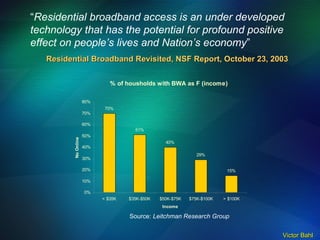
Source:  Leitchman Research Group “ Residential broadband access is an under developed  technology that has the potential for profound positive  effect on people’s lives and Nation’s economy ” Residential Broadband Revisited, NSF   Report, October 23, 2003
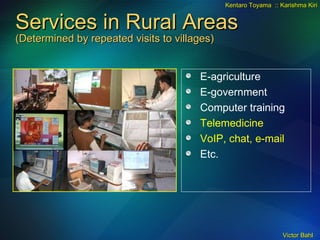
Services in Rural Areas (Determined by repeated visits to villages) E-agriculture E-government Computer training Telemedicine VoIP, chat, e-mail Etc. Kentaro Toyama  :: Karishma Kiri
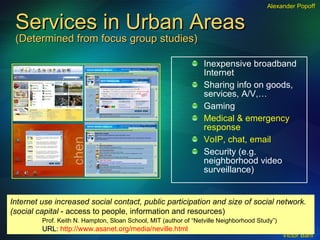
Services in Urban Areas (Determined from focus group studies) Inexpensive broadband Internet Sharing info on goods, services, A/V,… Gaming Medical & emergency response VoIP, chat, email Security (e.g. neighborhood video surveillance) Internet use increased social contact, public participation and size of social network.  (social capital  - access to people, information and resources) Prof. Keith N. Hampton, Sloan School, MIT (author of “Netville Neighborhood Study”) URL:  http://www.asanet.org/media/neville.html Alexander Popoff
You should care! Because… The future is about rich multimedia services & information exchange … possible only with wide-scale availability of broadband Internet access But… Billions of people still do not have meaningful Internet service Majority of the developing world does not have broadband connectivity As much as 32 million homes in America do not take broadband service (rural areas, older neighbourhoods, poor neighbourhoods)
Design Constraints Technology must be: inexpensive, possibly free for end-users easy to setup & deploy require minimal ramp up time & easy to use robust, handle failures (power-cuts, dust, heat, etc.)  self-managing – require minimal human intervention
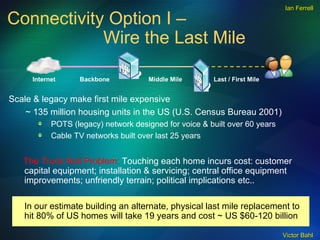
Connectivity Option I –  Wire the Last Mile Scale & legacy make first mile expensive ~ 135 million housing units in the US (U.S. Census Bureau 2001) POTS (legacy) network designed for voice & built over 60 years Cable TV networks built over last 25 years The Truck Roll Problem:  Touching each home incurs cost: customer capital equipment; installation & servicing; central office equipment improvements; unfriendly terrain; political implications etc.. In our estimate building an alternate, physical last mile replacement to hit 80% of US homes will take 19 years and cost ~ US $60-120 billion Internet Backbone Middle Mile Last / First Mile Ian Ferrell
Connectivity Option 2  – Wireless Last Mile < $2 Billion for 80% of the homes in US Readily available & inexpensive 802.11 hardware or some version of it Low deployment cost Decentralized ownership & maintenance Trivial setup & small hardware Integrates easily indoors & outdoors Flexible Deployable In difficult terrain, both urban or remote
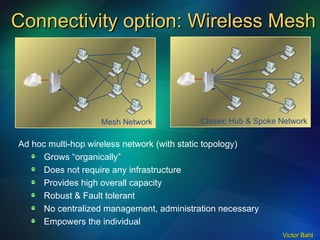
Connectivity option: Wireless Mesh Ad hoc multi-hop wireless network (with static topology) Grows “organically” Does not require any infrastructure Provides high overall capacity Robust & Fault tolerant No centralized management, administration necessary Empowers the individual Classic Hub & Spoke Network Mesh Network
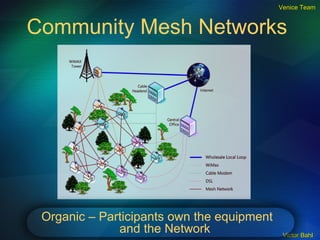
Community Mesh Networks Organic – Participants own the equipment and the Network Venice Team
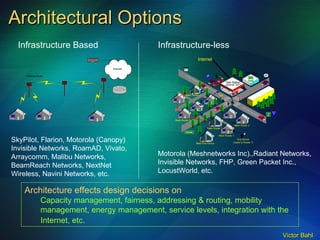
Architectural Options SkyPilot, Flarion, Motorola (Canopy)  Invisible Networks, RoamAD, Vivato,  Arraycomm, Malibu Networks,  BeamReach Networks, NextNet  Wireless, Navini Networks, etc. Motorola (Meshnetworks Inc).,Radiant Networks,  Invisible Networks, FHP, Green Packet Inc.,  LocustWorld, etc.  Infrastructure Based Infrastructure-less Architecture effects design decisions on Capacity management, fairness, addressing & routing, mobility management, energy management, service levels, integration with the Internet, etc .
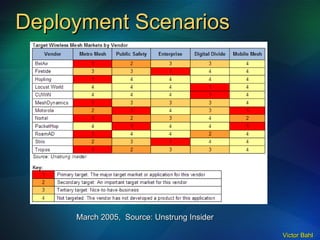
Deployment Scenarios March 2005,  Source: Unstrung Insider
Related Work The CITRIS TIER Project (UC Berkeley, USA) Technology and Infrastructure for emerging regions Richard Newton, Drew Issacs, Eric Brewer, Tom Kalil http://tier.cs.berkeley.edu/ The Digital Gangetic Plains Project (IIT Kanpur, India) 802.11-based low-cost Networking for Rural India Bhaskaran Raman, Dheeraj Sanghi, A.R. Harish, Mohan K. Mishra,  Anish Bhatia, A.K. Singh, Ram Chandra Prajapati http://www.iitk.ac.in/mladgp The Roofnet Project (MIT, USA) 802.11 mesh network for broadband IA in cities Dan Aguayo, John Bicket, Sanjit Biswas, Robert Morris http://pdos.csail.mit.edu/roofnet/doku.php The TAPs Project (Rice University, USA) Wireless broadband to residential and public places Edward Knightly, Behnaam Aazhang, J. Patrick Frantz, David Johnson,  Ashu Sabarwal http://taps.rice.edu/index.html
Some Relevant Standards IETF MANET Layer 3 protocols for Mobile Ad Hoc Networks IEEE 802.11s Extended Service Set for Mesh Networking IEEE 802.16 Broadband Wireless Metropolitan Area Networks IEEE 802.20 Mobile Broadband Wireless Access for business & residential markets IEEE 802.22 Wireless Regional Area Networks (WRANs) OBAN Broadband Coverage in Urban Area (European effort)
Wireless Meshes
Many Challenges Deployment “ Real-world” study with real traffic traces, usage patterns and failure /performance logs Self Healing & Management  Minimal human intervention - avoid network operator Mechanisms for data cleaning, anomaly detection & liar detection Automatic tools for what-if analysis for optimal operation Pleasant, hassle-free user experience (zero-configuration setup) Smart Spectrum Utilization Spectrum Policy - etiquettes and/or rules with technical input Spectrum Leasing Cognitive software & applications Agile radios, cognitive radios, 60 GHz radio, underlay technologies
Power Battery capacity doubles in energy density every 35 years [Pow95] Security, Privacy, and Fairness Guarding against malicious users Priority for VoIP and time-sensitive data Connectivity, Range, Scale, and Capacity Inexpensive electronically steerable directional antenna and/or MIMO Multi-frequency meshes & multi-radio / multi-channel hardware  Data channel MAC with Interference management for higher throughput Analytical Tools Information theoretic tools that predict network viability & performance with practical constraints, based on experimental data Many Challenges (cont.)
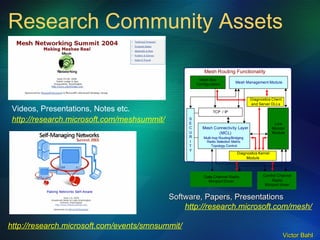
Research Community Assets Videos, Presentations, Notes etc. http://research.microsoft.com/meshsummit/ Software, Papers, Presentations http://research.microsoft.com/mesh/ http://research.microsoft.com/events/smnsummit/
Academic Resource Kit 2005 [email_address] Prof. Sivaram Murthy,  IIT, Chennai, India Hybrid wireless mesh for rural communities Prof. Sanjiva Prasad,  IIT, New Delhi, India Async. messaging in Wireless network Prof. Lili Qiu,  University of Texas Austin Resilience in wireless mesh Networks Prof. William Arbaugh,  University of Maryland Security and Privacy in wireless meshes Prof. Suman Banerjee,  University of Wisconsin Quality of service in wireless meshes Prof. Dan Rubenstein,  Columbia University Channelization and routing Prof. Richard Newton,  UC Berkeley The TIER Project MS ERP has budgeted $1.2 million for research funding in FY06 under their Digital Inclusion Initiative http://research.microsoft.com/netres/kit/
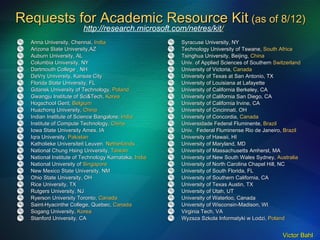
Requests for Academic Resource Kit  (as of 8/12) Anna University, Chennai,  India Arizona State University,AZ Auburn University, AL Columbia University, NY Dartmouth College , NH DeVry University, Kansas City Florida State University, FL Gdansk University of Technology,  Poland Gwangju Institute of Sci&Tech,  Korea Hogschool Gent,  Belgium Huazhong University,  China Indian Institute of Science Bangalore,  India Institute of Compute Technology,  China Iowa State University Ames, IA Iqra University,  Pakistan  Katholieke Universiteit Leuven.  Netherlands National Chung Hsing University,  Taiwan National Institute of Technology Karnataka,  India National University of  Singapore New Mexico State University, NM Ohio State University, OH Rice University, TX Rutgers University, NJ Ryerson University Toronto,  Canada Saint-Hyacinthe College, Quebec,  Canada Sogang University,  Korea Stanford University, CA Syracuse University, NY Technology University of Tswane,  South Africa Tsinghua University, Beijing,  China Univ. of Applied Sciences of Southern  Switzerland University of Victoria,  Canada University of Texas at San Antonio, TX University of Louisiana at Lafayette University of California Berkeley, CA University of California San Diego, CA University of California Irvine, CA University of Cincinnati, OH University of Concordia,  Canada Universidade Federal Fluminente,  Brazil Univ.  Federal Fluminense Rio de Janeiro,  Brazil  University of Hawaii, HI University of Maryland, MD University of Massachusetts Amherst, MA University of New South Wales Sydney,  Australia University of North Carolina Chapel Hill, NC University of South Florida, FL University of Southern California, CA  University of Texas Austin, TX University of Utah, UT University of Waterloo, Canada University of Wisconsin-Madison, WI Virginia Tech, VA Wyzsza Szkola Informatyki w Lodzi,  Poland http://research.microsoft.com/netres/kit /
Broadband WiFi Debate Proponents Local and state government should provide WiFi access free everywhere Propel the country into yhr broadband age Lower cost, faster deployment (specially in rural areas) Stimulate competition by raising service standards Detractors Unfair to ask private sector to compete with local government who have tax dollars Not a utility,  highly competitive enterprise Continuously changing due to innovation  Two sides to the coin…. Phone Giants Are Lobbying Hard To Block Towns' Wireless Plans Wall Street Journal, June 23, 2005
Common consumer electronic device Inexpensive; Value is clear; First waves of practical devices that integrate cameras, processor, network, & display are in the market “ The digital divide is really diminishing, and it's the mobile  phones doing it, not the PC” Len Waverman, London Business School
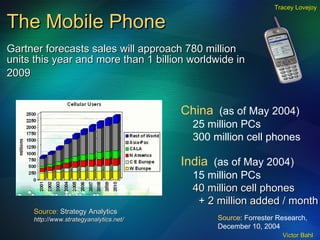
The Mobile Phone Gartner forecasts sales will approach 780 million units this year and more than 1 billion worldwide in 2009   China   (as of May 2004) 25 million PCs 300 million cell phones India   (as of May 2004) 15 million PCs 40 million  cell phones  + 2 million added / month Tracey Lovejoy Source:  Strategy Analytics http://www.strategyanalytics.net/ Source : Forrester Research,  December 10, 2004
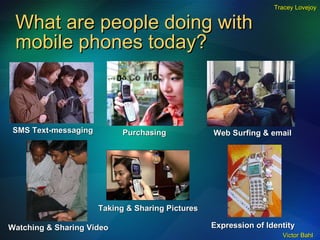
What are people doing with mobile phones today? SMS Text-messaging Purchasing Web Surfing & email Watching & Sharing Video  Taking & Sharing Pictures  Expression of Identity  Tracey Lovejoy
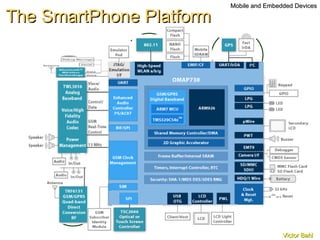
The SmartPhone Platform Mobile and Embedded Devices
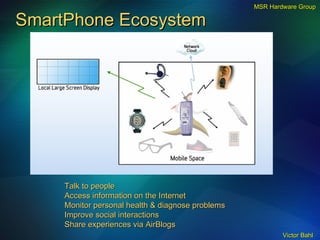
SmartPhone Ecosystem Talk to people  Access information on the Internet Monitor personal health & diagnose problems Improve social interactions Share experiences via AirBlogs Energy Harvesting MEMS Display WITTY HealthGear SPOT Barcode Reader μ PEN Xnav MSR Hardware Group WLAN, Cellular
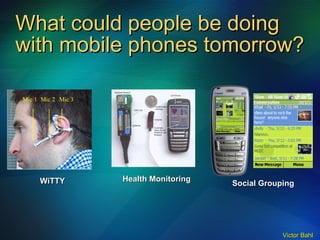
What could people be doing with mobile phones tomorrow? WiTTY Health Monitoring Social Grouping
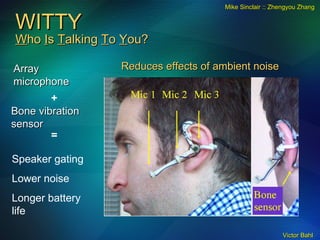
WITTY W ho  I s  T alking  T o  Y ou? Array microphone + Bone vibration sensor = Speaker gating Lower noise Longer battery life Mike Sinclair :: Zhengyou Zhang Reduces effects of ambient noise
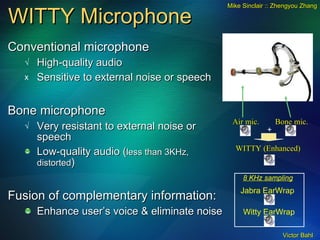
WITTY Microphone  Conventional microphone High-quality audio Sensitive to external noise or speech Bone microphone Very resistant to external noise or speech Low-quality audio ( less than 3KHz, distorted ) Fusion of complementary information: Enhance user’s voice & eliminate noise + WITTY (Enhanced) 8 KHz sampling Jabra EarWrap Witty EarWrap Bone mic. Air mic. Mike Sinclair :: Zhengyou Zhang
Health Monitoring Aging population in developed countries Rural areas in developing countries SmartPhone technology will transforming health care Early detection of health deterioration Notifying health care providers in critical situations Enhancing sense of connectedness with loved ones Find correlations between lifestyle and health Sports conditioning
Sleep Apnea A common undiagnosed condition Affects children and adults 4% in men and 2% in women (higher for elderly) Untreated causes $3.4 billion of medical costs 40 million undiagnosed Americans Periods of interrupted breathing (apnea) & reduced breathing (hypoapnea) Leads to Hypoxia, asphyxia and awakenings Increased heart-rate, high blood pressure Extreme fatigue, poor concentration Compromised immune system Cardio/cerebrovascular problems   Nuria Oliver :: Fernando-Flores Mangas :: Mike Sinclair
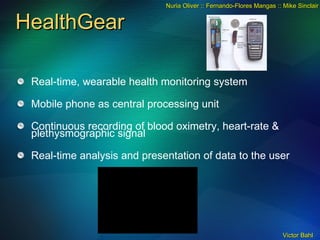
HealthGear Real-time, wearable health monitoring system Mobile phone as central processing unit Continuous recording of blood oximetry, heart-rate & plethysmographic signal Real-time analysis and presentation of data to the user Nuria Oliver :: Fernando-Flores Mangas :: Mike Sinclair
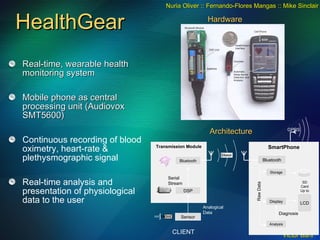
HealthGear Real-time, wearable health monitoring system Mobile phone as central processing unit (Audiovox SMT5600) Continuous recording of blood oximetry, heart-rate & plethysmographic signal Real-time analysis and presentation of physiological data to the user Nuria Oliver :: Fernando-Flores Mangas :: Mike Sinclair SmartPhone Bluetooth Storage Display Analysis SD Card Up to 2.0 Gb Raw Data Diagnosis LCD Transmission Module Sensor Bluetooth DSP Analogical Data Serial Stream GPRS CLIENT SERVER Hardware Architecture
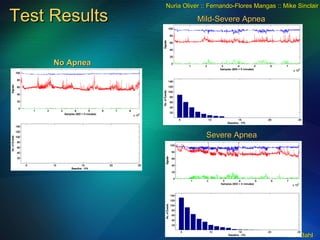
Nuria Oliver :: Fernando-Flores Mangas :: Mike Sinclair No Apnea Mild-Severe Apnea Severe Apnea Test Results
Related Work MDKeeper, Tadiran Spectralink Launching in 2006 For cardiac and circulatory disease Measures pulse rate, cardiac rhythm (ECG or EKG) and blood oxygen levels. Can store or transmit using GPRS : : :
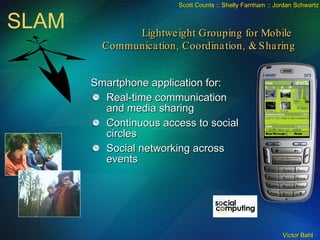
Smartphone application for: Real-time communication and media sharing Continuous access to social circles Social networking across events SLAM Scott Counts :: Shelly Farnham :: Jordan Schwartz Lightweight Grouping for Mobile  Communication, Coordination, & Sharing
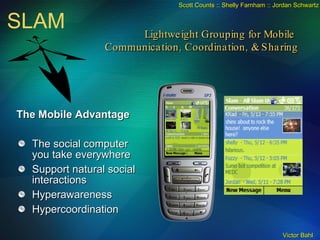
The Mobile Advantage The social computer you take everywhere  Support natural social interactions Hyperawareness Hypercoordination SLAM Scott Counts :: Shelly Farnham :: Jordan Schwartz Lightweight Grouping for Mobile  Communication, Coordination, & Sharing
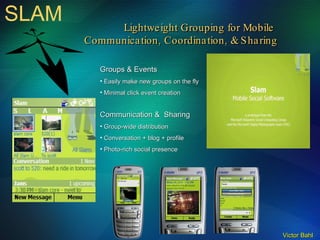
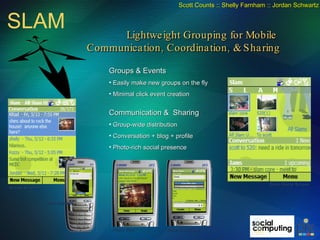
SLAM Lightweight Grouping for Mobile  Communication, Coordination, & Sharing Groups & Events Easily make new groups on the fly Minimal click event creation Communication &  Sharing Group-wide distribution Conversation + blog + profile Photo-rich social presence
Bridging the Information Divide Technology can help Connectivity Options Organically growing wireless meshes that require minimal human intervention Services Platform SmartPhone for deploying compelling services but we have to work together……. The power of ideas and opportunities, fueled by local entrepreneurial energy, is the  most important resource available in this resource-scarce part of our world. -  Richard Newton, Dean UC Berkeley
Call To Action Together academia, government, and industry must develop common vision Perform scenario & systems based research tackling hard problems Partner in building and  deploying real-world test beds
Thanks! http://research.microsoft.com/~bahl
Backup Material
Automatic Detection of Sleep Apnea Multithreshold Time Analysis: Defines multiple levels of desaturation (drop gap) and resaturation (return gap) Desaturation starts when oxygen level falls below a baseline by a certain amount  continues until the signal recovers to a level, which is lower than the baseline by 25% of the specified amount Spectral Analysis: Periodogram of the mean-subtracted oximetry signal Sleep apnea events are detected as a peak in the range 0.015-0.04Hz This frequency has a fisiological explanation corresponding to the typical lenghts of apnea events Nuria Oliver :: Fernando-Flores Mangas :: Mike Sinclair
Groups & Events Easily make new groups on the fly Minimal click event creation Communication &  Sharing Group-wide distribution Conversation + blog + profile Photo-rich social presence Slam Home Screen Group Screen Photo View  Make New Group Send Message SLAM Lightweight Grouping for Mobile  Communication, Coordination, & Sharing Scott Counts :: Shelly Farnham :: Jordan Schwartz

Bahl Information Divide

  • 1.
    Bridging the InformationDivide Victor Bahl Senior Researcher Manager, Networking Group Microsoft Research January 2005
  • 2.
    3+ billion people…Pay a “poverty premium” for basic goods and services Have little access to important amenities Make livelihood decisions with incomplete information
  • 3.
    Technology alone isnot the answer… The Real Digital Divide The Economist Mar 10th 2005 Deeper socio-economic issues have to be addressed However technology can help….
  • 4.
    Remarks by SecretaryGeneral Kofi Annan ( Opening ceremony of the World Electronic Media Forum) December 9, 2003 “ The goal is an information society – open and inclusive – in which knowledge empowers all people, and serves the cause of improving human condition” “ All over the developing world, as antennas and satellite dishes sprout across the landscape - we can see the immense thirst for connection. Let us show that we are listening.”
  • 5.
    Thirst for Connection…VSAT for kiosk in Kodia, Madhya Pradesh n-Logue corDECT wireless tower
  • 6.
    Thirst for Connection…Driven by e-governance, telemedicine, e-learning, LRIS (Land record Information System) Projects, Business India, Jan. 3, 2005 Project Akshaya in Kerala Project Bhoomi in Karnataka Project Sarita in Maharashtra Project Bhu-Lekh in Haryana Project Apna Khata in Rajastan Project Tamil Nilan in Tamil Nadu Project Rajiv Internet Village Project (Planned) 6000 centers up to 22,000 panchayat In developing countries……
  • 7.
  • 8.
    Thirst for Connection…New Orleans launches free Wi-Fi service, Associated Press, November 30, 2005 “ Biggest such effort by a major city yet” San Francisco Keeps Pushing City Wide WiFi, CNET News.com, August 17, 2005 “ San Francisco Mayor Gavin Newsom wants to make Wi-Fi coverage in the city as ubiquitous as the fog that blankets its neighborhoods.” Wi-Fi Hits the Hinterlands , BusinessWeek Online, July 5, 2004 “ Who needs DSL or cable? New “mesh” technology is turning entire small towns into broadband hot spots” Rio Rancho N.M., population 60,000, 500 routers covering 103 miles 2 NYC wireless network will be unprecedented , Computerworld, June 18, 2004 “ New York City plans to build a public safety wireless network of unprecedented scale and scope, with a capacity to provide tens of thousands of mobile users” Rural Areas need Internet too! Newsweek, June 7, 2004 Issue “ EZ Wireless built the country's largest regional wireless broadband network, a 600-square-mile Wi-Fi blanket, and activated it this February” Hermiston, Oregon, population 13,200, 35 routers with 75 antennas covering 600 miles 2 Mesh Casts Its Net , Unstrung, January 23, 2004 “ Providing 57 miles 2 of wireless coverage for public safety personnel in Garland Texas” In United States……
  • 9.
    Thirst for connection…PCCW takes Wireless Broadband to London, The Register, September 2, 2005 “ Prices for the service in UK start from £10 / month for 256 Kbps to £18 /month for 1 Mbps” Anacapa and Firetide Bring Free Wireless Internet to La Semaine Italienne in Paris, France , Business Wire, 24 May, 2005 Bell Canada and Nortel Networks launch Project Chapleau, [designed to evaluate broadband in rural Canada], Optical Networks Daily, 18 July 2005 Nationwide Wi-Fi for Macedonia, Wi-Fi Planet, 18 Nov. 18, 2005 … Around the world…
  • 10.
    Source: LeitchmanResearch Group “ Residential broadband access is an under developed technology that has the potential for profound positive effect on people’s lives and Nation’s economy ” Residential Broadband Revisited, NSF Report, October 23, 2003
  • 11.
    Services in RuralAreas (Determined by repeated visits to villages) E-agriculture E-government Computer training Telemedicine VoIP, chat, e-mail Etc. Kentaro Toyama :: Karishma Kiri
  • 12.
    Services in UrbanAreas (Determined from focus group studies) Inexpensive broadband Internet Sharing info on goods, services, A/V,… Gaming Medical & emergency response VoIP, chat, email Security (e.g. neighborhood video surveillance) Internet use increased social contact, public participation and size of social network. (social capital - access to people, information and resources) Prof. Keith N. Hampton, Sloan School, MIT (author of “Netville Neighborhood Study”) URL: http://www.asanet.org/media/neville.html Alexander Popoff
  • 13.
    You should care!Because… The future is about rich multimedia services & information exchange … possible only with wide-scale availability of broadband Internet access But… Billions of people still do not have meaningful Internet service Majority of the developing world does not have broadband connectivity As much as 32 million homes in America do not take broadband service (rural areas, older neighbourhoods, poor neighbourhoods)
  • 14.
    Design Constraints Technologymust be: inexpensive, possibly free for end-users easy to setup & deploy require minimal ramp up time & easy to use robust, handle failures (power-cuts, dust, heat, etc.) self-managing – require minimal human intervention
  • 15.
    Connectivity Option I– Wire the Last Mile Scale & legacy make first mile expensive ~ 135 million housing units in the US (U.S. Census Bureau 2001) POTS (legacy) network designed for voice & built over 60 years Cable TV networks built over last 25 years The Truck Roll Problem: Touching each home incurs cost: customer capital equipment; installation & servicing; central office equipment improvements; unfriendly terrain; political implications etc.. In our estimate building an alternate, physical last mile replacement to hit 80% of US homes will take 19 years and cost ~ US $60-120 billion Internet Backbone Middle Mile Last / First Mile Ian Ferrell
  • 16.
    Connectivity Option 2 – Wireless Last Mile < $2 Billion for 80% of the homes in US Readily available & inexpensive 802.11 hardware or some version of it Low deployment cost Decentralized ownership & maintenance Trivial setup & small hardware Integrates easily indoors & outdoors Flexible Deployable In difficult terrain, both urban or remote
  • 17.
    Connectivity option: WirelessMesh Ad hoc multi-hop wireless network (with static topology) Grows “organically” Does not require any infrastructure Provides high overall capacity Robust & Fault tolerant No centralized management, administration necessary Empowers the individual Classic Hub & Spoke Network Mesh Network
  • 18.
    Community Mesh NetworksOrganic – Participants own the equipment and the Network Venice Team
  • 19.
    Architectural Options SkyPilot,Flarion, Motorola (Canopy) Invisible Networks, RoamAD, Vivato, Arraycomm, Malibu Networks, BeamReach Networks, NextNet Wireless, Navini Networks, etc. Motorola (Meshnetworks Inc).,Radiant Networks, Invisible Networks, FHP, Green Packet Inc., LocustWorld, etc. Infrastructure Based Infrastructure-less Architecture effects design decisions on Capacity management, fairness, addressing & routing, mobility management, energy management, service levels, integration with the Internet, etc .
  • 20.
    Deployment Scenarios March2005, Source: Unstrung Insider
  • 21.
    Related Work TheCITRIS TIER Project (UC Berkeley, USA) Technology and Infrastructure for emerging regions Richard Newton, Drew Issacs, Eric Brewer, Tom Kalil http://tier.cs.berkeley.edu/ The Digital Gangetic Plains Project (IIT Kanpur, India) 802.11-based low-cost Networking for Rural India Bhaskaran Raman, Dheeraj Sanghi, A.R. Harish, Mohan K. Mishra, Anish Bhatia, A.K. Singh, Ram Chandra Prajapati http://www.iitk.ac.in/mladgp The Roofnet Project (MIT, USA) 802.11 mesh network for broadband IA in cities Dan Aguayo, John Bicket, Sanjit Biswas, Robert Morris http://pdos.csail.mit.edu/roofnet/doku.php The TAPs Project (Rice University, USA) Wireless broadband to residential and public places Edward Knightly, Behnaam Aazhang, J. Patrick Frantz, David Johnson, Ashu Sabarwal http://taps.rice.edu/index.html
  • 22.
    Some Relevant StandardsIETF MANET Layer 3 protocols for Mobile Ad Hoc Networks IEEE 802.11s Extended Service Set for Mesh Networking IEEE 802.16 Broadband Wireless Metropolitan Area Networks IEEE 802.20 Mobile Broadband Wireless Access for business & residential markets IEEE 802.22 Wireless Regional Area Networks (WRANs) OBAN Broadband Coverage in Urban Area (European effort)
  • 23.
  • 24.
    Many Challenges Deployment“ Real-world” study with real traffic traces, usage patterns and failure /performance logs Self Healing & Management Minimal human intervention - avoid network operator Mechanisms for data cleaning, anomaly detection & liar detection Automatic tools for what-if analysis for optimal operation Pleasant, hassle-free user experience (zero-configuration setup) Smart Spectrum Utilization Spectrum Policy - etiquettes and/or rules with technical input Spectrum Leasing Cognitive software & applications Agile radios, cognitive radios, 60 GHz radio, underlay technologies
  • 25.
    Power Battery capacitydoubles in energy density every 35 years [Pow95] Security, Privacy, and Fairness Guarding against malicious users Priority for VoIP and time-sensitive data Connectivity, Range, Scale, and Capacity Inexpensive electronically steerable directional antenna and/or MIMO Multi-frequency meshes & multi-radio / multi-channel hardware Data channel MAC with Interference management for higher throughput Analytical Tools Information theoretic tools that predict network viability & performance with practical constraints, based on experimental data Many Challenges (cont.)
  • 26.
    Research Community AssetsVideos, Presentations, Notes etc. http://research.microsoft.com/meshsummit/ Software, Papers, Presentations http://research.microsoft.com/mesh/ http://research.microsoft.com/events/smnsummit/
  • 27.
    Academic Resource Kit2005 [email_address] Prof. Sivaram Murthy, IIT, Chennai, India Hybrid wireless mesh for rural communities Prof. Sanjiva Prasad, IIT, New Delhi, India Async. messaging in Wireless network Prof. Lili Qiu, University of Texas Austin Resilience in wireless mesh Networks Prof. William Arbaugh, University of Maryland Security and Privacy in wireless meshes Prof. Suman Banerjee, University of Wisconsin Quality of service in wireless meshes Prof. Dan Rubenstein, Columbia University Channelization and routing Prof. Richard Newton, UC Berkeley The TIER Project MS ERP has budgeted $1.2 million for research funding in FY06 under their Digital Inclusion Initiative http://research.microsoft.com/netres/kit/
  • 28.
    Requests for AcademicResource Kit (as of 8/12) Anna University, Chennai, India Arizona State University,AZ Auburn University, AL Columbia University, NY Dartmouth College , NH DeVry University, Kansas City Florida State University, FL Gdansk University of Technology, Poland Gwangju Institute of Sci&Tech, Korea Hogschool Gent, Belgium Huazhong University, China Indian Institute of Science Bangalore, India Institute of Compute Technology, China Iowa State University Ames, IA Iqra University, Pakistan Katholieke Universiteit Leuven. Netherlands National Chung Hsing University, Taiwan National Institute of Technology Karnataka, India National University of Singapore New Mexico State University, NM Ohio State University, OH Rice University, TX Rutgers University, NJ Ryerson University Toronto, Canada Saint-Hyacinthe College, Quebec, Canada Sogang University, Korea Stanford University, CA Syracuse University, NY Technology University of Tswane, South Africa Tsinghua University, Beijing, China Univ. of Applied Sciences of Southern Switzerland University of Victoria, Canada University of Texas at San Antonio, TX University of Louisiana at Lafayette University of California Berkeley, CA University of California San Diego, CA University of California Irvine, CA University of Cincinnati, OH University of Concordia, Canada Universidade Federal Fluminente, Brazil Univ. Federal Fluminense Rio de Janeiro, Brazil University of Hawaii, HI University of Maryland, MD University of Massachusetts Amherst, MA University of New South Wales Sydney, Australia University of North Carolina Chapel Hill, NC University of South Florida, FL University of Southern California, CA University of Texas Austin, TX University of Utah, UT University of Waterloo, Canada University of Wisconsin-Madison, WI Virginia Tech, VA Wyzsza Szkola Informatyki w Lodzi, Poland http://research.microsoft.com/netres/kit /
  • 29.
    Broadband WiFi DebateProponents Local and state government should provide WiFi access free everywhere Propel the country into yhr broadband age Lower cost, faster deployment (specially in rural areas) Stimulate competition by raising service standards Detractors Unfair to ask private sector to compete with local government who have tax dollars Not a utility, highly competitive enterprise Continuously changing due to innovation Two sides to the coin…. Phone Giants Are Lobbying Hard To Block Towns' Wireless Plans Wall Street Journal, June 23, 2005
  • 30.
    Common consumer electronicdevice Inexpensive; Value is clear; First waves of practical devices that integrate cameras, processor, network, & display are in the market “ The digital divide is really diminishing, and it's the mobile phones doing it, not the PC” Len Waverman, London Business School
  • 31.
    The Mobile PhoneGartner forecasts sales will approach 780 million units this year and more than 1 billion worldwide in 2009 China (as of May 2004) 25 million PCs 300 million cell phones India (as of May 2004) 15 million PCs 40 million cell phones + 2 million added / month Tracey Lovejoy Source: Strategy Analytics http://www.strategyanalytics.net/ Source : Forrester Research, December 10, 2004
  • 32.
    What are peopledoing with mobile phones today? SMS Text-messaging Purchasing Web Surfing & email Watching & Sharing Video Taking & Sharing Pictures Expression of Identity Tracey Lovejoy
  • 33.
    The SmartPhone PlatformMobile and Embedded Devices
  • 34.
    SmartPhone Ecosystem Talkto people Access information on the Internet Monitor personal health & diagnose problems Improve social interactions Share experiences via AirBlogs Energy Harvesting MEMS Display WITTY HealthGear SPOT Barcode Reader μ PEN Xnav MSR Hardware Group WLAN, Cellular
  • 35.
    What could peoplebe doing with mobile phones tomorrow? WiTTY Health Monitoring Social Grouping
  • 36.
    WITTY W ho I s T alking T o Y ou? Array microphone + Bone vibration sensor = Speaker gating Lower noise Longer battery life Mike Sinclair :: Zhengyou Zhang Reduces effects of ambient noise
  • 37.
    WITTY Microphone Conventional microphone High-quality audio Sensitive to external noise or speech Bone microphone Very resistant to external noise or speech Low-quality audio ( less than 3KHz, distorted ) Fusion of complementary information: Enhance user’s voice & eliminate noise + WITTY (Enhanced) 8 KHz sampling Jabra EarWrap Witty EarWrap Bone mic. Air mic. Mike Sinclair :: Zhengyou Zhang
  • 38.
    Health Monitoring Agingpopulation in developed countries Rural areas in developing countries SmartPhone technology will transforming health care Early detection of health deterioration Notifying health care providers in critical situations Enhancing sense of connectedness with loved ones Find correlations between lifestyle and health Sports conditioning
  • 39.
    Sleep Apnea Acommon undiagnosed condition Affects children and adults 4% in men and 2% in women (higher for elderly) Untreated causes $3.4 billion of medical costs 40 million undiagnosed Americans Periods of interrupted breathing (apnea) & reduced breathing (hypoapnea) Leads to Hypoxia, asphyxia and awakenings Increased heart-rate, high blood pressure Extreme fatigue, poor concentration Compromised immune system Cardio/cerebrovascular problems Nuria Oliver :: Fernando-Flores Mangas :: Mike Sinclair
  • 40.
    HealthGear Real-time, wearablehealth monitoring system Mobile phone as central processing unit Continuous recording of blood oximetry, heart-rate & plethysmographic signal Real-time analysis and presentation of data to the user Nuria Oliver :: Fernando-Flores Mangas :: Mike Sinclair
  • 41.
    HealthGear Real-time, wearablehealth monitoring system Mobile phone as central processing unit (Audiovox SMT5600) Continuous recording of blood oximetry, heart-rate & plethysmographic signal Real-time analysis and presentation of physiological data to the user Nuria Oliver :: Fernando-Flores Mangas :: Mike Sinclair SmartPhone Bluetooth Storage Display Analysis SD Card Up to 2.0 Gb Raw Data Diagnosis LCD Transmission Module Sensor Bluetooth DSP Analogical Data Serial Stream GPRS CLIENT SERVER Hardware Architecture
  • 42.
    Nuria Oliver ::Fernando-Flores Mangas :: Mike Sinclair No Apnea Mild-Severe Apnea Severe Apnea Test Results
  • 43.
    Related Work MDKeeper,Tadiran Spectralink Launching in 2006 For cardiac and circulatory disease Measures pulse rate, cardiac rhythm (ECG or EKG) and blood oxygen levels. Can store or transmit using GPRS : : :
  • 44.
    Smartphone application for:Real-time communication and media sharing Continuous access to social circles Social networking across events SLAM Scott Counts :: Shelly Farnham :: Jordan Schwartz Lightweight Grouping for Mobile Communication, Coordination, & Sharing
  • 45.
    The Mobile AdvantageThe social computer you take everywhere Support natural social interactions Hyperawareness Hypercoordination SLAM Scott Counts :: Shelly Farnham :: Jordan Schwartz Lightweight Grouping for Mobile Communication, Coordination, & Sharing
  • 46.
    SLAM Lightweight Groupingfor Mobile Communication, Coordination, & Sharing Groups & Events Easily make new groups on the fly Minimal click event creation Communication & Sharing Group-wide distribution Conversation + blog + profile Photo-rich social presence
  • 47.
    Bridging the InformationDivide Technology can help Connectivity Options Organically growing wireless meshes that require minimal human intervention Services Platform SmartPhone for deploying compelling services but we have to work together……. The power of ideas and opportunities, fueled by local entrepreneurial energy, is the most important resource available in this resource-scarce part of our world. - Richard Newton, Dean UC Berkeley
  • 48.
    Call To ActionTogether academia, government, and industry must develop common vision Perform scenario & systems based research tackling hard problems Partner in building and deploying real-world test beds
  • 49.
  • 50.
  • 51.
    Automatic Detection ofSleep Apnea Multithreshold Time Analysis: Defines multiple levels of desaturation (drop gap) and resaturation (return gap) Desaturation starts when oxygen level falls below a baseline by a certain amount continues until the signal recovers to a level, which is lower than the baseline by 25% of the specified amount Spectral Analysis: Periodogram of the mean-subtracted oximetry signal Sleep apnea events are detected as a peak in the range 0.015-0.04Hz This frequency has a fisiological explanation corresponding to the typical lenghts of apnea events Nuria Oliver :: Fernando-Flores Mangas :: Mike Sinclair
  • 52.
    Groups & EventsEasily make new groups on the fly Minimal click event creation Communication & Sharing Group-wide distribution Conversation + blog + profile Photo-rich social presence Slam Home Screen Group Screen Photo View Make New Group Send Message SLAM Lightweight Grouping for Mobile Communication, Coordination, & Sharing Scott Counts :: Shelly Farnham :: Jordan Schwartz

Editor's Notes

  • #2 This talk describes technology options for providing connectivity and services to people around the world who are currently not benefiting from the technology innovations. The goal is to inspire researchers &amp; students to work on problems that have the potential of impacting billions. The research described in this talk represents a few projects researcher in MSR are pursuing in this space. We recognize that the problems are not simple and solutions are not limited to providing Internet technology only. To elevate the standard-of-living, people from govt., industry and academia have to come together and go after a common vision. MSR researchers are investing time and money and making our software available to academia (in source form) to speed up this march towards reaching a vision of ubiquitous access &amp; services. The talk does not cover all projects MSR is engaged in that are relevant in this space -- One notable omission is MSR India’s work on rural computing.
  • #3 A substantial portion of our world still does not have connectivity. There people see technology as a luxury and its value is not clear. However, there exist plenty of examples where easy information access and communications has made a difference in improving people’s lives.
  • #7 Project Akshaya – Akshaya addresses three issues in IT Dissemination to masses in rural India:  (1) Bringing the benefits of technology to the Households (Access) , (2) providing ample information base in local language relevant to citizens&apos; lives (Contents) and (3) sufficient understanding of the world of Information Technology and how it can touch their lives (Skillsets) in terms of using simple programs, internet browsing for information, emails etc... http://akshaya.net/akshaya/ Project Bhoomi - Bhoomi is a self-sustainable e-governance project for the computerized delivery of 20 million rural land records to 6.7 million farmers through 177 Government owned kiosks in the Indian state of Karnataka which has eliminated red tape and corruption in the issue of land title records, and is fast becoming the backbone for credible IT-enabled Government services for the rural population. http://www.revdept-01.kar.nic.in/Bhoomi/Importance.htm Project RAJiv –The Govt. launched the Rajiv Internet Village programme to bring Govt. services/benefits closer to the people living in villages and rural areas. Rajiv Internet village centres are being set up in 8618 villages across the State. These centres are expected to be functional by October, 2005. http://www.aponline.gov.in/Quick%20Links/events/RIV%20Launch/RaJiv.htm
  • #11 This graph shows that even in developed nations like the US, a large percentage of the people with low income do not have broadband Internet connectivity. The $40 - $50 /month cost is a bit too much for them to pay. In order to make access to information ubiquitous, the cost has to come down. Wireless community networks, can accelerate deployment by lowering cost and reachablity barrier. One Internet gateway into the neighborhood can feed most houses in the neighborhood.
  • #12 Kentaro and Karishma have visited many villages in India to come up with this list of services. Browsing on the web, many rural projects that have been started by many government initiatives &amp; companies focus on providing such services.
  • #13 Cheskin (www.cheskin.com) consulting &amp; strategic Market Research firm was hired by Microsoft to determine what services people most care about. Their study included 3 focus groups / market across 2 markets (Seattle, Austin). The 3 groups were (1) Urban focus group – a mix of single family home and shared home dwellers, acquainted with 4+ neighbors, broadband users, multiple PC owners, some with home networks (2) Suburban focus group – a mix of single family home and condominium dwellers, acquainted with 4+ neighbors, broadband users, multiple PC owners, some with home networks, and (3) Rural focus group - single family home dwellers, dial up or broadband users, multiple PC owners, some with home networks. The lettering in red indicates commonality with Kentaro’s and Karishma’s findings.
  • #14 Data is from the FCC, December 22, 2004 report under “Local Telephone Competition and Broadband Deployment”, Report title is: “Federal Communications Commission releases data on High-Speed Internet Access Services ”. Note: FCC defines High-speed lines as 200 Kbps in at least one-direction and Advanced Services Lines where speeds &gt; 200 Kbps in both directions. High-speed lines : 32.5 million (30.1 million serve residential &amp; small business subscribers); General break-up ADSL: 11.4 million, Coaxial: 18.6 million, Wireless/satellite: 2.5 million Advanced Services Lines : 23.5 million (of the 32.5 million) – of these 21.2 million serve residential &amp; small businesses. From CIA FactBook US Population (July 2005 est): 295 million Internet users: 159 million (as of 2002)
  • #15 ..has to be inexpensive, easy to use and maintain.
  • #16 Back of the envelope calculations – See the accompanying Excel spread sheet. From Tren, $1000 / home to do an overlay (term used by wireline broadband providers). Assuming $110 million households (293 million population), the average amount to do a complete wired solution is close to 110 billion.
  • #17 802.11 chip cost have plummeted, The BoM for 802.11 &lt; $10 We can keep the same Physical layer, i.e. OFDM, but the MAC (carrier Sense Multiple Access with Collision Avoidance CSMA/CA) may change – by doing this we can reuse the chipset, and hence benefit from the lower cost.
  • #18 There are two options for last mile wireless connectivity (1) an infra-structure based system [the classic hub &amp; spoke Network] (2) a Mesh network [where every node is equal]. Example of (1) is the WiFi networks deployed in companies, airports, hotels public places etc. We prefer the mesh network, because theoretically it does not require ISPs. In a mesh network, anyone can become an ISP. For example an entrepreneur kid in the neighbourhood can get a T-1 link and start providing Internet Service to the neighbourhood. Similarly a local school could provide Internet connectivity to the neighbouring houses. A mesh network is relatively inexpensive to deploy because the “customer” owns his or her equipment. People collaborate and give resources to the network and in-turn cooperatively use the network.
  • #19 People buy a Wireless Access Point for their home network. These AP are equipped with multiple radios and mesh software. The radios is end devices (laptops, desktops, tablets, phones etc.) to connect. The APs also discover one another and connect to form a wireless mesh backbone network. The network ends at a Internet Gateways (there can be a number of Internet gateways). Internet feed could be in the form of T1, Satellite, WiMAx, etc. Technologies for community networking are directly applicable to: Connecting villages in rural areas City-wide blanket coverage Enterprise-wide wireless networks (i.e. networking in old buildings without cables) What about WiMax ? WiMAx as a long-haul wireless backbone technology can works nicely with wireless meshes. In low density areas WiMax requires high power towers or lots of towers; not very cost effective NLOS reduces range &amp; bandwidth significantly, no longer as attractive End-node Equipment expected to be fairly expensive in the next 3 to 5 years, compared to WiFi Requires infra-structure roll out and ISP services
  • #20 Within mesh networking there are two different architectural options. (1) infra-structure based, this is like the Metricom Richchet network. Radio transmitters are placed on pole-tops and end-nodes connect to them wirelessly – this is similar to a corporate WLAN network. The difference is that the poletop receivers form a mesh between themselves. (2) every node is a a router. (Note companies like Motorola have products of both kind) Why did Ricochet fail? Required physical infrastructure build-out of wireless access points every ¼ mile or so; more of a last 100 ft. solution than last mile. Went bankrupt as a result and now revived in Denver and San Diego. Back-haul cost was very high
  • #22 There are others as well, but most are non-academic – for example various community networks that are sprouting up everywhere (1) Seattle Wireless (2) Urbana Champaign wireless (3) Free-Net in Erlangen, Germany (4) Free-Net in Finland etc. Check out: http://www.scn.org/commnet/ (or simply search for “community Network” in one of the search engines. Most of these are grass root efforts. The ones listed above are academic / research efforts.
  • #24 Video shows three ideas MSR Redmond has developed (1) Multi-radio meshes for capacity &amp; scale; (2) dual-frequency meshes for range (3) layer 2.5 source routing with a multi-radio link metric. In addition to this MSR Redmond has also made significant progress in (4) Fault detection &amp; diagnosis (5) Security . We have also been pioneers in pushing for spectrum regulation reforms. We made one of the first (probably the first) technical proposal on spectrum etiquettes and lobbied the FCC to open up additional bandwidth in the 5 GHz range and more recently yhe 700 MHz band for unlicensed use (in November 2003, FCC opened up additional 255 MHz for unlicensed use.
  • #28 Announce the Academic Resource Kit. The kit contains complete source code for our mesh connectivity layer and Virtual WiFi technologies. We are also giving away source code for our performance measurement and debugging tools along with DDK, WinXP, WinCE, videos, papers, and presentations.
  • #34 Interesting components to point out GPS (location services) WiFi (local area networking); Bluetooth (personal area networking); GSM / GPRS (cellular networking) Strong Arm processor,
  • #38 Play the Audio file
  • #42 Current ways to Diagnose Sleep Apnea “ Classical” Diagnoses of Sleep Apnea Nocturnal Polysomnography (PSG): Patient stays in the sleep center for 1-2 nights System continuously monitors 8 physiological signals via simultaneous multi-channel measurements Very expensive, cumbersome, time consuming, just one sample (i.e. one night at the sleep enter) and subject to manual scoring and human error Pulse Oximetry: Useful as screening and diagnostic tool One simple, light-weight sensor on finger, toe or earlobe
  • #43 21 volunteers: 80% male, ages 25-65 30% healthy, 70% with sleep apnea or suspected Wore HealthGear for one full night in their own homes
  • #45 Slam is an application for the smartphone being developed by the social computing research group. This application allows users to create and communicate with groups of people from their mobile device. Take the dinner party scenario: you are at a dinner party and you just want the other folks there to have the pictures you are taking from your camera phone, but options for sharing, such as via mms or posting to a website are so much effort they spoil the spontaneity and fun of it. Slam supports really simple group formation from the mobile device just for this reason. Once you quickly create a slam group for the dinner party, picture sharing is built in to the picture taking process: pictures taken from within slam are distributed to all other group member’s mobiles with a single message. Based on previous research done in the group as well as ethnographic studies of mobile device use, the more common usage scenario for slam is group-based communication for social coordination. At a conference and want to coordinate a lunch? Again, quickly make a slam group for on-the-fly coordination around when and where to meet and who is going to the lunch. And of course these groups can be more persistent groups like friends and family. From a social computing perspective, we’re really trying to enable people to be not just always on, but always in touch with the people they care about.
  • #46 The mobile device is just critical to providing always in touch social interactions because it’s the computer you have with you when are out in the physical world being social. This allows you to supporting naturally existing social interactions: Humans are very evolved for physical social interaction, with well established practices for self-presentation, the reading of social contextual cues, and so on. Given that the device is with the user in her physical world social environment, we can use technology to augment these interactions rather than creating exclusively digital social interactions like many of the social networking sites. This also allows you to support hyperawareness: because the device is always with the person, she can always be aware of people and events she cares about. Ethnographic studies of early adopters of these mobile social technologies highlight the role of in-time, in-place updates and changes of plans, or “hypercoordination”. For example, if you look at the social coordination practices of teens in Japan, rather than specifying precise times and places to meet, they start with a neighborhood and general time, such as Shibuya in the early afternoon, and through mobile messaging they coordinate on the fly to converge on a time and place.
  • #47 A couple of screen shots here point out the primary functionality of slam. The large image in the upper right shows the application home screen. Each of the 4 favorite groups –or slams- are represented by the most recently shared photo in order to give a sense of social presence right at the top level. At the bottom of the main screen is a list of upcoming events – or “jams”. Because this is a social system with a focus on supporting our everyday social lives, events are very simple in comparison to the more formal or structured events like scheduled meetings at work or eVites, which are geared toward larger events. Events are simply messages sent to a group with a date and time associated with them that other group members can respond to. So, here we’re trying to support the common and often very fluid social events we all have, such as the Japanese teens meeting on a Saturday afternoon or a group of friends deciding what movie to go to on a Friday night. The screen on the left shows a click into the page for an individual group. Again, all messages are distributed to the entire group, creating a group-wide conversation thread. The conversation brings together text message and photos, as well as group events and membership. Making a new group is as simple as giving it a name, selecting some people to invite – either from other slams or by phone number, and clicking ‘create’. And that really is the core of slam: helping people communicate, coordinate, and share their lives through simple group creation and conversation on mobile devices.
  • #53 A couple of screen shots here point out the primary functionality of slam. The large image in the upper right shows the application home screen. Each of the 4 favorite groups –or slams- are represented by the most recently shared photo in order to give a sense of social presence right at the top level. At the bottom of the main screen is a list of upcoming events – or “jams”. Because this is a social system with a focus on supporting our everyday social lives, events are very simple in comparison to the more formal or structured events like scheduled meetings at work or eVites, which are geared toward larger events. Events are simply messages sent to a group with a date and time associated with them that other group members can respond to. So, here we’re trying to support the common and often very fluid social events we all have, such as the Japanese teens meeting on a Saturday afternoon or a group of friends deciding what movie to go to on a Friday night. The screen on the left shows a click into the page for an individual group. Again, all messages are distributed to the entire group, creating a group-wide conversation thread. The conversation brings together text message and photos, as well as group events and membership. Making a new group is as simple as giving it a name, selecting some people to invite – either from other slams or by phone number, and clicking ‘create’. And that really is the core of slam: helping people communicate, coordinate, and share their lives through simple group creation and conversation on mobile devices.