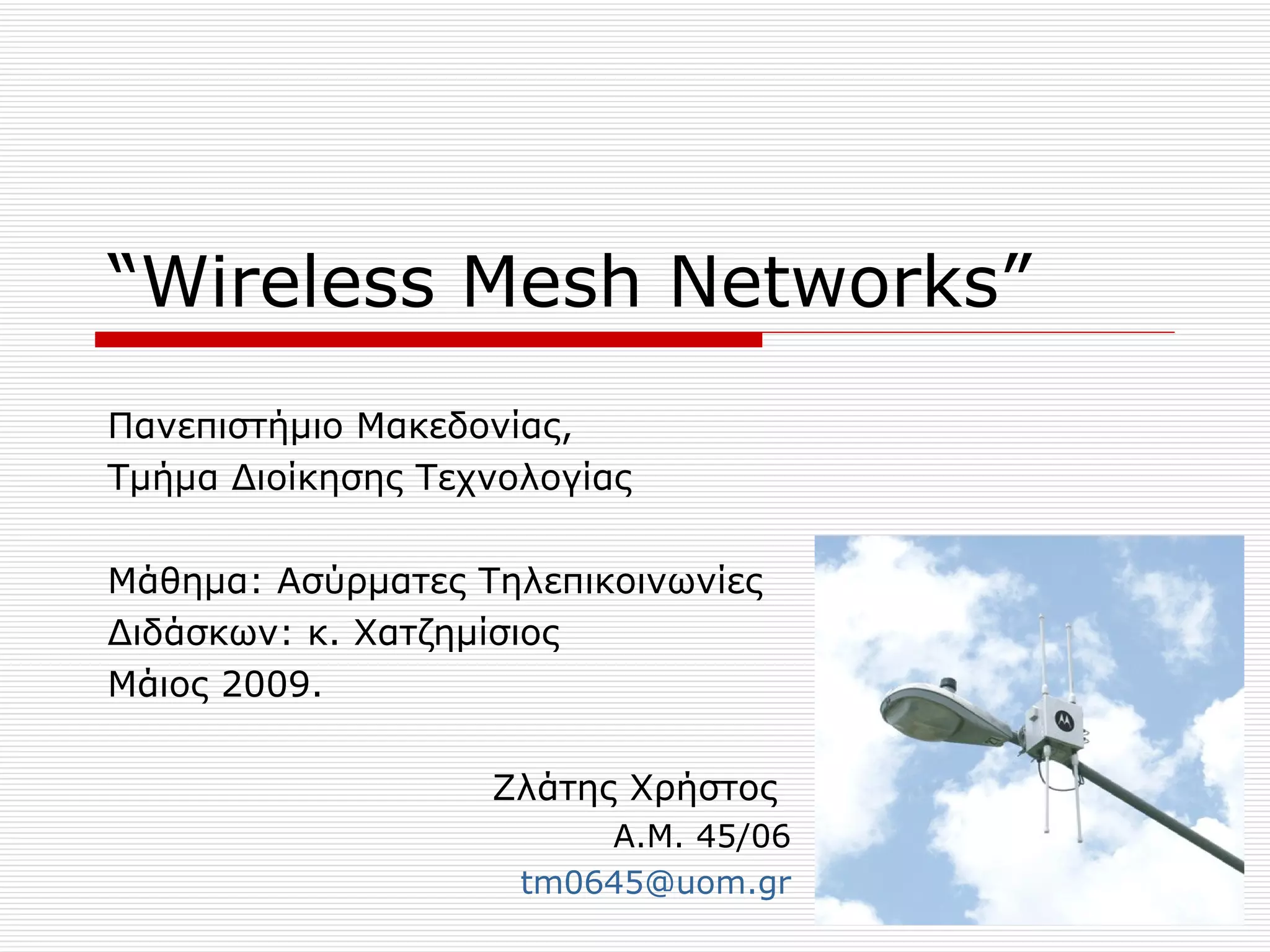
“Wireless Mesh Networks”
Πανεπιστήμιο Μακεδονίας,
Τμήμα Διοίκησης Τεχνολογίας

Μάθημα: Ασύρματες Τηλεπικοινωνίες
Διδάσκων: κ. Χατζημίσιος
Μάιος 2009.

                   Ζλάτης Χρήστος
                         Α.Μ. 45/06
                     tm0645@uom.gr
Contents
   Introduction – Definitions
   Technology & Network architecture
   Advantages of WMNs
   Critical Design factors
   Research Challenges & problems
   Applications of WMNs
   Conclusion
Introduction – Definitions
   "A mesh network is a network that employs one of two
    connection arrangements, full mesh topology or partial
    mesh topology. In the full mesh topology, each node is
    connected directly to each of the others. In the partial
    mesh topology, nodes are connected to only some, not
    all, of the other nodes.“
                 [TechTarget and Telecom Glossary 2K definition]

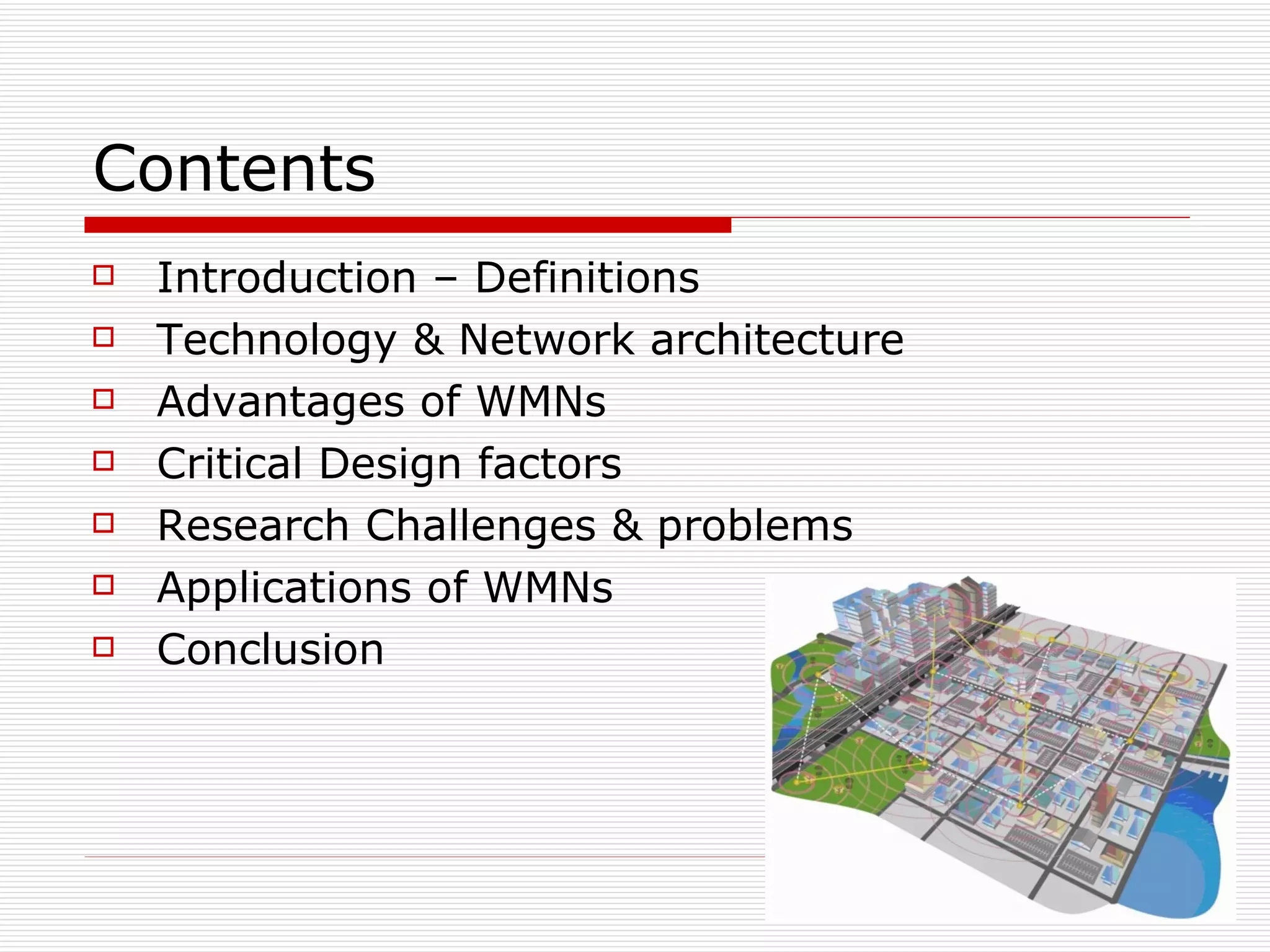
   Wireless mesh networks (WMNs) are regarded as an
    economical alternative key technology for next-
    generation wireless networking.
   Wireless mesh networks can easily, effectively and
    wirelessly connect entire cities using inexpensive,
    existing technology.
Let’s talk about Technology and
Network architecture… [1/2]
   Wireless mesh networks (WMNs) are dynamically self-
    organized and self-configured and they are comprised of
    two types of nodes: mesh routers and mesh
    clients.

   Three types of wireless mesh networks:
   Infrastructure wireless mesh networks: Mesh
    routers form an infrastructure for clients.
   Client wireless mesh networks: Client nodes
    constitute the actual network to perform routing and
    configuration functionalities.
   Hybrid wireless mesh networks: Mesh clients can
    perform mesh functions with other mesh clients as well
    as accessing the network.
Let’s talk about Technology and
Network architecture… [2/2]
   In a wireless mesh network, only one node needs to
    be physically wired to a network connection like a
    DSL Internet modem.
    That one wired node then shares its Internet
    connection wirelessly with all other nodes in its
    vicinity. Those nodes then share the connection
    wirelessly with the nodes closest to them.
   The more nodes  the further the connection spreads 
    creating a wireless "cloud of connectivity" that can
    serve a small office or a city of millions.
   WMNs have rapid commercialization in many application
    scenarios such as broadband home networking,
    community networking, building automation, high-
    speed metropolitan area networks, and enterprise
    networking.
Why WMNs are interesting?
    Fewer wires  less cost to set up a network
    More nodes  bigger and faster wireless networks
    Same WiFi standards (802.11a, b and g)
    Useful for Non-Line-of-Sight (NLoS) network
     configurations  wireless signals are intermittently
     blocked.
    “Self configuring" networks  the network
     automatically incorporates a new node into the existing
     structure without needing any adjustments by a network
     administrator.
    “Self healing" networks  the network automatically
     finds the fastest and most reliable paths to send data,
     even if nodes are blocked or lose their signal.
    Wireless mesh configurations allow local networks to
     run faster  local packets don't have to travel back to
     a central server.
What are the Advantages of WMNs?
   Price: 802.11 radios are quite cheap, but the radios are
    often still expensive. Each mesh node runs both as a
    client and as a repeater  less radios.
   Ease and simplicity: Pre-installed wireless mesh
    software, standard wireless protocols  the setup is
    extremely simple.
   Organization and business models: A decentralized
    ownership model  each participant in the network
    owns and maintains their own hardware  simplify the
    financial and community aspects of the system.
   Integration: Mesh hardware is typically small,
    noiseless, and easily encapsulated in weatherproof
    boxes.
   Power: The substrate nodes of a mesh network can be
    built with extremely low power requirements 
    autonomous units with solar, wind, or hydro power.
What are the Critical Design
Factors?
   Radio Techniques.  increase capacity and flexibility
    of wireless systems (directional and smart antennas,
    MIMO systems and multi-radio/multi-channel systems).
   Scalability. Without support of this feature, the
    network performance degrades significantly as the
    network size increases.
   Mesh Connectivity.  network self-organization and
    topology control algorithms are needed.
   Broadband and QoS. Different from classical ad hoc
    networks, most applications of WMNs are broadband
    services with heterogeneous QoS requirements.
   Ease of Use. Protocols must be designed to enable the
    network to be as autonomous as possible  network
    management tools need to be developed
What are the Research Challenges?
   Scalability. Based on existing MAC, routing, and
    transport protocols, network performance is not scalable
    with either the number of nodes or the number of hops
    in the network.
      This problem can be alleviated by increasing the
    network capacity through using multiple
    channels/radios per node or developing wireless radios
    with higher transmission speed.
   Security. WMNs are vulnerable to security attacks in
    various protocol layers.
      Still exists a need for a comprehensive
    mechanism to prevent or counter attacks in all protocol
    layers.
   Moreover, there is a need for self-organization and
    self configuration capability, improved protocols and
    new schemes.
Let’s talk about Applications of
WMNs… [1/2]
   Developing Countries
     Solar-powered nodes can be connected to one cellular
    or satellite Internet connection, which could keep a
    whole village online.
   Isolated Locations, Rugged Terrain
     A series of nodes would be mounted from the nearest
    available wired access point out to the hard-to-reach
    area.
   Education
     This solution eliminates the need to bury cables in old
    buildings and across campuses. Mesh networks also
    have the capacity to handle the high-bandwidth needs.
   Safety and Security
     Schools can also monitor security cameras and keep
    all personnel in constant communication in emergency
    situations.
Let’s talk about Applications of
WMNs… [2/2]
   Healthcare
    Wireless mesh nodes can send signals short distances to
    ensure access in every operating room, lab and office.
     The ability to connect to the network is crucial as
    more doctors and caregivers maintain and update
    patient information on portable electronic devices carried
    from room to room.
   Hospitality
     Wireless mesh networks are quick and easy to set up
    indoors and outdoors without having to remodel existing
    structures or disrupt business.
   Warehouses
    There is simply no effective way to keep track of stock
    and shipping logistics without the types of Ethernet-
    enabled handheld scanners used in modern warehouses.
     Wireless mesh networks can ensure connectivity
    throughout a huge warehouse structure with little effort.
The future of the WMNs
applications?
   The U.S. military, which helped develop wireless mesh
    technology, foresees a day when thousands of
    microchip-size mesh nodes can be dropped onto a
    battlefield to set up instant scouting and surveillance
    networks. Information can be routed to both ground
    troops and headquarter personnel.
   Carmakers and telecom companies are working to
    develop Intelligent Transport Systems (ITS)
    powered by street and highway-based wireless mesh
    networks. Using an automated network of surveillance
    cameras and in-car sensors, public safety officials can
    tightly monitor traffic accidents and dangerous road
    conditions.
   PC Magazine reports that there's even technology which
    promise upgrades for in-car entertainment options
    like digital music and movie downloads.
Conclusion
    The Internet: The Original Mesh Network
    “The Internet is the world's largest mesh network.
     Information travels across the Internet by being
     bounced automatically from one router to the next until
     it reaches its destination. The Internet is often depicted
     as a "cloud" or "web" of connectivity because of the
     billions of potential paths across which data can travel.”

Case Studies
  Afrimesh, Simple & Easy dashboard for network
   management of wireless mesh networks for rural Africa.
  Patmos, the first Greek Wireless Mess networked island
   with hot zones and hotspots by Nortel company.

Wireless Mesh Networks

  • 1.
    “Wireless Mesh Networks” ΠανεπιστήμιοΜακεδονίας, Τμήμα Διοίκησης Τεχνολογίας Μάθημα: Ασύρματες Τηλεπικοινωνίες Διδάσκων: κ. Χατζημίσιος Μάιος 2009. Ζλάτης Χρήστος Α.Μ. 45/06 tm0645@uom.gr
  • 2.
    Contents  Introduction – Definitions  Technology & Network architecture  Advantages of WMNs  Critical Design factors  Research Challenges & problems  Applications of WMNs  Conclusion
  • 3.
    Introduction – Definitions  "A mesh network is a network that employs one of two connection arrangements, full mesh topology or partial mesh topology. In the full mesh topology, each node is connected directly to each of the others. In the partial mesh topology, nodes are connected to only some, not all, of the other nodes.“ [TechTarget and Telecom Glossary 2K definition]  Wireless mesh networks (WMNs) are regarded as an economical alternative key technology for next- generation wireless networking.  Wireless mesh networks can easily, effectively and wirelessly connect entire cities using inexpensive, existing technology.
  • 4.
    Let’s talk aboutTechnology and Network architecture… [1/2]  Wireless mesh networks (WMNs) are dynamically self- organized and self-configured and they are comprised of two types of nodes: mesh routers and mesh clients.  Three types of wireless mesh networks:  Infrastructure wireless mesh networks: Mesh routers form an infrastructure for clients.  Client wireless mesh networks: Client nodes constitute the actual network to perform routing and configuration functionalities.  Hybrid wireless mesh networks: Mesh clients can perform mesh functions with other mesh clients as well as accessing the network.
  • 5.
    Let’s talk aboutTechnology and Network architecture… [2/2]  In a wireless mesh network, only one node needs to be physically wired to a network connection like a DSL Internet modem. That one wired node then shares its Internet connection wirelessly with all other nodes in its vicinity. Those nodes then share the connection wirelessly with the nodes closest to them.  The more nodes  the further the connection spreads  creating a wireless "cloud of connectivity" that can serve a small office or a city of millions.  WMNs have rapid commercialization in many application scenarios such as broadband home networking, community networking, building automation, high- speed metropolitan area networks, and enterprise networking.
  • 6.
    Why WMNs areinteresting?  Fewer wires  less cost to set up a network  More nodes  bigger and faster wireless networks  Same WiFi standards (802.11a, b and g)  Useful for Non-Line-of-Sight (NLoS) network configurations  wireless signals are intermittently blocked.  “Self configuring" networks  the network automatically incorporates a new node into the existing structure without needing any adjustments by a network administrator.  “Self healing" networks  the network automatically finds the fastest and most reliable paths to send data, even if nodes are blocked or lose their signal.  Wireless mesh configurations allow local networks to run faster  local packets don't have to travel back to a central server.
  • 7.
    What are theAdvantages of WMNs?  Price: 802.11 radios are quite cheap, but the radios are often still expensive. Each mesh node runs both as a client and as a repeater  less radios.  Ease and simplicity: Pre-installed wireless mesh software, standard wireless protocols  the setup is extremely simple.  Organization and business models: A decentralized ownership model  each participant in the network owns and maintains their own hardware  simplify the financial and community aspects of the system.  Integration: Mesh hardware is typically small, noiseless, and easily encapsulated in weatherproof boxes.  Power: The substrate nodes of a mesh network can be built with extremely low power requirements  autonomous units with solar, wind, or hydro power.
  • 8.
    What are theCritical Design Factors?  Radio Techniques.  increase capacity and flexibility of wireless systems (directional and smart antennas, MIMO systems and multi-radio/multi-channel systems).  Scalability. Without support of this feature, the network performance degrades significantly as the network size increases.  Mesh Connectivity.  network self-organization and topology control algorithms are needed.  Broadband and QoS. Different from classical ad hoc networks, most applications of WMNs are broadband services with heterogeneous QoS requirements.  Ease of Use. Protocols must be designed to enable the network to be as autonomous as possible  network management tools need to be developed
  • 9.
    What are theResearch Challenges?  Scalability. Based on existing MAC, routing, and transport protocols, network performance is not scalable with either the number of nodes or the number of hops in the network.  This problem can be alleviated by increasing the network capacity through using multiple channels/radios per node or developing wireless radios with higher transmission speed.  Security. WMNs are vulnerable to security attacks in various protocol layers.  Still exists a need for a comprehensive mechanism to prevent or counter attacks in all protocol layers.  Moreover, there is a need for self-organization and self configuration capability, improved protocols and new schemes.
  • 10.
    Let’s talk aboutApplications of WMNs… [1/2]  Developing Countries  Solar-powered nodes can be connected to one cellular or satellite Internet connection, which could keep a whole village online.  Isolated Locations, Rugged Terrain  A series of nodes would be mounted from the nearest available wired access point out to the hard-to-reach area.  Education  This solution eliminates the need to bury cables in old buildings and across campuses. Mesh networks also have the capacity to handle the high-bandwidth needs.  Safety and Security  Schools can also monitor security cameras and keep all personnel in constant communication in emergency situations.
  • 11.
    Let’s talk aboutApplications of WMNs… [2/2]  Healthcare Wireless mesh nodes can send signals short distances to ensure access in every operating room, lab and office.  The ability to connect to the network is crucial as more doctors and caregivers maintain and update patient information on portable electronic devices carried from room to room.  Hospitality  Wireless mesh networks are quick and easy to set up indoors and outdoors without having to remodel existing structures or disrupt business.  Warehouses There is simply no effective way to keep track of stock and shipping logistics without the types of Ethernet- enabled handheld scanners used in modern warehouses.  Wireless mesh networks can ensure connectivity throughout a huge warehouse structure with little effort.
  • 12.
    The future ofthe WMNs applications?  The U.S. military, which helped develop wireless mesh technology, foresees a day when thousands of microchip-size mesh nodes can be dropped onto a battlefield to set up instant scouting and surveillance networks. Information can be routed to both ground troops and headquarter personnel.  Carmakers and telecom companies are working to develop Intelligent Transport Systems (ITS) powered by street and highway-based wireless mesh networks. Using an automated network of surveillance cameras and in-car sensors, public safety officials can tightly monitor traffic accidents and dangerous road conditions.  PC Magazine reports that there's even technology which promise upgrades for in-car entertainment options like digital music and movie downloads.
  • 13.
    Conclusion  The Internet: The Original Mesh Network “The Internet is the world's largest mesh network. Information travels across the Internet by being bounced automatically from one router to the next until it reaches its destination. The Internet is often depicted as a "cloud" or "web" of connectivity because of the billions of potential paths across which data can travel.” Case Studies  Afrimesh, Simple & Easy dashboard for network management of wireless mesh networks for rural Africa.  Patmos, the first Greek Wireless Mess networked island with hot zones and hotspots by Nortel company.