Adhoc Technologies 
MANET 
WSN 
VANET 
By Shashi Gurung 
Assistant Professor 
CTIEMT
2 
Introduction MANET 
• A Mobile Ad hoc Network (MANET) is an autonomous 
system of nodes (MSs) connected by wireless links. 
• A MANET does not necessarily need support from any 
existing network infrastructure like an Internet gateway 
or other fixed stations. 
• The network’s wireless topology may dynamically change 
in an unpredictable manner since nodes are free to move. 
• Information is transmitted in a store-and forward manner 
using multi hop routing.
3 
Introduction (Cont’d) 
• Each node is equipped with a wireless transmitter and 
a receiver with an appropriate antenna. 
• We assume that it is not possible to have all nodes 
within each other’s radio range. 
• When the nodes are close-by i.e., within radio range, 
there are no routing issues to be addressed. 
• At a given point in time, wireless connectivity in the 
form of a random multi-hop graph exists between the 
nodes.
4 
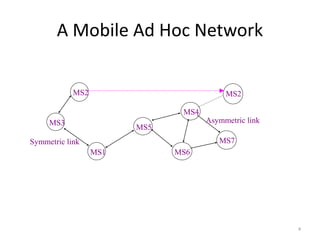
A Mobile Ad Hoc Network 
MS3 
MS2 
MS4 
MS1 
MS5 
MS6 
MS2 
Asymmetric link 
Symmetric link MS7
Characteristics of Ad Hoc Networks 
5 
• Dynamic topologies: Network topology may change 
dynamically as the nodes are free to move. 
• Bandwidth-constrained, variable capacity links: 
Realized throughput of wireless communication is 
less than the radio’s maximum transmission rate. 
Collision occurs frequently. 
• Energy-constrained operation: Some nodes in the 
ad hoc network may rely on batteries or other 
exhaustible means for their energy. 
• Limited physical security: More prone to physical 
security threats than fixed cable networks.
Introduction to WSN 
• A sensor network is composed of a large number of 
sensor nodes, 
– which are densely deployed either inside the 
phenomenon or very close to it. 
• It consist of A large number of low-cost, low-power, 
multifunctional, and small sensor nodes. 
• Sensor node consists of sensing, data processing, and 
communicating components
Introduction 
• The differences between sensor networks and 
ad hoc networks are outlined below: 
– The number of sensor nodes in a sensor network 
is much more than the nodes in an ad hoc 
network. 
– Sensor nodes are densely deployed. 
– Sensor nodes are prone to failures. 
– The topology of a sensor network changes very 
frequently.
Introduction 
• The differences between sensor networks and 
ad hoc networks are outlined below: 
– Sensor nodes mainly use broadcast 
communication paradigm whereas most ad hoc 
networks are based on point-to-point 
communications. 
– Sensor nodes are limited in power, computational 
capacities, and memory.
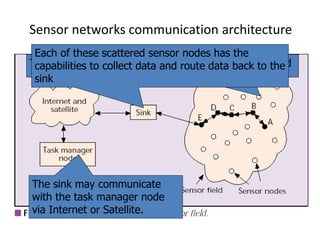
Sensor networks communication architecture 
Each of these scattered sensor nodes has the 
capabilities to collect data and route data back to the 
sink 
The sensor nodes are usually scattered in a sensor field 
The sink may communicate 
with the task manager node 
via Internet or Satellite.
VANET 
• A VANET consists of vehicles to form a network 
which is similar to a Mobile Ad Hoc Network 
(MANET). However, there are following differences 
between these two networks. 
– Vehicles mobility 
• Vehicles move at high speed but mobility is regular and 
predictable 
– Network topology 
• High speed movement makes network topology dynamic 
– No significant power constraint 
• Recharging batteries from vehicle 
– Localization 
• Vehicles position estimate accurately through GPS systems or on-board 
sensors
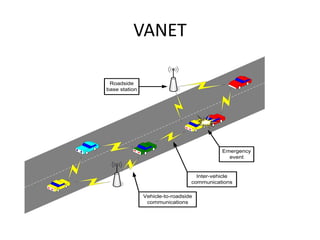
VANET 
Roadside 
base station 
Inter-vehicle 
communications 
Vehicle-to-roadside 
communications 
Emergency 
event
• THANKYOU

Adhoc technologies

  • 1.
    Adhoc Technologies MANET WSN VANET By Shashi Gurung Assistant Professor CTIEMT
  • 2.
    2 Introduction MANET • A Mobile Ad hoc Network (MANET) is an autonomous system of nodes (MSs) connected by wireless links. • A MANET does not necessarily need support from any existing network infrastructure like an Internet gateway or other fixed stations. • The network’s wireless topology may dynamically change in an unpredictable manner since nodes are free to move. • Information is transmitted in a store-and forward manner using multi hop routing.
  • 3.
    3 Introduction (Cont’d) • Each node is equipped with a wireless transmitter and a receiver with an appropriate antenna. • We assume that it is not possible to have all nodes within each other’s radio range. • When the nodes are close-by i.e., within radio range, there are no routing issues to be addressed. • At a given point in time, wireless connectivity in the form of a random multi-hop graph exists between the nodes.
  • 4.
    4 A MobileAd Hoc Network MS3 MS2 MS4 MS1 MS5 MS6 MS2 Asymmetric link Symmetric link MS7
  • 5.
    Characteristics of AdHoc Networks 5 • Dynamic topologies: Network topology may change dynamically as the nodes are free to move. • Bandwidth-constrained, variable capacity links: Realized throughput of wireless communication is less than the radio’s maximum transmission rate. Collision occurs frequently. • Energy-constrained operation: Some nodes in the ad hoc network may rely on batteries or other exhaustible means for their energy. • Limited physical security: More prone to physical security threats than fixed cable networks.
  • 6.
    Introduction to WSN • A sensor network is composed of a large number of sensor nodes, – which are densely deployed either inside the phenomenon or very close to it. • It consist of A large number of low-cost, low-power, multifunctional, and small sensor nodes. • Sensor node consists of sensing, data processing, and communicating components
  • 7.
    Introduction • Thedifferences between sensor networks and ad hoc networks are outlined below: – The number of sensor nodes in a sensor network is much more than the nodes in an ad hoc network. – Sensor nodes are densely deployed. – Sensor nodes are prone to failures. – The topology of a sensor network changes very frequently.
  • 8.
    Introduction • Thedifferences between sensor networks and ad hoc networks are outlined below: – Sensor nodes mainly use broadcast communication paradigm whereas most ad hoc networks are based on point-to-point communications. – Sensor nodes are limited in power, computational capacities, and memory.
  • 9.
    Sensor networks communicationarchitecture Each of these scattered sensor nodes has the capabilities to collect data and route data back to the sink The sensor nodes are usually scattered in a sensor field The sink may communicate with the task manager node via Internet or Satellite.
  • 10.
    VANET • AVANET consists of vehicles to form a network which is similar to a Mobile Ad Hoc Network (MANET). However, there are following differences between these two networks. – Vehicles mobility • Vehicles move at high speed but mobility is regular and predictable – Network topology • High speed movement makes network topology dynamic – No significant power constraint • Recharging batteries from vehicle – Localization • Vehicles position estimate accurately through GPS systems or on-board sensors
  • 11.
    VANET Roadside basestation Inter-vehicle communications Vehicle-to-roadside communications Emergency event
  • 12.