Good evening!
Activity time!
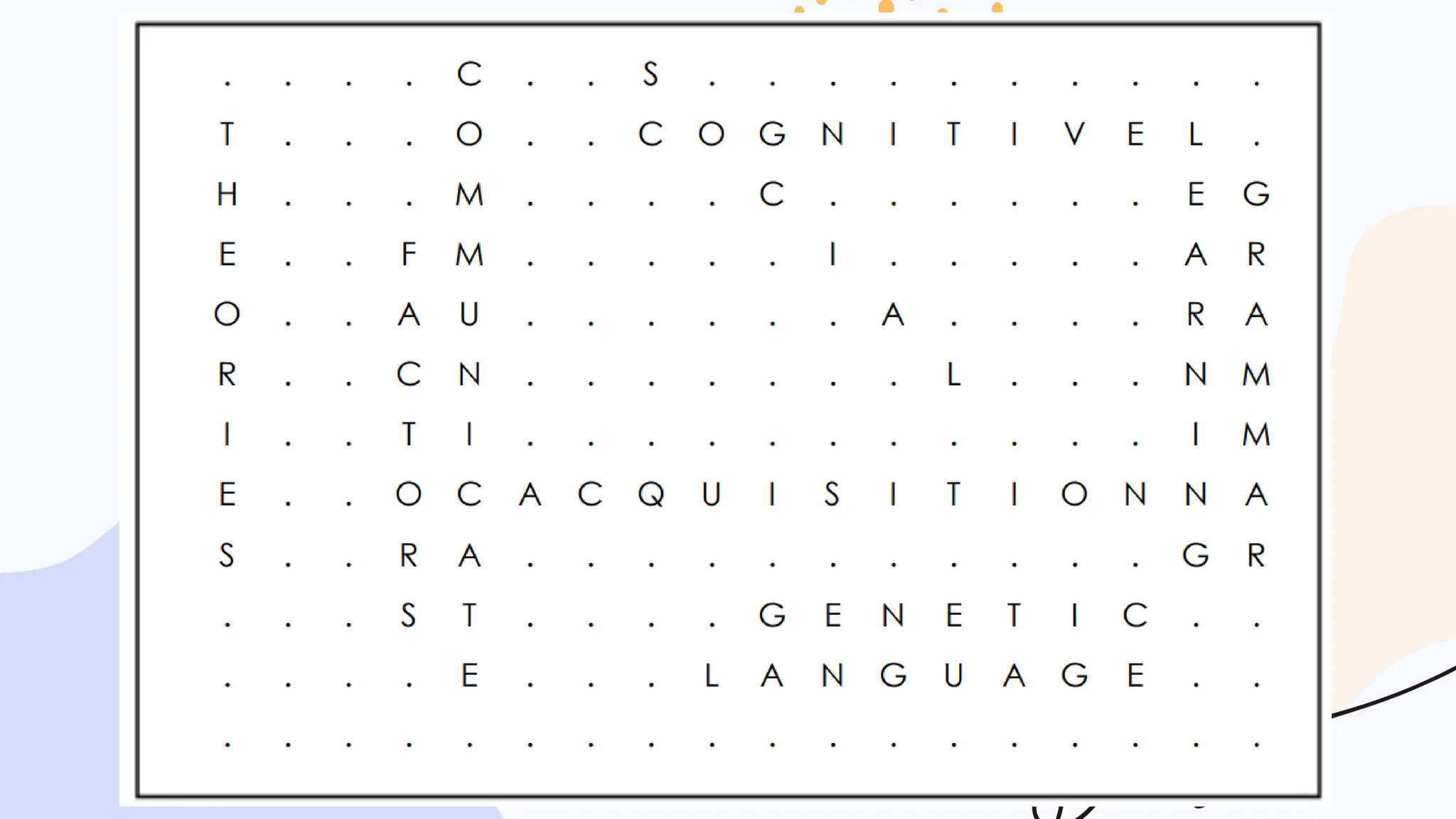
Word Puzzle
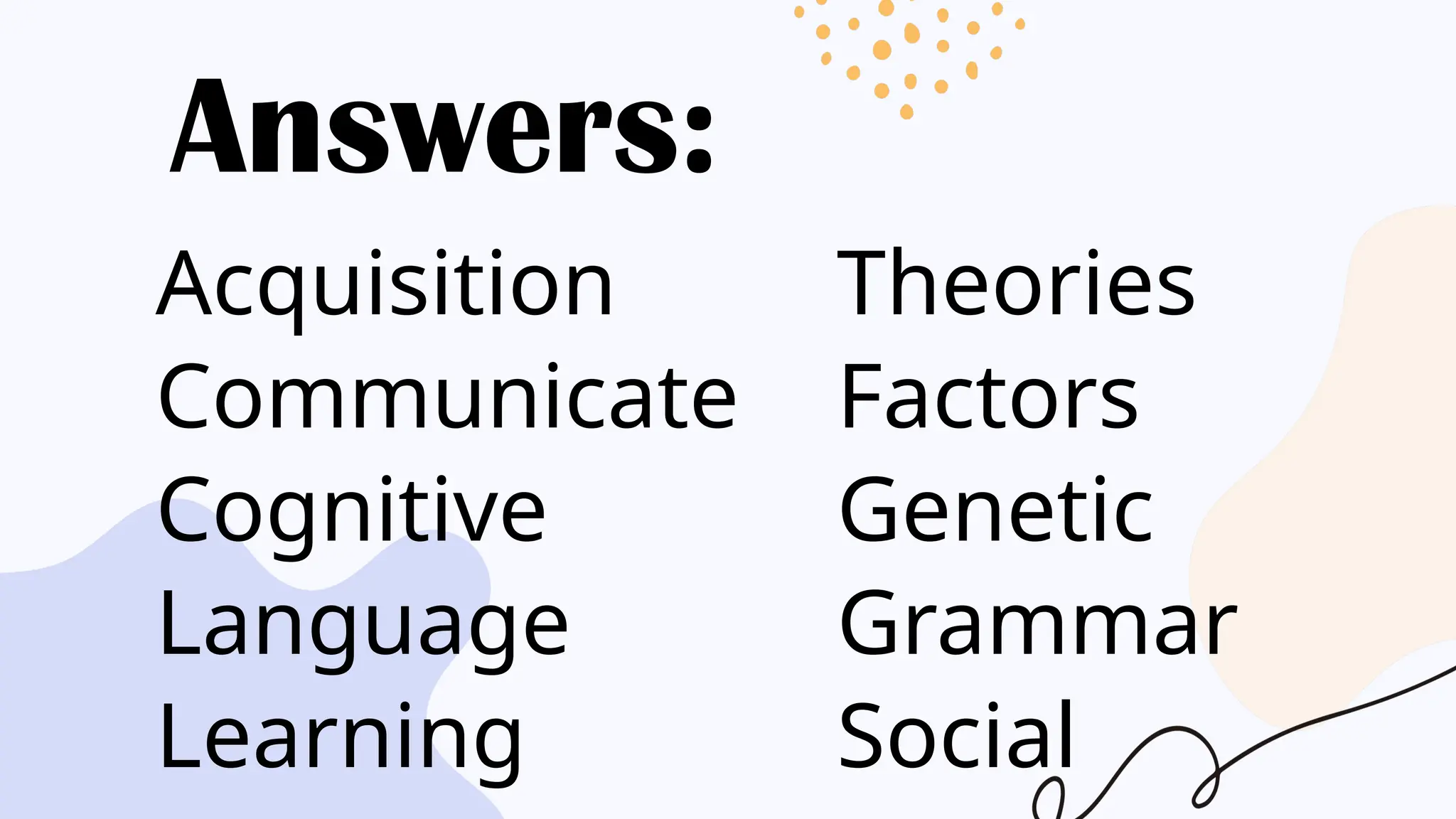
Answers:
Acquisition
Communicate
Cognitive
Language
Learning
Theories
Factors
Genetic
Grammar
Social
Question:
What makes us human?
Question:
When did we learn to
speak?
Question:
How did we learn to speak?
- in psychology refers to the process by
which humans acquire the ability to
perceive, produce, and use words to
understand and communicate.This innate
capacity typically develops in early
childhood and involves complex interplay
of genetic, cognitive, and social factors.

(Lemetyinen, ed. 2023)

Language Acquisition
- Infants as young as 12 months are
reported to have sensitivity to the
grammar needed to understand causative
sentences (who did what to whom; e.g.,
the bunny pushed the frog (Rowland &
Noble, 2010).
Language Acquisition
Language Acquisition Theory:
Behaviorist Theory
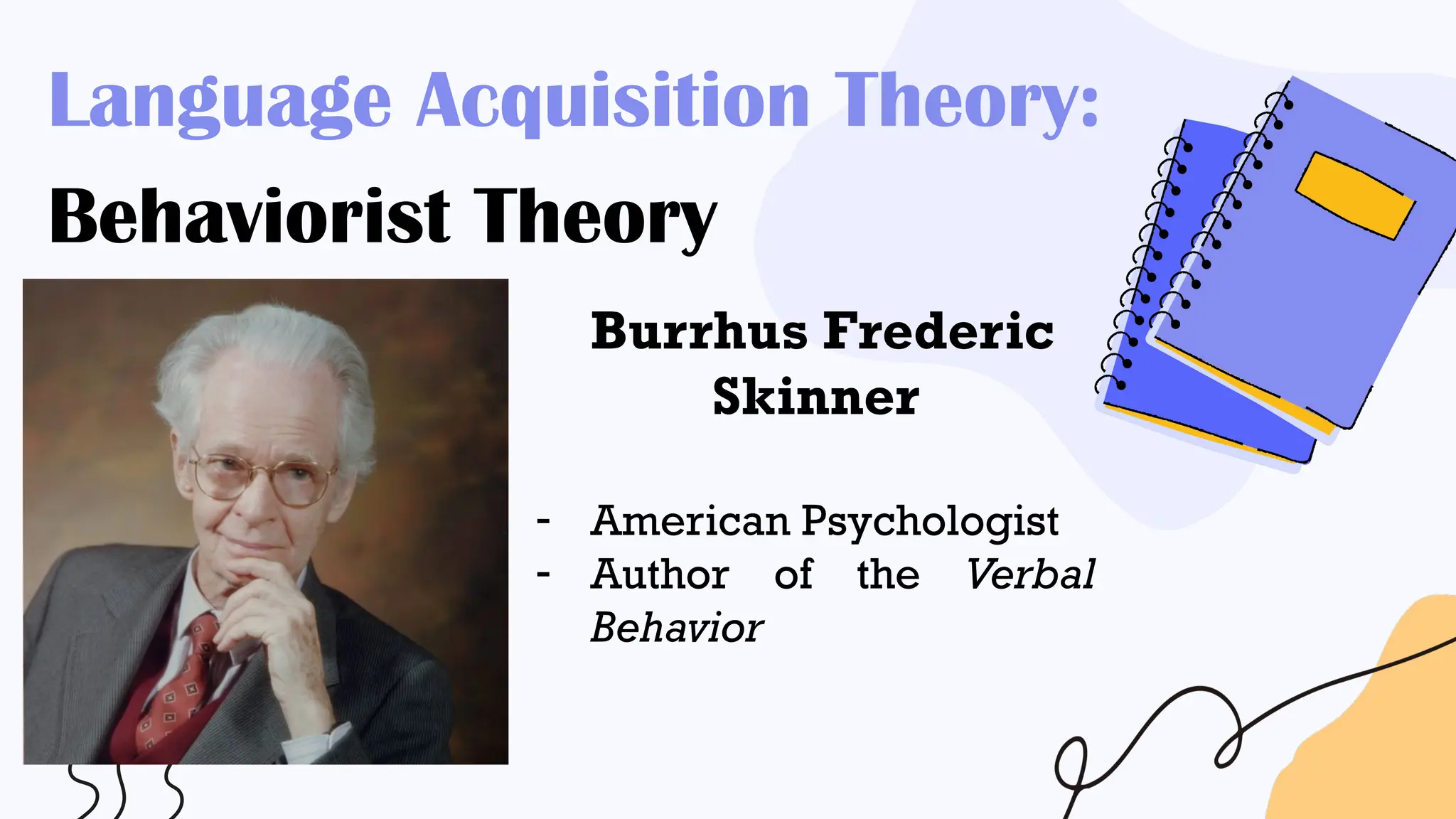
Burrhus Frederic
Skinner
- American Psychologist
- Author of the Verbal
Behavior
Language Acquisition Theory:
Behaviorist Theory
- This theory proposes that language
develops as a result of children trying to
imitate their caregivers or those around
them.
Language Acquisition Theory:
Behaviorist Theory
- The theory assumes that children have no innate
ability to learn the language and rely on operant
conditioning to form and improve their
understanding and use of it.
- The theory believes that children are born 'tabula
rasa' - as a 'blank slate'.
What is Operant Conditioning?
- Operant conditioning is the idea that actions are
reinforced.
- There are two types of reinforcement that are vital to
this theory: positive reinforcement and negative
reinforcement.
In Skinner's theory, children alter their use of language
in response to this reinforcement.
What is Operant Conditioning?
For example, a child may correctly ask for food, (eg.
saying something like 'mama, dinner'). They then receive
positive reinforcement by receiving the food they'd asked
for, or being told they're clever by their caregiver.
Alternatively, if a child uses language incorrectly, they
may simply be ignored, or may be corrected by the
caregiver, which would be negative reinforcement.
Evidence for Skinner's theory
Operant conditioning is well understood and supported
as a behaviorist explanation for many things, and there may
be some ways that it can be applied to language
development.
For example, children may still be able to learn that certain
sounds or phrases get certain results, even if this doesn't
contribute to their language development as a whole.
Limitations of Skinner's theory
Developmental Milestones
Contrary to Skinner's behavioral theory, research has shown
that children go through a series of developmental
milestones at around the same age. This suggests that
there may be more than just simple imitation and
conditioning taking place, and that children may actually
have an internal mechanism that facilitates language
development.
Limitations of Skinner's theory
The critical period of language acquisition
Age 7 is thought to be the end of the critical period for
language acquisition. If a child has not developed
language by this point, they will never be able to fully
grasp it.
For example:
Genie (as studied by Curtiss et al., 1974) is perhaps the most
notable example of someone who has failed to develop language
by the critical period. Genie was a young girl who was raised in
complete isolation and never given a chance to develop language
due to her solitude and poor living conditions.
When she was discovered in 1970, she was twelve years old. She
had missed the critical period and was therefore unable to become
fluent in English despite extensive attempts to teach and
rehabilitate her.
Limitations of Skinner's theory
The complicated nature of language
It has also been argued that language and its
development are simply too complicated to be taught
sufficiently through reinforcement alone.
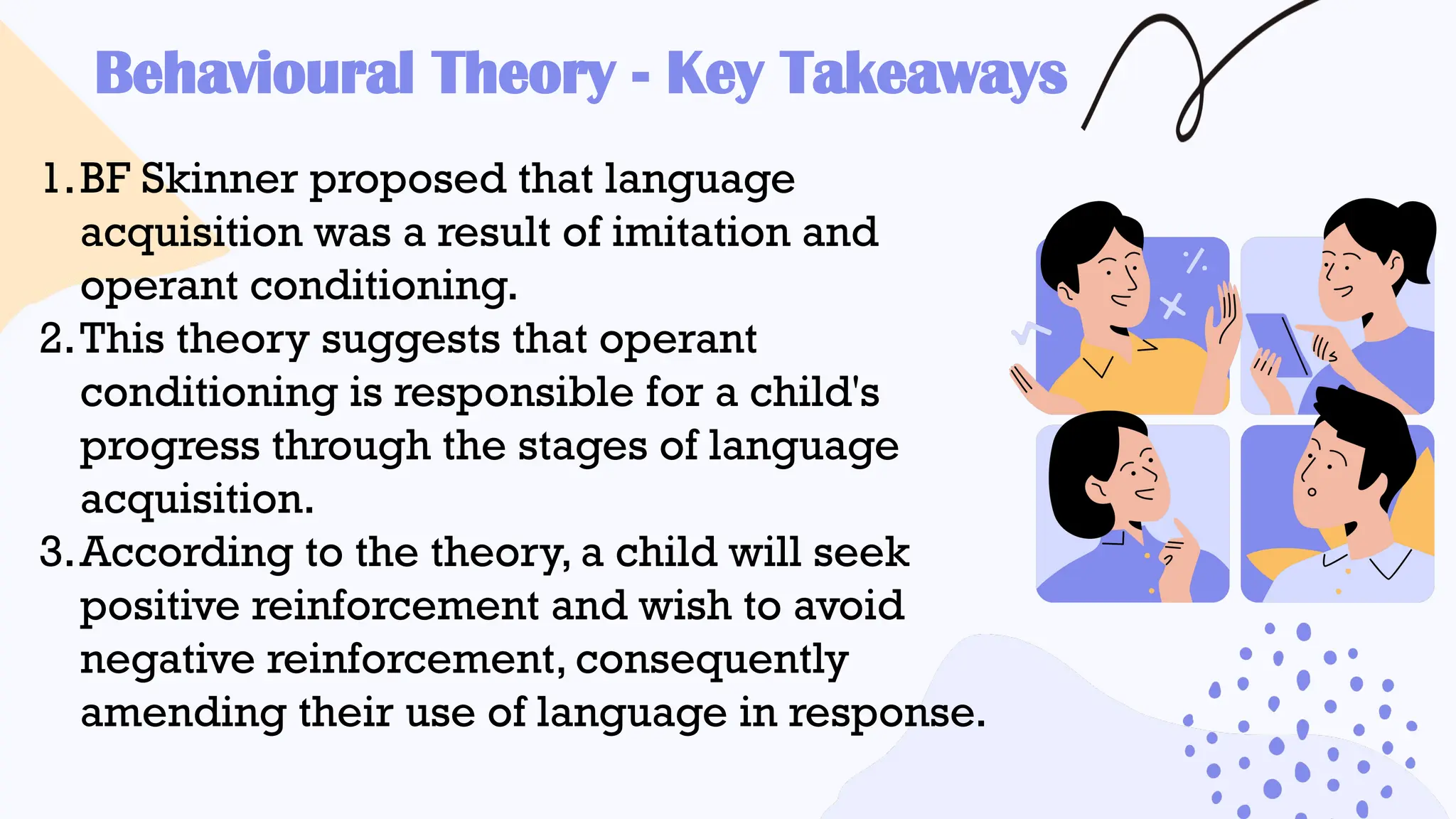
Behavioural Theory - Key Takeaways
1.BF Skinner proposed that language
acquisition was a result of imitation and
operant conditioning.
2.This theory suggests that operant
conditioning is responsible for a child's
progress through the stages of language
acquisition.
3.According to the theory, a child will seek
positive reinforcement and wish to avoid
negative reinforcement, consequently
amending their use of language in response.
Behavioural Theory - Key Takeaways
4.The fact that children imitate accents and
colloquialisms, alter their use of language
when entering school, and associate some
sounds/phrases with positive outcomes, may
be evidence for Skinner's theory.
5. Skinner's theory is limited. It can't account for
the critical period, comparative
developmental milestones regardless of
language background, and the complexities
of language.
Activity time!
• Innate
• Device
• Acquisition
• Language
• Noam Chomsky
Answers:
Language Acquisition Theory:
Nativist Theory
Noam Chomsky
- American Linguist
- Reviewed (1959) the Verbal
Behavior by B.F. Skinner
- Authored Aspects of the Theory of
Syntax (1965) and Cartesian
Linguistics (1966)
Language Acquisition Theory:
Nativist Theory
- is a biologically-based theory which argues that
humans are pre-programmed with the innate ability
to develop language.
- this theory claims that our capacity for producing
and understanding verbal correspondence is coded
into our brains from birth.
Language Acquisition Device
(LAD)
- Chomsky developed the idea of the Language
Acquisition Device (LAD) which is a
hypothetical ‘tool’ hard-wired into the brain that
helps children rapidly learn and understand
language.
Language Acquisition Device
(LAD)
Chomsky added that this is not a physical part of the
brain like the hypothalamus, or the medulla oblongata.
- The LAD is a general term used to explain the many
complex processes the brain has for learning languages.
Compared to other species, humans have developed a
complex language with structure and rules. The LAD is
part of the reason for this.
Universal Grammar
(UG)
Chomsky does not believe that a child from England is born
with the innate ability to learn English, or that a child from Japan
has a LAD containing Japanese vocabulary.
Instead, he suggests that all human languages share many of the
same common grammar principles.
For example, most languages:
- Differentiate between verbs and nouns
- Have a way of talking about the past and present tense
- Have a way of asking questions
- Have a counting system
Universal Grammar
(UG)
According to Universal Grammar theory, the
basic grammatical structures of language are
already encoded in the human brain at birth. It is a
child’s environment that will determine which
language they will learn.
So, let's break down how
the LAD supposedly
works:
1. The child hears adult speech, which triggers
the LAD.
2. The child automatically applies universal
grammar to speech.
3. The child learns new vocabulary and applies
the appropriate grammar rules.
4. The child is able to use the new language.
Virtuous Errors
When children are first learning a language, they
will, of course, make mistakes. These mistakes can
give us information as to how children learn. For
example, children have an unconscious ability to
recognize the past tense and will begin to associate
words ending with a /d/ /t/ or /id/ sound with the
past.
Virtuous Errors
Chomsky suggests this is why children make
‘virtuous errors’ such as,‘I goed’ rather than ‘I went’
when first learning a language. Nobody taught them
to say ‘I goed’; they figured that out for themselves.
To Chomsky, these virtuous errors suggest that
children are born with the subconscious ability to
work out the grammatical rules of language.
The Poverty of Stimulus
This argument by Chomsky states that children
are not exposed to enough linguistic data in their
environment to learn every feature of the language.
Chomsky suggested that the human brain must have
evolved to contain certain linguistic information
from birth, which helps children figure out the basic
structures of language.
Criticisms of Chomsky's theory
Behaviorists argue that there is not enough
scientific evidence to support the existence of a
language acquisition device. For example, we do not
know where the LAD is located in the brain. For this
reason, many linguists reject this theory.
Language Acquisition Device (LAD) -
Key takeaways
1.The Language Acquisition Device is a
hypothetical tool in the brain that helps
children understand the fundamental rules of
human language.
2.The LAD was proposed by the American
linguist Noam Chomsky in the 1960s.
3.Chomsky suggests that the LAD contains
information on Universal Grammar, a shared
set of grammatical structures that all human
languages follow.
Language Acquisition Device (LAD) -
Key takeaways
4.The fact children show signs of understanding
grammar structures before being shown or
taught them is evidence that a LAD exists.
5. Some theorists, particularly behaviourist
theorists, reject Chomsky's theory as it lacks
scientific evidence.
Question:
Nature or Nurture?
Question:
As teachers, why is it important
for us to understand how learners
acquire the language?
References:
Curtiss et al. (1974) The Development of Language in Genius: a Case of
Language Acquisition beyond the "critical period“. Retrieved from:
https://www.studysmarter.co.uk/explanations/english/language-
acquisition/behavioral-theory/
Lemetyinen, H. (ed. 2023) Language Acquisition Theory. Retrieved from:
https://www.simplypsychology.org/language.html
McGilvray, J. A. (2024, June 18). Noam Chomsky. Encyclopedia Britannica.
Retrieved from: https://www.britannica.com/biography/Noam-Chomsky
Smith, D. S. (2018) Language: Nativism. Retrieved from:
https://www.researchgate.net/publication/312474843_Language_Nativism
StudySmarter (n.d.) Language Acquisition Device (LAD). Retrieved from:
https://www.studysmarter.co.uk/explanations/english/language-
acquisition/language-acquisition-device lad/#:~:text=A%20Language
%20Acquisition%20Device%20(LAD,structures%20common%20to%20all
%20languages.
StudySmarter (n.d.) Behavioral Theory. Retrieved from:
https://www.studysmarter.co.uk/explanations/english/language-
acquisition/behavioral-theory/
Thank you!
Credits
This presentation template is free
for everyone to use thanks to the following:
SlidesCarnival for the presentation template
Canva Creative Studio for the lesson plan
Pexels for the photos
Happy designing!

Behaviourist and Nativist Theory in Language Learning.pptx

  • 1.
  • 2.
  • 5.
  • 6.
  • 7.
    Question: When did welearn to speak?
  • 8.
    Question: How did welearn to speak?
  • 9.
    - in psychologyrefers to the process by which humans acquire the ability to perceive, produce, and use words to understand and communicate.This innate capacity typically develops in early childhood and involves complex interplay of genetic, cognitive, and social factors. (Lemetyinen, ed. 2023) Language Acquisition
  • 10.
    - Infants asyoung as 12 months are reported to have sensitivity to the grammar needed to understand causative sentences (who did what to whom; e.g., the bunny pushed the frog (Rowland & Noble, 2010). Language Acquisition
  • 11.
    Language Acquisition Theory: BehavioristTheory Burrhus Frederic Skinner - American Psychologist - Author of the Verbal Behavior
  • 12.
    Language Acquisition Theory: BehavioristTheory - This theory proposes that language develops as a result of children trying to imitate their caregivers or those around them.
  • 13.
    Language Acquisition Theory: BehavioristTheory - The theory assumes that children have no innate ability to learn the language and rely on operant conditioning to form and improve their understanding and use of it. - The theory believes that children are born 'tabula rasa' - as a 'blank slate'.
  • 14.
    What is OperantConditioning? - Operant conditioning is the idea that actions are reinforced. - There are two types of reinforcement that are vital to this theory: positive reinforcement and negative reinforcement. In Skinner's theory, children alter their use of language in response to this reinforcement.
  • 15.
    What is OperantConditioning? For example, a child may correctly ask for food, (eg. saying something like 'mama, dinner'). They then receive positive reinforcement by receiving the food they'd asked for, or being told they're clever by their caregiver. Alternatively, if a child uses language incorrectly, they may simply be ignored, or may be corrected by the caregiver, which would be negative reinforcement.
  • 16.
    Evidence for Skinner'stheory Operant conditioning is well understood and supported as a behaviorist explanation for many things, and there may be some ways that it can be applied to language development. For example, children may still be able to learn that certain sounds or phrases get certain results, even if this doesn't contribute to their language development as a whole.
  • 17.
    Limitations of Skinner'stheory Developmental Milestones Contrary to Skinner's behavioral theory, research has shown that children go through a series of developmental milestones at around the same age. This suggests that there may be more than just simple imitation and conditioning taking place, and that children may actually have an internal mechanism that facilitates language development.
  • 18.
    Limitations of Skinner'stheory The critical period of language acquisition Age 7 is thought to be the end of the critical period for language acquisition. If a child has not developed language by this point, they will never be able to fully grasp it.
  • 19.
    For example: Genie (asstudied by Curtiss et al., 1974) is perhaps the most notable example of someone who has failed to develop language by the critical period. Genie was a young girl who was raised in complete isolation and never given a chance to develop language due to her solitude and poor living conditions. When she was discovered in 1970, she was twelve years old. She had missed the critical period and was therefore unable to become fluent in English despite extensive attempts to teach and rehabilitate her.
  • 20.
    Limitations of Skinner'stheory The complicated nature of language It has also been argued that language and its development are simply too complicated to be taught sufficiently through reinforcement alone.
  • 21.
    Behavioural Theory -Key Takeaways 1.BF Skinner proposed that language acquisition was a result of imitation and operant conditioning. 2.This theory suggests that operant conditioning is responsible for a child's progress through the stages of language acquisition. 3.According to the theory, a child will seek positive reinforcement and wish to avoid negative reinforcement, consequently amending their use of language in response.
  • 22.
    Behavioural Theory -Key Takeaways 4.The fact that children imitate accents and colloquialisms, alter their use of language when entering school, and associate some sounds/phrases with positive outcomes, may be evidence for Skinner's theory. 5. Skinner's theory is limited. It can't account for the critical period, comparative developmental milestones regardless of language background, and the complexities of language.
  • 23.
  • 24.
    • Innate • Device •Acquisition • Language • Noam Chomsky Answers:
  • 25.
    Language Acquisition Theory: NativistTheory Noam Chomsky - American Linguist - Reviewed (1959) the Verbal Behavior by B.F. Skinner - Authored Aspects of the Theory of Syntax (1965) and Cartesian Linguistics (1966)
  • 26.
    Language Acquisition Theory: NativistTheory - is a biologically-based theory which argues that humans are pre-programmed with the innate ability to develop language. - this theory claims that our capacity for producing and understanding verbal correspondence is coded into our brains from birth.
  • 27.
    Language Acquisition Device (LAD) -Chomsky developed the idea of the Language Acquisition Device (LAD) which is a hypothetical ‘tool’ hard-wired into the brain that helps children rapidly learn and understand language.
  • 28.
    Language Acquisition Device (LAD) Chomskyadded that this is not a physical part of the brain like the hypothalamus, or the medulla oblongata. - The LAD is a general term used to explain the many complex processes the brain has for learning languages. Compared to other species, humans have developed a complex language with structure and rules. The LAD is part of the reason for this.
  • 29.
    Universal Grammar (UG) Chomsky doesnot believe that a child from England is born with the innate ability to learn English, or that a child from Japan has a LAD containing Japanese vocabulary. Instead, he suggests that all human languages share many of the same common grammar principles. For example, most languages: - Differentiate between verbs and nouns - Have a way of talking about the past and present tense - Have a way of asking questions - Have a counting system
  • 30.
    Universal Grammar (UG) According toUniversal Grammar theory, the basic grammatical structures of language are already encoded in the human brain at birth. It is a child’s environment that will determine which language they will learn.
  • 31.
    So, let's breakdown how the LAD supposedly works: 1. The child hears adult speech, which triggers the LAD. 2. The child automatically applies universal grammar to speech. 3. The child learns new vocabulary and applies the appropriate grammar rules. 4. The child is able to use the new language.
  • 32.
    Virtuous Errors When childrenare first learning a language, they will, of course, make mistakes. These mistakes can give us information as to how children learn. For example, children have an unconscious ability to recognize the past tense and will begin to associate words ending with a /d/ /t/ or /id/ sound with the past.
  • 33.
    Virtuous Errors Chomsky suggeststhis is why children make ‘virtuous errors’ such as,‘I goed’ rather than ‘I went’ when first learning a language. Nobody taught them to say ‘I goed’; they figured that out for themselves. To Chomsky, these virtuous errors suggest that children are born with the subconscious ability to work out the grammatical rules of language.
  • 34.
    The Poverty ofStimulus This argument by Chomsky states that children are not exposed to enough linguistic data in their environment to learn every feature of the language. Chomsky suggested that the human brain must have evolved to contain certain linguistic information from birth, which helps children figure out the basic structures of language.
  • 35.
    Criticisms of Chomsky'stheory Behaviorists argue that there is not enough scientific evidence to support the existence of a language acquisition device. For example, we do not know where the LAD is located in the brain. For this reason, many linguists reject this theory.
  • 36.
    Language Acquisition Device(LAD) - Key takeaways 1.The Language Acquisition Device is a hypothetical tool in the brain that helps children understand the fundamental rules of human language. 2.The LAD was proposed by the American linguist Noam Chomsky in the 1960s. 3.Chomsky suggests that the LAD contains information on Universal Grammar, a shared set of grammatical structures that all human languages follow.
  • 37.
    Language Acquisition Device(LAD) - Key takeaways 4.The fact children show signs of understanding grammar structures before being shown or taught them is evidence that a LAD exists. 5. Some theorists, particularly behaviourist theorists, reject Chomsky's theory as it lacks scientific evidence.
  • 38.
  • 39.
    Question: As teachers, whyis it important for us to understand how learners acquire the language?
  • 40.
    References: Curtiss et al.(1974) The Development of Language in Genius: a Case of Language Acquisition beyond the "critical period“. Retrieved from: https://www.studysmarter.co.uk/explanations/english/language- acquisition/behavioral-theory/ Lemetyinen, H. (ed. 2023) Language Acquisition Theory. Retrieved from: https://www.simplypsychology.org/language.html McGilvray, J. A. (2024, June 18). Noam Chomsky. Encyclopedia Britannica. Retrieved from: https://www.britannica.com/biography/Noam-Chomsky Smith, D. S. (2018) Language: Nativism. Retrieved from: https://www.researchgate.net/publication/312474843_Language_Nativism StudySmarter (n.d.) Language Acquisition Device (LAD). Retrieved from: https://www.studysmarter.co.uk/explanations/english/language- acquisition/language-acquisition-device lad/#:~:text=A%20Language %20Acquisition%20Device%20(LAD,structures%20common%20to%20all %20languages. StudySmarter (n.d.) Behavioral Theory. Retrieved from: https://www.studysmarter.co.uk/explanations/english/language- acquisition/behavioral-theory/
  • 41.
  • 42.
    Credits This presentation templateis free for everyone to use thanks to the following: SlidesCarnival for the presentation template Canva Creative Studio for the lesson plan Pexels for the photos Happy designing!